Axewelledge, a leading exporter from India, specializes in high-quality Bentonite. With a commitment to excellence, we supply premium Bentonite to the Middle East and Southeast Asia markets.


North Angle Complex, 304,
150 Feet Ring Rd, Opposite Ambedkar Nagar BRTS Stop,
Madhav Park, Punit Nagar,
Mavdi, Rajkot, Gujarat 360004
© Axewelledge 2026, All Rights Reserved.
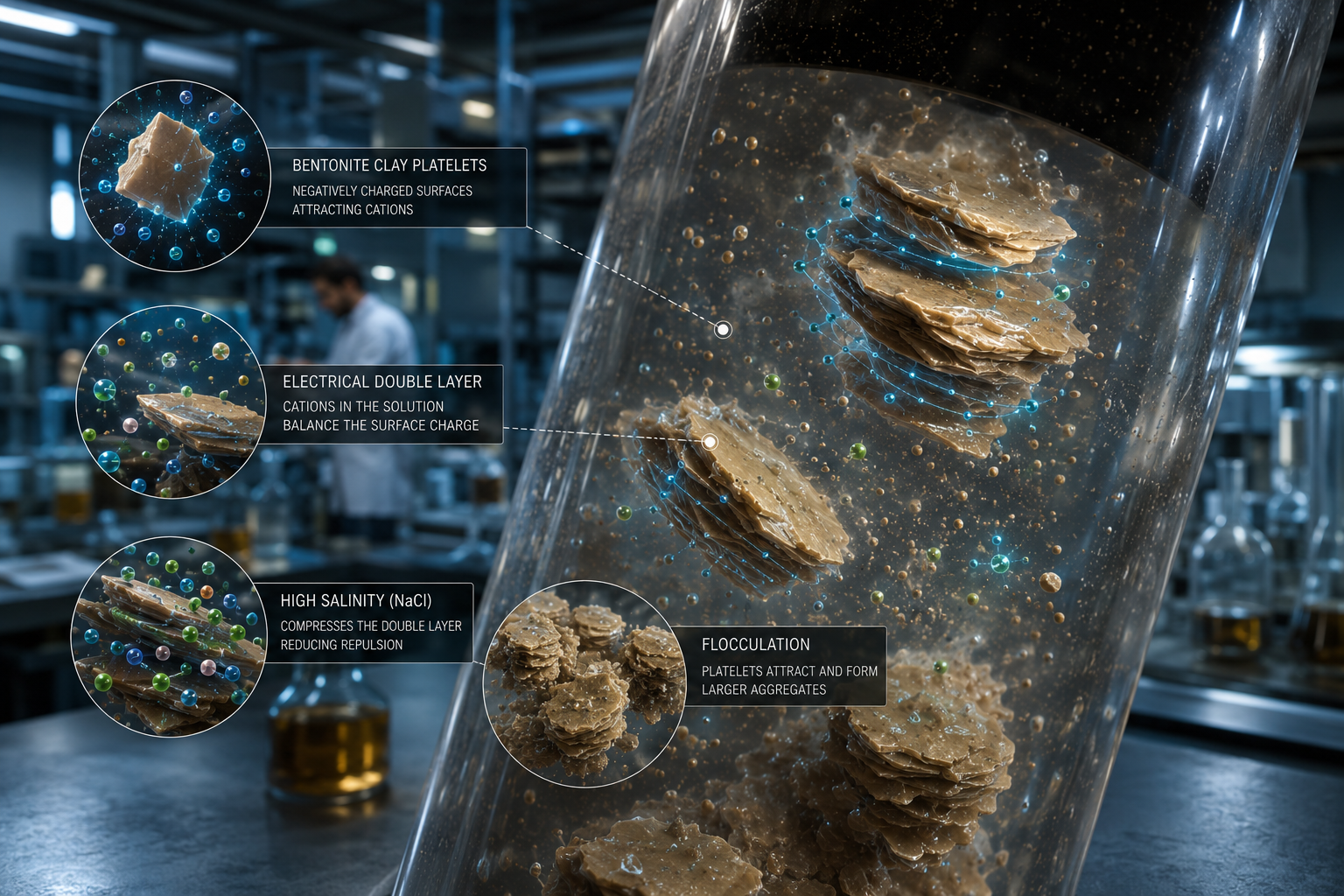
Standard sodium bentonite loses up to 80% of its swelling capacity and yield strength when mixed with brine or exposed to formations exceeding 10,000 ppm total dissolved solids (TDS).
When a smooth 35-lb API bentonite slurry turns into a watery, settled mixture upon drilling a salt dome, penetrating an evaporite section, or pumping seawater, fluid loss spikes, cuttings fall out of suspension, and differential sticking risks rise.
This failure stems from fundamental surface chemistry and electrokinetics rather than low-grade raw clay. Sodium bentonite depends on an expanded electrical double layer to hydrate and build structure, but dissolved salts collapse this layer instantly.
Understanding the precise mechanics of electrolyte contamination allows mud engineers, drilling superintendents, and operators to prevent wellbore instability, lost circulation, and stuck pipe. Below are the four primary reasons standard bentonite fails in high-salinity environments, the underlying chemistry, and practical engineering solutions.
To evaluate why salt impairs bentonite performance, consider how sodium bentonite hydrates in fresh water.
Bentonite consists primarily of montmorillonite, a 2:1 expandable clay mineral. Each clay platelet features an octahedral alumina sheet sandwiched between two tetrahedral silica sheets. Isomorphic substitution—where trivalent aluminum ions replace tetravalent silicon, or divalent magnesium replaces aluminum within the crystal lattice—gives the platelet surface a permanent negative electrical charge.
In fresh water, sodium ions ($Na^+$) attach loosely to these negatively charged faces. Because sodium possesses a large hydrated ionic radius and a single positive charge, water molecules readily enter the interlayer spaces between individual platelets.
This process triggers two distinct structural steps:
Once dispersed, the negatively charged faces and weakly positive edges create a continuous three-dimensional network. This network generates yield point (YP), plastic viscosity (PV), and gel strength, which enables the drilling mud to suspend barite and lift cuttings out of the hole.
In high-salinity fluids, this hydration mechanism breaks down entirely.
The primary cause of bentonite breakdown in saline water is the rapid compression of the clay particle's electrical double layer (EDL).
Gouy-Chapman electrokinetic theory states that the negatively charged surface of a montmorillonite platelet generates an electrostatic potential that attracts counter-cations while repelling anions. This distribution forms an ion cloud divided into a rigid inner Stern layer and a loose outer diffuse double layer.
The thickness of this diffuse double layer (denoted as $1/\kappa$, where $\kappa$ represents the Debye-Hückel screening parameter) determines the repulsive forces between adjacent clay platelets:
Where $I$ is the ionic strength of the bulk fluid.
Introducing sodium chloride ($NaCl$), potassium chloride ($KCl$), or calcium chloride ($CaCl_2$) increases the bulk ion concentration. This high ionic strength reduces the thickness of the diffuse double layer.
As the electrical double layer compresses:
The fluid loses yield point and gel strength rapidly. Viscosity drops toward water-like levels, causing suspended solids to drop out of suspension.
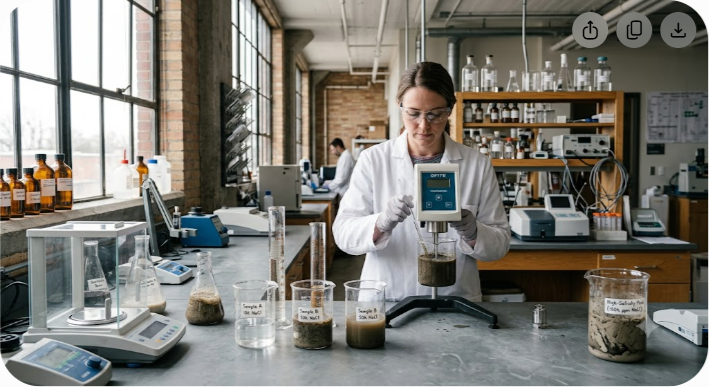
Monovalent sodium ions ($Na^+$) cause double-layer compression at high concentrations, but divalent cations like calcium ($Ca^{2+}$) and magnesium ($Mg^{2+}$) alter clay structure at much lower thresholds.
In high-salinity environments, salt content often extends beyond sodium chloride. Anhydrite beds, gypsum layers, cement contamination, and deep formation brines release substantial amounts of $Ca^{2+}$ ions into the drilling fluid.
Montmorillonite exhibits a high Cation Exchange Capacity (CEC), typically ranging from 80 to 100 meq/100g. Surface-bound cations swap continuously with ions in the surrounding fluid based on valence preference and concentration.
The lyotropic series outlines the relative replacement preference of common cations on clay surfaces:
Because calcium ($Ca^{2+}$) carries a divalent positive charge, the clay surface binds it more strongly than monovalent sodium ($Na^+$).
When $Ca^{2+}$ ions displace $Na^+$ ions on the montmorillonite lattice, hydration properties change:
If makeup water contains 300 to 500 ppm of hardness ($Ca^{2+}/Mg^{2+}$), raw sodium bentonite yield drops by over 50%. Drilling through gypsum beds with calcium concentrations above 2,000 ppm halts bentonite viscosification.
Salinity changes do not only reduce viscosity. Under specific pH levels and ionic conditions, high salt concentrations trigger viscosity inversion or charge-driven flocculation.
The edges and faces of a montmorillonite platelet exhibit distinct chemical properties:
In standard alkaline drilling muds (pH 8.5 to 10.5), particle edges carry a net negative or weakly positive charge. When elevated salinity combines with pH shifts or ionic imbalances, edge positive charges increase while negative face repulsion is screened by dissolved ions.
Instead of remaining dispersed, positively charged edges bind to negatively charged faces of adjacent platelets, forming an Edge-to-Face (E-F) flocculated network.
This dynamic creates specific operational challenges:
Raw bentonite is often combined with synthetic or natural polymers—such as Partially Hydrolyzed Polyacrylamide (PHPA), Polyanionic Cellulose (PAC), Carboxymethyl Cellulose (CMC), or xanthan gum—to improve performance in moderately saline fluids.
These polymers modify bentonite systems through two primary mechanisms:
However, relying on polymer-extended bentonite in high-salinity water introduces vulnerabilities through polymer chain collapse.
Polymers such as PAC and PHPA rely on charged carboxylate groups ($-COO^-$) along their structure. Electrostatic repulsion between negative charges maintains an extended chain conformation that builds viscosity.
Adding salt introduces three specific failure modes:
When polymer extensions break down, the underlying bentonite is exposed directly to the brine system.
The table below outlines how different drilling fluid systems and clay additives perform as salt concentrations increase:
| Fluid / Additive Type | Fresh Water (0–1,000 ppm TDS) | Brackish Water (1,000–10,000 ppm TDS) | Seawater (35,000 ppm TDS) | Saturated Brine (300,000+ ppm TDS) | Primary Failure Mechanism |
|---|---|---|---|---|---|
| Standard API Sodium Bentonite | Excellent: Full osmotic swelling, high yield, low fluid loss. | Moderate: 30–50% yield reduction, fluid loss increases. | Poor: Severe flocculation, zero osmotic swelling, high fluid loss. | Unusable: Total mud collapse, immediate solids settling. | Double layer compression and $Ca^{2+}$ cation exchange. |
| Polymer-Extended Bentonite (PAC/PHPA) | Superior: High initial viscosity and low fluid loss. | Good: Stable up to ~15,000 ppm if hardness remains low. | Poor to Fair: Polymer coiling occurs; viscosity drops above 200°F. | Unusable: Polymer precipitation and thermal hydrolysis. | Polymer chain coiling and competitive adsorption. |
| Pre-Hydrated Bentonite System | N/A (Requires fresh water preparation) | Good: Retains yield if added steadily to brine systems. | Moderate: Requires continuous fluid-loss additive treatment. | Poor: Hydration shell strips over extended exposure. | Desorption of hydrated water shell under osmotic gradients. |
| Salt-Water Clays (Attapulgite / Sepiolite) | Poor: Minimal swelling, limited filtration control. | Fair: Builds mechanical structure via needle entanglement. | Excellent: Stable rheology; viscosity unaffected by salt. | Excellent: Stable in saturated $NaCl$ and $CaCl_2$ systems. | Complete lack of filtration control (requires starches or PAC). |
| Organophilic Clay (Oil-Based Mud) | Insoluble (N/A) | Insoluble (N/A) | Excellent: Unaffected by water phase salinity. | Excellent: Salinity stabilizes the internal water phase. | High operational cost and strict disposal guidelines. |
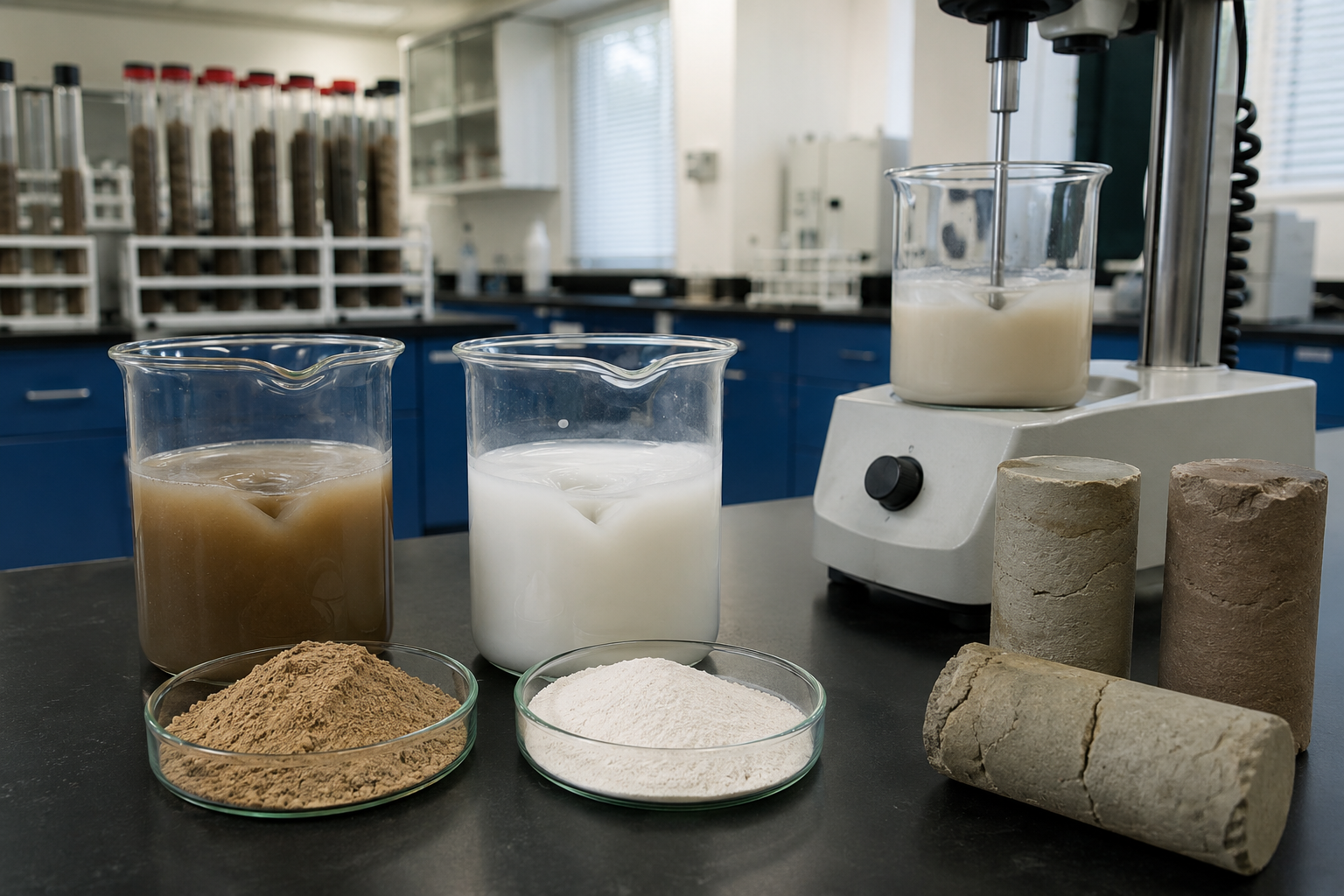
When encountering high-salinity formations, salt domes, or marine locations with limited fresh water, specific engineering strategies help maintain mud stability.
When using API sodium bentonite in saline conditions, pre-hydration helps protect clay particles.
Although bentonite does not hydrate effectively directly in salt water, fully hydrating it in fresh water forms a bound water layer that resists moderate salinity upon introduction.
This approach supports spud muds and top-hole sections, though it requires dedicated freshwater tank capacity.
For high-salinity applications, including salt dome drilling or saturated brine operations, replacing montmorillonite with needle-like clay minerals such as attapulgite (palygorskite) or sepiolite offers stable rheology.
Attapulgite consists of elongated magnesium-aluminum silicate crystals. Shearing attapulgite in water separates needle clusters to form a mechanical network that encapsulates fluid without relying on electrostatic swelling.
When calcium or magnesium ions cause clay aggregation, chemical pre-treatment neutralizes contaminants before introducing bentonite.
$$Ca^{2+} + Na_2CO_3 ightarrow CaCO_3 downarrow + 2 Na^+$$
Pre-treat makeup water with soda ash before adding bentonite. Adding soda ash after calcium binds to clay surfaces will not restore original sodium bentonite hydration.
For deep reservoirs or high-temperature wells, specialized fluid formulations replace conventional bentonite systems:
Bentonite performance varies by source and refinement quality. Standard API Spec 13A Section 9 bentonite functions predictably in fresh water, but high-salinity conditions require raw materials with high initial swelling capacity, high montmorillonite purity, and low native calcium content.
Lower-purity bentonite decreases overall mud tolerance to downhole salt contamination.
As an international supplier with dedicated sodium bentonite reserves, Axewelledge processes high-yield bentonite engineered for industrial and drilling applications. By managing mining operations and processing standards, Axewelledge delivers consistent CEC levels, thermal stability, and reliable yield properties.
Whether formulating high-viscosity spud muds, pre-hydrated bentonite blends, or civil engineering slurries, sourcing high-purity sodium bentonite provides the baseline stability required to manage downhole contaminants.
When mud properties degrade during drilling operations, use this structured testing procedure to verify electrolyte contamination:
Perform an API silver nitrate ($AgNO_3$) titration on a filtrate sample. Rapid increases in chloride levels ($Cl^-$) indicate saltwater influx, formation salt leaching, or makeup water contamination.
Titrate the filtrate with EDTA. Soluble calcium levels above 400 mg/L (ppm) signal active divalent cation exchange on sodium bentonite.
A filter cake thickness exceeding 2/32 inch (1.6 mm) with a soft, permeable texture indicates clay flocculation and filtration degradation.
By analyzing electrical double layer compression, cation exchange mechanisms, edge-to-face flocculation, and polymer stability, drilling teams can address contamination early and maintain drilling fluid performance in high-salinity formations.













Have questions about our products? We're here to help!