Axewelledge, a leading exporter from India, specializes in high-quality Bentonite. With a commitment to excellence, we supply premium Bentonite to the Middle East and Southeast Asia markets.


North Angle Complex, 304,
150 Feet Ring Rd, Opposite Ambedkar Nagar BRTS Stop,
Madhav Park, Punit Nagar,
Mavdi, Rajkot, Gujarat 360004
© Axewelledge 2026, All Rights Reserved.
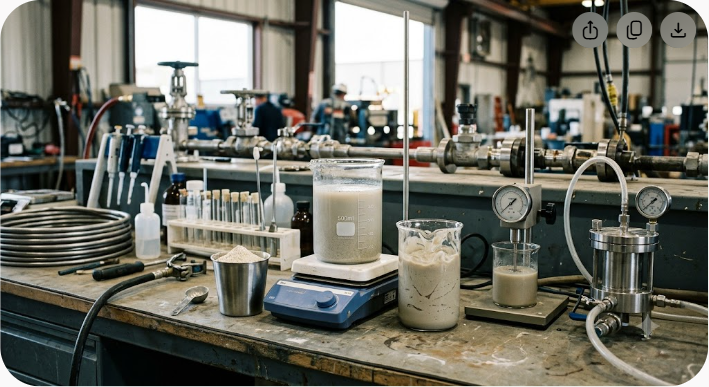
Bentonite has a useful role in selected oilfield completion and workover fluid systems, but it is not a standard ingredient in every completion fluid. Conventional completion fluids are often designed as highly filtered, low-solids or solids-free brines, particularly when they will contact a productive formation. Bentonite is used where its specific properties, such as viscosity development, solids suspension, filtration control, or temporary sealing, solve a defined operational problem.
That distinction matters. A clay that performs well in a drilling fluid may be unsuitable across a producing interval because residual solids, filter cake, or clay invasion can affect formation productivity. In other applications, however, those same properties can be useful and deliberately engineered into the fluid.
So, what are the main bentonite applications in oilfield completion fluids? The seven most relevant functions are viscosity building, solids suspension, fluid-loss and filtration control, temporary plugging, spotting and displacement support, organophilic rheology in nonaqueous systems, and selected workover or specialty completion applications.
The right choice depends on the base fluid, well conditions, formation sensitivity, required rheology, temperature, salinity, exposure time, and cleanup strategy. Bentonite should be selected as part of the finished-fluid formulation, not simply by product name or price.
Bentonite is a natural clay dominated by smectite minerals, particularly montmorillonite. Its performance in water-based systems comes from the interaction between clay platelets and water. Sodium-rich bentonite can hydrate and swell, creating a dispersed particle network that changes the fluid's rheology, suspension behaviour, and filtration characteristics.
Those properties can be valuable when a fluid needs to hold particles in suspension, develop low-shear viscosity, limit fluid movement through a permeable surface, or create a temporary barrier. They can also create problems if the same clay reaches a sensitive production interval and remains there after the job.
This is why bentonite isn't simply added because it is a familiar oilfield material. The fluid designer needs to define the job first. Where will the fluid be placed? How long will it remain downhole? What pressure and temperature will it encounter? What solids level is acceptable? How will the fluid be displaced or removed?
API Specification 13A provides specifications and test procedures for drilling-fluid materials, including bentonite and OCMA-grade bentonite. Completion-fluid requirements can involve different considerations, including brine properties, leakoff behaviour, cleanliness, and formation compatibility. The distinction between drilling-fluid material standards and completion-fluid design is important when specifying a clay for a completion-related application.
Bentonite is most useful when its rheological and filtration properties are matched to a specific operating requirement. The seven applications below cover the principal ways conventional or organophilic clay can contribute to completion-related fluid systems.
The most familiar bentonite application is viscosity control.
When properly hydrated, bentonite creates a particle network that increases low-shear viscosity. This can improve the fluid's ability to carry suspended material and maintain a more stable system during circulation and static periods.
That property can be useful during selected workover and specialty completion operations. A fluid may need enough viscosity to keep particulate material suspended while pumps are stopped, or it may need controlled rheology to improve placement and prevent rapid settling.
The objective isn't to make the fluid as thick as possible. Excessive viscosity can increase frictional pressure losses, make circulation harder to restart, complicate displacement, and affect the pressure profile in the well. A well-designed system aims for the required rheological behaviour with as little unnecessary resistance to flow as practical.
Bentonite concentration is therefore formulation-specific. There is no single concentration that can be recommended for every completion-related fluid. Water chemistry, clay type, mixing energy, hydration time, temperature, salinity, pH, polymers, weighting agents, and other additives all influence the final rheology.
A useful laboratory screening procedure starts with the actual base fluid rather than an idealized laboratory medium. Add the clay under controlled mixing conditions, allow an appropriate development period, and measure the resulting rheology. The same sample should then be evaluated after aging when downhole exposure is expected to be significant.
A viscosity number measured at one shear rate doesn't tell the whole story. A completion-related fluid may circulate at one set of conditions and then remain static for an extended period. Its low-shear viscosity and gel behaviour can determine whether suspended particles remain distributed during that static interval.
A good formulation therefore considers both circulating and static conditions. The target is controlled suspension without excessive gel strength or restart pressure.
Bentonite can also help keep particulate material suspended during workover and specialty fluid operations.
When circulation stops, particles tend to settle under gravity. The rate depends on particle size, density difference, fluid rheology, temperature, well deviation, and the length of the static period. Increasing low-shear viscosity and developing an appropriate weak structure can slow that settling.
This can help maintain a more uniform fluid system and reduce problems associated with density variation. It may also make circulation easier to restart after a planned pause.
The key phrase is controlled suspension. Maximum gel strength isn't the objective.
An overly strong static structure can require excessive pressure to break and restart circulation. In a narrow operating pressure window, that can be undesirable. On the other hand, insufficient suspension can allow weighting material or other solids to settle into the wellbore.
The formulation should therefore be tested under conditions that resemble the actual job. Consider the density and particle-size distribution of the solids, expected static time, temperature, circulation rate, and required restart behaviour.
Organophilic clays provide a related function in oil- and synthetic-based systems. These treated clays are designed to interact with nonaqueous base fluids and can develop viscosity and gel structure when properly dispersed and sheared.
That distinction is worth remembering when sourcing material. Bentonite isn't a single performance category. Conventional hydrophilic bentonite and organophilic clay can have very different behaviour because their surface chemistry and intended base fluids are different.
Fluid-loss control is another important clay function in selected oilfield systems.
When hydrated bentonite particles are driven toward a permeable surface by differential pressure, they can accumulate and form a relatively low-permeability filter cake. The resulting layer can reduce the rate at which the liquid phase enters the permeable medium.
This mechanism is well established in drilling-fluid technology. API Specification 13A includes requirements and test procedures for bentonite used in drilling-fluid applications, including measurements related to rheological performance and filtrate volume for applicable grades.
In completion-related work, however, filtration control cannot be considered in isolation. A filter cake that limits fluid invasion may be useful during one operation and undesirable during another. If the cake is difficult to remove from a productive interval, it may interfere with near-wellbore flow.
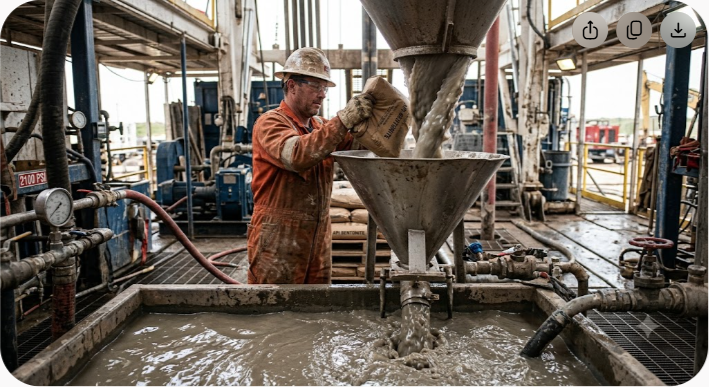
Before using bentonite for fluid-loss control, ask several practical questions:
These questions shift the focus from the dry clay to the finished fluid, which is where performance ultimately matters.
Bentonite can contribute to temporary sealing systems when the immediate objective is to limit fluid movement into a permeable interval, weak formation, or other loss zone.
Hydrated clay can reduce permeability within a deposited layer and may contribute to a seal when combined with other materials. The effectiveness of the system depends on the formation, pore or fracture geometry, particle-size distribution, differential pressure, fluid chemistry, and placement method.
This can be useful during selected workover or recompletion operations where uncontrolled fluid losses make circulation or pressure management difficult. Reducing losses can also limit fluid consumption and help maintain a more controlled operation.
Bentonite should not, however, be treated as a universal lost-circulation material. The appropriate treatment depends on the loss mechanism. Significant losses into fractures or larger openings may require a designed blend of granular materials, fibres, bridging agents, polymers, or other additives. Particle size and distribution are particularly important because a material must be capable of bridging the relevant opening rather than simply increasing fluid viscosity.
Temporary plugging also has a second requirement: the barrier must be compatible with the next stage of the operation.
A seal that effectively stops fluid movement may become a problem if it remains across a production interval after completion. The operator therefore needs to consider not only how the barrier is created but also how it will be removed, broken, displaced, or bypassed.
The practical lesson is simple. Temporary plugging should be designed around the complete operating sequence, not just the initial loss-control target.
Specialty bentonite-containing fluids can also serve as spotting or displacement systems during selected workover and completion-related operations.
A spotting fluid is normally placed to address a defined downhole condition or maintain contact with a particular zone for a controlled period. Bentonite can contribute rheology and suspension so that particulate components remain distributed during placement and static contact.
But placement is only one part of the job.
The fluid eventually needs to be displaced, diluted, circulated out, chemically treated, or otherwise removed. A formulation that is easy to place but difficult to clean up can create problems later in the operation.
This is particularly relevant when the well is being prepared for equipment installation or return to production. Completion work commonly places a high value on wellbore cleanliness, removal of solids, and protection of the production interval.
For that reason, the displacement plan should be considered while the spotting or conditioning fluid is being designed. Fluid density, rheology, compatibility, mixing behaviour, contact time, and displacement sequence all influence how cleanly one fluid can replace another.
Bentonite can be useful when its rheological contribution solves a real placement or suspension problem. If the operation ultimately requires a very clean, low-solids wellbore, a clay-containing system may create additional cleanup requirements that need to be justified by its operational benefit.
Not all oilfield clay applications involve conventional sodium bentonite dispersed in water.
Organophilic clay is chemically treated so its surface interacts with nonaqueous base fluids. It is used as a viscosifier and gelling agent in suitable oil-based and synthetic-based systems, including selected drilling, workover, and completion-related applications.
The difference comes down to surface chemistry. Conventional hydrophilic bentonite has a strong affinity for water, while organophilic treatment modifies the clay so it can function in a nonaqueous environment.
This distinction is critical during material selection. Adding conventional sodium bentonite to an oil-based system isn't equivalent to selecting an organophilic clay designed for that base fluid.
Organophilic clay performance also depends on dispersion and shear. The material must be incorporated under appropriate mixing conditions so that it develops the intended rheological structure. Poor dispersion can produce inconsistent viscosity, weak gel development, or undesirable settling.
For nonaqueous systems, the evaluation should therefore cover more than a conventional bentonite specification. Consider base-fluid compatibility, viscosity development, gel strength, shear response, thermal stability, solids tolerance, and behaviour after aging.
This is also why the term oilfield grade isn't sufficient by itself. The grade needs to be tied to the intended base fluid and operating conditions.
The final category covers specialty workover and completion support fluids in which clay-based rheology is intentionally part of the formulation.
Workover operations can involve circulation, suspension, spotting, temporary isolation, wellbore conditioning, fluid displacement, and other tasks that don't necessarily require the same fluid properties as a final production-zone completion fluid.
That distinction is important because the acceptable solids level can change with the location and purpose of the fluid. A controlled amount of clay may be acceptable in a nonproductive interval or in a system designed for later removal. A fluid placed directly across a sensitive producing formation may have much stricter solids and filtration requirements.
The application should therefore determine the material specification. Starting with a preferred bentonite grade and trying to build an application around it reverses the normal engineering process.
Start with the well objective. Define the fluid properties. Identify the formation and equipment constraints. Then determine whether bentonite, organophilic clay, a polymer, a clear brine, or another fluid technology provides the appropriate solution.
Bentonite-containing fluids and conventional clear completion brines serve different purposes and should not be treated as interchangeable.
Conventional completion fluids are commonly formulated as clear brines using salts such as chlorides, bromides, or formates. They are often filtered to minimize suspended solids and are selected to provide the required density and chemical compatibility while limiting formation damage.
Bentonite-containing systems deliberately introduce clay solids to obtain properties such as viscosity, suspension, filtration control, or temporary sealing.
| Consideration | Bentonite-containing specialty fluid | Clear completion brine |
|---|---|---|
| Primary purpose | Rheology, suspension, filtration, or temporary sealing | Density, pressure control, cleanliness, and compatibility |
| Solids | Deliberately present when required by the formulation | Normally minimized |
| Viscosity | Can be developed through clay structure and additives | Usually relatively low, depending on formulation |
| Formation exposure | Requires careful clay and filter-cake assessment | Usually designed to minimize solids-related exposure |
| Typical applications | Selected workover and specialty operations | Many production-zone completion operations |
| Cleanup | May require planned displacement or removal | Often simpler to maintain as a clean fluid |
| Material selection | Depends strongly on clay type and base-fluid chemistry | Depends on density, salt system, temperature, and compatibility |
Neither category is automatically appropriate for every well. The correct choice follows from the operation, formation, pressure window, fluid chemistry, and cleanup requirements.
Selecting bentonite by price per bag is a poor substitute for formulation testing. The material needs to perform in the actual fluid and under conditions that resemble the intended application.
First determine whether the system is freshwater-based, saline, polymer-containing, oil-based, or synthetic-based. Conventional sodium bentonite and organophilic clay are different materials for different environments.
Specify the viscosity and gel behaviour the operation needs rather than simply asking for a high-yield clay. Consider circulation, static periods, restart pressure, suspension requirements, and displacement.
Calcium and magnesium ions can interfere with clay hydration and dispersion. High salinity can also reduce the swelling and hydration behaviour expected from freshwater sodium bentonite.
If field water is already available, use it during qualification. If not, prepare a laboratory brine that represents the expected ionic composition as closely as practical.

Where filtration control is part of the objective, measure fluid loss and examine the resulting filter cake. The finished-fluid response is more informative than relying on a dry powder specification alone.
Downhole temperature and exposure time can change rheology, filtration, additive compatibility, and gel development. A candidate material should be tested after representative thermal aging when the application warrants it.
Bentonite can interact with polymers, salts, weighting materials, deflocculants, lubricants, and other additives. Mixing order and shear can also affect the finished fluid.
Test the complete formulation rather than evaluating each ingredient in isolation. A clay that performs well alone may behave differently after the rest of the fluid package is added.
If the fluid will contact a producing interval, determine how clay solids and filter cake will be removed or broken. Consider permeability impact, exposure time, pressure differential, and the planned return-to-production sequence.
Drilling fluids are designed for functions such as cuttings transport, wellbore stability, pressure control, and filtration during drilling. Completion fluids often have much tighter cleanliness and formation-compatibility requirements.
A drilling-fluid bentonite specification therefore doesn't automatically make the finished fluid suitable for completion work.
Sodium bentonite is valued for hydration and swelling, particularly in water-based systems, but that doesn't make it suitable for every oilfield fluid. The base fluid and operating conditions determine whether conventional bentonite is appropriate.
A clay that hydrates strongly in fresh water may behave very differently in saline water. Field water should be characterized and reproduced during laboratory qualification whenever possible.
Higher viscosity isn't automatically better. The fluid must meet the operational target without producing excessive pressure losses, difficult displacement, poor cleanup, or an undesirable filter cake.
If the fluid is intended for temporary placement, decide how it will leave the well before introducing it. Displacement, dilution, chemical treatment, circulation, and mechanical cleanup may all have implications for fluid selection.
Particle size and price are useful procurement considerations, but neither describes complete oilfield performance. Hydration, rheology, filtration, residue, chemistry, consistency, and batch-to-batch behaviour also matter.
A supplier datasheet is useful for screening candidates, but it doesn't replace testing in the intended fluid. Small changes in water chemistry, mixing history, additive concentration, and temperature can alter finished-fluid performance.
A useful procurement specification should describe the properties that matter to the application rather than simply stating oilfield grade bentonite.
Depending on the fluid system, the qualification package may include:
API Specification 13A provides standardized requirements and test procedures for drilling-fluid materials, including applicable bentonite grades. For a completion-related project, those material requirements should be considered alongside the specifications and performance tests applicable to the finished completion fluid.
This distinction is especially important when a purchasing team asks for a generic oilfield bentonite grade. The supplier should understand what the clay needs to do in the finished fluid. Otherwise, a material can meet a familiar specification and still fail to deliver the required field performance.
A structured laboratory programme can identify formulation problems before field deployment. The workflow below keeps the focus on the finished fluid rather than the dry clay alone.
This process is more useful than choosing a clay from a product name or a single viscosity number. It also gives the operator and supplier a common technical basis for troubleshooting if field performance differs from expectations.
No. Bentonite can help control fluid loss in an appropriate formulation, but clay solids can also contribute to formation damage if they invade sensitive pore spaces or remain in the near-wellbore region.
The apparent contradiction disappears when the full fluid-exposure cycle is considered. A low-permeability filter cake can limit fluid invasion, while mobile or retained clay particles may reduce permeability under different conditions.
Completion-fluid design therefore needs to consider placement, pressure differential, contact time, filtration, invasion, cleanup, and return to production as connected stages of one operation.
This is one reason clean completion-fluid systems are widely used across production-zone applications. When solids are not required for the job, eliminating unnecessary solids can simplify formation-protection and cleanup objectives.
Where clay is required, the same principle still applies: use the minimum effective concentration, qualify the complete fluid, and establish a realistic removal or cleanup strategy before field use.
Not all bentonite deposits produce the same clay, and even material from the same source can vary between batches. Mineralogy, exchangeable ions, moisture, particle size, processing, and contamination can all influence hydration and rheological performance.
For oilfield applications, consistency is particularly important. A formulation developed with one batch should not behave substantially differently when the next shipment arrives.
Quality control should therefore consider both the material specification and the consistency of finished-fluid performance. A supplier should be able to provide appropriate technical information and support representative qualification testing.
For water-based systems, relevant screening may include hydration behaviour, viscosity development, filtration, residue, and response to the expected water chemistry. For organophilic systems, the evaluation shifts toward nonaqueous compatibility, dispersion, gel development, shear response, and thermal stability.
For an industrial mineral supplier, the useful question isn't simply whether a bentonite is labelled oilfield grade. The more important question is whether its properties are consistent with the fluid formulation and operating conditions.
Axewelledge supplies bentonite for oilfield and other industrial applications, with processing and quality-control capabilities focused on consistent mineral performance. For a completion-related project, the appropriate grade should be evaluated against the required rheology, hydration behaviour, filtration performance, salinity tolerance, temperature range, and compatibility with the complete fluid formulation.
If you're sourcing bentonite for an oilfield application, provide the intended base fluid, target rheology, salinity, temperature range, filtration requirement, solids tolerance, and operating objective. Those details create a much more useful technical basis for grade selection than a generic request for the cheapest oilfield bentonite.
Bentonite has seven practical roles in selected oilfield completion and workover fluid applications: building viscosity, suspending solids, supporting filtration control, contributing to temporary plugging, supporting spotting and displacement systems, providing organophilic rheology in nonaqueous fluids, and serving in other specialty workover or completion systems where controlled clay content is appropriate.
The important qualification is that bentonite isn't a universal completion-fluid additive. Conventional completion fluids are often deliberately low in solids because formation cleanliness, equipment protection, and production performance are central concerns.
Bentonite becomes useful when its specific properties solve a defined problem without creating a larger formation-damage, displacement, or cleanup issue.
The practical approach is to start with the well objective, define the required fluid properties, reproduce the relevant chemistry and temperature in the laboratory, test the complete formulation, and specify performance rather than relying on a generic product label.
That is the basis for selecting bentonite that can perform reliably downhole.













Have questions about our products? We're here to help!