Axewelledge, a leading exporter from India, specializes in high-quality Bentonite. With a commitment to excellence, we supply premium Bentonite to the Middle East and Southeast Asia markets.


North Angle Complex, 304,
150 Feet Ring Rd, Opposite Ambedkar Nagar BRTS Stop,
Madhav Park, Punit Nagar,
Mavdi, Rajkot, Gujarat 360004
© Axewelledge 2026, All Rights Reserved.
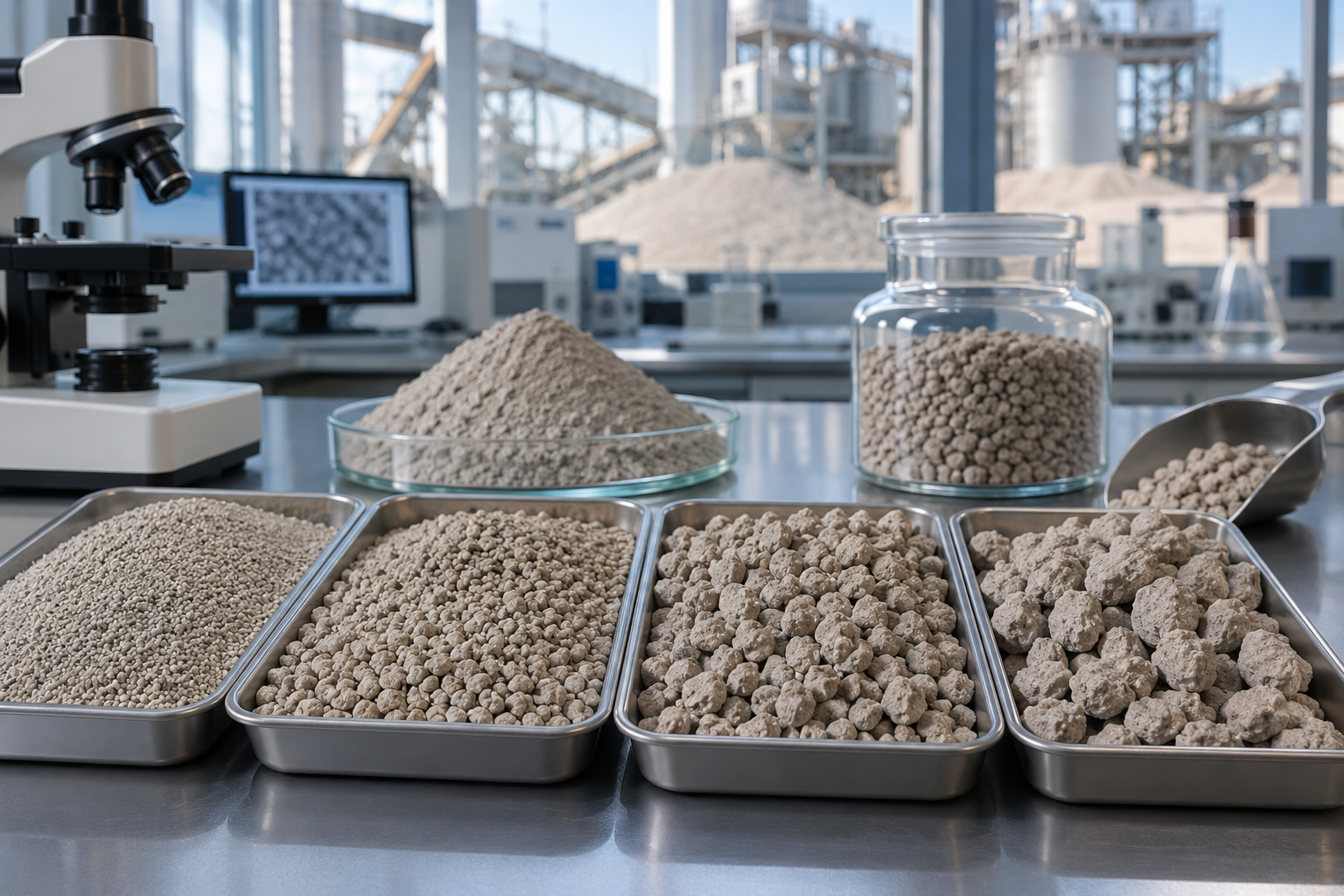
Bentonite is one of the key raw materials used to make clumping cat litter because some grades can absorb liquid, swell, and form cohesive clumps without relying on a synthetic binder. For manufacturers, the challenge isn't simply finding bentonite; it is selecting a consistent grade and processing it into granules that deliver the right balance of clumping, absorption, dust control, strength, and handling characteristics.
Sodium-rich bentonite is particularly useful for clumping formulations because it can swell substantially when hydrated. However, the performance of finished litter depends on much more than the clay type. Mineral composition, particle size, moisture content, granule structure, drying conditions, screening, and blending all affect the result.
This guide explains seven important roles bentonite can play in cat litter production, how each property works, what manufacturers should measure, and where common processing mistakes can reduce product quality.
The defining feature of suitable swelling bentonite is its interaction with water. Bentonite contains clay minerals, commonly dominated by smectite such as montmorillonite. When the clay is exposed to water, it hydrates and expands. In a properly designed litter granule, that swelling helps capture urine and bind nearby particles into a removable clump.
For a manufacturer, this creates several useful functions at once:
Not every bentonite deposit performs the same way. Two materials sold simply as sodium bentonite can behave differently because their mineralogy and processing history differ. That is why laboratory testing and production trials matter.
The first job of clumping litter is to deal with liquid quickly. Swelling bentonite is well suited to this because its fine clay particles interact strongly with water.
When urine reaches the litter, water moves into and around the clay particles. The smectite component hydrates, expands, and changes the structure of the granule. Instead of simply letting liquid pass through the litter bed, the clay retains much of the moisture within the hydrated mass.
The exact absorption behavior varies with mineral composition, particle size, moisture content, and the chemistry of the liquid. For that reason, manufacturers should avoid treating a single absorption number as a universal specification.
Raw bentonite normally goes through several stages before it becomes a finished litter ingredient. Depending on the deposit and product design, these can include crushing, drying, milling, screening, granulation, and final classification.
Drying deserves particular attention. If feed material enters granulation with excessive moisture, the process can become difficult to control and the resulting granules may not have the desired strength. If it is excessively dry, granulation can also become less efficient.
Particle size matters too. Very fine material hydrates quickly, while larger particles can influence permeability, handling, and the physical character of the litter bed. A controlled particle-size distribution is usually more useful than simply making every particle as fine as possible.
Good liquid retention helps reduce the amount of wet material that reaches the bottom of the litter tray. It also gives the manufacturer a foundation for producing a litter that forms manageable clumps instead of turning into a loose, muddy mass.
A useful production program therefore tests absorption and swelling under controlled conditions rather than relying only on the supplier's general product description.
Clumping is the property most closely associated with sodium bentonite cat litter. The underlying mechanism is straightforward: water hydrates the swelling clay, and the expanded clay helps bind particles together.
The chemistry is more nuanced than the common description that "sodium ions make bentonite clump." Bentonite behavior depends on the type and proportion of clay minerals, exchangeable cations, layer structure, particle size, and the composition of the liquid contacting the clay. Sodium-rich smectite generally has strong swelling behavior, which is why sodium bentonite is widely used in clumping applications.
A finished litter granule contains a population of clay particles and other mineral components. When liquid reaches the granule, the swelling clay hydrates. As the hydrated clay expands, particles become interconnected and a cohesive mass develops around the wet area.
The final clump isn't determined by mineral chemistry alone. Granule design has a major role.
Manufacturers need to balance:
If the granules are too hard or too coarse, liquid may take longer to penetrate the material. If they contain too many fines, dust and tracking can increase. If swelling is excessive without adequate structural control, the clump may become larger than desired or difficult to handle.
A simple laboratory comparison can reveal more than a specification sheet. Test equal quantities of different bentonite grades under the same conditions and record liquid uptake, clump formation time, clump mass, clump strength, and residue left after removal.
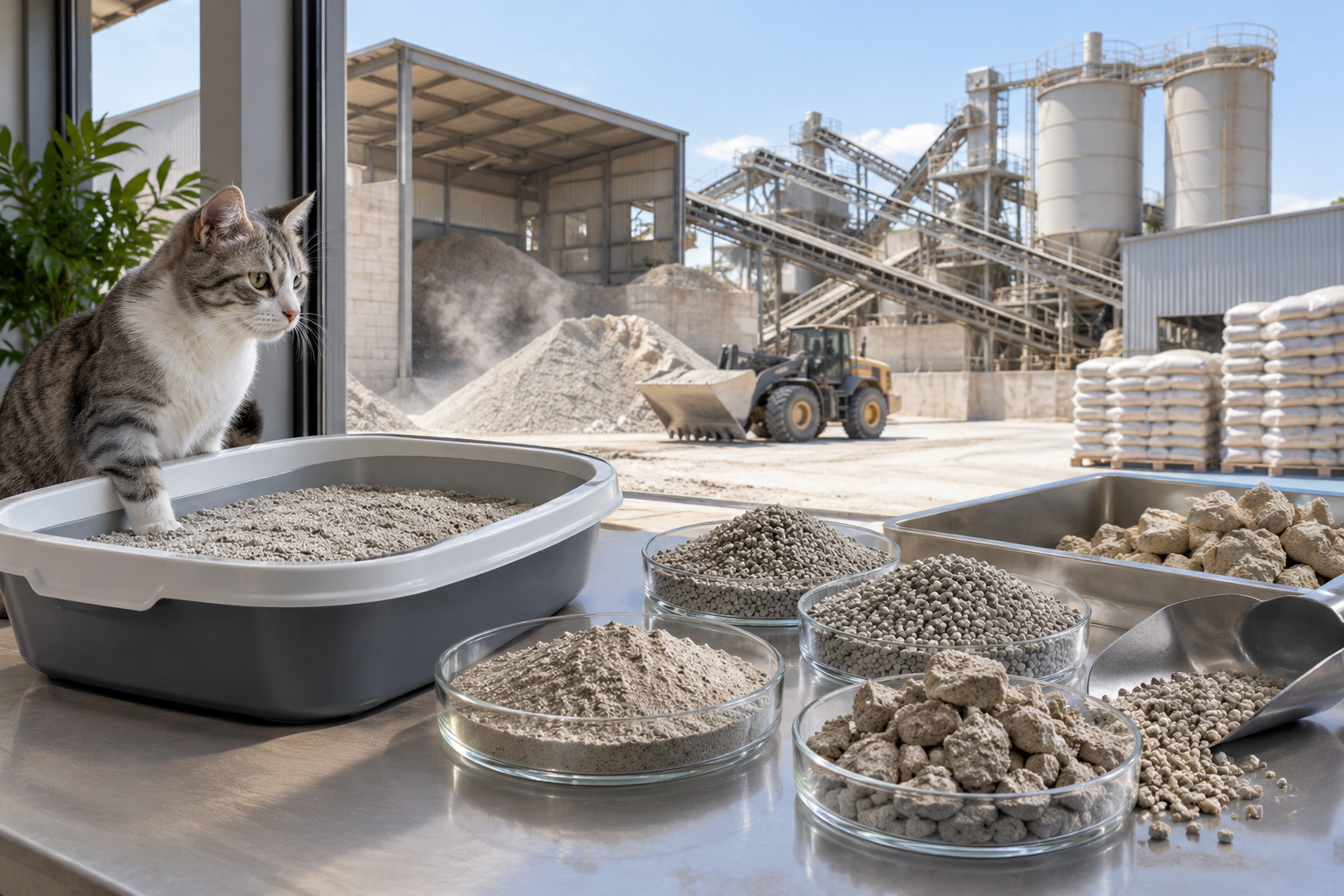
The goal isn't the biggest clump. It is a clump that forms quickly, stays together during scooping, and doesn't leave an unnecessarily large amount of wet material behind.
Bentonite can contribute to odor management, but it is important not to overstate what the mineral does. Bentonite isn't a universal chemical neutralizer for every odor compound, and ordinary sodium bentonite shouldn't be described as making an airtight seal or eliminating ammonia on its own.
Its main contribution is physical: rapid liquid capture and clump formation can reduce the amount of wet waste spread through the litter bed. Removing concentrated urine clumps also removes much of the source material responsible for unpleasant odors.
Cat urine contains urea, which can break down over time and contribute to ammonia formation. Odor depends on several factors, including moisture, microbial activity, ventilation, litter-box cleanliness, and the chemistry of the waste.
A litter formulation can address some of these factors by absorbing liquid efficiently and making waste easier to remove. Manufacturers may also combine bentonite with other odor-control ingredients, such as activated carbon, zeolite, or formulated fragrance systems, depending on the product's positioning and applicable requirements.
Bentonite has cation-exchange capacity, which is an important mineral property. However, cation exchange should not automatically be presented as proof that bentonite chemically neutralizes ammonia or captures every odor molecule.
For a product claim to be meaningful, manufacturers should test the finished formulation under defined conditions. Odor performance depends on the complete recipe, not just the bentonite grade.
Dust is an important quality issue for both manufacturing facilities and consumers. Bentonite naturally occurs as a fine clay material, so converting it into controlled granules is a central part of litter processing.
The objective is not simply to remove every fine particle. Some fine material can contribute to rapid hydration and clumping. The practical target is a controlled particle-size distribution with enough fine material for performance but not so much that the product becomes excessively dusty.
Several process steps can help:
A litter can leave the production line with acceptable dust levels and still generate fines during transportation. Repeated impacts, conveyor transfers, bag filling, and handling can weaken poorly formed granules.
That is why finished-product testing should include both initial dust measurement and an assessment of particle durability after handling.
Bulk density affects how much litter fits into a package, how the product feels when poured, and how it behaves in the litter box. It is closely connected to particle size, moisture, porosity, and granule structure.
There is no single bulk-density value that is ideal for every bentonite cat litter. A lightweight litter, a standard clumping product, and a coarse-grain formulation may intentionally use different physical specifications.
| Property | Fine-Particle Formulation | Coarse-Granule Formulation | Blended Formulation |
|---|---|---|---|
| Granule size | Smaller | Larger | Mixed sizes |
| Liquid contact | Rapid | More gradual | Balanced |
| Dust sensitivity | Higher if fines are excessive | Often easier to control | Depends on fine fraction |
| Tracking | Can be higher | Can be lower | Depends on shape and size |
| Packaging density | Generally higher | Generally lower | Intermediate |
| Clump behavior | Fast hydration | More localized penetration | Tunable |
These are general processing relationships, not fixed product specifications. Actual performance should be established through testing.
Granules need enough mechanical strength to survive production, filling, transport, and consumer handling. But excessive hardness can slow liquid penetration.
This creates a useful manufacturing trade-off: the granule must be strong enough to remain intact in the bag but responsive enough to break down and swell when exposed to liquid.
Manufacturers can adjust this behavior through feed moisture, granulation conditions, particle-size distribution, drying, and screening. The exact settings depend on the equipment and the characteristics of the bentonite being processed.
Bentonite can function as a binder in granulated products because hydrated clay particles develop cohesion. This is one reason a separate synthetic binder isn't necessarily required in a conventional bentonite-based clumping formulation.
However, calling bentonite automatically "eco-friendly" or "biodegradable" needs more care. Bentonite is a naturally occurring mineral, but mining, drying, transportation, packaging, waste handling, and the overall product formulation all contribute to environmental impact.
The mineral itself is not biodegradable in the same sense as an organic material. It remains a mineral after use. A more accurate description is that bentonite can serve as a naturally occurring mineral component and, in suitable formulations, can provide binding and clumping without a polymer binder.
During granulation, fine bentonite particles are assembled into larger units with a controlled size and strength. The process can improve handling characteristics while preserving the swelling behavior needed for clumping.
A manufacturer may choose different granulation approaches depending on the desired product. Important variables include:
The best process is the one that produces repeatable granules rather than simply the largest or hardest granules.
A good formulation can still fail commercially if the mineral feed changes from one shipment to the next. Consistency is therefore one of the most important considerations when sourcing bentonite for industrial litter production.
Manufacturers should establish raw-material specifications before purchasing at scale. Depending on the product, these may include swelling performance, moisture, particle-size distribution, bulk density, mineralogical composition, pH, and other relevant physical or chemical parameters.
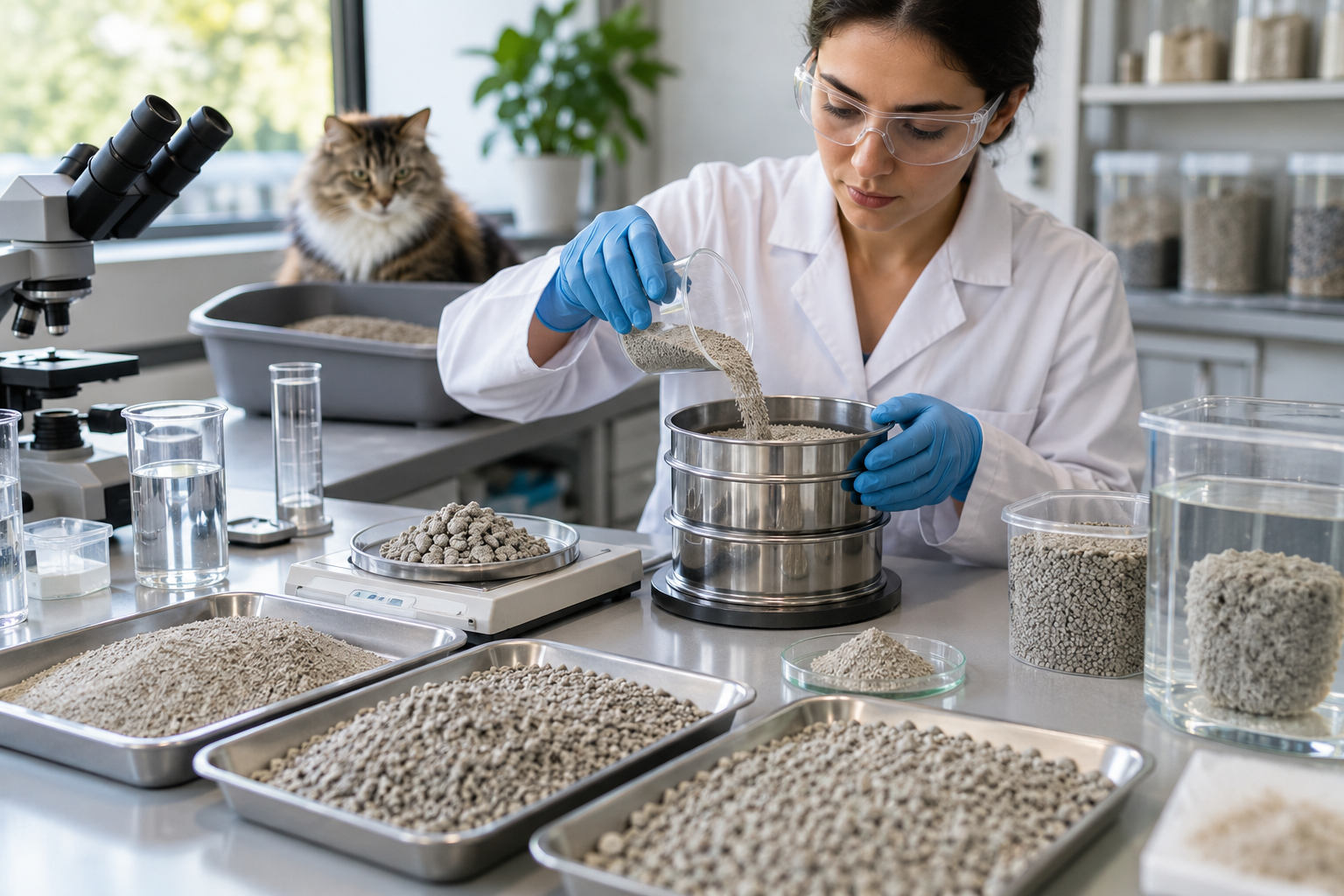
Bentonite is a natural mineral, so properties can vary within a deposit. Material from one section of a mine may not behave exactly like material from another section.
A supplier with strong geological control, appropriate stockpiling practices, blending procedures, and laboratory testing can help reduce these variations. This matters particularly when the customer's production line has been tuned to a specific clay behavior.
Before entering a long-term supply agreement, manufacturers should ask for representative samples and test them in their own process. A useful supplier evaluation can cover:
| Supplier factor | Why it matters |
|---|---|
| Swelling performance | Influences absorption and clumping |
| Moisture consistency | Affects drying and granulation |
| Particle-size distribution | Influences hydration and dust |
| Mineralogical consistency | Helps maintain predictable performance |
| Production capacity | Supports larger purchase volumes |
| Quality-control process | Reduces batch variation |
| Packaging and loading | Protects material during transport |
| Documentation | Supports incoming quality checks |
A supplier should be evaluated on actual material performance, not only on a product name such as "premium sodium bentonite."
The difference between sodium-rich and calcium-rich bentonite is important when selecting a clay for clumping litter.
| Characteristic | Sodium-Rich Bentonite | Calcium-Rich Bentonite |
|---|---|---|
| Swelling in water | Generally higher | Generally lower |
| Suitability for clumping | Commonly used | Less suitable in untreated form for strong clumping |
| Hydration behavior | Strong swelling response | More limited swelling |
| Typical role in litter | Clumping formulations | Often used in non-clumping or blended applications |
| Need for formulation testing | Yes | Yes |
This distinction isn't absolute. Mineral composition varies between deposits, and some calcium bentonites can be modified or activated to change their performance. Product developers should therefore test the actual material rather than relying only on the geological classification.
The exact process varies by manufacturer, but a typical bentonite-based production sequence looks like this:
Some products also include additional ingredients for odor control, fragrance, color, or other performance characteristics. Those additions should be evaluated as part of the complete formulation because they can change the way the bentonite hydrates and clumps.
A strong quality-control program should test both the raw bentonite and the finished litter.
Depending on the formulation, manufacturers may measure:
The swelling index is particularly useful for comparing swelling behavior between samples, but it should not be treated as a complete predictor of finished-litter performance.
Finished products can be evaluated for:
Testing the finished product is essential because processing can change how the original mineral behaves.
A high swelling index can look attractive on paper, but it doesn't guarantee excellent litter. Clump strength, granule durability, dust, particle size, and liquid penetration also matter.
Too many fines can increase dust and tracking. Too many coarse particles can slow hydration. Screening and blending should produce a deliberate distribution rather than an accidental one.
Drying affects both final moisture and mechanical properties. Excessive or poorly controlled drying can change granule strength and may increase breakage during handling.
Finished granules experience vibration, impacts, and compression before reaching the consumer. A product that performs well in a laboratory test but generates large amounts of fines after transportation needs further process development.
Natural mineral does not automatically mean sustainable, biodegradable, or environmentally harmless. Responsible product claims should reflect the complete manufacturing and disposal context.
Supplier data is useful for screening materials, but manufacturers should validate representative samples on their own equipment. A clay that performs well in one granulation process may behave differently in another.
Start with a clear material specification. Define the properties that actually affect your product instead of purchasing on a broad grade description.
A practical sourcing process can include the following steps:
For manufacturers purchasing internationally, supply reliability matters alongside mineral quality. A supplier should be able to provide appropriate technical documentation, consistent material, and a realistic production and shipping schedule.
Bentonite's value in cat litter comes from a combination of mineral chemistry and controlled processing. Sodium-rich swelling bentonite is widely used for clumping because it can hydrate, expand, and develop strong cohesion around liquid.
The seven main roles discussed here are:
The important point is that no single bentonite specification determines litter quality. A successful product comes from matching the mineral to the granulation process and then validating the complete formulation.
For manufacturers evaluating bentonite supply, Axewelledge can be considered as one potential source of bentonite from India. Before committing to a commercial specification, request representative material, review the available technical data, and conduct your own production and quality tests. That approach gives the formulation team a much clearer basis for choosing a grade and setting reliable process parameters.













Have questions about our products? We're here to help!