Axewelledge, a leading exporter from India, specializes in high-quality Bentonite. With a commitment to excellence, we supply premium Bentonite to the Middle East and Southeast Asia markets.


North Angle Complex, 304,
150 Feet Ring Rd, Opposite Ambedkar Nagar BRTS Stop,
Madhav Park, Punit Nagar,
Mavdi, Rajkot, Gujarat 360004
© Axewelledge 2026, All Rights Reserved.
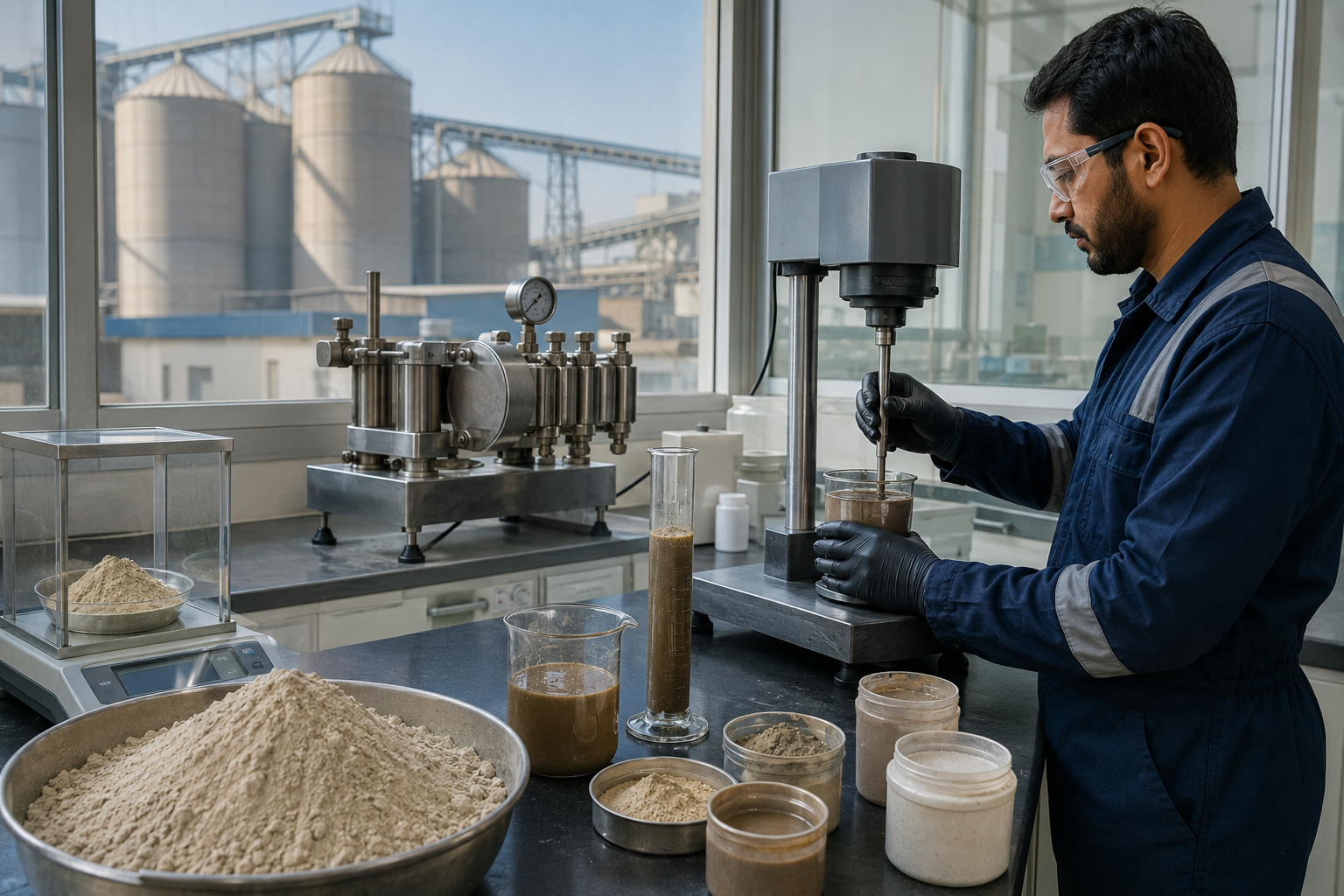
Buying bentonite for a drilling program shouldn't come down to the lowest price per ton. The useful question is whether the material will deliver the required rheology and filtration performance when it is mixed with the actual water used in the field.
For buyers evaluating API 13A bentonite, the starting point is simple: verify the applicable API 13A section, review the supplier's batch-specific test results, and confirm the material through independent or witnessed testing when the order is commercially important. For API 13A Section 9 bentonite, that means paying close attention to suspension properties, filtrate volume, residue on the specified sieve, moisture, and the test conditions behind the reported results.
A certificate that simply says "API grade" isn't enough. The details matter. Water quality, storage, processing, particle size, sampling, and even the way the slurry is prepared can change what the drilling fluid does in practice.
This guide explains what drilling fluid buyers should check before approving a bentonite shipment, how to interpret the main laboratory tests, where procurement teams commonly make mistakes, and how to build a practical incoming-quality-control process.
API Specification 13A covers drilling fluid materials and provides standardized requirements and test methods for materials used in drilling-fluid systems. For bentonite buyers, the relevant section depends on the grade and intended application. API 13A Section 9 is commonly associated with drilling-grade bentonite used to develop viscosity and suspension in freshwater-based systems.
The important distinction is that an API reference is not a generic promise of quality. A supplier should be able to identify the applicable specification, edition, product grade, test methods, and actual results for the material being offered.
That distinction becomes important during procurement. Two powders can both be described commercially as bentonite, yet behave very differently after hydration. Mineralogy, exchangeable cations, particle-size distribution, processing conditions, moisture, and the chemistry of the mixing water all influence performance.
A product can meet a specification under controlled laboratory conditions and still require careful formulation at the rig. API tests provide a common basis for evaluating material quality; they don't replace a drilling-fluid program designed around the well, formation, water chemistry, temperature, density, and other additives.
Buyers should therefore use API compliance as one part of qualification rather than treating it as a guarantee that every field formulation will perform identically.
A good procurement file should contain at least these items:
If a supplier cannot provide this information, the buyer has limited ability to verify whether the material supplied is actually the material that was tested.
For API 13A Section 9 bentonite, the most useful procurement checks are the suspension properties, filtrate volume, residue on the specified sieve, and moisture content. The reported values should always be read together with the test conditions and the applicable specification edition.
Rheology tells you how a bentonite suspension behaves when it is sheared. In drilling fluids, that matters because the mud must carry drilled solids, maintain a suitable structure when circulation slows, and flow through the surface and downhole equipment without creating unnecessary pressure losses.
One of the important laboratory indicators for API-grade bentonite is the viscometer dial reading at 600 revolutions per minute under the specified test procedure. Published API 13A Section 9 technical data commonly report a minimum 600 rpm dial reading of 30, although buyers should verify the requirement against the edition of the specification written into their purchase contract.
The number alone isn't enough. A test result should identify how the slurry was prepared, the concentration used, the water quality, mixing procedure, hydration time, and instrument conditions. Without that information, comparing two certificates can be misleading.
For procurement purposes, ask three questions:
A result that barely clears a minimum may deserve closer attention than a result with a comfortable margin, particularly when the product will be purchased repeatedly or shipped over long distances.
Yield point and plastic viscosity are calculated from viscometer measurements and describe different aspects of mud behavior. Plastic viscosity is associated primarily with the concentration and interaction of solids in the fluid, while yield point reflects the attractive forces that contribute to the fluid's ability to suspend material and transport cuttings.
The yield point-to-plastic-viscosity ratio is also used in the API bentonite evaluation. For Section 9 material, the applicable specification places a limit on this ratio under the prescribed test conditions.
This is not the same thing as saying that a higher yield point is always better. Excessive rheology can increase circulating pressure, complicate solids control, and make a mud system harder to manage. The drilling objective is a controlled rheological profile, not the highest possible number on a laboratory report.
Filtrate volume measures how much liquid passes through the test filter medium during the specified laboratory test. It is a useful indicator of the filtration behavior of the bentonite suspension.
For API 13A Section 9 bentonite, commonly published specifications set a maximum filtrate volume of 15 mL under the prescribed test conditions. Buyers should confirm the exact requirement in the applicable edition and contract because standards can be revised and customer specifications may be more demanding.
A lower laboratory filtrate result generally indicates better filtration control under that test condition, but it should not be interpreted in isolation. Actual filtration behavior in a well also depends on formation characteristics, salinity, temperature, solids concentration, polymer additives, and the complete mud formulation.
The practical procurement lesson is straightforward: don't accept a certificate that reports only viscosity. Filtrate performance is a separate quality indicator and should be documented separately.
Particle-size control matters because oversized particles and non-dispersed mineral fragments do not contribute efficiently to the desired mud properties. They can increase unwanted solids loading and may contribute to equipment wear.
API testing evaluates residue retained above the specified particle-size threshold. For Section 9 bentonite, the commonly cited limit for material retained above 75 micrometres is a maximum mass fraction of 4.0 percent under the applicable test method.
Buyers sometimes refer to this as a "200-mesh test." That shorthand can be useful in commercial conversations, but the specification should be identified by its actual test method and particle-size requirement rather than relying only on mesh terminology.
A good supplier should be able to explain the test result and show that the reported residue is tied to the same lot being shipped.
Moisture affects more than the number printed on a certificate. Excess water reduces the amount of dry material delivered per unit of shipment weight and can contribute to caking during storage or transportation.
API 13A requirements for moisture should be checked against the applicable edition rather than copied from an old product brochure. Published Section 9 technical data commonly show a maximum moisture requirement of 13 percent by mass, but the contractual specification and current standard should control.
For bulk procurement, moisture is particularly important because a small percentage difference becomes significant across a large shipment. Buyers should also inspect packaging for evidence of moisture ingress after the material leaves the processing plant.
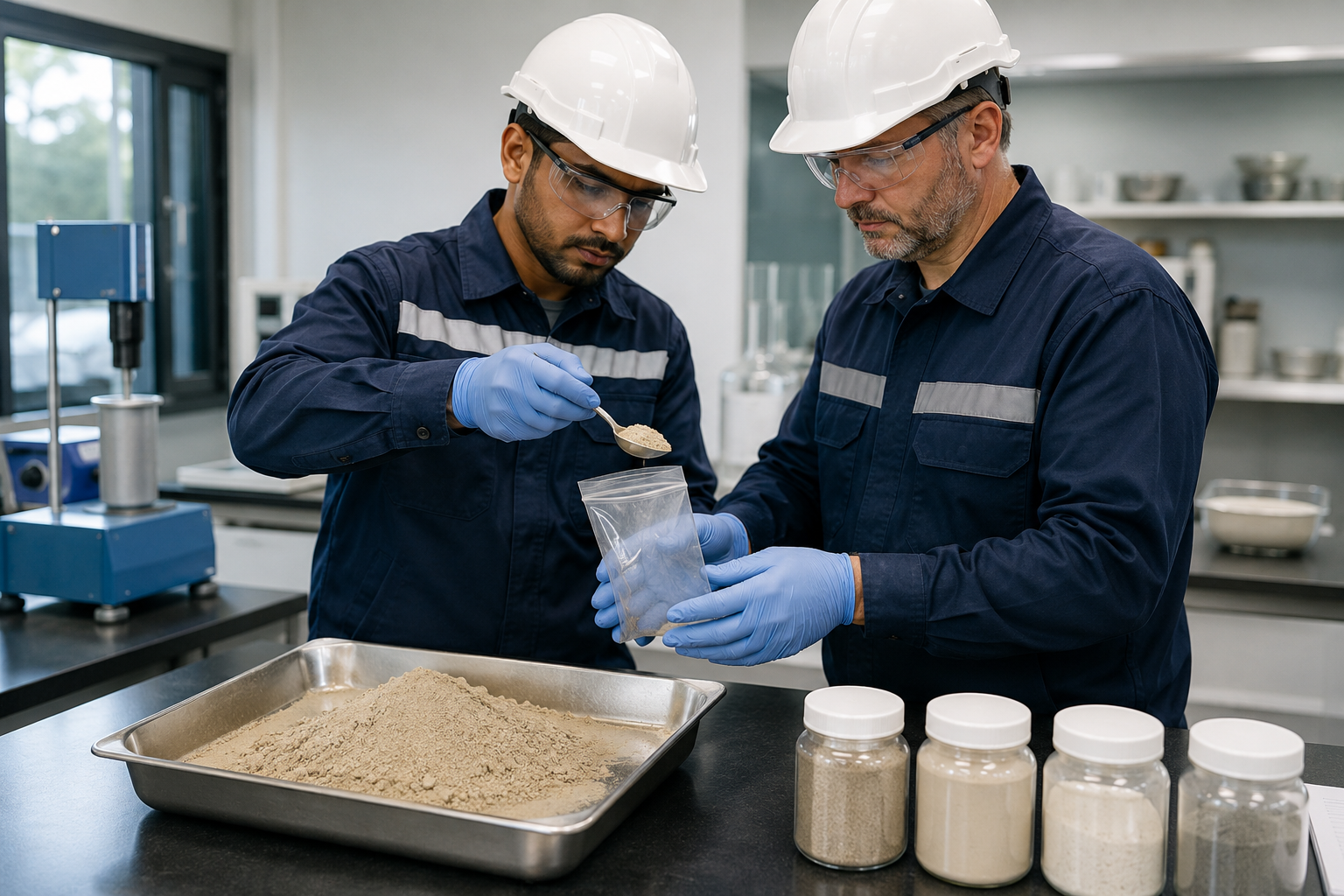
A procurement team can make the qualification process much more reliable by separating product qualification from shipment inspection.
Confirm the following information with the supplier:
The purchase order should not simply say "API bentonite." It should identify the exact grade and acceptance criteria. That small change can prevent a large amount of confusion later.
Request a representative sample and test it using a documented procedure. If the material is intended for a demanding drilling program, compare the supplier's certificate with an independent laboratory result.
The purpose isn't to create unnecessary testing. It is to establish a reference point before a large quantity is committed.
For example, suppose a supplier reports a strong 600 rpm reading and acceptable filtrate volume. An independent test can confirm whether the material behaves similarly under the agreed test conditions. If the results differ materially, the discrepancy can be investigated before the product reaches the rig.
Bentonite does not hydrate in a vacuum. The water used to prepare the slurry has a major influence on how the clay develops viscosity and filtration properties.
Fresh, relatively low-hardness water is generally favorable for sodium bentonite hydration. Calcium and magnesium ions can interfere with clay dispersion and promote flocculation. Salinity can also change the behavior of the clay system.
This is why a supplier's laboratory result should not be copied directly into a field mud program. The laboratory may use controlled water that is substantially different from the rig's make-up water.
If make-up water contains significant hardness, the drilling-fluid team may need to condition the water before adding bentonite. Soda ash is commonly used in freshwater mud systems to reduce the effects of calcium hardness, but the correct treatment should be determined from water testing and the overall mud design.
The key procurement lesson is to test the material with representative water when possible. A bentonite that looks excellent in standardized laboratory water can behave differently in hard or contaminated field water.
Before a large bentonite order, obtain a representative water sample or a recent water analysis. At minimum, review the parameters that are relevant to the mud program, including hardness and chloride content.
Then conduct a controlled pilot test using the actual or representative water. Compare the results with the supplier's standard-water certificate.
That comparison tells you something the certificate cannot: how much of the laboratory performance is likely to translate to your operating conditions.
One common procurement mistake is treating an API product test and a field mud test as interchangeable. They are not.
An API product test asks whether the bentonite meets defined material requirements under a standardized procedure. A field mud test asks whether the complete drilling-fluid system has the properties required for the current operation.
The distinction can be summarized as follows:
| Test or review | Main purpose | Typical decision |
|---|---|---|
| API product testing | Verify material against the applicable specification | Accept or qualify the bentonite grade |
| Independent laboratory verification | Confirm supplier-reported results | Approve supplier or investigate discrepancy |
| Water analysis | Understand make-up water chemistry | Decide whether water conditioning is needed |
| Pilot mud test | Evaluate material under representative conditions | Confirm formulation and treatment requirements |
| Rig-site mud testing | Track the complete circulating system | Adjust the active mud program |
A buyer should use all of these at the appropriate stage rather than expecting one test to answer every question.
The phrase "high yield bentonite" is widely used in commercial specifications, but buyers should define exactly what they mean by yield.
In drilling-fluid discussions, yield is often expressed in barrels of mud produced per ton of bentonite at a specified viscosity criterion. This can be useful for comparing products, but the number is meaningful only when the test basis is the same.
A supplier claiming 90 barrels per ton and another claiming 100 barrels per ton may not be making directly comparable claims if they use different test procedures, slurry concentrations, or performance criteria.
For procurement, ask the supplier to provide the test basis behind the stated yield. Better still, compare the actual API test results and conduct a controlled pilot test when the difference has a meaningful commercial impact.
Consider two hypothetical products. Product A costs less per ton but requires more material to reach the desired mud properties. Product B costs more per ton but develops the required rheology at a lower treatment rate.
The correct comparison is not simply purchase price. It is the delivered cost of achieving the required mud performance.
A useful procurement calculation includes:
This approach gives the drilling team a much clearer basis for supplier comparison.
Not every clay sold for drilling or slurry applications is interchangeable. The buyer needs to match the material to the specification and job.
| Property | API 13A Section 9 Bentonite | Unspecified Industrial Clay | Untreated Calcium-Rich Bentonite |
|---|---|---|---|
| Standardized drilling-grade evaluation | Yes, when properly qualified | Not necessarily | Not necessarily |
| Freshwater hydration | Designed for the specified application | Variable | Generally less effective than sodium-rich material |
| Viscosity development | Controlled by specification requirements | Highly variable | Usually lower without treatment |
| Filtration performance | Evaluated under the API test | Variable | Often requires treatment or additives |
| Particle-size control | Subject to specified residue limit | Variable | Product dependent |
| Procurement documentation | Should include specification and test data | Often less standardized | Must be verified product by product |
This comparison doesn't mean an API 13A product is automatically the best choice for every drilling fluid. It means the buyer has a defined performance baseline that can be checked against the intended application.
The lowest quoted price can be attractive until the mud engineer needs substantially more product or additional additives to reach the target properties.
Compare cost per unit of useful performance, not just cost per shipment weight.
The phrase "API grade" is too vague for a technical purchase order. Ask which section applies, which edition is being referenced, and which test results demonstrate compliance.
A strong viscosity result does not eliminate the need to review filtrate volume, sieve residue, moisture, and the other applicable requirements.
A material should be evaluated as a complete specification package.
A laboratory result is meaningful only in the context of the procedure used to obtain it. Water quality, concentration, mixing, hydration, temperature, instrument settings, and other conditions can affect the result.
The first shipment may be excellent while later lots vary because of changes in mining area, blending, drying, grinding, or processing conditions.
For recurring purchases, establish a lot-based quality-control plan rather than relying permanently on the original qualification sample.
Bentonite color can vary naturally with mineral composition and processing. Color alone is not a reliable indicator of API performance.
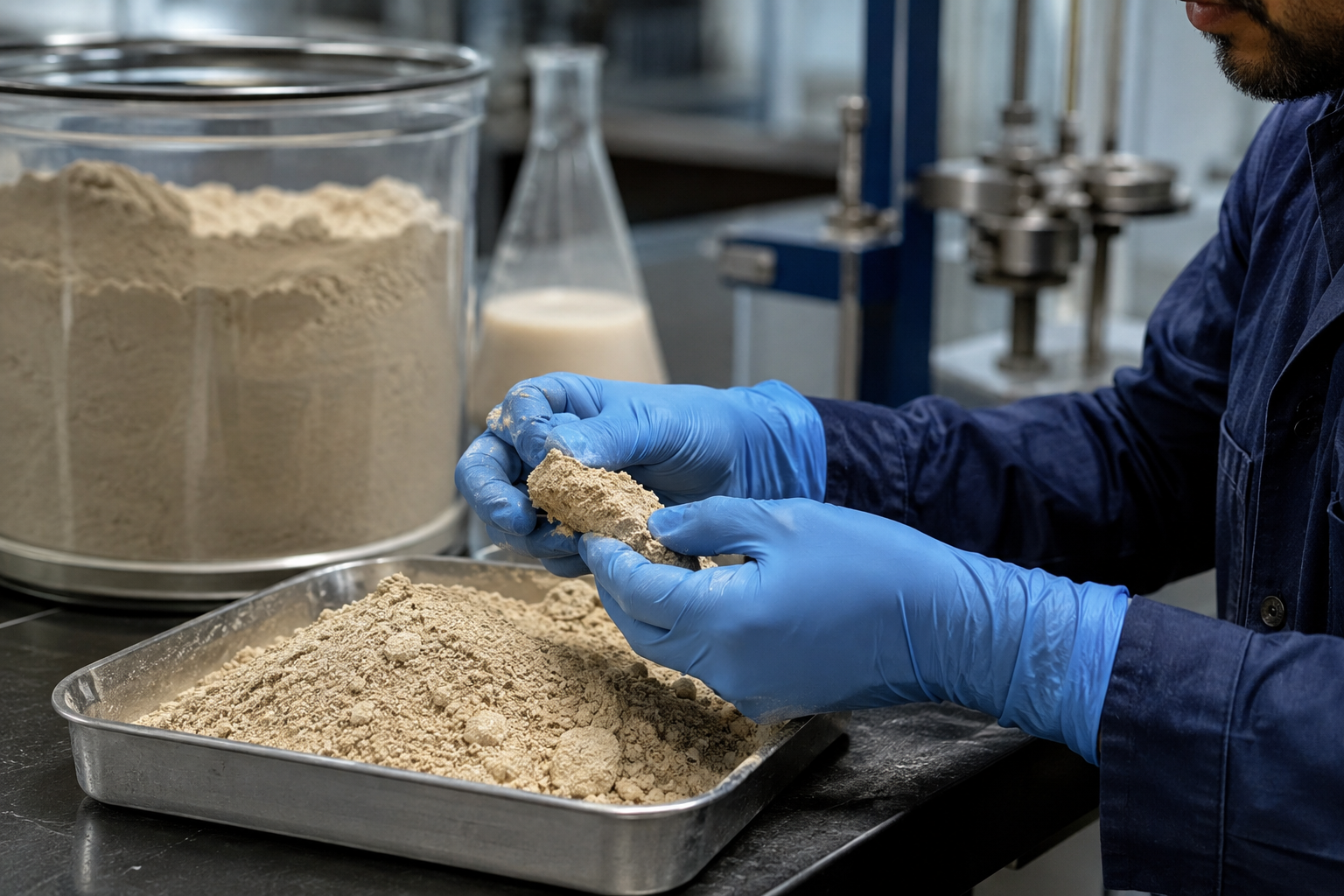
Use laboratory data and representative sampling instead.
One bag may not represent a container, pallet, bulk bag, or vessel shipment. Sampling should follow an agreed procedure designed to produce a representative composite or set of samples.
A certificate of analysis is valuable, but it should be traceable to the shipment and backed by a defined quality system. For critical orders, independent verification can provide additional confidence.
Quality control shouldn't stop when the purchase order is closed. Transport and storage can introduce problems that weren't present when the product left the processing plant.
Check bags or bulk containers for tears, broken seals, punctures, water marks, and visible caking. Damaged packaging should be documented before unloading or consumption.
Match lot numbers, production dates where provided, packaging quantities, and shipping documents against the purchase order and certificate of analysis.
Look for unexpected lumps, foreign material, unusual contamination, or signs of moisture exposure. Visual inspection is not a substitute for laboratory testing, but it can identify obvious handling problems quickly.
Follow the agreed sampling procedure rather than selecting the easiest bag to reach. For large shipments, retain samples so that later disputes can be investigated against material from the same lot.
For high-value or technically sensitive orders, repeat the relevant laboratory tests. Compare the results with the supplier certificate and contractual acceptance limits.
If a shipment fails inspection, record the lot number, quantity affected, photographs, sampling details, test results, and storage conditions. Good documentation makes supplier discussions much easier and protects both sides if a technical dispute develops.
Even good bentonite can deteriorate as a practical product if it is stored badly. The main concerns are moisture exposure, damaged packaging, contamination, and uncontrolled warehouse conditions.
Keep powdered bentonite protected from rain, standing water, and excessive humidity. Bags should be stored in a way that prevents direct contact with wet floors and allows inspection of the packaging.
For bulk operations, the storage system should also prevent contamination from other powders. A clean, dry, clearly identified storage area is a basic quality-control measure.
First-in, first-out inventory practices can help reduce long storage periods, particularly where packaging integrity may be affected by repeated handling.
Not every shipment requires the same level of verification. Testing intensity should reflect the commercial and operational risk.
Independent testing is especially useful when:
The goal isn't to duplicate every supplier test forever. A sensible program establishes confidence at qualification, monitors ongoing consistency, and increases testing when results or operating conditions change.
A strong technical inquiry can save several rounds of emails and prevent ambiguity in the purchase order. Ask the supplier for:
For recurring supply, also ask how the supplier controls variation between production lots. A technically strong mine and processing plant should have a clear answer about sampling, blending, processing, and release testing.
Traceability is particularly useful when bentonite is purchased in large quantities or under a long-term contract. A buyer should know where the material originated and which processing facility handled it.
Direct mine ownership isn't automatically proof of superior quality, just as trading isn't automatically a sign of poor quality. What matters is whether the supplier can control and document the material throughout the supply chain.
A vertically controlled operation can make that easier because the supplier may have greater visibility into the mineral source, processing conditions, blending practices, and shipment lots.
For an exporter such as Axewelledge, the relevant question for a buyer should be practical: can the supplier provide consistent API 13A material, traceable documentation, representative samples, and reliable shipment support for the required volume?
Those are stronger procurement criteria than a marketing claim about being a mine owner or exporter.
A purchase specification should translate the drilling team's technical requirements into measurable acceptance criteria.
Instead of writing "supply high-quality API bentonite," specify the grade, applicable API section, test requirements, documentation, packaging, sampling, and acceptance procedure.
A practical specification can include:
| Procurement item | What to define |
|---|---|
| Product identity | Exact grade and product name |
| API reference | Applicable section and edition |
| Performance | Required API test properties and limits |
| Certificate | Batch or lot-specific documentation |
| Sampling | Quantity, method, and retention period |
| Packaging | Bag or bulk format and liner requirements |
| Moisture protection | Storage and transport expectations |
| Inspection | Buyer or independent testing rights |
| Nonconformance | Rejection, replacement, or corrective-action process |
| Traceability | Lot identification from production through shipment |
This level of detail reduces the chance that procurement, quality control, logistics, and the drilling team are working from different definitions of acceptable material.
Bentonite is only one part of a drilling-fluid system. Depending on the well, the formulation may also include weighting materials, polymers, fluid-loss-control additives, lubricants, shale inhibitors, lost-circulation materials, deflocculants, or other treatment products.
That means a strong bentonite result shouldn't be interpreted as proof that the final mud system will meet every operational target.
For example, a bentonite may provide the required base viscosity in freshwater, while a change in salinity or temperature alters the final rheology. A polymer may then be required to control filtration or rheology more precisely. Similarly, adding barite changes the solids concentration and therefore affects the behavior of the complete fluid.
Procurement teams should therefore qualify the bentonite independently, then allow the drilling-fluid engineer to evaluate it as part of the complete formulation.
When several suppliers submit quotations, create a technical-commercial comparison rather than ranking the offers by price alone.
Start with compliance. Eliminate products that don't meet the required specification or cannot provide adequate documentation.
Next, compare performance. Look at the actual laboratory results and the margin to the contractual limits.
Then evaluate consistency. Ask for historical data or multiple lot results when available. A supplier with slightly higher pricing may be more attractive if the material is consistently within specification and the supply chain is dependable.
Finally, evaluate logistics. Consider lead time, minimum order quantity, packaging, port availability, freight, documentation, and the supplier's ability to maintain the required volume.
A useful supplier scorecard can therefore include four categories: technical compliance, consistency, delivered cost, and supply reliability.
API 13A bentonite should be purchased as a controlled technical material, not as an anonymous bulk mineral.
The most important steps are straightforward:
For buyers, the biggest improvement usually comes from making the purchase specification more precise. When the grade, test method, acceptance limits, documentation, sampling procedure, and traceability requirements are clearly defined, both the supplier and the drilling team know exactly what is being purchased.
Reliable drilling-fluid supply depends on more than having material available at the mine. Export buyers also need consistent processing, documented quality control, suitable packaging, dependable logistics, and technical information that can be reviewed before the shipment arrives.
Axewelledge supplies bentonite from India for international industrial and drilling applications. For buyers evaluating API 13A material, the right next step is to request the exact product grade, applicable specification reference, current technical data, certificate information, packaging details, and a representative sample for qualification.
The strongest supplier relationship is built on measurable requirements and repeatable quality. A clear specification on the front end makes that possible, while lot-level testing and traceability help maintain it throughout the supply relationship.













Have questions about our products? We're here to help!