Axewelledge, a leading exporter from India, specializes in high-quality Bentonite. With a commitment to excellence, we supply premium Bentonite to the Middle East and Southeast Asia markets.


North Angle Complex, 304,
150 Feet Ring Rd, Opposite Ambedkar Nagar BRTS Stop,
Madhav Park, Punit Nagar,
Mavdi, Rajkot, Gujarat 360004
© Axewelledge 2026, All Rights Reserved.
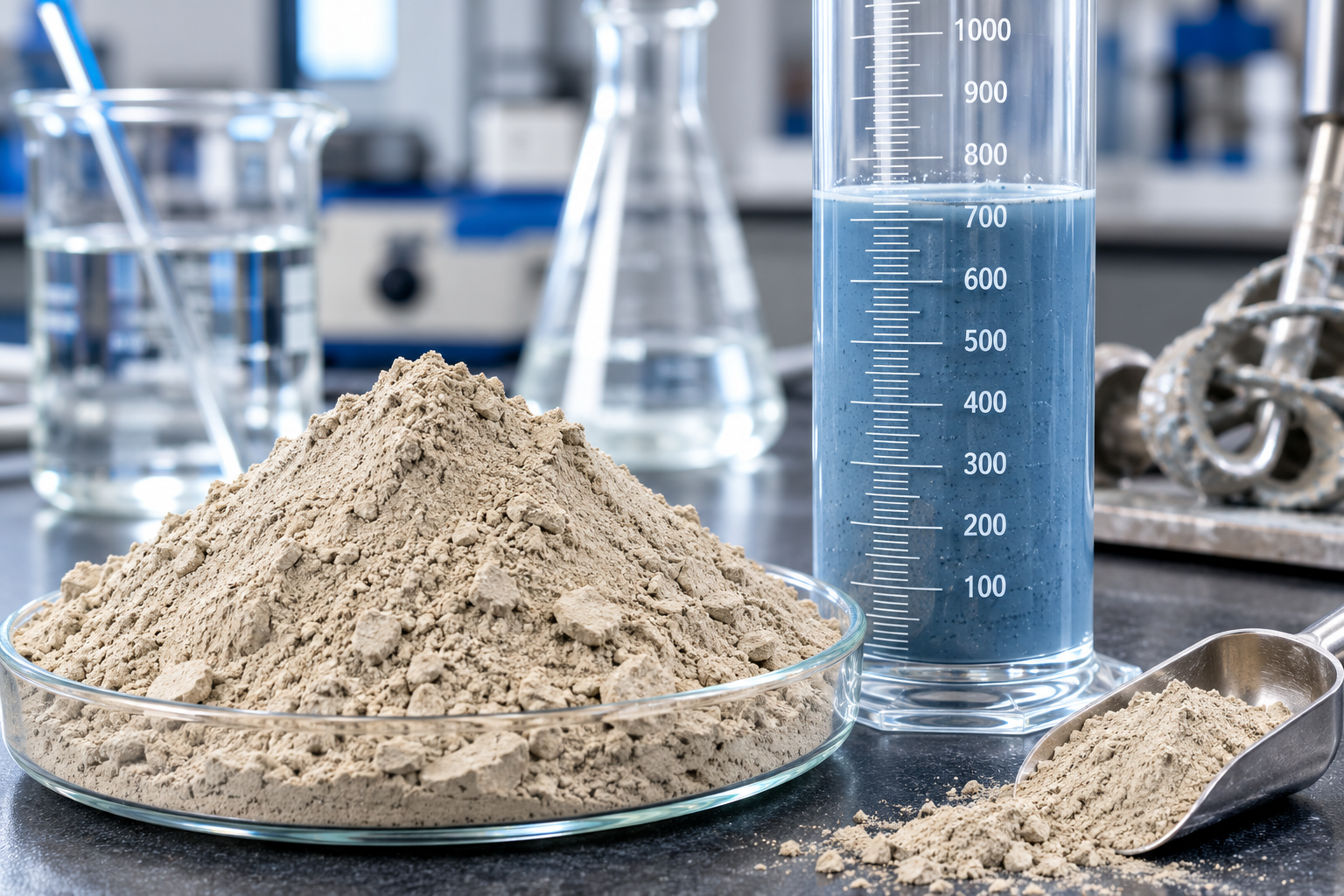
When you are out on a drilling site, the last thing you want to worry about is the failure of your drilling fluid. It is the lifeblood of your operation. It cools the bit, carries cuttings to the surface, and keeps the wellbore stable. At the heart of most water-based drilling fluids is bentonite. However, not all bentonite is created equal. If you have been looking at product sheets, you have likely run into two acronyms that seem to dominate the conversation: API and OCMA.
Understanding the difference between API-grade and OCMA-grade bentonite isn't just about reading a label. It is about matching the right material to your specific drilling environment. Choosing incorrectly can lead to poor wellbore stability, lost circulation, or wasted time. As someone working in the field, you need to know how these standards influence your daily results.
API stands for the American Petroleum Institute. When you buy bentonite marked as API grade, you are buying a product that meets a specific set of international benchmarks for the oil and gas industry. These standards are rigorous because the stakes in oil drilling are incredibly high.
API 13A is the go-to standard here. It dictates how the bentonite must behave when mixed into a mud system. It covers everything from how much water the clay can absorb to how well it manages fluid loss. If you are drilling a deep oil well, you almost certainly need API-grade material. It provides a level of predictability that is essential when you are thousands of feet underground.
OCMA stands for the Oil Companies Materials Association. While API is an American standard, the OCMA standard was historically developed to provide a slightly different set of requirements, often focused on performance in specific types of drilling muds. In many parts of the world, you will see these terms used interchangeably or see products that meet both.
OCMA-grade bentonite is engineered to provide excellent yield and viscosity control. Like API grade, it is a high-quality sodium bentonite. It is designed to create a thin, impermeable filter cake against the walls of the borehole. This is the secret to preventing the surrounding formation from collapsing into the hole you are drilling.
To the naked eye, a bag of API-grade bentonite and a bag of OCMA-grade bentonite look identical. They are both fine, light-colored powders. But under the microscope, they behave differently in a slurry.
Sodium bentonite is famous for its ability to swell. When it comes into contact with water, it can expand to many times its dry volume. Both API and OCMA grades use this property. However, the chemistry of the clay determines how fast and how much it swells. API-grade products are often optimized for high-temperature and high-pressure environments where the clay structure must remain stable even when things get hot.
In a mud system, viscosity is everything. You need your fluid to be thick enough to carry heavy rock cuttings up to the surface, but thin enough to pump through the drill string. Both grades provide excellent rheological properties, but manufacturers like Axewelledge fine-tune their processing to ensure that regardless of the grade, the material hits these specific targets every single time.
One of the biggest risks in drilling is fluid loss. If your mud leaks too much water into the formation, the wellbore can weaken. Both API and OCMA specifications have strict limits on how much filtrate the mud can lose. API-grade bentonite is typically tested for very low fluid loss, making it safer for challenging geological conditions.
While knowing the difference between API and OCMA is helpful, the quality of the raw ore is even more important. At Axewelledge, we have seen over 15 years of operations that the processing technique matters as much as the classification. You can have a material that technically meets a standard but is full of impurities that will wear down your pump and drilling equipment.
When we talk about high-quality sodium bentonite, we are talking about purity. High-purity bentonite has lower levels of grit and sand. If your bentonite is 'dirty,' you are basically pumping sandpaper through your system. Over time, that adds up to massive maintenance costs and downtime. Whether you are choosing API or OCMA, always check the technical data sheet for grit content and sand percentage. It is a detail that separates a smooth drilling operation from a maintenance nightmare.
So, how do you decide which one to order for your next project? Usually, the answer is found in the drilling program provided by your project engineer.
It is also worth noting that some suppliers offer products that are 'API-OCMA' compliant. These are often the best of both worlds, as they are engineered to meet the strictest requirements of both standards, giving you versatility if your drilling project requirements shift mid-stream.
There is no point in having the best API-grade bentonite in the world if it is sitting in a warehouse halfway across the globe when your rig is halted. Drilling operations are fast-paced. You need a partner who understands that a day of downtime costs a fortune.
Reliability is the hidden component of quality. When we manage our supply chain, we look at the process from the mine all the way to the drill site. This involves having strategically located processing facilities that can ramp up production quickly. For example, our presence in the Middle East and Southeast Asia ensures that we are not just shipping a product; we are delivering a solution that integrates into your site operations without a hitch.
Drilling is an industrial process, but that does not mean it has to be ecologically reckless. Natural sodium bentonite is a mineral. It is inherently more environmentally friendly than many synthetic drilling additives. Because it is a natural clay, it is generally easier to manage during the waste disposal phase compared to synthetic polymers.
When choosing your supplier, look for companies that emphasize sustainable mining practices. You want a partner who manages their reserves responsibly. After all, you are using a finite resource. A commitment to mining and processing efficiency isn't just good for the planet; it is good for your bottom line, as it leads to a more consistent product quality.
Even with the best materials, things can go wrong. If you are struggling with your mud system, here is how to troubleshoot:
Taking care of your fluid system is about constant monitoring. Don't wait until you have a stuck pipe to check your mud quality. Regular testing of the mud density and viscosity will give you early warning signs that something is changing in the borehole.
One thing we have learned over the last decade and a half is that the best results come from collaboration. We aren't just selling bags of minerals; we are working with drilling companies to solve complex challenges. Whether it is adjusting the rheology for a specific depth or ensuring a rapid supply for a remote site, the 'value' of the bentonite is really in the service that backs it up.
If you are ever unsure which grade to choose, reach out to your technical representative. Give them the details of your project: the type of formation, the depth, and your equipment limitations. A good supplier will be able to guide you toward the right product, even if it is not the most expensive one on the shelf.
As drilling technology advances, so do the expectations for drilling fluids. We are seeing a shift toward more specialized, high-performance bentonite blends that can withstand extreme geothermal temperatures. We are also seeing a greater focus on automation in mud mixing.
This means that the quality consistency of the bentonite becomes even more critical. If you are moving toward automated fluid mixing, a 'clumpy' or uneven bentonite will cause more problems than it did in the old, manual-mixing days. Uniformity in particle size and rapid hydration rates will be the key features that define the 'next generation' of drilling mud.
At the end of the day, the choice between API and OCMA bentonite is about managing risk. Both are excellent products when they are sourced correctly and used as intended. API offers a standardized, internationally recognized benchmark that is essential for the oil and gas sector. OCMA provides a specialized framework that serves as a cornerstone for many drilling applications worldwide.
Remember, your drilling fluid is a complex chemical system. Treat it with the respect it deserves, source your materials from a supplier who understands the mining and processing side of the equation, and never compromise on the purity of the material you pump downhole.
Before we wrap up, do you have a specific drilling environment in mind, such as sandy soil or high-temperature rock, for which you need to select the most appropriate bentonite grade?













Have questions about our products? We're here to help!