Axewelledge, a leading exporter from India, specializes in high-quality Bentonite. With a commitment to excellence, we supply premium Bentonite to the Middle East and Southeast Asia markets.


North Angle Complex, 304,
150 Feet Ring Rd, Opposite Ambedkar Nagar BRTS Stop,
Madhav Park, Punit Nagar,
Mavdi, Rajkot, Gujarat 360004
© Axewelledge 2026, All Rights Reserved.
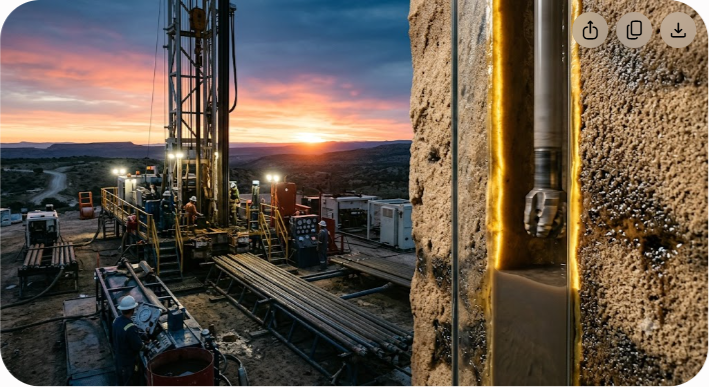
When a drill bit breaks ground, you immediately start fighting three continuous forces: hydrostatic pressure imbalances, dynamic mechanical friction, and the relentless tendency of uncased formations to slough into the hole. A single fluid loss event or washed-out zone can cost tens of thousands of dollars in non-productive time, compromised casing strings, or stuck drill pipe.
The secret to preventing these costly failures lies in the drilling fluid's base material. High-swelling sodium bentonite clay acts as the primary mechanical and hydraulic anchor for water-based drilling muds. When processed correctly, a single ton of high-grade sodium bentonite creates tens of thousands of gallons of shear-thinning fluid capable of sealing porous sands, suspending heavy cuttings, and exerting continuous structural pressure against weak formations.
Here is how high-swelling bentonite works, why its molecular structure matters so much under downhole stress, and how to deploy it to maximize rate of penetration while keeping boreholes completely stable.
Not all clay minerals perform the same downhole. While calcium bentonite expands modestly (typically 2 to 4 times its dry volume), high-swelling sodium bentonite can expand between 15 and 20 times its original dry volume when exposed to fresh water.
At the microscopic level, sodium bentonite consists primarily of montmorillonite, a 2:1 layer-lattice aluminosilicate mineral. Each individual sheet consists of an octahedral alumina layer sandwiched between two tetrahedral silica layers. In sodium-dominant bentonite, hydrated sodium ions (Na+) occupy the interlayer spaces between these sheets.
[ Tetrahedral Silica Layer ] [ Octahedral Alumina Layer ] <-- Montmorillonite Sheet [ Tetrahedral Silica Layer ]
[ Na+ hydrated ions & water ] <-- Interlayer space (high swelling)
[ Tetrahedral Silica Layer ] [ Octahedral Alumina Layer ] [ Tetrahedral Silica Layer ]
Because sodium ions possess a large hydration radius and a relatively weak electrostatic attraction to the clay sheets, water molecules readily wedge themselves between the layers. This process breaks the clay mass into tiny, negatively charged platelets measuring less than two micrometers across.
When mixed into water, these dispersed platelets form a complex electro-chemical network:
This dynamic balance between low running viscosity and rapid static gelation is what keeps drill cuttings suspended the moment circulation stops.
+-----------------------------------+
| Primary Functions of Bentonite | +-----------------------------------+ | +---------------------------+---------------------------+
| | | v v v +---------------+ +---------------+ +---------------+
| Borehole | | Cuttings | | Filtration |
| Wall Sealing | | Suspension | | Loss Control |
| (Filter Cake) | | (Thixotropy) | | (Hydraulic) | +---------------+ +---------------+ +---------------+
As drilling fluid flows past porous formations like gravel beds or poorly consolidated sands, water tries to escape from the mud column into the surrounding rock. High-swelling bentonite stops this liquid loss by forming an impermeable filter cake along the borehole wall.
Because the sodium montmorillonite platelets are exceptionally small and flexible, fluid pressure flattens them against the formation face. They stack like fine shingles, creating an ultra-thin barrier—often less than 2 millimeters thick—with permeability measured in nano-darcies. This microscopic seal keeps water in the borehole and prevents sensitive shales from hydrating, swelling, or sloughing off.
Carrying rock chips out of a 5,000-foot lateral hole requires precise fluid mechanics. High-swelling bentonite provides both plastic viscosity (PV) and yield point (YP):
Rotary friction between the drill string and the formation generates extreme thermal energy. High-swelling bentonite forms a slick slurry that coats the drill pipe, lowering the coefficient of friction downhole. This mechanical lubrication reduces torque, prevents differential sticking in permeable zones, and extends bit life.
Selecting the wrong bentonite grade or relying solely on synthetic polymers can undermine hole stability. The comparison table below highlights how high-swelling sodium bentonite stacks up against common alternatives.
| Property / Fluid System | High-Swelling Sodium Bentonite | Low-Swelling Calcium Bentonite | Polymer-Only Systems (PAC/PHPA) |
|---|---|---|---|
| Free Swelling Volume | 15–20 mL/g | 2–5 mL/g | N/A (Soluble polymers) |
| API Yield (BBL/Ton) | 90–120+ bbl | 30–50 bbl | N/A |
| Filter Cake Quality | Ultra-thin, pliable, tough | Thick, brittle, leaky | Minimal mechanical structure |
| Thixotropic Gel Strength | Outstanding, rapid return | Poor | Moderate to weak |
| Thermal Stability | Stable up to 400°F (204°C) | Moderate | Degrades above 250–300°F |
| Formation Sealing Mechanism | Physical platelet stacking | Weak particulate bridge | Chemical viscosity extension |
| Cost-Efficiency | Excellent base system | Poor efficiency | High unit cost |
While polymers offer fast viscosity in clean water, they lack the solid physical structure required to build a durable, low-permeability filter cake in troublesome formations. Pairing high-swelling sodium bentonite with low-dose polymer extenders often delivers the ideal balance between low fluid loss and manageable solids content.
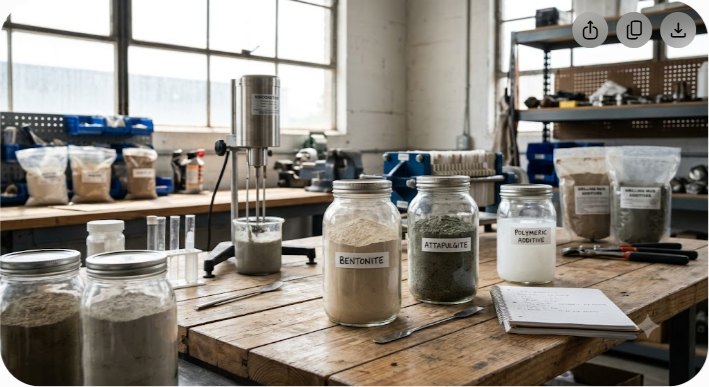
Achieving maximum well efficiency requires correct batch mixing, hydration timing, and chemical treatment in the pits. Here is the field-tested protocol for preparing and maintaining high-swelling bentonite muds.
+-----------------------+ | 1. Pre-Treat Water | -> Adjust pH to 8.5-9.5 & soften water +-----------------------+ | v +-----------------------+ | 2. Mix Bentonite | -> Add slowly through high-shear hopper +-----------------------+ | v +-----------------------+ | 3. Allow Hydration | -> Yield 30-45 mins before pumping +-----------------------+ | v +-----------------------+ | 4. Monitor & Maintain | -> Test Marsh funnel viscosity & fluid loss +-----------------------+
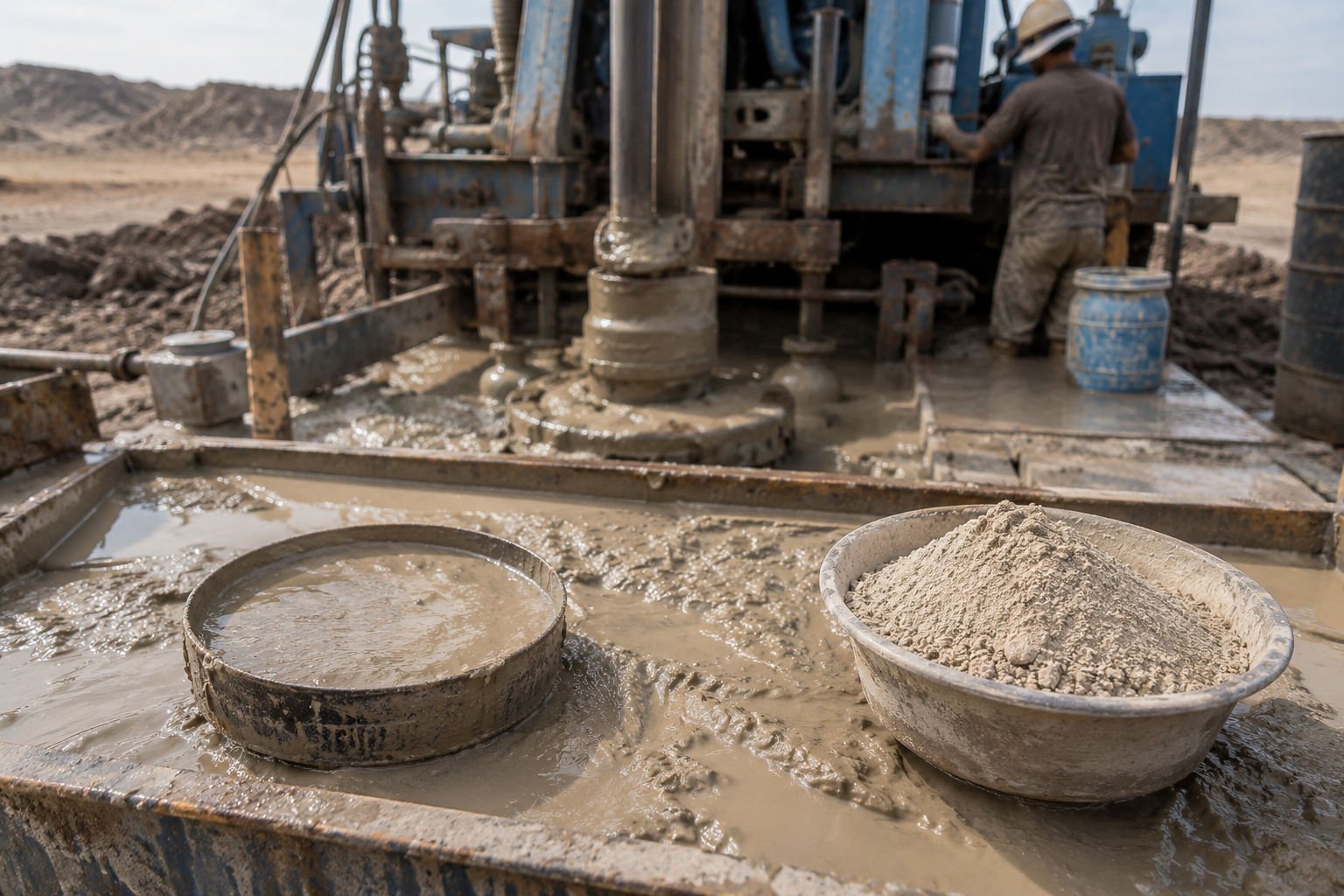
Never dump raw bentonite directly into hard or acidic make-up water. High levels of calcium (Ca2+) or magnesium (Mg2+) ions will react with the sodium bentonite, causing it to flocculate into clumpy, low-yield chunks.
Introduce dry bentonite slowly through a Venturi hopper into the high-velocity stream. Avoid dumping material in large batches into the pit, as unhydrated clay aggregates will settle out as wasted grit.
Give the fluid time to hydrate fully. High-swelling bentonite requires at least 30 to 45 minutes of active recirculation to reach full swell potential. Pumping unhydrated bentonite downhole wastes money because the swelling occurs in the formation matrix rather than inside the mud pit where it belongs.
Continuously monitor rheology on the shaker deck and at the fluid pits:
Even with top-grade raw materials, field conditions can degrade mud performance. Here is how to diagnose and correct common bentonite drilling problems.
Drilling performance depends heavily on the mineral purity of your raw clay. Unprocessed clays often carry high amounts of non-swelling quartz, feldspar, and gypsum solids that abrade pump liners and weaken gel strength.
As one of the world's largest mine owners and refined mineral suppliers, Axewelledge provides high-yield, API-grade sodium bentonite processed from top-tier reserves. Axewelledge processes high-purity sodium bentonite engineered specifically for challenging well drilling, civil engineering, and trenchless horizontal directional drilling (HDD) applications. By ensuring high swelling volume, controlled particle size distribution, and low grit content, Axewelledge helps fluid engineers maintain consistent downhole viscosity and complete structural stability from surface casing to total depth.













Have questions about our products? We're here to help!