Axewelledge, a leading exporter from India, specializes in high-quality Bentonite. With a commitment to excellence, we supply premium Bentonite to the Middle East and Southeast Asia markets.


North Angle Complex, 304,
150 Feet Ring Rd, Opposite Ambedkar Nagar BRTS Stop,
Madhav Park, Punit Nagar,
Mavdi, Rajkot, Gujarat 360004
© Axewelledge 2026, All Rights Reserved.
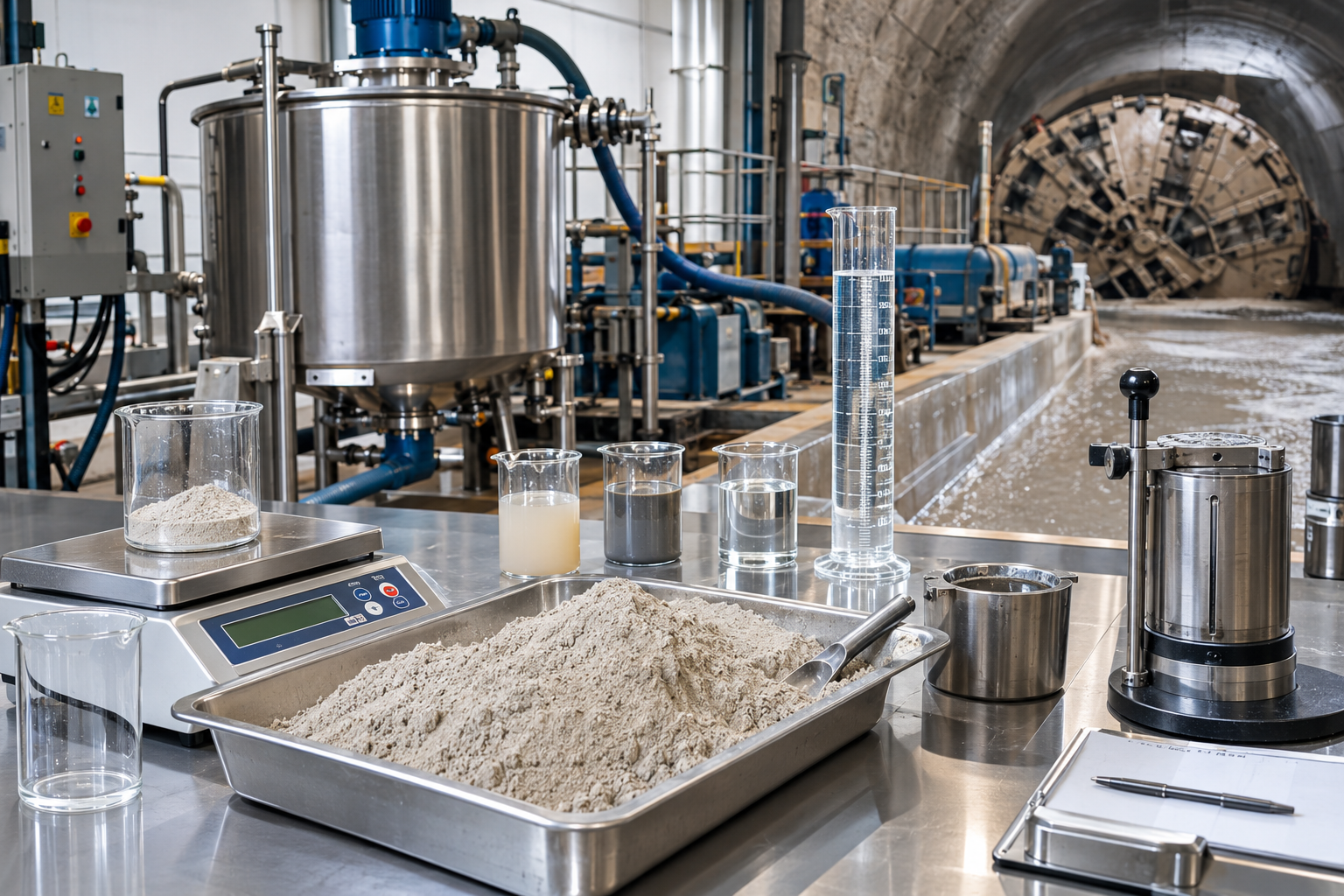
Bentonite dosage for tunneling slurry is calculated by multiplying the selected dry-bentonite concentration by the volume used as the calculation basis. If the target is 40 kg/m3 and the plant prepares 100 m3 of make-up water, the starting requirement is 4,000 kg of dry bentonite.
The calculation itself is simple. Selecting the right dosage is not.
A tunneling slurry has to work with the actual water, ground conditions, excavation system, and solids loading. The right concentration is therefore a design result established through testing, not a universal number that can be copied from one tunnel to another.
This guide explains how to calculate bentonite dosage, choose a sensible laboratory trial range, convert between common concentration units, account for hydration and water quality, and use field measurements to confirm that the selected mix is doing its job.
Bentonite dosage is the quantity of dry bentonite added to water to produce a slurry with the properties required for the excavation process. Depending on the tunneling method, those properties can include filtration control, suspension of excavated solids, face support, lubrication, pumpability, and suitable rheological behavior.
The dosage can be expressed in several ways:
These units aren't interchangeable unless the calculation basis is clear. A statement such as "use 4% bentonite" is incomplete if it doesn't say whether the percentage refers to total slurry mass, water mass, or another basis.
For many field mixing operations, kg/m3 of make-up water is a practical way to specify the recipe because the plant measures water before dispersing the dry bentonite. The key is consistency: the laboratory and field calculations must use the same basis.
A slurry is part of a larger excavation system. Its performance depends on the interaction between bentonite, water, ground, excavated solids, pumps, separation equipment, and operating conditions.
The same bentonite concentration can behave differently in clean freshwater and hard or saline water. Water containing calcium, magnesium, or dissolved salts can affect hydration and dispersion. Recycled process water can also behave differently from the water used during initial product qualification.
Ground conditions matter just as much. Coarse sand, silt, clay, and mixed formations place different demands on a slurry. Reactive clay can change viscosity, while fine solids generated during excavation can accumulate in the circulating fluid and alter density, rheology, and filtration without any change to the original bentonite dosage.
That is why dosage should be treated as a trial-and-adjust parameter rather than a fixed recipe.
A practical design sequence is:
The last step is easy to overlook. Fresh laboratory slurry is not the same fluid as slurry that has circulated through a tunnel, picked up formation fines, and passed through separation and treatment equipment.
When the target concentration is expressed as kilograms of dry bentonite per cubic metre of water or slurry, the basic calculation is:
Suppose laboratory testing supports a target of 35 kg/m3 and the mixing plant needs to prepare 50 m3 of water.
The batch therefore requires approximately 1.75 metric tonnes of dry bentonite, before any separately defined allowance for handling losses, residual material, or batching inefficiency.
If the selected concentration is 45 kg/m3 and the plant prepares 250 m3:
That is 11.25 metric tonnes of dry bentonite.
The arithmetic is straightforward. The important part is making sure the concentration and volume use the same basis. A dosage specified per cubic metre of water should not be multiplied by a finished-slurry volume without first confirming that the specification allows it.
This is one of the most common sources of dosing errors.
If a specification says 40 kg/m3 of make-up water, then 40 kg of dry bentonite is assigned to each cubic metre of water used for mixing.
If the specification says 40 kg/m3 of finished slurry, the calculation needs more care. Adding dry bentonite to 1 m3 of water produces a final mixture whose mass and volume are not identical to the original water quantity. The supplier or laboratory should therefore define exactly how the concentration was established.
For field operations, using make-up water as the batching reference is often convenient because the water volume is measured before the powder enters the mixing system. There is nothing inherently wrong with using a slurry-volume basis, provided it is defined and used consistently.
Before ordering large quantities of bentonite, write the calculation basis directly into the mix sheet. For example:
That single line removes ambiguity from the batching calculation and makes the laboratory recipe easier to reproduce at the plant.
Laboratory reports sometimes specify slurry concentration as a percentage by mass. Before converting that figure to kg/m3, determine exactly what the percentage represents.
If the concentration is 4% of total slurry mass, the bentonite-to-water relationship can be calculated as:
For a 4% total-slurry concentration:
For 1,000 kg of water:
Because one cubic metre of fresh water has a mass close to 1,000 kg, this gives an estimated dosage of about 41.7 kg per m3 of water, subject to the actual water density and temperature.
But if the laboratory means 4 kg of bentonite for every 100 kg of water, the calculation is different:

The difference is only 1.7 kg per 1,000 kg of water in this example, but the discrepancy becomes material when thousands of cubic metres are processed.
Always record the concentration basis before converting a percentage into a field dosage.
A sound trial program tests several concentrations instead of committing the entire operation to one assumed number.
For example, an initial laboratory screening series might include:
This is a screening range, not a universal tunneling specification. The appropriate range depends on the selected bentonite, water quality, ground conditions, tunneling method, and project requirements.
The objective isn't to produce the thickest slurry. Excessive viscosity can increase pumping pressure losses, make solids separation more difficult, and raise material consumption without improving the excavation process.
Instead, look for the lowest practical concentration that consistently meets the required performance with enough operating margin for normal changes in the system.
That distinction matters over a long tunnel drive. Small differences in concentration can translate into substantial differences in material consumption.
Dosage should be connected to measurable slurry behavior. The exact test program depends on the tunneling method and project specification, but several measurements are commonly useful.
A Marsh funnel provides a quick indication of flow behavior and is useful for routine field trending when the test method and temperature are controlled.
It isn't a complete rheological measurement. Two slurries can have similar funnel times and still behave differently under shear, so funnel viscosity should be used alongside other relevant measurements where the application requires them.
For projects where pressure, transport, suspension, or pumping behavior is critical, rotational rheology can provide more information than a single funnel reading.
Depending on the project, testing may examine apparent viscosity, plastic viscosity, yield stress, or parameters from a selected rheological model.
The target should come from the tunneling method, equipment, and project acceptance criteria. A generic rheology value copied from another application may not be appropriate.
Bentonite is often selected because it can form a relatively low-permeability filter cake and help limit fluid loss into permeable ground.
A slurry that has acceptable viscosity but poor filtration control may still be unsuitable. Increasing the bentonite concentration isn't automatically the answer. Poor filtration can also result from unsuitable bentonite, inadequate hydration, unfavorable water chemistry, or excessive contamination by excavated solids.
Density provides useful information about the solids condition of the slurry.
Freshly mixed slurry may have a relatively controlled solids concentration. As excavation continues, formation material enters the system. Without effective solids management, density and rheology can move away from the fresh-slurry design.
The exact measurement depends on the project, but monitoring excavated solids is essential in slurry-based tunneling.
A slurry can be correctly dosed at the mixing plant and still become unsuitable after circulating through the excavation. Dosage control therefore needs to be considered alongside slurry treatment, separation, and disposal procedures.
Use the following workflow to turn a laboratory target into a practical field batch.
Start with the excavation requirements rather than the powder.
Identify the required filtration behavior, suspension capacity, face-support characteristics, pumpability, lubrication requirements, and any project-specific limits for rheology or density.
These requirements establish what the bentonite formulation needs to accomplish.
Determine whether the water is fresh, hard, saline, recycled, or otherwise chemically different from the water used during product qualification.
Water chemistry can affect bentonite hydration and dispersion. If the plant uses recycled water, test that water rather than assuming it will behave like fresh water.
Prepare several concentrations using the same mixing energy, mixing sequence, water source, and hydration procedure that will be used in the field as closely as practical.
An initial screening series might use 20, 30, 40, 50, and 60 kg/m3, but the actual range should be selected for the project and bentonite grade.
Record the properties that matter to the tunnel. Don't judge the formulation by appearance alone.
Compare viscosity, filtration, density, solids behavior, and other project-specific parameters with the acceptance criteria.
Choose a concentration that meets the requirements without adding unnecessary solids or cost.
If 40 kg/m3 reliably meets the filtration requirement but 30 kg/m3 does not, 40 kg/m3 becomes a logical operating candidate. If both concentrations perform adequately, additional testing can determine whether the lower concentration provides enough margin for normal field variation.
Once the target concentration has been established, calculate the batch requirement with:
For large batches, divide the result by 1,000 to convert kilograms to metric tonnes.
If the project uses an allowance for transfer losses, dust collection, residual material, or batching inefficiency, show that allowance separately on the material plan.
Keeping the engineering dosage and procurement allowance separate makes material consumption easier to audit and prevents an operational allowance from being mistaken for a change in slurry concentration.
Suppose laboratory testing identifies 45 kg/m3 as the selected concentration based on make-up water.
The plant needs 500 m3 of water for the batch.
Calculation:
If the project has a separately established 3% material-handling allowance:
That is approximately 23.18 metric tonnes of planned dry material.
The distinction matters. The engineering dosage remains 45 kg/m3. The additional 3% is a procurement or handling allowance, not an increase in the designed slurry concentration.
Suppose a laboratory report specifies 4% bentonite by total slurry mass and you want to estimate the dry bentonite required for 10,000 kg of water.
Use:

The approximate dosage is therefore 41.7 kg per 1,000 kg of water.
If the laboratory instead means 4% of water mass, the calculation becomes:
The difference is 16.7 kg on a 10,000 kg water basis. That example shows why a percentage without a stated basis isn't enough for reliable field batching.
Bentonite doesn't reach its final performance as soon as the powder contacts water.
Hydration behavior depends on mineralogy, particle size, water chemistry, mixing energy, temperature, and the characteristics of the particular bentonite grade. The required hydration period should therefore be established during product and formulation testing rather than assumed.
This is also why an operator can mistake a hydration problem for a dosage problem.
For example, if a slurry is tested immediately after mixing and appears too thin, adding more powder may seem like the obvious response. If the original material simply hasn't hydrated adequately, however, that extra bentonite can leave the system over-concentrated after hydration is complete.
Use a consistent hydration procedure and test the slurry after the specified hydration period before changing the dosage.
The mathematical dosage can stay the same while the slurry's actual performance changes.
Water containing elevated levels of calcium or magnesium can interfere with the hydration and dispersion behavior of sodium bentonite. Salinity can also affect swelling and rheological response.
This matters when:
If the water chemistry changes, don't automatically increase the bentonite dose. First determine whether the existing product and formulation remain suitable under the new conditions.
This distinction is fundamental to slurry control.
Fresh slurry is the fluid prepared from water and bentonite. Circulating slurry has already passed through the excavation and can contain clay, silt, sand, and other formation material.
The two fluids can have very different properties.
A practical control plan should therefore distinguish between:
The fresh-slurry calculation tells you how much bentonite to add during preparation. It doesn't, by itself, determine how much additional bentonite should be added to the circulating system after solids have accumulated.
That decision requires process monitoring and a defined slurry-treatment strategy.
These two terms describe different things.
Bentonite concentration tells you how much bentonite has been intentionally added. Total solids concentration includes bentonite as well as formation solids and any other suspended material in the slurry.
Imagine a fresh slurry designed at 40 kg/m3. After several hours of excavation, the circulating slurry may contain a substantial quantity of additional mineral solids. Adding more bentonite without first controlling those excavated solids can push density and rheology higher than intended.
Bentonite dosage is therefore a formulation variable, while total solids is a condition of the circulating system.
Keeping those concepts separate makes troubleshooting much easier.
A recipe that worked in clean sand with one bentonite grade and one water source may perform differently in mixed ground with different water chemistry.
Published dosage ranges can provide a starting point, but the actual formulation should be validated under project conditions.
40 kg/m3 and 4% may appear similar, but they aren't automatically the same concentration.
Always state the denominator and whether the percentage is based on water mass or total slurry mass.
Poorly hydrated bentonite can make a slurry appear under-dosed. Increasing the powder before checking hydration can create excessive concentration once the material fully develops its properties.
Viscosity is important, but it doesn't tell the whole story. Filtration, density, solids loading, and other project-specific properties can be equally important to slurry performance.
If the material is supplied with measurable moisture, the as-supplied weight isn't identical to the dry-bentonite mass.
For precise dosing, define whether the specification is based on dry solids or as-supplied product weight, and make sure the field weighing procedure follows that definition.
Fresh slurry can meet every target at the mixer while the active circulating system moves outside those limits during excavation.
Monitor the slurry after it has done actual work, not only when it leaves the mixing tank.
More bentonite can increase viscosity, pumping demand, separation difficulty, and material consumption. The target should be based on demonstrated performance rather than the assumption that a thicker slurry is always better.
A practical mix sheet can contain the following fields:
| Parameter | Example |
|---|---|
| Water volume | 100 m3 |
| Target bentonite dosage | 40 kg/m3 |
| Dry bentonite required | 4,000 kg |
| Planned handling allowance | 3% |
| Planned material quantity | 4,120 kg |
| Hydration time | Project-defined |
| Fresh slurry checks | Viscosity, density, filtration |
| Circulating slurry checks | Density, solids, rheology, filtration |
The numbers above demonstrate the calculation method; they aren't a universal tunnel recipe.
For an actual project, acceptance criteria should be tied to the excavation system, ground conditions, water chemistry, equipment, separation process, and project specification.
Increase the dosage only after identifying the reason the slurry is outside its required performance range.
A higher concentration may be justified when testing shows inadequate filtration control, insufficient suspension, or another defined performance shortfall.
Before adding more bentonite, check:
If one of these factors has changed, increasing dosage may not solve the underlying problem.
A useful way to approach dosage is to start with a laboratory range, identify the lowest concentration that meets the required performance, and then confirm that concentration under field conditions.
For example, suppose a trial program produces the following results:
| Dosage | Filtration | Rheology | Interpretation |
|---|---|---|---|
| 20 kg/m3 | Fails target | Low | Insufficient |
| 30 kg/m3 | Borderline | Acceptable | Limited operating margin |
| 40 kg/m3 | Meets target | Acceptable | Candidate operating point |
| 50 kg/m3 | Meets target | High | May increase pumping burden |
| 60 kg/m3 | Meets target | Very high | Unnecessary unless another requirement exists |
The actual selection must follow the project's acceptance criteria and operating conditions. The point of the trial is to replace a guessed dosage with a concentration supported by measured performance.
For a tunneling project, the bentonite supplier should be involved in technical qualification rather than treated simply as a source of bulk material.
Before approving a product, request consistent product specifications, relevant quality information, application guidance, and samples for laboratory testing with the project's actual water.
Axewelledge supplies sodium bentonite for industrial applications and can support the material-selection process around properties relevant to the intended use. For tunneling slurry, the useful next step is to evaluate the proposed grade against the project's water, dosage range, mixing procedure, and performance requirements rather than selecting a product from a generic dosage figure.
The core formula is simple:
The harder part is defining the target correctly.
A reliable tunneling slurry calculation starts with water and ground characterization, moves through concentration trials, and ends with field verification. A screening range such as 20 to 60 kg/m3 can be useful for laboratory work, but it shouldn't replace project-specific testing.
The goal isn't to use the most bentonite possible. It's to develop a formulation that consistently provides the required filtration, rheology, suspension, pumpability, and face-support performance while keeping material consumption under control.
If you're qualifying bentonite for a tunneling slurry, Axewelledge can help you evaluate a suitable sodium bentonite grade and structure material trials around your water quality, dosage range, and application requirements.













Have questions about our products? We're here to help!