Axewelledge, a leading exporter from India, specializes in high-quality Bentonite. With a commitment to excellence, we supply premium Bentonite to the Middle East and Southeast Asia markets.


North Angle Complex, 304,
150 Feet Ring Rd, Opposite Ambedkar Nagar BRTS Stop,
Madhav Park, Punit Nagar,
Mavdi, Rajkot, Gujarat 360004
© Axewelledge 2026, All Rights Reserved.
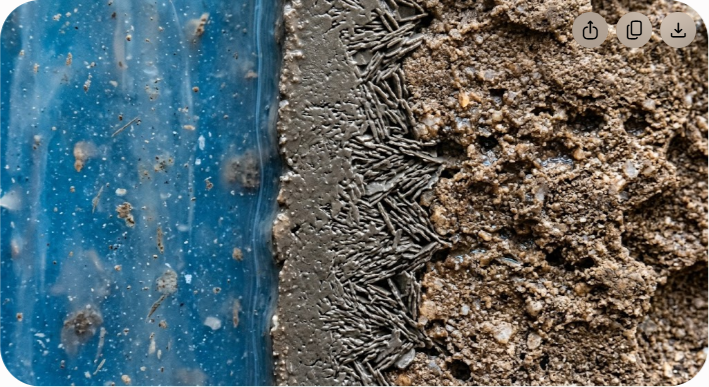
Bentonite is one of the main solids used to control filtration in many water-based drilling fluids. When a suitable sodium bentonite is properly hydrated and dispersed, its fine clay platelets help build a thin, low-permeability filter cake on the wellbore wall. That cake limits filtrate invasion while also contributing to suspension, viscosity, and overall mud performance.
The important point is that bentonite doesn't simply "block" the formation. Filtration control is a dynamic process. Pressure drives the liquid phase of the mud toward permeable rock, solids bridge and deposit at the formation surface, and hydrated clay particles pack into the developing cake. Mud chemistry, particle-size distribution, shear, temperature, salinity, hardness, and other additives all influence the result.
This guide explains how bentonite improves drilling fluid filtration control, how its swelling and dispersion behavior contributes to filter cake formation, how engineers measure filtration, and what to check when fluid-loss results move in the wrong direction. It also covers common mistakes, bentonite-polymer interactions, and practical considerations when selecting a drilling-grade bentonite.
Drilling fluid filtration is the movement of the liquid phase of drilling mud from the wellbore into a permeable formation under a pressure differential. The pressure inside a properly balanced well is generally maintained above formation pressure to help prevent unwanted influx of formation fluids. That pressure difference also creates a driving force for filtrate to enter permeable rock.
Filtration control is the practice of limiting that invasion to an acceptable level. The objective isn't to eliminate every drop of filtrate. Instead, the mud should quickly establish a competent filter cake that restricts further fluid movement without becoming excessively thick or damaging the wellbore.
A well-designed filter cake is typically thin, relatively impermeable, and mechanically stable under the conditions in which the well is being drilled. Its properties matter because an unnecessarily thick or weak cake can create its own problems, including increased torque and drag and a greater risk of differential sticking across permeable intervals.
Poor filtration control can affect several parts of a drilling operation at once:
These effects don't come from fluid loss alone. They result from the interaction between filtration, formation properties, mud chemistry, solids content, pressure, temperature, and drilling practices. Bentonite is valuable because it helps address the filtration side of that system while also contributing useful rheological properties.
Bentonite is a naturally occurring clay material in which smectite minerals, particularly montmorillonite, provide much of the performance associated with drilling-grade bentonite. Montmorillonite has a layered crystal structure and a high surface area, giving it an unusually strong interaction with water.
At the microscopic level, clay platelets carry a net negative charge on their broad faces as a result of substitutions within the crystal lattice. Exchangeable cations balance that charge. The type and concentration of those cations strongly influence hydration, swelling, dispersion, and rheological behavior.
Sodium-dominant bentonite generally hydrates and disperses more effectively in fresh water than calcium-dominant bentonite. That makes suitable sodium bentonite particularly useful in conventional freshwater water-based drilling fluids.
The difference isn't simply that sodium bentonite "swells more." The way the clay hydrates and disperses determines how many fine particles become available to build the filter cake. A well-dispersed clay system can provide a large population of small platelets that pack into a relatively tight structure at the formation face.
The distinction is useful when evaluating clay performance:
| Property | Sodium-dominant bentonite | Calcium-dominant bentonite |
|---|---|---|
| Hydration in fresh water | Generally strong | Generally lower |
| Swelling tendency | Higher | Lower |
| Dispersion | Typically greater | Typically more limited |
| Freshwater filtration control | Well suited | Usually less effective without treatment or formulation changes |
| Sensitivity to water chemistry | Significant | Different response because calcium is already the dominant exchangeable cation |
This doesn't mean calcium bentonite has no industrial value. Different bentonites are selected for different applications. For conventional freshwater drilling mud, however, a high-quality sodium bentonite is commonly preferred when strong hydration, suspension, and filtration-control performance are required.
Dry bentonite doesn't reach its full performance potential the moment it enters the mud system. The clay needs time, water, and adequate mixing to hydrate and disperse. The exact behavior depends on the clay's mineralogy, particle size, water chemistry, concentration, and shear history.
When sodium bentonite contacts suitable freshwater, water molecules associate with the exchangeable sodium ions and clay surfaces. Hydration begins around the clay layers, increasing the distance between them.
At this stage, the clay particles are taking up water but aren't necessarily fully dispersed. Adding more clay or moving the mud through a mixing system doesn't automatically guarantee complete hydration. Contact time matters.
As hydration progresses, differences in ion concentration between the spaces associated with the clay layers and the surrounding water encourage additional water uptake. This osmotic component can separate the clay layers much more strongly than initial surface hydration alone.
The result is a much larger, hydrated clay structure with greater potential to break apart into individual platelets. The amount of swelling depends heavily on the clay's exchangeable cations and the chemistry of the surrounding water.
Hydration and shear work together. Mechanical energy from mixing equipment, mud pumps, and circulation helps separate hydrated clay aggregates into smaller, dispersed platelets.
Those platelets are extremely fine and have a large surface area relative to their mass. Once dispersed, they can remain suspended in the water phase and become available for filtration-control and rheological functions.
This is why simply dumping dry bentonite into a poorly mixed system can produce disappointing results. A clay that hasn't hydrated or dispersed properly isn't providing the same population of fine particles as a fully conditioned mud system.
The key filtration mechanism is straightforward: pressure drives fluid toward the formation, while the solids in the mud progressively restrict the pathways through which that fluid can escape.
Bentonite contributes large numbers of fine, plate-shaped particles to this process. Those particles become concentrated near the filtration surface and help reduce the permeability of the developing cake.
When fresh permeable rock is first exposed, there may be little or no established filter cake at that location. The initial filtrate volume can therefore be relatively high.
This early phase is often described as spurt loss. Its magnitude depends on the formation's pore structure, mud solids, pressure differential, particle-size distribution, and the time required to establish a competent seal.
Spurt loss matters because the first stage of filtration can have a disproportionate effect on near-wellbore invasion. A mud system that rapidly establishes a low-permeability cake can limit continued filtrate movement more effectively than one that takes longer to seal the formation surface.
Larger solids in the drilling fluid can begin to bridge pore openings. In some formulations, dedicated bridging materials such as sized calcium carbonate are also used when the formation and drilling objectives call for them.
The particle-size distribution needs to match the pore structure being sealed. Bentonite alone isn't a universal solution for every formation. Its fine particles are excellent for reducing cake permeability, but larger particles may be needed to establish the initial bridge in larger pore throats.

Once a basic bridge has developed, fine bentonite particles are carried toward the filtration surface by the filtrate flow. The platelets accumulate and form a dense layer.
Their shape is important. Thin, flexible particles can overlap and pack into narrow pathways, reducing the effective permeability of the cake. Hydrated clay also retains water around its surfaces, adding resistance to fluid movement through the deposited structure.
This is sometimes described as a shingle-like arrangement. The comparison is useful as a visual model, but the actual cake is a complex, compressed network of clay and other drilling-fluid solids rather than a uniform stack of perfectly aligned particles.
As filtration continues, the deposited solids can become more compact. Pressure and continued fluid flow compress the cake, reducing the size and connectivity of the pathways available for filtrate movement.
A useful filter cake therefore isn't judged only by its thickness. Cake permeability, strength, lubricity, solids composition, and behavior under the actual well conditions are all important.
A very thin cake isn't automatically a good cake, and a low fluid-loss number isn't enough by itself to prove that the complete mud system is performing well. Engineers need to consider the whole set of mud properties and the formation response.
Filtration changes when the mud is circulating. The difference between dynamic and static conditions is important because the wellbore wall experiences different forces in each case.
During circulation, drilling fluid moves along the wellbore wall. That flow can erode the outer portion of the filter cake while pressure continues to drive filtrate toward the formation.
At the same time, solids continue to deposit. The resulting cake reflects a balance between deposition and erosion. If the cake is too weak, circulation can remove material faster than it can be replaced. If the solids system deposits too aggressively, the cake may become unnecessarily thick.
Bentonite helps because its fine, hydrated particles can form a coherent cake that resists excessive erosion. The exact performance depends on the entire mud formulation, including polymers, drill solids, salinity, temperature, and shear conditions.
When circulation stops, the erosive effect of the flowing mud decreases sharply. Pressure across the formation can remain, so filtration can continue while additional solids consolidate at the wellbore wall.
Static conditions occur during routine operations such as connections, trips, and other periods when circulation is interrupted. A mud that performs well only while circulating can still create problems if its static filtration behavior is poor.
The objective is to maintain a filter cake that remains thin and competent during both circulating and non-circulating periods.
Filtration performance should be measured rather than inferred from mud appearance. Standardized laboratory tests provide repeatable data that help engineers compare treatments and monitor changes in the active system.
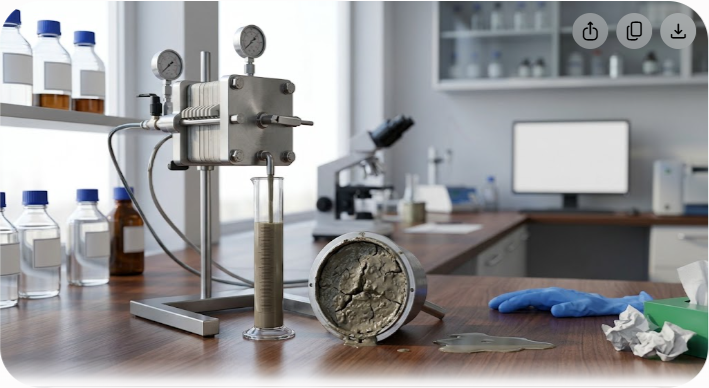
The standard low-pressure, low-temperature filtration test used for many water-based drilling fluids measures the filtrate volume collected under specified laboratory conditions over a defined period. API procedures specify the test equipment, pressure, time, filter medium, and reporting method.
A typical test involves the following steps:
A commonly used API low-pressure filtration condition is 100 psi for 30 minutes. Results are normally reported as filtrate volume in milliliters and filter-cake thickness in 32nds of an inch.
There isn't one universal "good" API fluid-loss value for every drilling fluid. A target should be selected based on the mud system, formation permeability, drilling objectives, and operating conditions. A freshwater bentonite system may have a different acceptable range from a polymer-enhanced, high-temperature, or reservoir-drilling fluid.
High-pressure, high-temperature filtration tests are used when ambient laboratory conditions don't adequately represent downhole conditions. The test subjects the mud to elevated temperature and pressure while measuring filtrate behavior and examining the filter cake.
A commonly used HPHT test configuration uses a 500 psi pressure differential, although the precise procedure and temperature depend on the applicable testing standard and the equipment being used.
Temperature can change clay-polymer interactions, viscosity, dispersion, and filter-cake properties. For that reason, an acceptable ambient fluid-loss result doesn't automatically guarantee acceptable filtration at bottom-hole conditions.
Bentonite is effective, but it isn't insensitive to mud chemistry. A formulation that performs well in clean freshwater can behave very differently after contamination with calcium, salt, cement, drilled solids, or other materials.
Calcium and magnesium can affect clay hydration and dispersion. Calcium contamination is particularly important because calcium can exchange with sodium on the clay and promote a less dispersed clay structure.
Sources can include hard makeup water, cement contamination, formation minerals, or other calcium-bearing materials encountered while drilling. The resulting change can show up as poorer rheological control, higher filtration, or changes in filter-cake texture.
Practical response: Test the water and mud chemistry rather than treating blindly. Where appropriate, soda ash may be used to reduce soluble calcium in makeup water before bentonite is added. Treatment rates should be based on measured chemistry and the mud program.
Salt changes the electrochemical environment around clay particles and can substantially reduce the swelling and dispersion of conventional freshwater bentonite. The effect becomes more pronounced as salinity increases.
That doesn't mean bentonite can never be used in saline systems. Saltwater and brine drilling fluids can be formulated with suitable clays and fluid-loss additives, but conventional freshwater bentonite should not be expected to behave the same way in seawater or concentrated brine.
Practical response: If the mud system permits it, pre-hydrate bentonite in suitable freshwater before exposing it to higher salinity. For systems designed around seawater or brine, use a formulation and clay grade intended for those conditions and verify performance through laboratory testing.
Mud pH affects clay dispersion, contaminant treatment, corrosion control, and the performance of other additives. A mildly alkaline range is commonly maintained in water-based mud systems, but the appropriate value depends on the complete formulation.
It is too simplistic to treat one pH number as universally ideal for every bentonite system. Excessive alkalinity can also change clay and polymer behavior.
Practical response: Monitor pH and alkalinity routinely and adjust them according to the drilling-fluid program. Caustic soda and other alkaline materials should be used based on measured conditions rather than fixed treatment assumptions.
Poor hydration is one of the easiest ways to underperform a good bentonite. If the clay enters the system too quickly, doesn't have enough water available, or isn't exposed to adequate mixing, a portion can remain in partially hydrated aggregates.
Those larger aggregates don't provide the same filtration-control surface area as a well-dispersed clay system.
Practical response: Follow the supplier's recommended mixing and hydration procedure. Give the clay sufficient contact time and use suitable mixing equipment before judging its final yield or filtration performance.
Drilled solids are not the same as deliberately added bentonite. As drilled rock accumulates, it can change the particle-size distribution and make the mud harder to control.
Fine drill solids can increase low-gravity solids concentration, alter rheology, and contribute to thicker or less desirable filter cakes. A mud can therefore have apparently strong viscosity while still having poor solids management.
Practical response: Monitor solids content and use the appropriate mechanical solids-control equipment for the mud system. Shale shakers, desanders, desilters, and centrifuges each have different operating ranges and should be selected and adjusted accordingly.
A single fluid-loss number rarely tells the whole story. Compare the filtrate volume with cake thickness, cake texture, rheology, solids content, and mud chemistry.
If filtration is high and the cake is unusually thin, the mud may not contain enough effective fine solids to build a low-permeability seal. Poor bentonite hydration or dispersion can produce a similar result.
What to check:
Adding more bentonite isn't always the correct answer. If the clay is being added to unsuitable water or isn't hydrating properly, increasing concentration may increase costs without fixing the underlying problem.
This combination can indicate poor solids packing or flocculation. Calcium contamination, high salinity, excessive drill solids, or an unsuitable additive balance can all contribute.
A thick cake with high fluid loss is especially worth investigating because it means the mud is depositing a substantial amount of material without creating an effective barrier.
What to check: Review calcium, chloride, pH, rheology, low-gravity solids, and the condition of the mud before deciding on treatment. Chemical treatment, dilution, or improved solids control may be more appropriate than simply adding more bentonite.
Low filtrate volume is not automatically a sign of an optimized mud. If the cake is excessively thick, the system may contain too many solids or may be producing a cake with poor mechanical properties.
What to check: Review total solids, low-gravity solids, rheological trends, cake thickness, and solids-control performance. A lower fluid-loss number achieved by building an unnecessarily thick cake can create a different set of drilling problems.
A sudden change is often more informative than a consistently mediocre result. Look for a contamination event or change in operating conditions.
Potential causes include cement contamination, salt or formation-water influx, hard makeup water, a change in bentonite source, poor mixing, excessive drilled solids, thermal exposure, or an incompatible chemical treatment.
Trend the data. Comparing today's result with the previous several mud checks can reveal a developing problem before it becomes a downhole event.
Bentonite provides the particle framework for many freshwater water-based muds, but it doesn't have to carry the entire filtration-control load. Polymers are often used to improve fluid loss, strengthen the cake, or maintain performance under conditions where conventional bentonite becomes less effective.
| Additive Type | Primary Filtration Function | Relationship With Bentonite |
|---|---|---|
| Polyanionic cellulose (PAC) | Reduces filtrate loss by increasing the viscosity of the liquid phase and improving cake quality | Works with dispersed clay to reduce flow through the fine pore structure of the cake |
| Starch | Provides fluid-loss control in selected water-based systems, including some saline formulations | Can supplement clay-based filtration control when salinity or temperature limits bentonite performance |
| Lignosulfonates and other deflocculants | Help control clay aggregation and rheology in appropriate mud systems | Can improve dispersion when used correctly, but treatment must be matched to the complete mud chemistry |
| Synthetic fluid-loss polymers | Provide targeted filtration control across a broad range of formulations | Can reduce the amount of clay needed for a particular filtration target, depending on the system |
The best additive package depends on the mud type and operating environment. There is no universal dosage of bentonite, PAC, or starch that guarantees a particular fluid-loss result.
Instead, engineers normally optimize the formulation through laboratory testing and field measurements. The goal is to achieve the required filtration and rheological properties without adding unnecessary solids or chemicals.
Filtration control is only one reason bentonite remains important in water-based drilling fluids. Properly hydrated bentonite can also contribute to apparent viscosity, low-shear-rate viscosity, and gel strength.
These properties help the mud transport drilled cuttings while circulating and suspend solids during periods when the pumps are off. That dual role makes bentonite particularly useful in systems where both carrying capacity and filtration control are required.
There is a trade-off, however. More bentonite isn't automatically better. Excessive clay concentration can increase viscosity and yield stress beyond the desired operating range, making the mud harder to pump and potentially increasing equivalent circulating density.
Good mud design balances filtration, rheology, solids control, density, inhibition, lubrication, and formation compatibility rather than optimizing one laboratory number in isolation.
Filter-cake thickness deserves special attention in permeable formations. When the drill string rests against a cake across a permeable interval, the pressure difference between the wellbore and formation can create a force that holds the pipe against the wall.
This is the basis of differential sticking. A thick or sticky cake can increase the contact area and make the problem more difficult, although differential sticking depends on several factors, including pressure differential, permeability, pipe contact, cake properties, and time.
The practical objective is therefore not simply "the thinnest possible cake." The better target is a thin, low-permeability, mechanically competent cake that performs under both static and circulating conditions.
Several recurring mistakes can undermine a drilling-fluid program even when the selected bentonite is high quality.
A good clay cannot compensate indefinitely for unsuitable water. Hardness, salinity, and other contaminants should be evaluated before large quantities of bentonite are added.
High viscosity can be useful, but it doesn't prove that the clay is producing the desired filter cake. Fluid loss, cake thickness, rheology, solids content, and hydration behavior should be considered together.
Freshly mixed bentonite may not have reached its final performance. Compare results after the appropriate conditioning period rather than assuming the first reading represents fully developed clay properties.
High fluid loss can have many causes. Adding clay to a system contaminated with calcium, salt, or excessive drilled solids can make rheology and solids control worse without solving filtration.
A mud can contain plenty of bentonite and still produce a poor cake because the overall solids population has become uncontrolled. Mechanical solids control is part of filtration management.
Fluid-loss results are valuable, but they are only one part of a drilling-fluid specification. The right target depends on the formation, mud system, temperature, pressure, and operational objectives.
The quality of bentonite depends on its mineralogy, raw ore, processing, particle-size distribution, moisture, and other product characteristics. Two products sold under the same broad name can behave differently in a drilling-fluid test.
When evaluating a supplier, ask for technical documentation and representative test data rather than relying only on a marketing description.
Review the supplier's stated grade, intended application, moisture range, residue or grit information, and relevant performance data. For drilling applications, confirm that the material is produced and tested against the specification required by the project.
A clay that produces high viscosity isn't necessarily the clay that gives the best filtration performance. Compare yield, filtration, cake characteristics, and rheological behavior under the conditions relevant to the mud program.
The best bentonite for a freshwater system may not be the best choice for seawater, high-salinity, or high-temperature applications. Product selection should begin with the intended mud environment.
Consistency matters in drilling because changes in clay performance can shift the entire mud balance. A reliable supplier should be able to provide product specifications and quality-control information for individual batches or production lots where required.
Bentonite remains widely used because it can perform several jobs within one water-based mud system. It contributes fine solids for filter-cake formation, supports suspension and rheology, and can be comparatively economical relative to relying entirely on specialty polymers for every function.
That doesn't mean bentonite should replace every other additive. Polymer-enhanced systems can provide lower fluid loss, improved performance in saline environments, better high-temperature behavior, or other properties that a conventional clay system cannot deliver on its own.
The economic question is therefore about the total mud system, not the price of bentonite by itself. A lower-cost clay that requires excessive treatment or produces unstable mud properties may cost more in operation than a consistent, higher-performing grade.
Environmental considerations also depend on the complete formulation and local regulatory requirements. Bentonite is a naturally occurring mineral and is widely used in applications such as water-well construction, but the environmental profile of a drilling fluid depends on all of its ingredients, how the mud is handled, and how waste is managed.
Modern drilling fluids are engineered systems rather than single-additive products. Bentonite may form the foundation of a freshwater water-based mud, while polymers, salts, alkalinity-control chemicals, lubricants, weighting agents, bridging materials, and other additives are selected around the formation and drilling objectives.
A useful way to think about bentonite is as part of the mud's particle framework. It supplies fine, reactive clay solids that can contribute to filtration control and rheology. Other additives then modify the behavior of that framework to meet specific operating requirements.
For example, a relatively simple freshwater system may depend heavily on hydrated bentonite for both viscosity and filtration. A more demanding system may use less clay and more polymer to control fluid loss, particularly where high temperature, salinity, or other conditions limit conventional bentonite performance.
The formulation should therefore be designed around the actual well rather than a fixed recipe.
A disciplined workflow helps separate clay-quality problems from mud-maintenance problems.
This approach makes troubleshooting much more predictable. It also prevents the common mistake of treating a symptom while leaving the underlying contamination or formulation problem untouched.
Bentonite improves drilling fluid filtration control primarily through its ability to hydrate, disperse, and contribute fine clay platelets to the developing filter cake. Those particles help reduce cake permeability and restrict continued filtrate invasion into permeable formations.
The performance depends on more than bentonite concentration. Water chemistry, clay quality, hydration time, shear, salinity, calcium contamination, drilled solids, temperature, pressure, and polymer chemistry can all change the final result.
For field use, the most useful principles are straightforward:
For suppliers such as Axewelledge, the useful question isn't simply whether a product is labeled sodium bentonite. Buyers should look for consistent drilling-grade material, documented specifications, appropriate performance testing, and technical support that matches the intended application. A consistent clay is a better starting point for a stable mud system than a product selected on price or swelling claims alone.













Have questions about our products? We're here to help!