Axewelledge, a leading exporter from India, specializes in high-quality Bentonite. With a commitment to excellence, we supply premium Bentonite to the Middle East and Southeast Asia markets.


North Angle Complex, 304,
150 Feet Ring Rd, Opposite Ambedkar Nagar BRTS Stop,
Madhav Park, Punit Nagar,
Mavdi, Rajkot, Gujarat 360004
© Axewelledge 2026, All Rights Reserved.
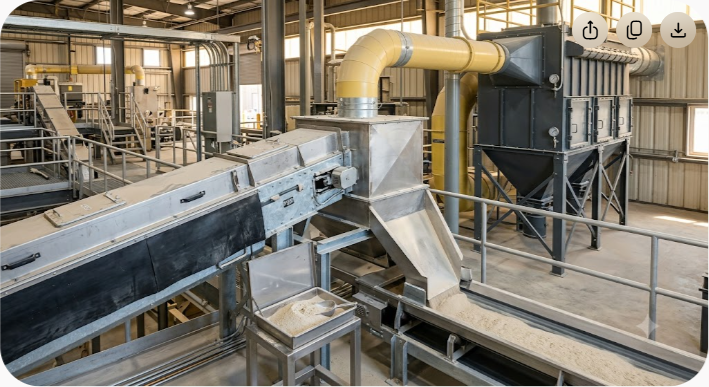
Bentonite dust is easiest to control before it becomes airborne. The most useful improvements usually happen at the point where material is opened, dropped, transferred, or discharged. Reducing free-fall distance, enclosing transfer points, controlling the feed rate, using local exhaust ventilation where necessary, and preventing settled powder from being re-suspended can substantially improve a handling area.
If your operation handles bags, bulk bags, tankers, conveyors, hoppers, or pneumatic equipment, don't start by treating every dusty task as a respirator problem. Start with the process. Ask where dust is being generated, how it is escaping, and why workers are exposed to it. Once those questions are answered, the appropriate combination of engineering controls, work practices, housekeeping, and personal protective equipment becomes much easier to identify.
For U.S. facilities, the applicable exposure-control requirements depend on the material, its composition, the task, and the workplace. Bentonite handling should therefore be assessed using the current Safety Data Sheet, process information, exposure data where appropriate, and applicable OSHA requirements. Sorptive clay processing is addressed separately in OSHA's silica compliance guidance, while applicable mineral-dust limits can still apply. Regulatory requirements should always be checked against the specific operation rather than assumed from the product name alone.
This guide explains where bentonite dust comes from, how to reduce it at the source, which controls are useful for different handling situations, and how to troubleshoot a process that suddenly becomes dustier.
Bentonite is supplied in several physical forms, including finely milled powder, granules, pellets, chips, and other processed grades. Fine powdered bentonite is particularly susceptible to becoming airborne because small particles can be disturbed by pouring, dropping, conveying, agitation, vibration, or air movement.
The material itself isn't the only factor. Handling geometry often determines how much dust escapes. The same bentonite can behave very differently in two systems. A controlled discharge through a short, enclosed chute may produce little visible dust, while an open discharge several feet above a receiving hopper can create a plume from the same quantity of material.
Several conditions can increase dust generation:
It helps to separate dust generation from dust capture. Generation controls reduce the amount of airborne material produced in the first place. Capture controls collect dust after it has been generated. A well-designed system uses both, but it gives priority to controlling the source.
That distinction matters. A powerful extraction system can't fully compensate for an unnecessarily dusty transfer point, and good housekeeping can't solve a continuous dust leak from an open hopper.
Start with the places where bentonite changes direction, falls through the air, enters another piece of equipment, or is opened by an operator. These locations often provide the clearest opportunities for improvement.
A practical sequence is:
This order is important. Fixing the source is generally more useful than simply moving contaminated air around the building.
One of the simplest bentonite dust-control improvements is also one of the easiest to overlook.
When powdered bentonite falls from a high point into a hopper, bag, bin, or conveyor, the moving material entrains air. That displaced air can carry fine particles upward and outward, producing a dust cloud around the receiving point.
Consider a hopper receiving powder from a discharge point several feet above the material surface. As the material falls, it accelerates and strikes the material already in the hopper. The impact and displaced air create turbulence. Lowering the discharge point and guiding the material through a suitable chute can reduce both effects.
The goal isn't simply to make the chute as short as possible. The chute still needs the right angle, opening, lining, clearance, and geometry for the material to flow without plugging or building up.
Where equipment design permits, position the discharge close to the receiving material. Adjustable chutes, telescopic loading spouts, flexible sleeves, and enclosed transfer pipes can reduce the distance that bentonite travels freely through open air.
Don't shorten a chute without considering blockage. Bentonite can adhere to surfaces, bridge, or accumulate when the chute geometry doesn't suit the grade being handled. Moisture, particle size, bulk density, and flow behavior can all affect performance.
The objective is controlled movement, not the shortest possible chute at any cost.
A chute designed for coarse aggregate may perform poorly with fine bentonite powder. Fine material can cling to surfaces and form deposits, while a poorly designed transition can create turbulence or interrupt flow.
During equipment trials, look for three practical indicators:
If buildup appears after reducing the drop distance, solve the flow problem rather than simply reopening the system and accepting the dust. A dust-control modification needs to remain workable during normal production.
If a transfer point produces dust, containing that point is usually more direct than attempting to dilute dust throughout an entire building.
A partial or full enclosure around a conveyor transfer, hopper, or bag-dumping station keeps contaminated air concentrated near the source. Local exhaust can then draw that air into a suitable collection system instead of allowing it to disperse into the general work area.
The enclosure doesn't need to make equipment inaccessible. Good design provides doors, inspection panels, access points, and maintenance provisions while limiting unnecessary openings during normal operation.
A practical enclosure should:
An enclosure that is almost closed but has large uncontrolled openings may perform poorly. Air follows the easiest available path. If that path leads toward an operator, the enclosure can provide much less protection than its appearance suggests.
Where negative pressure is used, the ventilation system should draw air into the enclosure rather than allowing dusty air to escape. Maintaining that airflow requires appropriate fan performance, ducting, pickup location, and controlled openings.
Conveyor systems can appear clean while generating substantial dust at the places where material leaves one belt, drops through a chute, and lands on another belt or enters a vessel.
Transfer points deserve particular attention because both material and air are moving at the same time. A falling stream of bentonite can entrain air, while the receiving conveyor and surrounding enclosure can create additional turbulence.
Inspect:
If dust appears mainly when a conveyor starts or stops, check for accumulated material, belt movement, and sudden changes in airflow. If dust increases with throughput, examine the transfer geometry, enclosure volume, skirt sealing, and extraction performance.
Skirt boards should contain material without creating unnecessary friction or gaps. Strip curtains can help retain dust when they are positioned correctly, but they shouldn't interfere with material flow or create a maintenance hazard.
A transfer enclosure also needs enough internal volume for the material stream and displaced air. An undersized enclosure can become pressurized as material enters, forcing dusty air through gaps.
Local exhaust ventilation, commonly called LEV, captures contaminated air close to its source before it reaches the worker's breathing zone.
It can be useful at enclosed bag-dumping stations, bulk transfer points, hopper charging areas, chute transitions, and other locations where dry powder is repeatedly introduced into equipment.
The key word is local. A large general ventilation fan mounted somewhere in the building may move a considerable amount of air without capturing the dust where it is generated.
A properly engineered LEV system considers hood or pickup location, airflow, duct dimensions, pressure losses, filtration, fan performance, make-up air, and maintenance. It shouldn't be selected solely by choosing a fan with a large nominal capacity.
Hood placement matters. If the pickup is too far from the dust source, particles may escape before reaching it. If the pickup is positioned poorly, it can interfere with material flow, pull product into the extraction system, or fail to capture the main dust plume.
The correct arrangement depends on the equipment geometry and the way air moves through the process. This is why LEV design should be based on the actual transfer point rather than copied from a different plant.
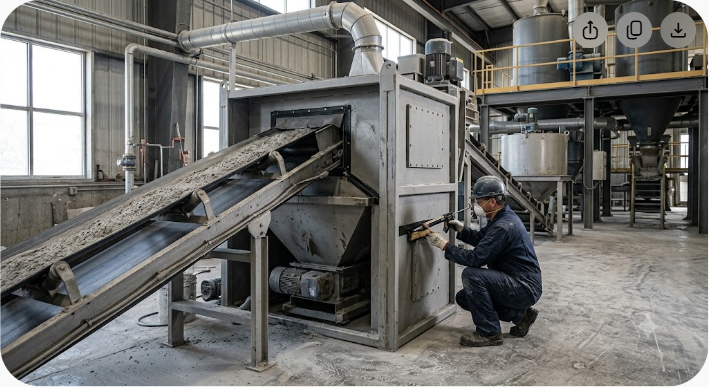
Where possible, test the system under normal operating conditions and inspect for visible leakage. Airflow measurements and other ventilation-system checks can provide additional evidence that the controls are functioning as intended.
A sudden dump of 500 kg of powder creates a very different air movement pattern from a controlled, continuous feed of the same quantity.
Rapid dumping creates turbulence and displaces air from the receiving vessel. If the vessel is already close to capacity, displaced air can carry fine bentonite out through vents or openings.
Where process requirements allow, controlled feeding can be achieved with equipment such as:
The right equipment depends on throughput, product grade, particle size, moisture, bulk density, flow characteristics, and downstream requirements.
The goal isn't necessarily to make the material move slowly. It is to eliminate sudden, uncontrolled bursts of material and air.
For batch charging, timing can matter as well. A controlled addition sequence may reduce the amount of displaced air compared with opening a large discharge path and releasing the entire charge at once.
Bulk bags can generate substantial dust during cutting, opening, shaking, and emptying. The problem becomes worse when a bag is suspended above an open hopper and the powder falls several feet before reaching the receiving material.
A better setup uses a suitable unloading frame, a controlled discharge connection, and a receiving hopper designed for containment.
Where practical, consider:
The operator shouldn't need to put their head over an open powder hopper to make the system work. If a task routinely requires an employee to lean into a dusty opening, the workstation design deserves attention.
The empty bag also needs consideration. Powder trapped inside packaging can become airborne when the bag is shaken, folded, compacted, or discarded. Establish a removal method that limits unnecessary disturbance.
For bagged bentonite, ordinary handling practices can have a noticeable effect on dust generation.
Dropping a 25 kg or 50 lb bag onto a pallet or floor can disturb settled powder and release material around seams or damaged packaging. Throwing bags onto conveyors or into hoppers creates additional turbulence.
Train operators to:
The aim isn't to slow production unnecessarily. It is to remove rough handling that provides no production benefit and creates avoidable dust.
Packaging quality also matters. If bags regularly arrive with torn seams, damaged corners, or powder contamination on the outside, investigate the cause with the packaging and logistics teams. Dust control begins before the material reaches the unloading station.
Adding moisture can suppress dust, but it isn't automatically appropriate for bentonite.
Bentonite is valued for properties such as swelling, water absorption, rheology, binding, and sealing. Water changes how the clay particles interact, so uncontrolled moisture can affect flowability, agglomeration, caking, storage stability, and final product performance.
For some bulk mineral-handling applications, controlled moisture conditioning may be useful. For a dry bentonite product that must remain free-flowing or disperse predictably later in the process, adding water may create a different problem.
Before using moisture for dust suppression, ask:
If product performance is critical, engineering controls are often preferable to adding moisture simply to make visible dust disappear.
If moisture conditioning is being considered, conduct a controlled trial and compare both dust performance and product properties. The result should be measured against the requirements of the actual application, not just the appearance of the handling area.
Two bentonite products can behave differently during handling even when both are described as bentonite powder.
Particle-size distribution influences flow, packing, segregation, dispersion, and the amount of fine material that can become airborne. A product containing a larger proportion of very fine particles may require tighter containment than a coarser grade.
Grinding and milling operations can create especially dusty conditions because they produce and expose fine particles. The same product may also behave differently after storage if moisture or agglomeration changes its flow characteristics.
When investigating recurring dust problems, review:
If the problem appeared after a change in supplier, milling conditions, product specification, or batch, compare the material characteristics before redesigning the entire handling system.
Material data doesn't replace process investigation, but it can explain why an unchanged system suddenly handles the product differently.
Dust suppression isn't a single technology. Different handling systems need different combinations of controls.
| Handling situation | Practical controls | Main consideration |
|---|---|---|
| Bag unloading | Enclosure, extraction, controlled opening | Keep the operator's breathing zone away from the source |
| Bulk bag discharge | Closed sleeve, hopper enclosure, LEV | Prevent leakage around the bag connection |
| Conveyor transfer | Enclosure, skirting, curtains, LEV | Control both material movement and displaced air |
| Hopper loading | Short chute, controlled feed, extraction | Reduce free fall and air displacement |
| Bulk tanker unloading | Sealed connections, controlled conveying, filtration | Prevent leaks at couplings and vents |
| Open stockpile handling | Process-specific suppression and work practices | Balance dust reduction with product quality |
| Manual cleanup | Suitable vacuum or compatible controlled wet method | Avoid re-suspending settled dust |
There is no universal bentonite dust-control method. The appropriate combination depends on the physical form of the product, throughput, equipment, workplace layout, and exposure risk.
Water sprays are often proposed as an easy answer to mineral dust. They can be useful in some applications, but increasing water flow isn't automatically an improvement.
Spray systems can alter airflow around a transfer point. Poorly designed sprays may create turbulence, interfere with material flow, or move dust toward areas that were previously cleaner.
Bentonite introduces another consideration: water changes the material itself.
If you're handling a grade intended to hydrate later in the process, uncontrolled water exposure during storage or transfer can affect flowability and cause buildup. For a dry powder product, this may be unacceptable.
If water suppression is being considered, run a controlled trial and check both dust performance and product properties before introducing it across the plant. Check storage behavior as well as immediate handling behavior; a small moisture increase that seems harmless during unloading can become a caking problem after several days in a bin or bag.
A common problem is an enclosure that looks sealed but leaks around multiple connections.
Inspect:
One small opening may not appear important, but several openings around a dusty transfer point can undermine containment.
Negative pressure inside an enclosure can help because air is drawn inward rather than dusty air being pushed outward. However, negative pressure only works as intended when the extraction system, enclosure geometry, openings, and make-up air are properly balanced.
Look for dust deposits outside access doors, around flexible connections, and beneath transfer points. These deposits can reveal leakage that isn't obvious while the system is running.
Settled bentonite isn't harmless simply because it is no longer airborne.
A layer of powder on beams, ledges, conveyor structures, equipment frames, or floors can become airborne again when people walk through the area, equipment vibrates, compressed air is used, or another spill occurs.
Clean the source of the accumulation, not just the floor beneath it.
Blowing a dusty surface with compressed air can turn a housekeeping task into an exposure event. Directed air can disperse settled particles into the breathing zone and contaminate surrounding equipment.
Where appropriate, a suitable industrial vacuum can remove settled powder without deliberately putting it back into the air. Wet cleaning can also be useful for compatible materials and surfaces, but it should be evaluated carefully for bentonite because moisture can create slip hazards, buildup, or changes in material behavior.
Housekeeping equipment should be selected for the dust and workplace conditions. Follow the equipment manufacturer's requirements for filtration, maintenance, and safe use.
A useful housekeeping schedule should identify elevated surfaces as well as floors. If dust repeatedly accumulates on overhead structures, don't accept cleaning as the permanent solution. Investigate why it is escaping from containment in the first place.
If a dust extraction system used to work well but performance has deteriorated, don't automatically increase fan speed.
Check the system itself.
Common causes of poor extraction include:
A dust collector can be correctly sized on paper and still fail to control dust if the pickup point isn't receiving the intended airflow.
Establish routine inspection points and record meaningful indicators such as pressure differential, airflow where measured, filter condition, fan condition, and visible dust leakage. Changes from the normal operating range can provide an early warning before workers begin reporting increased dust.
Maintenance also needs to cover the entire extraction path. Replacing a filter won't solve a disconnected duct, blocked hood, or damaged flexible connection.
Before selecting a control method, review the supplier's current Safety Data Sheet and product specification.
Check the composition, recommended handling conditions, exposure information, personal protective equipment guidance, physical properties, and storage requirements. If the product contains components that change the hazard assessment, those details need to be considered.
For U.S. workplaces, OSHA requirements can depend on the specific material and operation. Don't assume that one regulatory classification or exposure limit applies simply because two products are both called bentonite.
The same principle applies to process controls. A dust-control method that works for one mineral powder may be unsuitable for a bentonite grade with different moisture sensitivity, particle size, or downstream requirements.
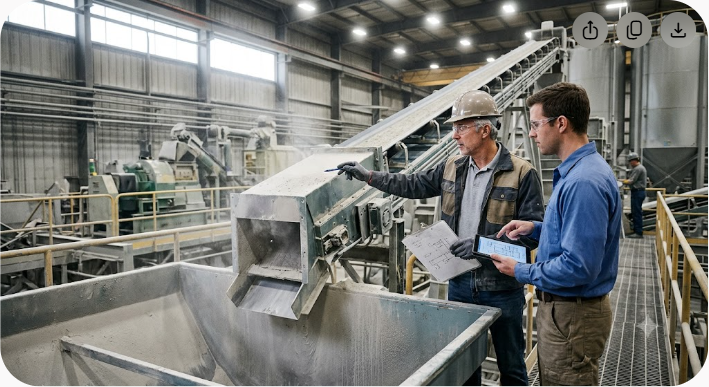
The SDS is an important starting point, but it isn't a substitute for a site-specific hazard assessment or competent occupational hygiene and engineering evaluation where those are needed.
Visible dust is useful as an immediate warning sign, but it isn't a substitute for exposure assessment.
You can have visible dust without knowing the concentration in a worker's breathing zone. You can also have respirable particles that aren't obvious to the eye.
If a risk assessment indicates potential exposure, occupational hygiene sampling can help determine whether existing controls are adequate and where additional improvements may be needed.
Sampling should match the hazard being evaluated. Depending on the material and operation, this can involve assessing total or inhalable particulate, respirable particulate, or a specific constituent such as crystalline silica when applicable.
For U.S. workplaces where OSHA's general-industry respirable crystalline silica standard applies, the standard includes an action level of 25 micrograms per cubic meter and a permissible exposure limit of 50 micrograms per cubic meter as an 8-hour time-weighted average. Whether those requirements apply to a particular bentonite operation must be determined from the material and task rather than assumed from the word bentonite alone.
The practical lesson is straightforward: don't use a visible dust cloud as your only measurement, and don't assume an apparently clean workplace is automatically free from exposure risk.
If you're troubleshooting a dusty handling line, walk through the process in the same direction as the material. Start at receiving and follow the product through storage, transfer, processing, and final discharge.
More airflow doesn't automatically mean better capture. If the hood is badly positioned or the enclosure leaks, a larger fan may simply move more contaminated air through the plant.
Fix the source, enclosure, and pickup geometry first. Then verify whether the extraction system is providing the airflow the process actually needs.
Water can suppress dust, but bentonite is sensitive to moisture. Uncontrolled water may change flowability, swelling behavior, storage stability, caking tendency, and downstream performance.
Test the material before adopting moisture addition as a permanent control. A dust-free transfer that leaves a hopper full of hardened buildup isn't a successful process improvement.
Respiratory protection may be necessary in some circumstances, but it doesn't remove dust from the process. Engineering and work-practice controls should receive appropriate attention first.
A respirator can protect a worker when other controls don't provide sufficient protection, but it shouldn't be used as a reason to accept a preventable dust release at a transfer point.
Plants often focus on milling equipment and overlook the short conveyor, hopper, chute, or bag-opening station downstream. These smaller points can become the actual source of the visible dust problem.
Walk the entire material path rather than inspecting only the largest piece of equipment.
If operators sweep dust every hour but the same transfer point keeps releasing powder, housekeeping is treating the consequence. Investigate the transfer itself.
Repeated dust accumulation is useful evidence. It can show where material is escaping, how far it travels, and which equipment needs closer inspection.
If you change the chute, add water, increase extraction, alter conveyor speed, and switch product grades at the same time, it becomes difficult to determine what actually solved the problem.
Where production conditions permit, make controlled changes and document the results. Compare dust observations, material behavior, equipment performance, and exposure measurements where applicable.
A handling system may appear to have failed when the material itself has changed. A different particle-size distribution, moisture level, bulk density, or physical form can alter flow and dust behavior.
When dust increases unexpectedly, compare the current product with a previous batch before assuming the equipment is responsible.
Both engineering controls and work practices matter, but they address different parts of the problem.
| Control | Example | Advantage | Limitation |
|---|---|---|---|
| Source enclosure | Enclosed hopper or transfer | Prevents dispersion | Requires access and maintenance design |
| LEV | Extraction at bag dump | Captures airborne dust near the source | Requires correct airflow and maintenance |
| Process control | Metered feeding | Reduces sudden dust generation | May require equipment changes |
| Moisture suppression | Controlled conditioning | Can reduce airborne fines in suitable applications | May change product properties |
| Housekeeping | Suitable vacuuming | Removes settled material | Doesn't fix ongoing generation |
| PPE | Respiratory protection | Adds worker protection when needed | Doesn't control the process itself |
A strong dust-control program normally combines several layers. Source containment reduces generation and escape, ventilation captures what remains airborne, housekeeping removes settled material, and PPE provides additional protection when required.
If you're designing a new system, address dust control before equipment is purchased. Retrofitting containment and extraction after installation is often more difficult than incorporating those requirements into the original layout.
A sensible design sequence is:
This approach is more reliable than buying a dust collector first and trying to make the rest of the process fit around it.
Dust-control equipment needs to work after months of production, not only during commissioning.
Provide practical access for filter inspection, duct inspection, skirt replacement, chute cleaning, and seal maintenance. If a component is difficult to reach, it is more likely to be neglected. Poor maintenance can gradually turn an effective containment system into a dusty one.
Also identify what normal performance looks like. Pressure differential, airflow measurements where available, filter condition, and visual inspection can provide useful maintenance indicators.
There isn't a universal answer because handling performance depends on the product specification and application.
Coarser grades, granulated products, and pellets can behave differently from finely milled powders. A fine powder may provide desirable dispersion or processing characteristics while requiring tighter containment during handling.
If dust generation is a recurring operational problem, discuss the required particle size and physical form with your supplier. Depending on the application, a different grade or handling format may be possible without sacrificing the required performance.
This is one area where product selection and plant engineering should be considered together. A slightly different material specification can sometimes reduce handling difficulty, but the change should be evaluated against the end-use requirements rather than selected solely because it appears less dusty.
Axewelledge supplies bentonite for applications including drilling, construction, water-related uses, agriculture, and industrial processing. When selecting a grade for a particular handling system, the useful discussion isn't simply whether the product is bentonite. Particle size, moisture, physical form, performance requirements, packaging, and intended application all matter.
If a plant normally runs clean and dust suddenly increases, look for a recent change before assuming the entire system has failed.
Check whether:
A useful troubleshooting method is to compare the current operating condition with the last known clean condition. Record the material grade, batch, throughput, equipment settings, moisture, and maintenance status. Then inspect the first location where dust appears.
If the same equipment produces more dust only with a particular batch, investigate the material. If dust increases across all batches after a maintenance event, investigate the equipment. If dust appears only at higher throughput, investigate transfer geometry and airflow.
Batch-to-batch consistency can matter for handling as well as final product performance. If one batch suddenly produces substantially more dust under the same operating conditions, retain samples where practical and compare relevant physical properties with previous material.
Bulk tanker unloading presents a different challenge from bag handling because the material moves through sealed connections and may be conveyed using pneumatic systems.
Start with the connection points. Couplings, flexible hoses, gaskets, valves, vents, and filter housings should be inspected for leakage. A small leak under conveying pressure can release fine powder rapidly.
The receiving vessel also needs adequate venting and filtration. When bentonite enters a bin, the displaced air needs somewhere to go. If the vent path is restricted or the filter is overloaded, pressure can force dusty air through other openings.
Pneumatic conveying requires attention to conveying air velocity and system design. Excessive velocity can increase turbulence, product degradation, or dust loading, while insufficient conveying conditions can create blockages. The appropriate operating range depends on the material and conveying system.
For tanker unloading, the objective is a sealed material path with controlled air movement rather than simply adding extraction around a leaking connection.
Manual handling requires particular attention to the worker's position. A task can be mechanically simple but still expose the operator if the bag opening, hopper, or container is positioned directly in front of the breathing zone.
Where practical, position the work so the operator can remain beside rather than directly above the source. Provide stable platforms, appropriate lifting equipment, and controls that can be operated without leaning into the process.
Train workers to recognize damaged packaging, unusual material flow, blocked chutes, and extraction problems. A good procedure should also explain what to do when the normal system isn't working. Otherwise, workers may improvise by shaking bags, opening access panels, or using compressed air to clear accumulated powder.
Work instructions should support the engineering controls rather than work around them.
A written handling procedure doesn't need to be complicated, but it should reflect the actual equipment and material used at the site.
At a minimum, define:
The procedure should be specific enough that an operator doesn't have to guess how to handle a dusty situation.
The most effective way to reduce bentonite dust during material handling is to prevent dust from escaping at the source. Reduce free fall, control the feed rate, enclose dusty transfers, use properly designed local exhaust ventilation, maintain seals and filters, and remove accumulated powder without unnecessarily re-suspending it.
Don't assume that adding water or buying a larger fan is the answer. Bentonite's physical properties matter, and a control method that reduces visible dust while damaging flowability, storage stability, or product performance isn't a complete solution.
For U.S. facilities, separate general dust-control practice from the specific regulatory requirements that apply to the material and operation. OSHA requirements should be checked against the current rules and the actual workplace conditions, while NIOSH publications can provide useful technical guidance on engineering controls, ventilation, and dust containment.
If you're sourcing bentonite and also dealing with recurring handling problems, product specification is part of the conversation. Axewelledge can help buyers evaluate bentonite grades and physical characteristics for their intended industrial application, so the material and the handling system can be considered together rather than separately.













Have questions about our products? We're here to help!