Axewelledge, a leading exporter from India, specializes in high-quality Bentonite. With a commitment to excellence, we supply premium Bentonite to the Middle East and Southeast Asia markets.


North Angle Complex, 304,
150 Feet Ring Rd, Opposite Ambedkar Nagar BRTS Stop,
Madhav Park, Punit Nagar,
Mavdi, Rajkot, Gujarat 360004
© Axewelledge 2026, All Rights Reserved.
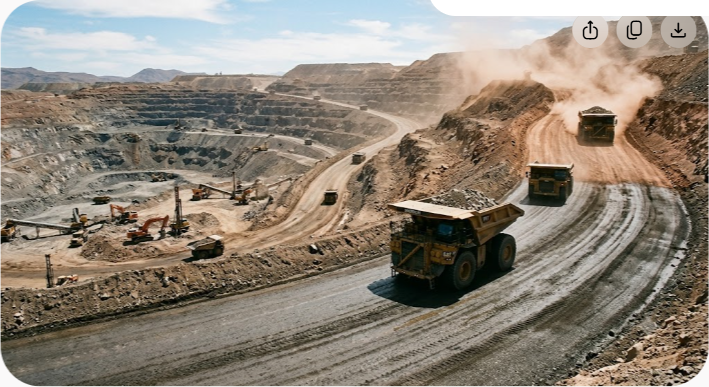
Bentonite can help control industrial dust, but it works best as a soil and mineral binder, not simply as a substitute for water spraying. When properly blended with suitable soil or aggregate and then hydrated and compacted, bentonite can bind loose fines, improve surface cohesion, and reduce the amount of material available to become airborne.
That distinction matters. Bentonite isn't a universal dust suppressant, and performance depends on the mineral grade, soil composition, application rate, traffic, moisture, and how well the treated layer is mixed and compacted. A well-designed treatment can reduce dust generation and extend the useful life of a stabilized surface; an unsuitable formulation can create muddy or slippery conditions instead.
Fugitive dust is a recurring problem in mining, quarrying, construction, aggregate handling, and other industries that move or expose large quantities of soil and mineral material. Unpaved haul roads are particularly challenging because vehicle tires continually break down aggregate and disturb fine particles. Wind then carries those fines beyond the immediate work area.
Water remains one of the simplest controls, but its effect is temporary. In hot, dry, or windy conditions, treated surfaces can dry quickly and require repeated watering. That consumes water and keeps water trucks, operators, and equipment in constant rotation. Other dust palliatives, including chlorides, lignosulfonates, and synthetic binders, have different strengths and limitations.
Bentonite offers another approach: instead of relying only on surface wetting, it can become part of the material structure. Its expandable clay minerals interact with water and fine particles, creating a cohesive matrix when the treatment is correctly designed.
The main reason bentonite can reduce dust is straightforward: hydrated bentonite increases cohesion between fine particles and helps hold moisture within the treated layer. When loose fines are incorporated into a stronger mineral matrix, they are less likely to become airborne under wind or vehicle traffic.
Bentonite is a clay-rich material composed predominantly of smectite minerals, especially montmorillonite. Its performance comes from the structure of these clay minerals and their interaction with water. The exact behavior varies by deposit and processing, so two products sold simply as bentonite may not deliver the same swelling, viscosity, or binding performance.
Several properties are relevant to dust control:
These properties make bentonite particularly interesting for applications where the objective is to stabilize a surface rather than simply wet it for a short period.
Bentonite contains expandable clay minerals with negatively charged surfaces and exchangeable cations. When water enters the clay structure, hydration causes the clay layers to separate and swell. Sodium-dominant bentonite generally exhibits greater swelling than calcium-dominant bentonite, although actual performance depends on mineralogy, chemistry, particle size, and processing.
As hydrated bentonite mixes with soil fines, it develops a cohesive, plastic consistency. With appropriate grading and compaction, that material can occupy voids between larger aggregate particles and create stronger contact between the particles in the treated layer.
The result isn't simply a wet road. The objective is a mechanically stable mineral matrix in which loose fines are less easily detached by tires, wind, or surface disturbance.
Industrial dust often originates from very fine particles that are easily disturbed. On an untreated gravel road, vehicle traffic can loosen silt and clay-sized particles from the surface. Once airborne, those particles can remain suspended long enough to affect visibility and air quality.
A binder changes the physical condition of the surface. Instead of leaving fine particles as independent, easily displaced material, the treatment incorporates them into a more cohesive layer.
That doesn't mean bentonite captures every airborne particle or eliminates emissions from an industrial operation. Crushing, screening, conveyor transfer, blasting, loading, and material discharge may require engineering controls of their own. Bentonite is most useful where surface stabilization and particle binding are part of the dust-control problem.
Bentonite can be considered for several dust-prone applications, but the treatment method should match the site. A haul road carrying heavy trucks requires a different formulation and construction method from a temporary soil surface or a static stockpile.
Unpaved haul roads are among the most practical applications for a mineral soil binder. Repeated traffic generates dust by disturbing loose fines and breaking down aggregate. Poor drainage and inadequate compaction can make the problem worse.
Bentonite can be incorporated into a prepared road layer to increase cohesion. The treatment works best when the road has a suitable blend of aggregate and fines rather than being made entirely of either coarse rock or highly plastic clay.
A typical road treatment involves grading the surface, distributing the bentonite, mixing it into the target depth, adding water, and compacting the layer. The objective is to create a dense, stable surface rather than leave a loose layer of clay on top.
Potential benefits include:
Actual watering intervals shouldn't be promised in advance. Traffic intensity, climate, drainage, road geometry, aggregate quality, and maintenance practices can change results substantially from one site to another.
Construction and earthmoving projects expose large areas of soil that may previously have been protected by vegetation. Grading, excavation, and vehicle movement can leave fine material exposed to wind.
Bentonite may be used as part of a soil stabilization strategy where a temporary bound surface is appropriate. It can be mixed into the upper soil layer, followed by controlled hydration and compaction.
The treatment needs to account for the intended duration of exposure. A temporary construction access area may require a different approach from a permanent roadbed. Sites subject to heavy rainfall also need adequate drainage because no clay binder can compensate for poor water management.
Where regulations require specific erosion or sediment controls, bentonite should be treated as one component of the overall site-management plan rather than as a replacement for required engineering controls.
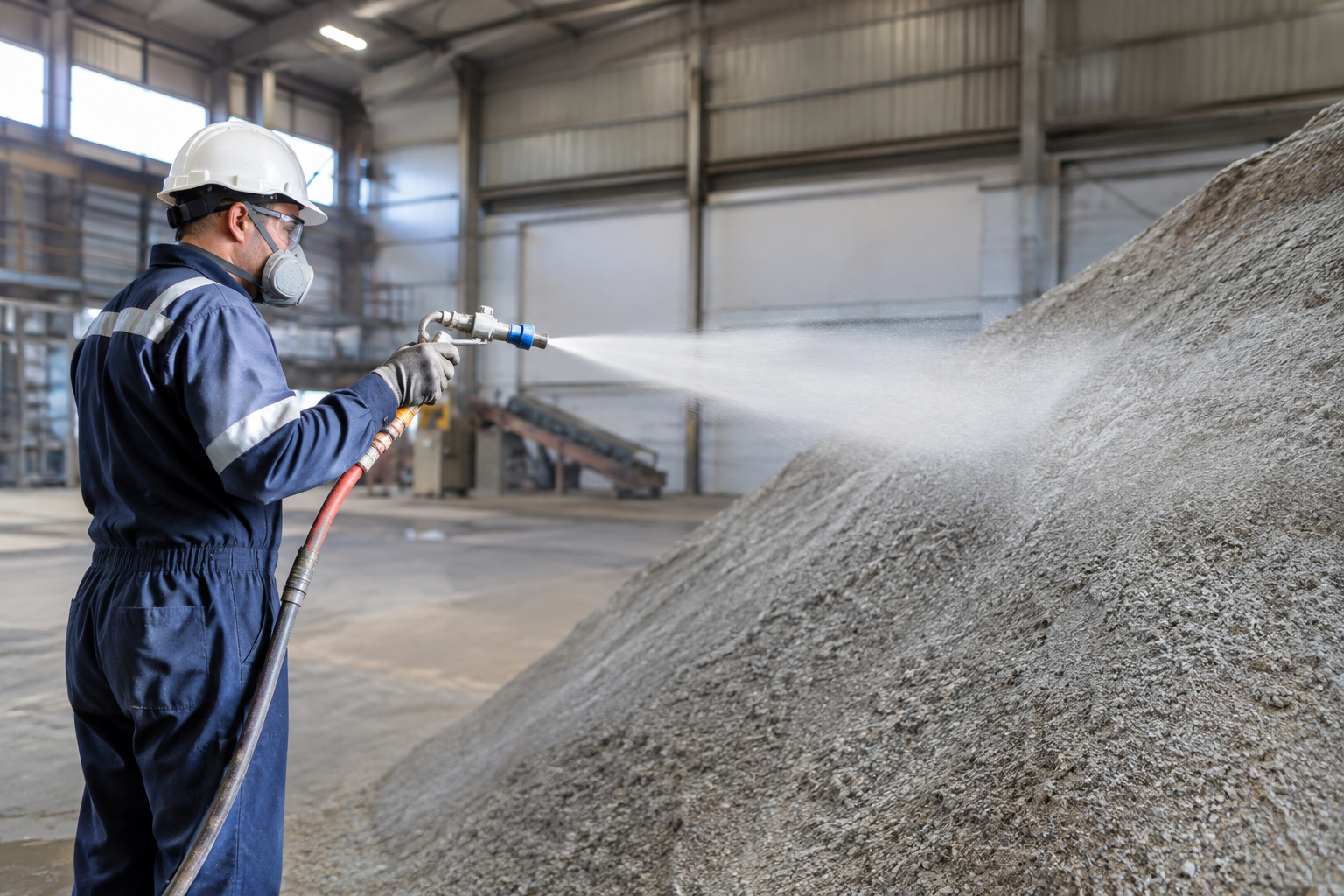
Outdoor stockpiles of aggregate, mineral products, tailings, and other fine materials can generate dust when wind moves across the exposed surface. The finer the material and the drier the surface, the greater the potential for wind-driven emissions.
A bentonite-containing slurry or surface treatment can form a cohesive layer over selected exposed areas. The practical objective is to reduce the number of loose particles available for wind transport.
Stockpile treatments require careful consideration of material recovery. A surface crust that controls dust effectively but interferes with reclaiming, screening, blending, or downstream product specifications may not be suitable.
For that reason, operators should test the treatment on a representative section before applying it across an entire stockpile. The trial should examine dust reduction, crust strength, rainfall response, reclaimability, and any effect on product quality.
Forestry roads, agricultural access roads, mine service roads, and industrial yards can all benefit from improved surface cohesion when dust is being generated by traffic.
Bentonite can act as a soil binder when the existing material has an appropriate particle-size distribution. It can help fine particles adhere to larger aggregate and reduce the amount of loose material disturbed by vehicle movement.
However, road stabilization and dust suppression aren't exactly the same objective. A treatment designed only to reduce dust may not provide enough structural strength for heavy haul traffic. Conversely, a heavily engineered road treatment may cost more than necessary for a lightly traveled access road.
Start with the actual problem. If the road is dusty because the surface lacks fines, adding a highly expansive clay may not be the right first step. If the surface already contains substantial fines but lacks cohesion, a binder may be more useful.
Dust can also form when bulk materials are loaded, discharged, screened, crushed, or transferred between conveyors. Bentonite can sometimes be introduced into a material stream when binding the fines is compatible with the product specification.
This application requires more caution than road stabilization. Adding bentonite changes the composition of the bulk material, so operators must confirm that the additive doesn't interfere with downstream processing, chemical specifications, combustion characteristics, filtration, recycling, or end-use requirements.
Where contamination isn't acceptable, conventional engineering controls such as enclosed transfer points, local exhaust ventilation, dust collectors, water misting, or improved chute design may be more appropriate.
The choice between sodium and calcium bentonite depends on the desired behavior and the composition of the treatment system. Sodium-dominant bentonite generally has higher swelling capacity, while calcium-dominant bentonite typically has lower swelling and different rheological behavior.
| Operational Feature | Sodium Bentonite | Calcium Bentonite |
|---|---|---|
| Dominant exchangeable cation | Sodium | Calcium |
| Typical swelling behavior | High | Low to moderate |
| Water interaction | Strong hydration and expansion | More limited expansion |
| Gel development | Generally stronger | Generally lower |
| Potential road-binding role | Useful where high cohesion is required | Useful where moderate binding is sufficient |
| Typical consideration | High-swelling applications | Applications where lower swelling is preferred |
The table describes general behavior rather than guaranteed product specifications. Mineral composition varies between deposits, and commercial grades can be processed or activated to produce different performance characteristics.
Sodium bentonite is often considered when strong swelling and cohesion are desirable. Once hydrated, it can form a highly cohesive clay matrix that helps bind fines and occupy voids within a granular surface.
That makes it a candidate for demanding soil-stabilization applications, particularly where the treated layer needs to retain cohesion after wetting. Even then, the mineral isn't automatically the best choice. High swelling can become a disadvantage if the road contains too much clay or if drainage is poor.
Calcium bentonite generally swells less than sodium bentonite and may be appropriate where extreme expansion isn't needed. It can still contribute to particle binding and soil conditioning, but the treatment should be designed around its actual performance rather than assuming that all bentonite behaves like sodium bentonite.
Some calcium bentonites are activated with sodium carbonate to increase swelling behavior. Whether activated material is appropriate depends on the application, required performance, cost, and product specifications.
The most important application principle is simple: mix the clay into the material that needs stabilization, hydrate it uniformly, and compact the treated layer when the application calls for a load-bearing surface.
Simply throwing dry bentonite onto an already dusty road usually produces an uneven treatment. Wind can remove the powder before it becomes hydrated, and concentrated pockets of clay may become slippery or muddy after rainfall.
For unpaved roads and industrial yards, in-place mixing is generally more reliable than surface-only application.
Application rates should be determined through testing rather than treated as a fixed recipe. The earlier draft's blanket recommendation of 1 to 3 pounds per square foot is not appropriate as a universal specification because the required amount depends on treatment depth, soil density, bentonite properties, and the desired performance.
Slurry application can be useful when mechanical mixing isn't practical, such as on certain embankments or exposed surfaces. The bentonite is dispersed in water and sprayed across the target area.
The slurry concentration should be established from the equipment capabilities and the desired deposited solids loading. A high-solids mixture may require specialized mixing and pumping equipment, while an overly dilute slurry can require excessive water and multiple passes.
A practical procedure is:
A slurry coating isn't automatically suitable for every stockpile. Operators should confirm that the resulting crust doesn't compromise material recovery or alter product quality.
Adding bentonite directly to a bulk material stream is a specialized approach. It can work where the additive is compatible with the material and the downstream process, but it should never be assumed to be acceptable simply because it reduces dust.
A controlled trial should establish the required additive level, mixing uniformity, dust reduction, and impact on product specifications. In many bulk-handling applications, engineering controls at the transfer point provide a better solution than changing the material itself.
Bentonite isn't necessarily better than every alternative. The right method depends on the source of dust, climate, traffic, soil conditions, regulatory requirements, water availability, and the consequences of introducing an additive.
| Performance Factor | Plain Water | Calcium or Magnesium Chloride | Lignosulfonates | Bentonite |
|---|---|---|---|---|
| Primary mechanism | Surface wetting | Moisture retention through hygroscopic action | Organic binding | Mineral binding and moisture interaction |
| Typical persistence | Short | Moderate to long, depending on conditions | Moderate to long, depending on conditions | Potentially long when incorporated into a stable layer |
| Water requirement | High for repeated treatment | Lower than continuous watering | Lower than continuous watering | Required during initial hydration |
| Corrosion concern | Low | Can be significant | Generally low | Generally low |
| Effect on soil/material | Primarily adds water | Adds soluble salts | Adds organic binder | Adds mineral clay |
| Rain response | Can be rapidly diluted or removed | Can be diluted or redistributed | Can be washed out | May rehydrate, depending on formulation and soil matrix |
| Main limitation | Frequent reapplication | Salt and corrosion concerns | Water sensitivity and material compatibility | Requires appropriate soil, dosage, mixing, and compaction |
Calcium chloride attracts and retains moisture, which is why it can work well on dry unpaved roads in suitable climates. Its limitations include potential corrosion of vehicles and infrastructure and the addition of soluble salts to the treated environment.
Bentonite takes a different route. Rather than depending primarily on atmospheric moisture retention, it can physically alter the structure of the treated soil or mineral layer. It therefore makes particular sense where surface stabilization is already needed.
Neither product should be selected solely on purchase price. A proper comparison should include application frequency, water consumption, equipment requirements, road maintenance, environmental controls, and the consequences of material failure.
Lignosulfonates are organic binders that can improve cohesion in unpaved surfaces. Their performance varies with formulation, soil conditions, moisture, and traffic. They can be useful where an organic binder is acceptable and the expected service conditions match the product.
Bentonite is an inorganic mineral binder with a different moisture response. The better choice depends on whether the project prioritizes mineral stabilization, organic binding, salt avoidance, water management, or another operational requirement.
Water is often the fastest way to knock down dust, particularly during active operations. Its weakness is duration. Once the surface dries, the dust problem can return.
Bentonite can complement rather than completely replace watering. A stabilized road may still require occasional watering during exceptionally dry or windy periods, but the frequency and volume should be established through field monitoring rather than assumed in advance.
A bentonite treatment succeeds or fails largely because of the material around it. The same bentonite grade can behave very differently in two soils.
A balanced granular material generally gives a binder more structure to work with. Larger particles provide the load-bearing skeleton, while sand and fines occupy voids. Bentonite can then contribute cohesion within that matrix.
A road made almost entirely of coarse, clean stone may not contain enough fine material to form the desired cohesive structure. At the other extreme, a soil already dominated by highly plastic clay may become difficult to work when additional expansive clay is introduced.
Particle-size testing is therefore one of the most useful preliminary checks. The objective isn't simply to find the maximum possible bentonite content. It's to develop a material blend that provides strength, cohesion, drainage, and traction together.
Hydration is essential, but more water isn't always better. Too little water can prevent the bentonite from developing its intended cohesive structure. Too much water can reduce workability and delay compaction.
The best moisture condition should be established during the field trial. Operators should also consider how quickly the surface loses water under local wind, temperature, and solar conditions.
A lightly used service road and a haul road carrying heavy mining trucks shouldn't be designed the same way. High traffic increases abrasion, shear, rutting, and surface disturbance.
If a road continues to fail structurally, adding more bentonite may not solve the problem. The underlying issue may be inadequate base thickness, poor drainage, weak subgrade, inappropriate aggregate grading, or insufficient compaction.
Drainage is one of the most overlooked factors in dust-control projects. Water that cannot leave the road structure can turn a well-bound surface into a soft, unstable layer.
Before applying bentonite, inspect crossfall, ditches, culverts, low points, and runoff paths. Dust control and water management should be designed together.
Excessive clay can reduce drainage, increase wet-weather slipperiness, and make a surface difficult to maintain. The correct dosage is the lowest practical amount that achieves the required performance under the site's actual conditions.
Surface-only application can leave an uneven layer that is vulnerable to wind and rain. Bentonite works more predictably when it is incorporated into the target material and hydrated uniformly.
A dust problem may be a symptom of a poorly constructed road. If the base is weak, drainage is inadequate, or aggregate grading is unsuitable, a clay binder won't turn the road into a structurally sound pavement.
Published rates can be useful starting points, but they aren't substitutes for field testing. Treatment depth, soil density, mineral grade, traffic, and climate all affect the amount required.
Dust from an unpaved road is different from dust generated at a crusher or conveyor transfer point. Surface binders are most relevant to exposed soil and mineral surfaces. Mechanical enclosure, ventilation, filtration, water misting, or other engineering controls may be necessary at processing equipment.
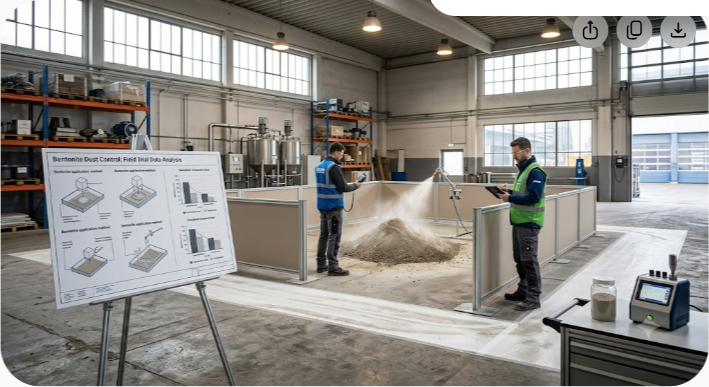
A small controlled trial can reveal problems before they become expensive. Test the treatment under representative traffic and weather conditions, then measure dust, surface strength, moisture behavior, and maintenance requirements.
A practical trial should produce measurable information rather than relying on visual impressions alone.
Start by selecting a representative section of the road, yard, embankment, or stockpile. Record the existing surface condition, traffic volume, material composition, and current watering or maintenance schedule.
Then apply one or more bentonite formulations at controlled rates. Keep the untreated area available as a comparison wherever practical.
Monitor:
This approach gives site managers a defensible basis for selecting the final treatment rate and application method.
Bentonite is a naturally occurring mineral, but that doesn't mean every bentonite product or application is automatically environmentally harmless. Product purity, associated minerals, site chemistry, application quantity, and local regulations all matter.
A responsible specification should include the supplier's product data and safety documentation, particularly when the material will be handled as a fine powder. Workers should follow the applicable dust-control and respiratory-protection requirements for handling dry mineral products.
The environmental advantage of bentonite is that it can provide physical stabilization without relying on soluble salts or certain synthetic organic binders. Still, operators should assess runoff, sediment movement, vegetation sensitivity, groundwater considerations, and the specific regulatory requirements of the site.
Bentonite also doesn't eliminate the need to control respirable dust generated by industrial processes. If the material contains respirable crystalline silica or another hazardous fraction, the site needs appropriate exposure assessment and engineering controls. A reduction in visible dust shouldn't be treated as proof that occupational exposure limits have been met.
The financial value of a bentonite treatment depends on what problem it solves. The strongest business case usually comes from combining dust reduction with improvements in road stability or maintenance.
If a treated road needs less frequent watering, the site may reduce water consumption, water-truck operating hours, fuel use, and labor requirements. The actual savings should be calculated from measured site data rather than from a generic percentage reduction.
A useful calculation compares the baseline cost of watering with the post-treatment cost over the same operating period. Include water, pumping, hauling, fuel, labor, equipment depreciation, and maintenance.
A well-designed stabilized surface may resist rutting, corrugation, and loss of fines better than an untreated road. Fewer grading cycles can translate into lower equipment hours and less disruption to traffic.
However, this benefit depends on proper road construction. Bentonite isn't a substitute for adequate aggregate, drainage, compaction, or subgrade preparation.
Reducing road dust can improve visibility for vehicle operators and reduce the amount of airborne particulate generated by traffic. That can contribute to a safer, cleaner working environment, although industrial operators should still monitor airborne concentrations where occupational exposure is a concern.
For some exposed stockpiles, reducing windblown fines may also reduce product loss. The economic benefit depends on the value and quantity of the material being lost and whether the surface treatment is compatible with reclaiming the stockpile.
| Observed Problem | Likely Cause | Recommended Corrective Action |
|---|---|---|
| Surface becomes slippery after rain | Excessive clay, poor grading, or inadequate aggregate structure | Review the application rate, add suitable granular material where appropriate, improve drainage, remix, and recompact |
| Dust returns quickly | Insufficient treatment, poor mixing, inadequate compaction, or unsuitable material | Inspect the treated depth and moisture condition, then conduct a controlled adjustment rather than simply adding more clay |
| Road develops deep ruts | Weak subgrade, poor base construction, drainage problems, or excessive moisture | Correct the structural problem, improve drainage, re-grade, and compact the road properly |
| Surface cracks or flakes | Excessive clay, uneven hydration, rapid drying, or poor surface preparation | Review the formulation and moisture control, then repair and retest the affected section |
| Bentonite forms lumps during mixing | Poor dispersion or insufficient mixing energy | Improve spreading and mechanical mixing; add water in a controlled manner rather than flooding the material |
| Treatment performs well when dry but fails in wet weather | Poor drainage or excessive swelling clay | Review drainage, soil composition, and bentonite dosage before modifying the treatment |
| Dust remains high around transfer points | Dust source is mechanical handling rather than exposed road surface | Use enclosure, local exhaust ventilation, filtration, misting, or other engineering controls suited to the process |
Before specifying bentonite for industrial dust control, answer these questions:
Supplier selection should focus on consistency rather than marketing claims alone. Ask for technical data covering mineral composition, swelling behavior, particle-size distribution, moisture content, and relevant quality-control specifications.
For road and soil stabilization projects, the supplier should also be able to discuss how the product behaves in different soil matrices. A bentonite grade that performs well in one application may not be appropriate for another.
A representative sample is valuable. Field or laboratory testing can compare candidate grades under the actual soil, aggregate, water, and compaction conditions expected at the site.
Product consistency matters just as much as peak performance. A treatment designed around one set of mineral properties can become unpredictable if subsequent shipments vary substantially in swelling or particle-size characteristics.
Bentonite can be an effective component of an industrial dust-control strategy when the problem involves loose fines on roads, exposed soil, embankments, or selected mineral surfaces.
Its value comes from more than moisture retention. Hydrated bentonite can swell, fill voids, and increase cohesion between fine and coarse particles. When that material is properly mixed and compacted, fewer loose particles remain available for wind and vehicle traffic to disturb.
The best results come from treating bentonite as an engineered soil binder rather than a universal dust suppressant. Soil composition, drainage, traffic, mineral grade, application rate, moisture, and compaction all matter.
Sodium bentonite is generally the stronger swelling grade, while calcium bentonite offers lower swelling and different handling characteristics. Neither is automatically the correct choice for every site.
Most importantly, don't select a dosage from a generic table and assume the job is finished. Run a representative trial, measure the results, inspect the treated surface through different weather conditions, and adjust the formulation to the site's actual requirements.
For mining, quarrying, construction, and industrial road applications, a consistent industrial-grade bentonite can be a useful part of a broader dust-abatement and surface-stabilization program. The right product and application method should be selected from measured field performance, not from swelling claims alone.













Have questions about our products? We're here to help!