Axewelledge, a leading exporter from India, specializes in high-quality Bentonite. With a commitment to excellence, we supply premium Bentonite to the Middle East and Southeast Asia markets.


North Angle Complex, 304,
150 Feet Ring Rd, Opposite Ambedkar Nagar BRTS Stop,
Madhav Park, Punit Nagar,
Mavdi, Rajkot, Gujarat 360004
© Axewelledge 2026, All Rights Reserved.
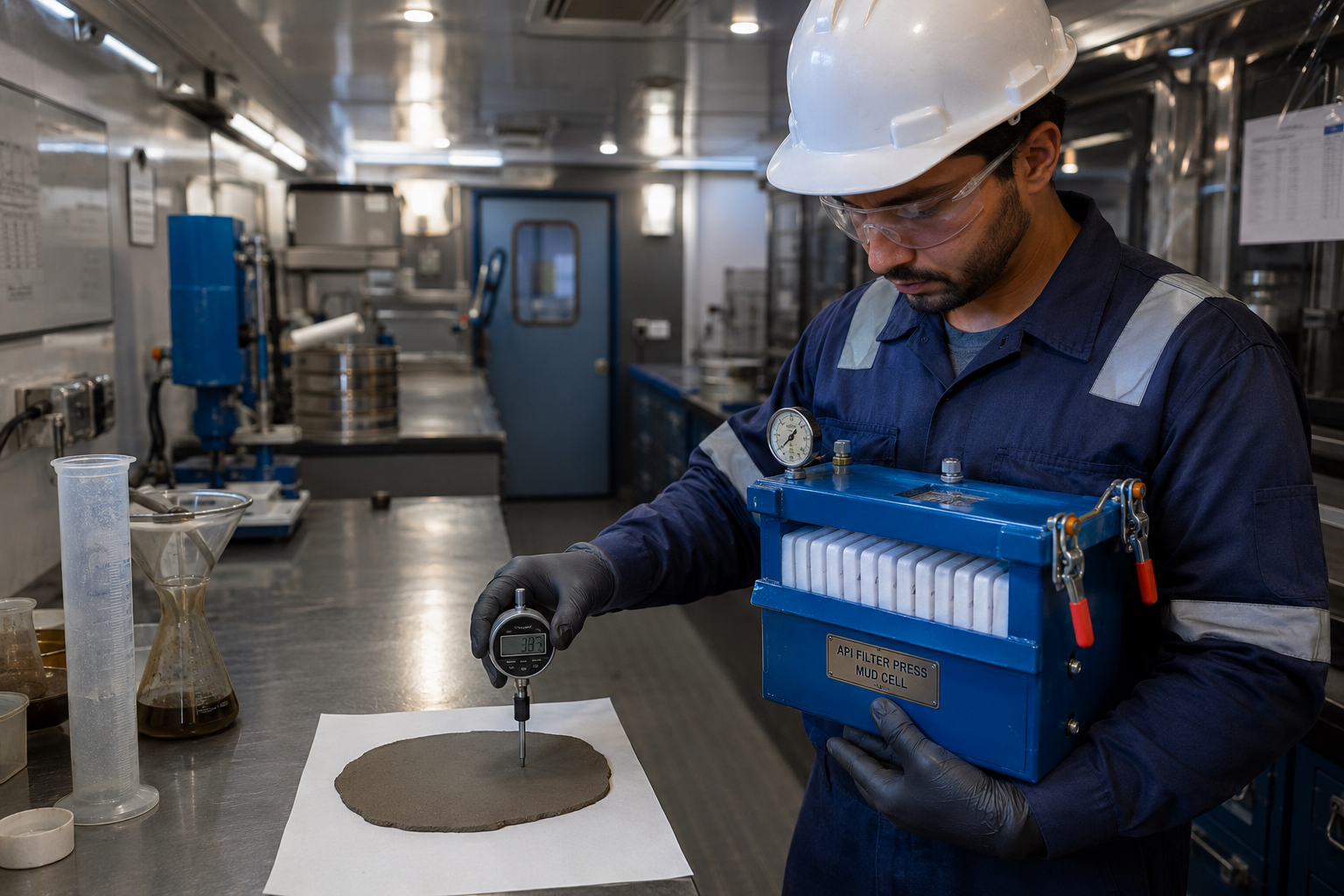
In horizontal directional drilling (HDD), the filter cake lining your borehole wall is the primary barrier separating a smooth pull from an expensive disaster. Measure it incorrectly—or ignore it entirely—and you open the door to differential sticking, excessive drag, borehole collapse, and inadvertent fluid returns.
To measure bentonite filter cake thickness accurately, run a standard API Low Pressure, Low Temperature (LPLT) filter press test at 100 psi for 30 minutes. Once the test concludes, measure the deposited mud cake on the filter paper using a specialized mechanical gauge or standard caliper calibrated in 32nds of an inch (or millimeters). A high-performing HDD filter cake should measure 2/32 inch (1.6 mm) or less—ideally 1/32 inch (0.8 mm)—while exhibiting low permeability, high slickness, and strong cohesion.
While filtrate volume gets most of the attention on daily mud reports, the physical property of the residual cake reveals far more about what is actually happening hundreds of feet underground. A thin, tough, impermeable cake holds sandy formations together and seals micro-fractures. A thick, spongy, soft cake grabs drill pipe, narrows the hole diameter, and increases swab and surge pressures.
This guide breaks down exact field measurement procedures, equipment setups, diagnostic formulas, and real-world corrective actions to keep your filter cake thin, slick, and structurally sound.
When high-yield sodium bentonite hydration occurs, flat, plate-like montmorillonite clay particles disperse into the fluid matrix. As drilling mud exerts hydrostatic pressure against permeable subterranean soils—like sand, gravel, or coarse silt—the water phase (filtrate) leaks off into the formation.
As water escapes, the suspended bentonite platelets stack up against the borehole wall. This physical accumulation forms the filter cake. The process breaks down into two distinct stages:
If your slurry relies on low-grade bentonite with inconsistent platelet sizing, the stack remains chaotic and porous. Water continues leaking off, building a thick, spongy cake to compensate for poor micro-sealing. High-yield sodium bentonite forms a dense, thin structure almost immediately, keeping total wall buildup minimal while virtually stopping fluid loss.
Accurate field measurement requires proper tool selection. Using improvised measurement tools like standard tape measures or rough visual estimation introduces errors that obscure critical mud changes.
| Tool Name | Primary Function | Ideal Measurement Precision | Recommended Field Role |
|---|---|---|---|
| API LPLT Filter Press | Simulates cake deposition under 100 psi pressure over 30 minutes. | Standard 3.0-inch cell size | Primary quantitative baseline test for drilling fluids. |
| Digital/Mechanical Cake Thickness Gauge | Directly measures cake height without crushing delicate clay structure. | 1/64 inch or 0.1 mm increments | Standard field measurement across mud testing labs. |
| Vernier / Digital Caliper | Measures total thickness (paper + cake) minus paper thickness. | 0.01 mm / 0.001 inch | Secondary backup when dedicated thickness gauges are unavailable. |
| Vernier Depth Micrometer | Non-destructive top-down height measurement resting on the cell ring. | 0.01 mm | Precise laboratory and quality control applications. |
| Wet Film Thickness Gauge (Comb Style) | Quick check of mud film thickness on metal downhole tooling. | 25 to 2000 microns | Rapid spot-checking of surface adhesion and coating quality. |
The standard API Low Pressure, Low Temperature (LPLT) filter press consists of:
Follow this six-step field testing workflow to produce repeatable, actionable filter cake data:
Take a fresh drilling fluid sample directly from the active mud line or suction tank, not the pit returns where heavy cutting contamination alters results. Stir the sample thoroughly for 60 seconds to ensure homogeneous particle distribution without trapping macro-air bubbles.
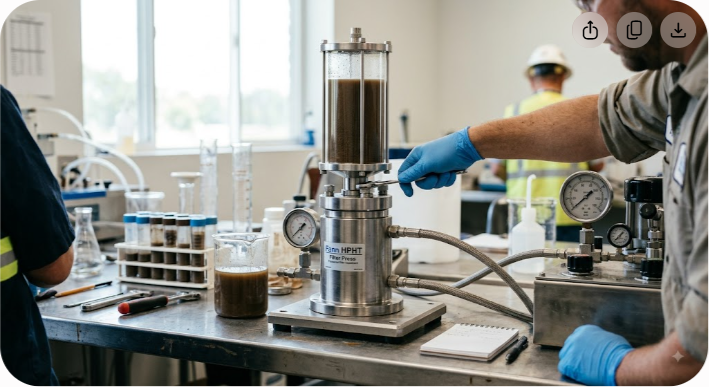
Once washed, measure the physical thickness of the mud deposit adhering to the filter paper. In North American HDD operations, cake thickness is traditionally reported in 32nds of an inch. Globally, millimeters (mm) or microns are standard.
If using a digital caliper:
| Fractional Value (Inches) | 32nds Designation | Millimeters (mm) | Microns (?m) | Field Assessment |
|---|---|---|---|---|
| 1/64 in | 0.5 / 32 in | ~0.4 mm | ~400 ?m | Exceptional (High-yield polymer/bentonite) |
| 1/32 in | 1 / 32 in | ~0.8 mm | ~800 ?m | Ideal Target for HDD Operations |
| 1/16 in | 2 / 32 in | ~1.6 mm | ~1600 ?m | Acceptable Upper Limit |
| 3/32 in | 3 / 32 in | ~2.4 mm | ~2400 ?m | Poor (High risk of stickiness and drag) |
| 1/8 in | 4 / 32 in | ~3.2 mm | ~3200 ?m | Critical Defect (Immediate mud treatment required) |
Thickness is only one variable. A 1/32-inch filter cake can fail downhole if it lacks structural integrity. When assessing the cake after measurement, perform a manual tactile inspection and record three key physical attributes on your daily mud report:
Rub a small portion of the cake between your thumb and index finger. It should feel slick, slippery, and completely smooth, like soft grease or butter. If it feels gritty, fine drill solids or unhydrated sand are incorporated into the matrix. Gritty cakes drastically increase rotational torque and pipe drag during pullbacks.
Bend the filter paper slowly over your index finger to a 45-degree curve.
A brittle filter cake will crack under downhole pressure surges, destroying hydraulic isolation and causing sudden fluid loss spikes in permeable zones.
Press your finger gently onto the cake surface.
While direct physical measurement yields immediate field numbers, integrating thickness into mathematical fluid models helps optimize bentonite dosing and polymer additive ratios.
The fundamental hydraulic conductivity of the filter cake can be calculated using Darcy's Law modified for filtration:
k= A??P?t V f ?
?h c ?
?? ?
Where:
f ?
= Total filtrate volume (cm 3 )
c ?
= Measured filter cake thickness (cm)
2 for standard API cell)
Takeaway: A higher cake thickness (h c ?
) accompanied by high filtrate volume (V f ?
) indicates extreme cake permeability—a clear signal that clay particles are aggregated rather than fully dispersed.
A quick operational metric used by mud engineers on high-risk HDD crossings is the C/F ratio:
$$ ext{C/F Ratio} = rac{ ext{Filter Cake Thickness (in 32nds)}}{ ext{30-Minute API Filtrate Loss (mL)}}$$
If your C/F ratio spikes above 0.20, unhydrated solids or low-quality clay are swelling the cake without providing fluid loss control.
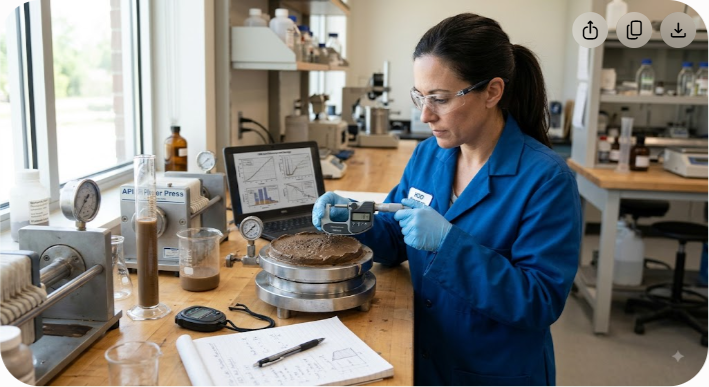
Understanding why cake thickness matters helps crews justify spending time on daily fluid tests. In horizontal directional drilling, the mud cake acts as a flexible conduit liner.
| Operational Property | Thin, Slick Filter Cake (1/32 in) | Thick, Soft Filter Cake (3/32+ in) |
|---|---|---|
| Wall Interaction | Dense, slick protective layer against formation face. | Soft, spongy wall mass that restricts hole diameter. |
| Pipe Movement | Drill string and product pipe slide with minimal friction. | Pipe sinks into cake under pressure, causing high drag. |
| Sticking Hazard | Low surface contact prevents differential sticking. | High suction contact area creates high differential sticking risk. |
| Hydraulic Flow | Full annular clearance maintains steady returns. | Restricted clearance creates high swab and surge pressures. |
Differential sticking occurs when drill pipe or product pipe is pulled firmly against the wall of the borehole by the difference between hydrostatic mud pressure and formation pressure.
When a thick, compressible filter cake is present, the pipe buries itself into the soft wall lining. The contact surface area between the steel pipe and the mud cake expands dramatically. Hydrostatic pressure acts on the back of the pipe, sealing it against the cake like a suction cup.
A thin (1/32 in), hard, slick cake prevents the pipe from embedding itself, drastically lowering total surface contact area and maintaining a lubricating barrier that slashes pullback forces.
When filter cake thickness swells, the effective internal diameter of the borehole shrinks. As you push product pipe or run large reamers, fluid must flow backward around the tool string to reach the exit pit.
A narrowed borehole restricts fluid clearance, causing severe swab and surge pressures downhole. These pressure spikes easily exceed formation pressure limits, rupturing overlying ground strata and sending bentonite slurry erupting to the surface (frac-out).
When field testing reveals a cake exceeding 2/32 inch (1.6 mm), systematically identify and resolve the root cause using this diagnostic matrix.
| Observed Symptom | Primary Cause | Immediate Field Correction | Long-Term Prevention |
|---|---|---|---|
| Thick cake (>2/32 in) + High fluid loss (>15 mL) | Low bentonite concentration or low-yielding commercial clay. | Dose with high-yield API Premium Sodium Bentonite; add PAC (Polyanionic Cellulose). | Upgrade raw bentonite source to high-yield API Grade sodium bentonite. |
| Thick cake (>3/32 in) + Low fluid loss (<8 mL) | Excessive inert drill solids buildup (drilled fine sand/silt contamination). | Dump and dilute active system with fresh water; maximize solids control equipment. | Improve shale shaker screen mesh sizing and optimize desander/desilter hydrocyclones. |
| Brittle, cracking filter cake | Calcium/magnesium hard water contamination causing clay flocculation. | Pre-treat make-up water with Soda Ash (Na2CO3) to precipitate hardness below 100 ppm. | Always test and treat raw make-up water sources before adding bentonite. |
| Spongy, high-porosity cake | High thermal or mechanical shear degradation of polymer chains. | Introduce high-molecular-weight starch or CMC (Carboxymethyl Cellulose) filtration control additives. | Maintain proper fluid mixing shear rates and monitor downhole temperature thresholds. |
| Sticky, high-drag cake | High sand content embedded directly into the wall matrix. | Add liquid mud lubricants (ester or glycol-based) to reduce coefficient of friction. | Increase fluid yield point to sweep coarse sand completely out of the borehole. |
Not all bentonite clays perform identically downhole. The structural quality of your filter cake depends directly on the mineral composition of the bentonite base.
| Bentonite Type | Particle Hydration & Alignment | Filter Cake Result |
|---|---|---|
| Low-Grade Calcium Bentonite | Flocculated packets with large internal void gaps. | Thick, porous, leaky cake with poor structural integrity. |
| Premium API Sodium Bentonite | Fully hydrated platelets in thin, dense overlapping layers. | Thin, tough, highly impermeable protective seal. |
2+ ) bonding clay layers together tightly. When mixed with water, it swells minimally (only 2 to 4 times its dry volume) and forms large, aggregated clumps. This yields a thick, porous, weak filter cake with massive fluid loss.
+ ). It hydrates fully, swelling 15 to 18 times its original dry volume. In fresh water, it delaminates into hundreds of millions of individual microscopic platelets per gram. These micro-platelets align flat against porous formations, creating an ultra-thin (1/32 in), highly impermeable seal.
To achieve elite filter cake performance on difficult HDD crossings (such as cobble, coarse riverbed gravel, or deep saline conditions), high-yield sodium bentonite is combined with specialized polymers:
HDD contractors operate worldwide, and testing terminology and specifications vary across regions. Understanding these differences ensures seamless site execution and client compliance.
| Parameter / Standard | North America (API / DCA) | Europe (ISO / DIN) | Asia-Pacific / Middle East |
|---|---|---|---|
| Primary Governing Standard | API Specification 13A / RP 13B-1 | ISO 10414-1 / DIN 4127 | API / ISO Localized Adapts |
| Cake Thickness Unit | 32nds of an inch (or fractions) | Millimeters (mm) | Millimeters (mm) / 32nds |
| Standard Target Thickness | ?1/32 in to 2/32 in | ?0.8 mm to 1.5 mm | ?1.0 mm |
| Filtrate Loss Unit | mL/30 min at 100 psi | cm 3 /30 min at 700 kPa | mL/30 min at 100 psi | | Water Quality Baseline | Total Hardness <100 ppm, pH 8.5–9.5 | Hardness <10 ? dGH, pH 8.5–10 | Total Hardness <100 ppm, pH 9.0–10.0 |
Regardless of unit standards, the core engineering physics remains identical: thinner and lower permeability is always better.
To ensure your HDD fluid consistently builds ultra-thin, high-strength filter cakes throughout a bore, enforce this four-stage operational sequence:
Never add bentonite directly to untreated raw water from municipal lines, ponds, or rivers. High calcium levels (hard water) cause bentonite particles to clump together (flocculate).
Bentonite needs mechanical energy to yield fully. Use high-shear venturi hoppers and continuous recirculation pumps. Allow a minimum of 15 to 30 minutes of hydration time before pumping slurry downhole. Unhydrated bentonite lumps simply act as inert sand grains, swelling filter cake thickness without providing sealing capacity.
Mechanical separation equipment is your primary defense against thick filter cakes. If your desanders and shakers allow fine drilled solids (<74 microns) to recirculate through the fluid system, those solids become trapped in the filter cake matrix. This inflates cake thickness rapidly while increasing torque.
Fluid conditions change rapidly during HDD bores as you cross varying soil strata. Conduct API filter press tests at minimum:
Even the most rigorous testing procedures and polymer additive regimes cannot fix a fluid system built on low-grade, inferior clay. Achieving a paper-thin, durable filter cake consistently requires high-yield sodium bentonite processed to exact particle size distribution standards.
Axewelledge is India's largest mine owner and exporter of premium sodium bentonite, ranking among the top global mineral producers with over 60 million tons of high-grade reserves. Strategically refined and tested to exceed API 13A international standards, Axewelledge bentonite delivers exceptional swelling capacity, rapid yield, and ultra-low fluid loss characteristics.
Whether you are executing a long-distance river crossing, navigating reactive clay formations, or pulling large-diameter steel pipe through sensitive urban corridors across North America, the Middle East, or Southeast Asia, Axewelledge provides stable, sustainable bentonite solutions designed for tough HDD environments.
Explore Axewelledge High-Yield Drilling Bentonite Solutions at https://axewelledge.com.
Keep this quick checklist pinned inside your field fluid testing trailer:













Have questions about our products? We're here to help!