Axewelledge, a leading exporter from India, specializes in high-quality Bentonite. With a commitment to excellence, we supply premium Bentonite to the Middle East and Southeast Asia markets.


North Angle Complex, 304,
150 Feet Ring Rd, Opposite Ambedkar Nagar BRTS Stop,
Madhav Park, Punit Nagar,
Mavdi, Rajkot, Gujarat 360004
© Axewelledge 2026, All Rights Reserved.
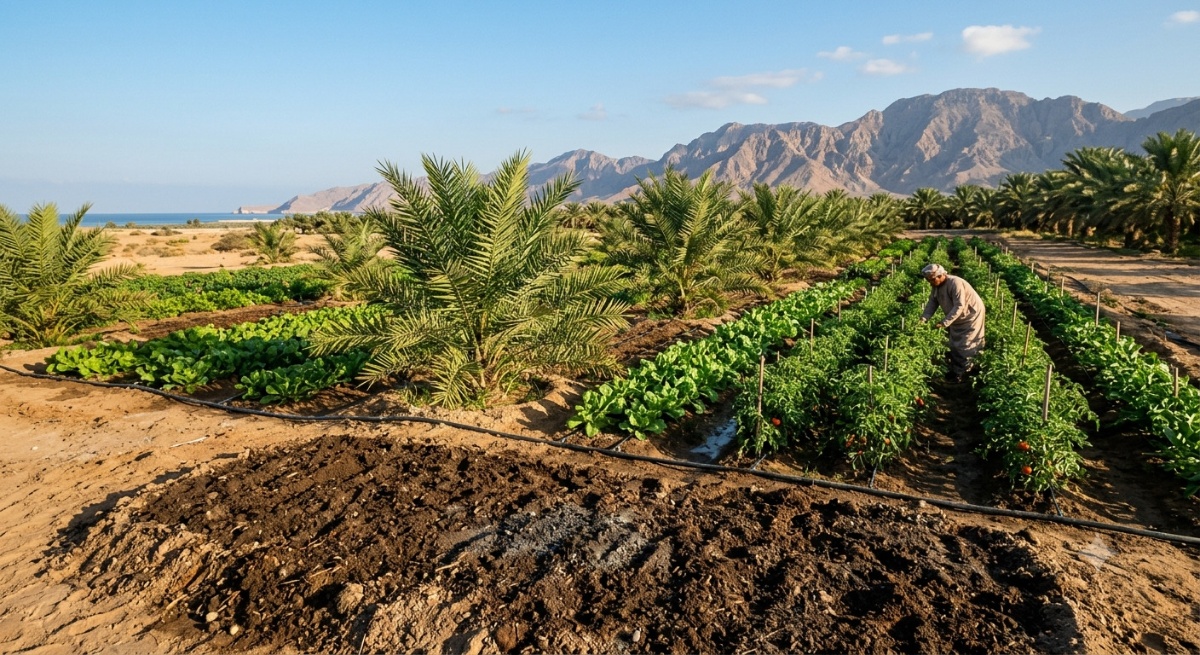
Oman’s agricultural sector is undergoing a massive transformation. With the Sultanate’s Vision 2040 heavily emphasizing food security and sustainable water management, farmers, landscapers, and agricultural enterprises are actively seeking innovative ways to turn hyper-arid desert sands into productive, high-yielding soils.
Among the most effective, natural, and economically viable solutions gaining traction across the region is Bentonite clay.
When applied to sandy and degraded soils, this naturally occurring volcanic ash residue acts as a powerful soil conditioner, completely altering the soil's physical and chemical structure. Here is a comprehensive look at how Bentonite is revolutionizing agriculture in Oman, how it works, and how to apply it effectively.
Agriculture in Oman faces severe environmental bottlenecks. The country’s landscapes are dominated by Batinah’s coastal plains, interior deserts, and rugged terrains where the prevailing soil type is predominantly sandy (Entisols and Aridisols).
These soils present several distinct challenges:
Low Water Holding Capacity (WHC): Irrigation water quickly percolates right past the root zone, leading to massive water waste and crop dehydration.
Nutrient Leaching: Essential fertilizers (such as Nitrogen, Phosphorus, and Potassium) wash away with the water before plants can absorb them.
High Salinity and Evaporation: Extreme summer temperatures accelerate evaporation, leaving behind high salt concentrations that stunt plant growth.
To overcome these hurdles, the soil matrix must be physically modified to retain moisture and nutrients. This is exactly where Bentonite clay excels.
Bentonite is an absorbent aluminum phyllosilicate clay formed primarily from the weathering of volcanic ash in the presence of water. It is highly valued for its unique crystalline structure, which gives it incredible swelling capabilities and a massive surface area.
There are two primary types of Bentonite, categorized by their dominant element:
Sodium Bentonite: Known for its high swelling capacity. It can expand to many times its dry volume when mixed with water, making it excellent for sealing dams, ponds, and trapping moisture.
Calcium Bentonite: Features a lower swelling capacity but possesses excellent ion-exchange properties, making it highly effective for soil conditioning and nutrient delivery.
For agricultural purposes, a carefully selected grade of Bentonite acts as a permanent structural modifier, binding with loose sand particles to create a stable, fertile loamy soil texture over time.
In a country where water is a precious and limited resource, optimizing irrigation is crucial. When Bentonite is incorporated into sandy soils, the clay particles fill the large macro-pores between sand grains.
When water hits the soil, the Bentonite swells and holds onto the moisture, creating a sub-surface reservoir right at the root level. This can reduce irrigation water requirements by up to 30% to 50%, preventing deep percolation and saving massive amounts of pumping energy and water costs.
Sandy soils have virtually no electrical charge, meaning they cannot hold onto positively charged plant nutrients ($Ca^{2+}$, $Mg^{2+}$, $K^+$, $NH_4^+$). They simply wash away.
Bentonite clay possesses a highly negative electrical charge. When added to the soil, it dramatically increases the soil's Cation Exchange Capacity (CEC). It acts like a chemical magnet, holding onto vital nutrients from fertilizers and releasing them slowly as the plant roots demand them. This prevents nutrient leaching and maximizes fertilizer efficiency.
Unlike organic soil conditioners (like compost or peat moss) that break down, oxidize, and disappear within one or two hot Omani summers, Bentonite is a mineral and does not degrade. Once applied and mixed thoroughly into the soil, it remains a permanent part of the soil matrix, continuously providing conditioning benefits year after year.
While Bentonite doesn't remove salt, its high water-retention capacity helps dilute the salt concentration within the soil solution. By maintaining a more consistent moisture level around the roots, it prevents the drastic spikes in osmotic pressure that occur when sandy soils dry out completely, protecting sensitive crops from salt shock.
When planning a soil amendment strategy, it helps to understand how Bentonite compares to other common materials used in Omani agriculture:
| Feature/Property | Bentonite Clay | Peat Moss / Compost | Perlite / Vermiculite |
| Primary Function | Water retention & CEC upgrade | Organic matter & nutrients | Aeration & lightweight drainage |
| Longevity in Soil | Permanent (Mineral-based) | Temporary (1–2 years max) | Long-term (Fragile to crushing) |
| Cation Exchange (CEC) | Very High | High (while active) | Low to Medium |
| Water Retention Mechanism | Swelling and internal absorption | Sponge-like fibrous trapping | Surface tension capillary trapping |
| Best Used For | Sandy soil structural rebuilding | Nutrient boosting & microbes | Potting mixes & hydroponics |
To achieve optimal results, Bentonite must be applied correctly based on the target crop and existing soil conditions.
Soil Testing: Determine your current soil texture and baseline pH.
Dosage calculation: Generally, an application rate of 10 to 20 tonnes per hectare (approx. 1 to 2 kg per square meter) is recommended for sandy soils, depending on the sand-to-clay ratio desired.
Spreading: Uniformly broadcast the granular or powdered Bentonite over the soil surface.
Tilling: Till or rotavate the clay into the top 20 to 30 cm of the soil profile (the active root zone).
Initial Irrigation: Water the area thoroughly to allow the clay to swell, activate, and bind with the sand particles before planting.
Pit Preparation: When digging the planting hole for a new sapling, set aside the excavated sandy soil.
Mixing: Blend 2 to 5 kg of Bentonite thoroughly with the excavated sand, along with organic compost.
Backfilling: Fill the hole back up around the root ball with the modified mixture. This creates a highly retentive localized "bucket" that keeps the young tree hydrated and fed.
Mix Bentonite at a rate of 1.5 kg per square meter into the top 15 cm of soil before laying down turf grass or hydroseeding. This prevents patches of the lawn from drying out unevenly.
Achieving successful results relies heavily on utilizing high-purity minerals designed for environmental and agricultural applications.
If you are looking to acquire top-tier raw materials, you can discover a wide range of industrial minerals by exploring the specialized industrial minerals product list available for regional distribution.
Additionally, if your operations span across broader civil engineering, environmental engineering, or water management sectors alongside agriculture, you can browse through the comprehensive product catalog to find targeted solutions tailored to Middle Eastern soil dynamics.
Using Bentonite aligns seamlessly with the environmental goals of Oman's Vision 2040. By optimizing water consumption, agricultural operations can reduce their reliance on over-pumped groundwater aquifers, stopping seawater intrusion in coastal zones like Al-Batinah. Furthermore, by making fertilizers more efficient, it reduces the risk of chemical runoff polluting surrounding environments.
For a deeper dive into how specialized minerals, aggregates, and advanced chemical products are driving infrastructural and ecological advancements across the region, feel free to read through our dedicated industrial minerals blog updates for expert insights and market trends.
[ ] Identify Soil Weakness: Confirm if high water percolation or low fertilizer retention is hindering your yield.
[ ] Select the Right Grade: Use agricultural-grade Bentonite that offers optimal swelling and CEC balances.
[ ] Calculate Quantities: Target roughly 1–2 kg per square meter for general open fields.
[ ] Integrate Deeply: Ensure the mineral is thoroughly mixed into the root zone (20–30 cm deep), not just left on the surface.
[ ] Combine with Organics: For the absolute best results, combine Bentonite with organic compost to build a complete, resilient soil ecosystem.
By investing in the structural health of Oman’s soils today, farms and landscaping projects can secure long-term productivity, massive water savings, and resilient green spaces for generations to come.













Have questions about our products? We're here to help!