Axewelledge, a leading exporter from India, specializes in high-quality Bentonite. With a commitment to excellence, we supply premium Bentonite to the Middle East and Southeast Asia markets.


North Angle Complex, 304,
150 Feet Ring Rd, Opposite Ambedkar Nagar BRTS Stop,
Madhav Park, Punit Nagar,
Mavdi, Rajkot, Gujarat 360004
© Axewelledge 2026, All Rights Reserved.
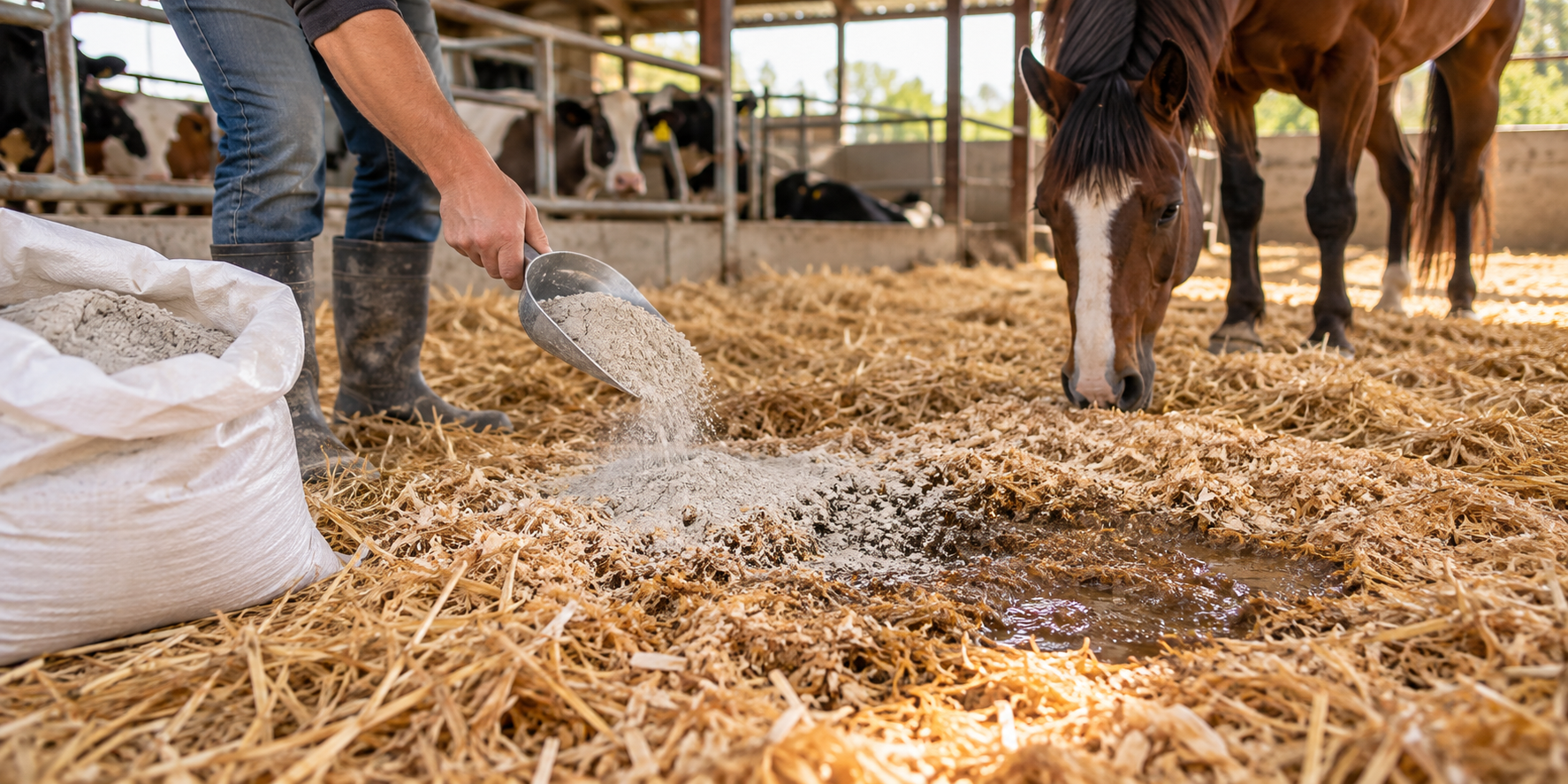
Bentonite can help control moisture in animal bedding, but it works best as part of a complete bedding-management system rather than as a stand-alone solution. Suitable grades can take up liquid, swell, and retain moisture, making them useful for localized wet spots caused by urine, spilled water, or other liquid waste.
The important question isn't simply whether bentonite absorbs water. It does. The better question is whether a particular bentonite grade, applied in the right way, improves the bedding system enough to justify its cost, handling requirements, and disposal considerations.
That depends on the animal, the bedding material, the source of moisture, the mineral grade, and the way the enclosure is managed.
Bentonite is a naturally occurring clay-rich material containing a high proportion of smectite minerals, particularly montmorillonite. Its properties vary considerably depending on mineral composition, geological source, processing, particle size, moisture content, and other product characteristics.
The two broad types buyers commonly encounter are sodium bentonite and calcium bentonite. They don't behave identically in contact with water. Sodium bentonite is generally associated with stronger swelling and water-retention behavior, while calcium bentonite typically shows lower swelling and different absorption characteristics.
That distinction matters when bentonite is being considered for moisture management.
Bentonite is already used in several industries, including drilling, foundry applications, sealing, absorbent products, and waste-management systems. However, a product being made from bentonite doesn't automatically make it suitable for animal bedding.
For bedding applications, the useful property is the mineral's interaction with liquid. When a suitable grade comes into contact with water, the clay particles hydrate. In sodium bentonite, water can enter between the mineral layers, causing the material to swell and retain moisture.
The result can be useful in places where liquid tends to collect. But the mineral still has limits. Once its available absorption capacity is reached, the material needs to be managed or removed like other saturated bedding components.
Yes. Suitable bentonite can help control moisture in animal bedding by absorbing and retaining liquid. Sodium bentonite is particularly known for its swelling and water-retention behavior, which can make it useful where localized wetness is a recurring problem.
There is, however, an important difference between controlling localized moisture and keeping an entire animal enclosure dry.
Bentonite can capture liquid that reaches the mineral. It can't repair a leaking drinker, stop rain from entering an open shelter, correct poor drainage, or replace routine bedding changes. If the moisture entering the system is greater than the bedding and mineral can manage, saturation will eventually occur.
A practical moisture-control system usually has several parts:
Bentonite is most useful when it solves a defined moisture problem rather than being added simply because the bedding feels damp.
Bentonite's moisture-control properties come from its clay mineral structure and large reactive surface area. In suitable grades, water interacts with the surfaces and layers of the clay minerals. This hydration can cause the particles to swell and hold water within the hydrated mineral mass.
Sodium bentonite is particularly well known for this behavior. When hydrated, it can form a dense, gel-like material. That swelling response is one reason sodium bentonite is used in applications where controlling water movement is important.
Particle size also affects performance. Fine particles generally offer more surface area and can react with liquid quickly. Coarser particles may behave differently during handling and distribution and may produce less airborne dust than very fine powders, depending on the formulation.
For animal bedding, maximum absorption isn't the only target. A material that absorbs aggressively but creates excessive dust, is difficult to distribute, or isn't appropriate for direct animal contact may be a poor practical choice.
A suitable bedding additive needs to balance several factors:
That's why buyers should evaluate the complete product specification instead of choosing bentonite based on the mineral name alone.
Moisture affects much more than how dry bedding feels underfoot. Persistent wetness can make bedding heavier, harder to clean, and less comfortable. It can also contribute to odor and faster accumulation of organic waste.
Urine is often a major source of localized moisture, but it isn't the only one. Leaking drinkers, spilled water, rain, condensation, washing activities, and poor drainage can all contribute.
Wet spots also tend to develop in predictable places. Areas near waterers, feeding points, resting areas, corners, and heavily used sections may receive more liquid than the rest of the enclosure.
Once bedding becomes saturated, adding more dry material isn't always the most efficient answer. The underlying source may need attention, and heavily contaminated bedding usually needs to be removed.
Effective moisture management can help:
Still, a dry surface isn't proof that an enclosure is clean. Bedding management has to consider moisture, manure, hygiene, ventilation, and animal comfort together.
Bentonite can be used in a range of animal-related absorbent and bedding applications, but suitability depends on the exact product and the intended use.
This is an important distinction for buyers. Bentonite produced for drilling fluids, foundry work, industrial sealing, or another technical application should not automatically be placed in an animal enclosure. Mineral composition, processing, particle size, contaminants, dust behavior, and intended-use requirements all need to be considered.
Potential applications may include:
The requirements can differ significantly between horses, cattle, poultry, goats, sheep, and other animals. A product that works well in one environment isn't automatically appropriate for another.
For that reason, product selection should begin with the animal and application, not simply with a preferred type of bentonite.
Horse bedding shows why moisture absorption is only one part of the decision.
A horse spends substantial time standing and resting on its bedding. The material therefore needs to provide a comfortable surface, manage urine effectively, remain practical to clean, and avoid creating unnecessary dust.
Bentonite may be considered as an absorbent component rather than a complete replacement for the main bedding material. Depending on the stable and product, it could be used alongside straw, wood-based bedding, or another suitable material to help manage localized wet areas.
Dust deserves particular attention. Fine mineral products can become airborne during pouring, spreading, sweeping, and stall cleaning. A product's particle-size distribution and handling characteristics should therefore be reviewed before use.
Horse owners and stable managers evaluating bentonite should ask suppliers for information about intended use, particle size, product composition, storage, handling, and relevant safety documentation.
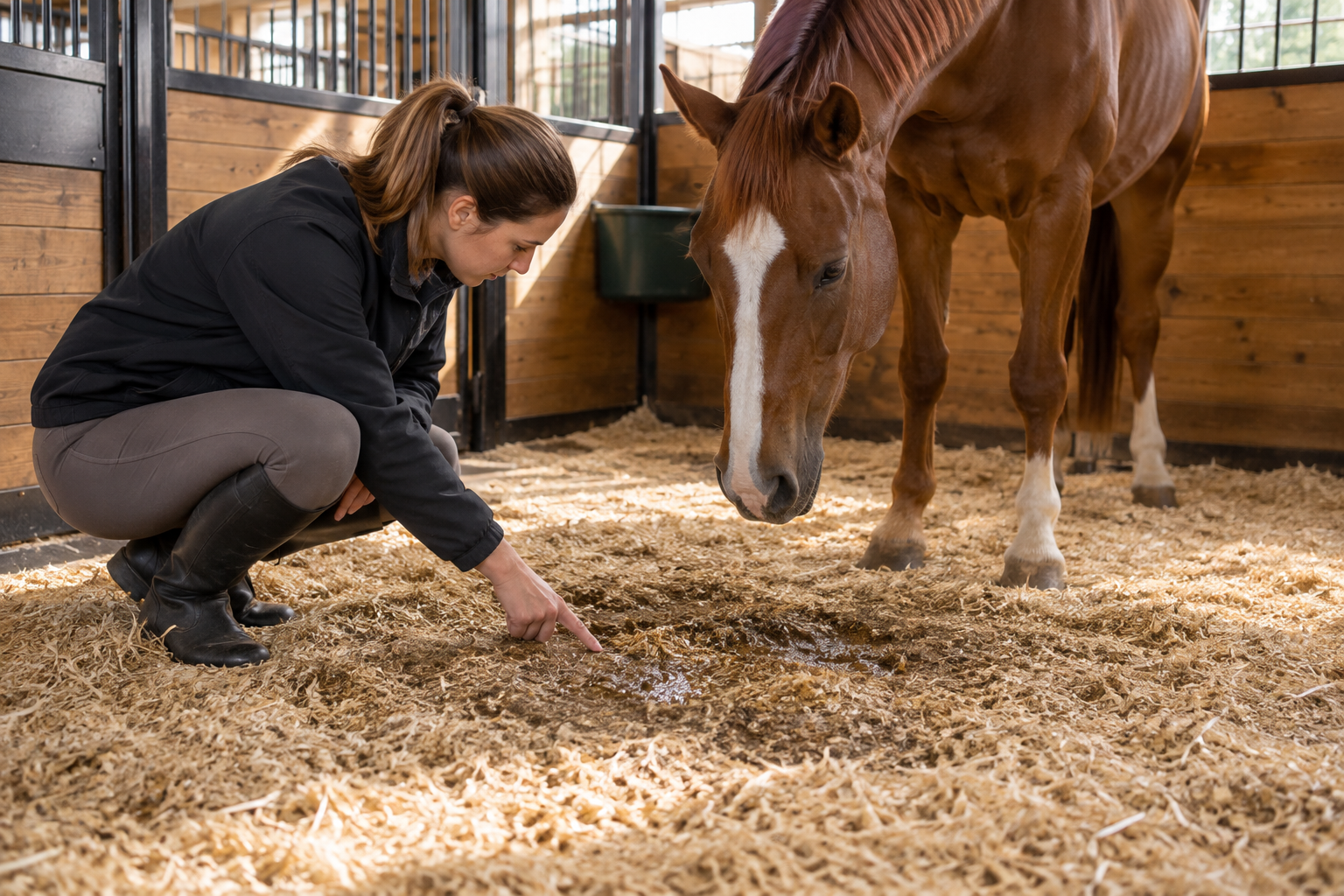
A small trial is also preferable to changing an entire stable at once. It gives you a chance to see how the material behaves during normal mucking and bedding cycles.
Poultry housing presents a different moisture-management challenge. Droppings, drinker performance, litter depth, ventilation, stocking density, and environmental conditions all influence litter moisture.
The objective isn't simply to make litter absorb as much liquid as possible. Good litter management starts by controlling the sources of excess moisture.
For example, if litter is repeatedly wet around drinkers, check the drinker height, pressure, leakage, and surrounding setup before increasing the amount of absorbent material. If moisture is widespread throughout the house, ventilation and environmental conditions may deserve more attention.
Bentonite may have a role as a mineral absorbent or bedding additive where the specific product and management system support its use. It should complement good poultry-house management rather than compensate for persistent equipment or ventilation problems.
The same principle applies across animal agriculture: identify the moisture source first, then decide whether additional absorbency is actually needed.
Livestock bedding has to deal with urine, manure, animal traffic, water, and regular cleaning. For larger operations, the economics of handling those materials can be just as important as the mineral's laboratory absorption characteristics.
Bentonite may be useful in areas where liquid repeatedly accumulates. The practical value depends on whether it reduces wetness, lowers bedding consumption, makes cleaning easier, or improves another measurable part of the operation.
For a commercial facility, don't compare bentonite solely by price per kilogram or tonne. Compare the total cost of achieving the required moisture-management result.
Before adopting a product, consider:
These questions provide a more useful basis for a purchasing decision than the mineral's price alone.
Bentonite and conventional bedding materials aren't necessarily competing products. In many applications, they perform different jobs.
| Feature | Bentonite | Wood-Based Bedding | Straw | Sand-Based Bedding |
|---|---|---|---|---|
| Moisture management | Strong for suitable grades | Moderate to high, depending on product | Moderate and highly management-dependent | Variable |
| Swelling behavior | High for suitable sodium bentonite | None | None | None |
| Cushioning | Limited | Good | Good | Moderate |
| Odor management | Can support moisture control | Depends on moisture and cleaning | Depends strongly on moisture and management | Variable |
| Primary role | Absorbent mineral or additive | Primary bedding material | Primary bedding material | Bedding surface or material |
| Dust considerations | Depends on particle size and formulation | Depends on product | Usually lower than fine mineral powders | Depends on material and conditions |
| Cleanup | Usually handled with surrounding bedding | Established bedding-management methods | Established bedding-management methods | Requires site-specific handling |
The comparison shows why a blended system can sometimes make sense. Bentonite can contribute absorbency, while a conventional bedding material provides the physical volume and cushioning needed by the animal.
The best combination depends on animal species, housing conditions, moisture load, labor, disposal requirements, product specifications, and total operating cost.
There isn't one universal application rate for bentonite in animal bedding.
The required amount depends on the mineral grade, particle size, moisture source, primary bedding, enclosure design, animal species, and desired outcome. Manufacturer guidance should take priority over a generic rate taken from another product.
If a supplier provides an application recommendation specifically for the intended use, use that as the starting point. Where no established rate is available, a controlled trial is safer and more informative than treating an entire facility immediately.
A useful trial can compare a normal bedding area with a comparable area using the proposed bentonite product. Keep the conditions as similar as possible and monitor the same measures over the same period.
Useful measurements include:
The goal isn't to prove that bentonite absorbs water. The goal is to determine whether it improves the real bedding system.
A small, controlled trial can reveal more than a product specification alone. The following process works well as a starting framework for farms, stables, shelters, and other animal facilities.
Determine whether the main problem comes from urine, manure, leaking drinkers, rain, condensation, cleaning water, or several sources at once.
Don't start by adding absorbent material everywhere. First find out what is making the bedding wet.
Map the areas that repeatedly become damp. Look around waterers, feeding areas, corners, resting zones, entrances, and low points where liquid may collect.
A localized problem may need a localized solution.
Confirm that the product is appropriate for the proposed animal-related application. Review its mineral type, particle size, product specifications, storage requirements, and relevant safety documentation.
Fine mineral powders can become airborne during handling. Consider how the product will be unloaded, stored, spread, mixed, and removed before committing to a large purchase.
Use a limited area and maintain normal cleaning and bedding routines. The trial should cover enough of the normal operating cycle to reveal how the product behaves under real conditions.
Don't judge performance only by how the material looks immediately after application. Track wet spots, bedding use, cleaning effort, odor, dust, and the condition of the underlying bedding.
Include the purchase price of bentonite, primary bedding, labor, storage, cleaning, transportation, and disposal where relevant.
If the trial produces a clear improvement without creating new handling or animal-management problems, expand the application gradually. Continue checking the results after scaling up.
Bentonite can help with odor management indirectly by controlling some of the moisture associated with urine and waste. It should not, however, be presented as a universal odor eliminator.
Odor in animal housing can result from manure, urine, moisture, microbial activity, decomposition, ventilation, and waste accumulation. Reducing persistent wetness can improve conditions, but the mineral doesn't remove the waste that produces the odor in the first place.
Regular removal of manure and saturated bedding remains essential. So does adequate ventilation and sensible enclosure management.
For a commercial facility, investigate the full system if odor is the main concern. Check moisture levels, ventilation, cleaning frequency, stocking density, drinker performance, drainage, and waste storage rather than simply increasing the amount of absorbent mineral.
Bentonite can be one useful tool. It isn't a substitute for housekeeping.
Bentonite can be effective when properly selected and applied, but several common mistakes can undermine the result.
Not every bentonite product is suitable for animal-related use. A material made for an industrial application should not be assumed appropriate for direct animal contact simply because it has good water absorption.
Bentonite primarily contributes moisture management. It doesn't necessarily provide the cushioning, bulk, surface structure, or comfort expected from a primary bedding material.
A leaking waterer can overwhelm any practical absorbent system. Repairing the source is usually more effective than continually adding more mineral.
Fine particles can become airborne during handling and cleaning. Review the product's particle size and dust characteristics and use appropriate handling practices.
Absorbency has a limit. Once material is heavily loaded with liquid and waste, adding more dry absorbent doesn't eliminate the need to remove contaminated bedding.
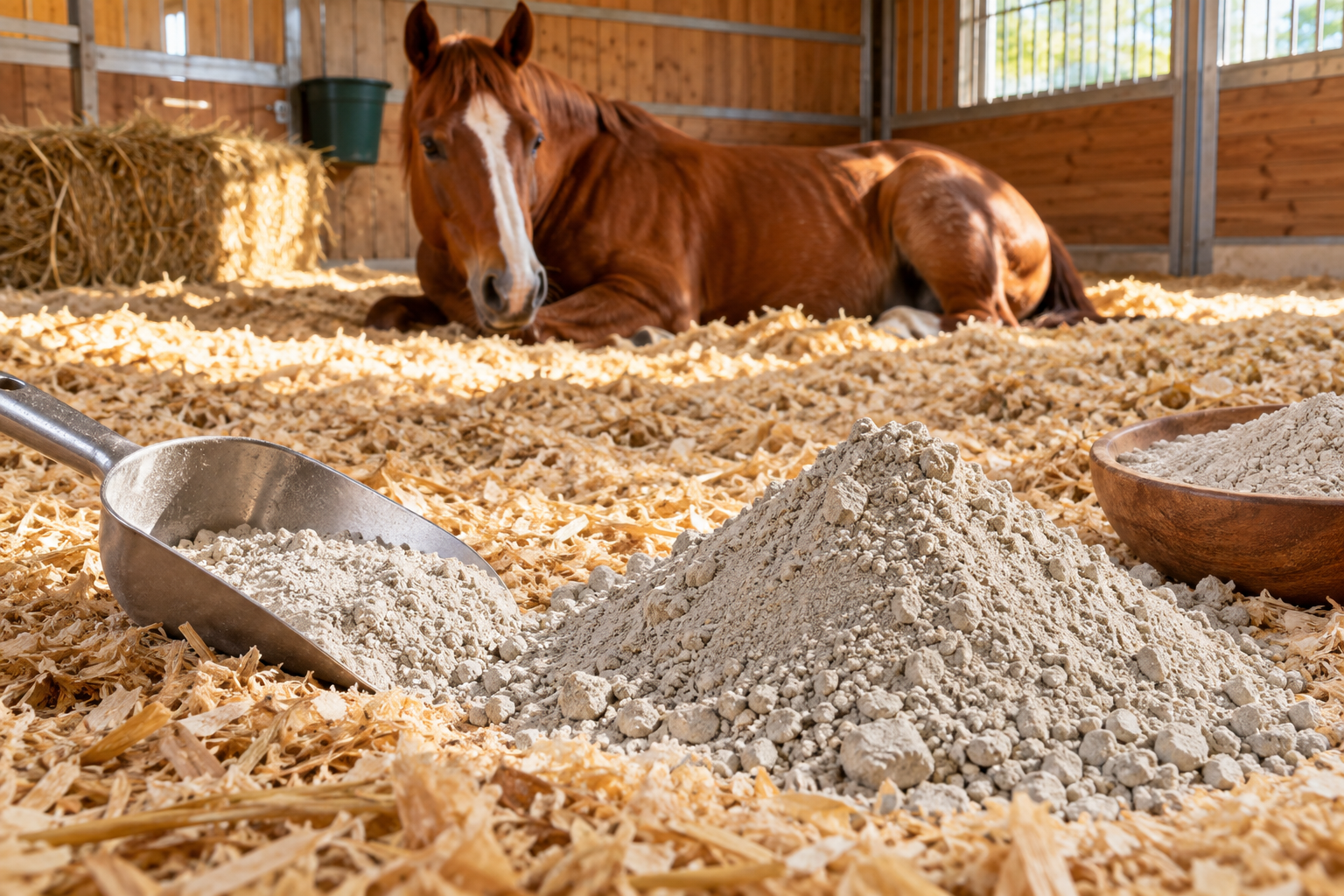
A surface may appear dry while moisture remains deeper in the bedding. Check the areas and depths where liquid actually collects.
Two products can have different mineral composition, swelling characteristics, particle-size distributions, moisture content, and processing. A lower price per kilogram doesn't necessarily mean a lower cost per useful result.
Large-scale changes are expensive to reverse. A controlled trial can reveal handling, dust, moisture, and cleanup issues before they affect the entire operation.
The difference between sodium and calcium bentonite is important because their behavior in water can differ substantially.
Sodium bentonite is generally associated with stronger swelling and water-retention behavior. This makes it valuable in applications where hydration, swelling, and control of water movement are important.
Calcium bentonite generally has lower swelling behavior and different absorption and ion-exchange characteristics. That doesn't make calcium bentonite unsuitable for every absorbent application. It simply means its properties need to match the job.
For moisture-control applications, buyers should ask about the actual product rather than stopping at the word "bentonite."
Useful questions include:
Product selection should be based on performance requirements, not mineral terminology alone.
A suitable bentonite product should be evaluated using more than one laboratory value.
Important characteristics may include:
For commercial buyers, consistency is especially important. If the mineral behaves differently from one shipment to the next, bedding performance can change even when the application method stays the same.
Ask suppliers which properties they routinely test and whether they can provide a technical specification or certificate of analysis appropriate to the purchase.
Bentonite should be protected from unwanted moisture before it reaches the bedding system. A material that has already taken on significant moisture during storage may not behave like a dry product when applied.
Keep bags or bulk material protected from rain, standing water, and avoidable humidity. Follow the supplier's recommended storage conditions and inspect packaging for damage before use.
Storage becomes even more important for bulk commercial purchases and international shipments. Transportation, warehouse conditions, packaging, and unloading can all affect the condition of the mineral.
For larger buyers, packaging should be considered part of the purchasing specification. A technically suitable product can still create problems if it arrives damaged, wet, or difficult to handle.
Safety depends on the specific product, not simply on the fact that it is bentonite.
Composition, processing, purity, particle size, contaminants, dust behavior, intended use, and the way the mineral is introduced into the animal environment all matter. Animal species and the likelihood of ingestion or inhalation also need to be considered.
For this reason, it isn't appropriate to describe every bentonite product as automatically safe for every animal.
If the mineral will be placed directly into animal housing, ask the supplier for documentation relevant to the intended application. Review product specifications and safety information, and consider the conditions in which animals and workers will handle the material.
A technical-grade bentonite manufactured for an unrelated industrial process should not be repurposed for animal bedding merely because it absorbs water.
For sensitive or high-value animals, or where ingestion is reasonably possible, seek advice from a veterinarian or another appropriately qualified animal-care professional before introducing a new bedding additive.
The most useful test is the effect on the bedding system, not the mineral's absorption claim in isolation.
For a small facility, track wet-spot frequency and the amount of bedding removed during each cleaning cycle. A commercial operation can collect more detailed figures, such as bedding consumption, labor time, disposal volume, and moisture measurements where suitable measurement methods are available.
For example, imagine a stable that normally uses 100 units of primary bedding each month. After a controlled trial, it uses less bedding while maintaining acceptable moisture and cleaning conditions. That is a practical improvement.
On the other hand, if adding bentonite increases total material use, labor, storage requirements, and disposal costs without improving bedding conditions, strong mineral absorption may have little commercial value.
Ask instead: Does this product improve the bedding system enough to justify its cost and handling requirements?
That question connects laboratory performance with what actually happens on the farm or in the stable.
Bentonite is a naturally occurring mineral, but that doesn't mean every application is automatically sustainable.
The environmental impact of a bedding system depends on several factors, including where the bentonite is mined, how it is processed, how far it travels, how much is used, and what happens to spent bedding.
Spent bedding may have potential uses depending on its composition, animal species, local regulations, manure-management practices, and land-application requirements. Once bentonite is mixed with manure, urine, straw, wood, or other bedding materials, the resulting waste stream needs to be evaluated as a whole.
For agricultural operations, disposal and reuse rules can vary by location. Buyers should therefore check applicable local requirements before deciding how mineral-containing spent bedding will be handled.
For international buyers, sustainability is best evaluated across the supply chain rather than based solely on the fact that bentonite is a natural material.
A reliable moisture-control strategy usually starts with prevention, then adds absorbency where it provides a measurable benefit.
First, reduce avoidable water entering the bedding. Repair leaking drinkers and plumbing, improve drainage, and limit rain exposure where practical.
Next, choose a primary bedding material that suits the animal, housing system, and cleaning routine. The bedding should provide the physical characteristics the animal needs rather than relying on a mineral additive to do every job.
Where recurring wet spots remain, an appropriate absorbent such as bentonite may provide additional capacity. Use it where the product's properties actually match the problem.
Ventilation should also be adequate for the housing environment without creating uncomfortable drafts or excessive dust. Finally, remove wet and contaminated bedding on a suitable schedule.
This layered approach is more dependable than expecting one material to solve every moisture problem.
For the right application, bentonite can be worth using. It is most likely to provide value when moisture is a recurring problem and the mineral's absorption or swelling properties address a specific need.
It may make sense for localized wet zones, as an absorbent component in a bedding blend, or where additional liquid-management capacity improves the performance of the existing bedding system.
It is less likely to solve the problem when the main issue is a leaking water source, poor drainage, inadequate ventilation, or infrequent cleaning. Those issues should be addressed first.
Cost also changes with scale. A targeted application may be practical for a small wet area, while a commercial operation needs a more detailed calculation that includes product cost, primary bedding consumption, labor, transport, storage, and disposal.
The best decision comes from a trial and a simple cost-per-result calculation rather than from an absorption specification alone.
If you're sourcing bentonite for an animal-related application, ask detailed questions before committing to a large order.
These questions can prevent an expensive mismatch between the product ordered and the application required.
A low price per tonne isn't necessarily a low-cost solution if the product creates additional dust, requires more material, performs inconsistently, or fails to reduce the amount of primary bedding being used.
For buyers evaluating bentonite for moisture-management and other agricultural or industrial applications, Axewelledge supplies bentonite from India with a focus on consistent quality, processing, and international supply.
Because bentonite performance depends on grade and application, sourcing should start with the buyer's actual requirements rather than a generic request for "bentonite." Relevant details may include the intended application, preferred particle size, packaging format, expected order volume, and required performance characteristics.
For animal bedding applications, suitability should be confirmed before any mineral is introduced directly into an animal environment. Product specifications and relevant safety information should be reviewed for the intended use.
The right product is not necessarily the one with the lowest purchase price. It is the product whose properties, consistency, handling characteristics, and total cost fit the job.
So, does bentonite control moisture in animal bedding? Yes. Suitable bentonite can absorb and retain liquid, and sodium bentonite is particularly notable for its swelling and water-retention behavior.
But bentonite isn't a replacement for good bedding management. It can't repair leaks, fix poor drainage, replace ventilation, or eliminate the need to remove saturated and contaminated material.
Start by identifying the source of moisture. Choose a bentonite product suited to the application, check its specifications, run a controlled trial, and measure the real-world result. If the mineral reduces recurring wetness, improves bedding performance, or lowers overall management costs without introducing unacceptable dust or handling problems, it may be a practical addition to the system.
For buyers looking for a consistent bentonite supply, Axewelledge can help evaluate product requirements and specifications before larger-volume procurement.













Have questions about our products? We're here to help!