Axewelledge, a leading exporter from India, specializes in high-quality Bentonite. With a commitment to excellence, we supply premium Bentonite to the Middle East and Southeast Asia markets.


North Angle Complex, 304,
150 Feet Ring Rd, Opposite Ambedkar Nagar BRTS Stop,
Madhav Park, Punit Nagar,
Mavdi, Rajkot, Gujarat 360004
© Axewelledge 2026, All Rights Reserved.
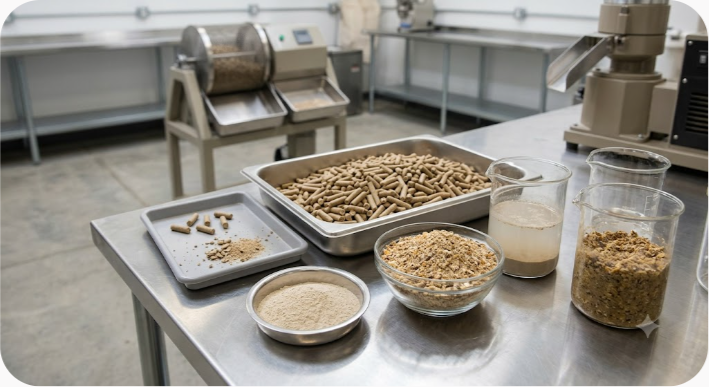
Bentonite can improve the physical quality of animal feed pellets, particularly when weak pellets, excessive fines, or poor resistance to handling are the main problems. It is not, however, a replacement for proper formulation, moisture control, steam conditioning, die selection, cooling, or mill maintenance.
Evidence reviewed by the European Food Safety Authority indicates that bentonites can increase pellet durability when included in complete feed at approximately 1% to 2%. The actual response depends on the bentonite product, feed matrix, processing conditions, and intended use.
That distinction matters. Adding more clay isn't a reliable way to fix every pelletizing problem. A feed mill should first understand where pellet strength is being lost, then test a suitable feed-grade bentonite under controlled conditions.
Yes. Bentonite can improve the physical quality of animal feed pellets by helping bind fine particles, increasing cohesion, and reducing the tendency of pellets to break down during handling. Its potential effect is most relevant to physical pellet quality, especially durability and fines generation.
Bentonite is a naturally occurring clay composed largely of montmorillonite, a smectite mineral with a layered structure. When exposed to water, montmorillonite can hydrate and disperse. Within a conditioned feed mixture, this fine mineral phase can contribute to cohesion as the mash is compressed through the pellet die.
The result can be a pellet with better resistance to abrasion and mechanical stress. Depending on the formulation and process, manufacturers may see:
Bentonite supports the pellet structure; it does not create that structure by itself. Starch gelatinization, protein behavior, moisture, steam conditioning, particle size, pressure, die geometry, cooling, and formulation remain important parts of the process.
A pellet can look strong when it leaves the die and still generate a significant amount of fines before it reaches storage or the animal. Finished pellets encounter repeated impacts as they move through coolers, elevators, conveyors, transfer points, trucks, bins, and feeding equipment.
Every impact creates an opportunity for a weak pellet to crack or shed particles. If the formulation separates into larger pellets and fines, the material consumed by the animal may not have the same physical distribution as the original feed mixture.
For manufacturers, excessive fines can also mean additional material handling, recycling, dust, and reduced confidence in finished-feed consistency. Pellet quality is therefore both a manufacturing concern and a feed-distribution concern.
One commonly used quality-control measurement is the Pellet Durability Index, or PDI. A higher PDI generally indicates greater resistance to mechanical breakdown under the specified test conditions. The appropriate target depends on the feed type, animal species, formulation, equipment, and handling system. A target from another feed mill should not automatically be treated as the correct target for your own process.
Bentonite's binding behavior is closely related to its mineral structure and its interaction with water.
Most bentonites contain a substantial proportion of montmorillonite. This mineral has a layered structure that allows water to interact with its surfaces and interlayer regions. Hydration causes the clay particles to disperse and develop a cohesive mineral phase within the feed mixture.
During conditioning and pelleting, that hydrated clay can help hold smaller feed particles together while mechanical pressure compacts the mash. Once the pellet leaves the die and is cooled to an appropriate moisture level, the resulting structure may have greater resistance to abrasion.
There is also a physical filling effect. A pellet is not a perfectly solid mass. Small spaces exist between individual feed particles, and the size and distribution of those spaces influence the strength of the finished pellet. Fine bentonite particles can occupy some of these spaces and contribute to a more continuous matrix.
This helps explain why dispersion and particle size matter. A bentonite that hydrates effectively but is poorly distributed through the mash may not perform consistently. Likewise, a product with a particle-size distribution that does not suit the mixing process can create handling or dust issues without delivering a proportional improvement in pellet quality.
Bentonite is recognized in technical literature as one of several materials that can function as an animal-feed pellet binder. Other approaches include starches, lignosulfonates, proteins, gums, and other binding systems. The appropriate choice depends on the feed formulation and the physical properties the manufacturer needs to improve.
Bentonite works as part of the entire pelleting process rather than as an isolated ingredient. Its performance is affected by mixing, hydration, conditioning, compression, cooling, and subsequent handling.
Uniform distribution is the first requirement.
If bentonite is concentrated in one part of the mixer and absent from another, the physical quality of pellets can vary within the same production batch. Fine mineral powders can also be difficult to disperse if they are introduced too late or added to a formulation with poor mixing characteristics.
For consistent results, bentonite should be treated as a controlled ingredient. Weigh it accurately, introduce it at the appropriate point in the batching process, and allow enough mixing time for uniform distribution.
A last-minute addition of dry clay is rarely a good substitute for a properly designed mixing procedure.
Moisture plays an important role because bentonite's behavior changes as it hydrates. Dry clay does not have the same physical structure as hydrated clay dispersed through a feed mixture.
That does not mean that more water will automatically produce better pellets. Excess moisture can increase drying requirements, affect throughput, create unstable pellets, and cause storage problems if the cooler cannot bring the finished product to the required moisture level.
The objective is controlled hydration within a stable conditioning process, not maximum water addition.
Steam conditioning exposes the mash to heat and moisture before it enters the die. Depending on the formulation, this can soften the feed matrix, promote starch gelatinization, and improve the conditions under which particles are compacted.
Conditioning also affects how hydrated bentonite interacts with the surrounding ingredients. Technical work on sodium bentonite in feed has reported improvements in pellet durability and hardness under steam-conditioned processing conditions.
The correct conditioning profile varies considerably between feeds. A cereal-rich poultry formula, a high-fiber livestock feed, and a formulation with substantial added fat can respond differently to the same steam temperature and retention time.
For that reason, bentonite trials should record conditioning conditions rather than treating steam settings as an unrelated part of production.
Conditioned mash enters the die, where pressure forces the particles into a compact structure. Bentonite contributes to cohesion within that compressed material.
Die diameter, compression ratio, roller settings, throughput, temperature, formulation, and moisture all influence the final pellet. If the mill is overloaded or the die is poorly matched to the feed, increasing bentonite may improve one measurement without fixing the underlying mechanical problem.
Fresh pellets leave the die warm and relatively moist. Cooling removes heat and excess moisture so the pellet can stabilize before storage and transport.
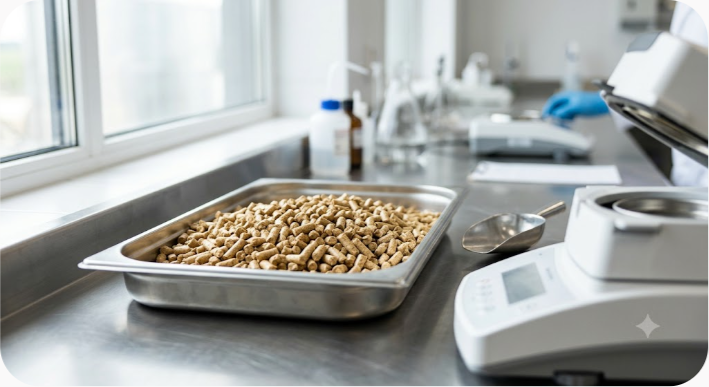
Poor cooling can leave pellets with an unstable internal structure. They may appear acceptable immediately after production but generate more fines during subsequent handling.
This is why finished-pellet testing should normally be performed after cooling. Testing only hot pellets can give an incomplete picture of the quality that customers will actually receive.
Bentonite is most useful when the problem involves physical pellet integrity. It should be considered one part of a broader process-control strategy.
Pellet durability is the clearest reason to evaluate bentonite as a binder. EFSA has reported that bentonites can increase pellet durability when used at approximately 1% to 2% of complete feed within the evaluated use context.
The size of the improvement will vary. A formulation that already contains favorable levels of starch, protein, moisture, and natural binding components may show only a modest response. A formulation producing fragile pellets may respond more noticeably.
The practical question is therefore not simply whether bentonite can raise PDI. It is whether the improvement is large enough to justify the inclusion, cost, and any changes to the manufacturing process.
Fragile pellets can generate fines during conveying, loading, unloading, and transport. Increasing cohesion can make the pellet more resistant to abrasion and reduce the amount of material that breaks away.
Fines are not always caused by inadequate binding, though. Poor conditioning, an unsuitable or worn die, excessive throughput, high fiber, formulation changes, insufficient cooling, or damage at transfer points can all contribute.
If fines remain high after a binder trial, investigate the mechanical and thermal parts of the process before simply increasing the clay dosage.
Stronger pellets generally tolerate conveying and storage better. This matters when finished feed passes through several transfer points before reaching the final feeding system.
Better physical integrity can also reduce the amount of material that must be recycled because of mechanical breakdown. The economic value depends on the individual mill's production volume, handling system, and current fines rate.
A stable pellet can help keep the formulated ingredients together. This is useful where a formula contains particles with substantially different sizes or densities.
Bentonite can contribute to physical cohesion, but it shouldn't be presented as a complete solution to formulation segregation. Particle-size control, ingredient preparation, mixer performance, and proper batching remain essential.
There is no universal dosage that applies to every animal feed. A commonly evaluated range for bentonite's pellet-binding function is approximately 1% to 2% of complete feed, and EFSA reported increased pellet durability within that range for the use it assessed.
That range should not be interpreted as permission to use any bentonite product at those levels. The appropriate inclusion rate depends on the exact product, feed formulation, animal species, intended function, regulatory requirements, and interactions with other feed ingredients or additives.
A sensible plant trial can compare a control formulation with several controlled bentonite inclusion levels while keeping the rest of the production process as consistent as possible. For example, a mill might compare its normal formulation with low, medium, and higher trial inclusions selected within the range permitted for the intended application.
The trial should measure more than one outcome. Useful measurements include:
This approach helps determine whether bentonite is genuinely improving the production system rather than simply changing one laboratory measurement.
Neither type should be selected solely from the name sodium or calcium. Sodium and calcium bentonites differ in their dominant exchangeable cations and can therefore behave differently in hydration, swelling, water retention, rheology, and binding.
Sodium bentonite generally has greater swelling and water-holding behavior than many calcium bentonites. Calcium bentonite typically shows lower swelling, but it can still provide useful binding and physical-quality performance in appropriate feed applications.
For animal feed, mineralogy is only one part of product selection. The actual specification, purity, particle-size distribution, regulatory status, intended use, and demonstrated performance in the target feed are more useful decision points.
| Factor | Sodium bentonite | Calcium bentonite |
|---|---|---|
| Typical hydration behavior | Higher swelling potential | Generally lower swelling potential |
| Water interaction | Strong water uptake and expansion | More moderate swelling in many grades |
| Binding use | Can provide strong mineral binding | Can provide useful binding and filler action |
| Product selection | Depends on feed-grade specification | Depends on feed-grade specification |
| Best comparison method | Controlled feed-mill trial | Controlled feed-mill trial |
A feed mill should compare actual products under its own processing conditions rather than assuming that one mineral type will outperform another in every formulation.
Not every bentonite sold commercially is suitable for animal feed. This is one of the most important distinctions a feed manufacturer needs to make.
Bentonite intended for drilling fluids, construction, foundry work, sealing, absorbents, or other industrial applications should not automatically be diverted into feed production. The intended use determines the relevant safety, quality, and regulatory requirements.
A feed manufacturer should request a specification designed for the intended animal-feed application. Depending on the market and use, important information can include mineralogical composition, montmorillonite content, moisture, particle-size distribution, contaminants, heavy metals, microbiological quality where applicable, and regulatory status.
Consistency matters as well. A clay that performs well during one trial but varies significantly between lots can make a production process difficult to control. Suppliers should be able to provide current quality documentation for the material being supplied rather than relying on a generic product description.
For an international feed manufacturer, supplier qualification should therefore cover both the physical product and the documentation that establishes its suitability for the destination market.
Fine bentonite provides substantial surface area for interaction with water and surrounding feed particles. This can influence hydration, dispersion, and binding behavior.
Finer is not automatically better, however.
Very fine mineral powder can increase dust during handling and may require stronger dust-control measures. It can also affect mixer behavior and change how readily the clay disperses through the mash.
The useful specification is the particle-size distribution that provides consistent performance in the actual mixing and pelleting process. A supplier should be able to provide relevant particle-size or sieve data rather than describing the material only as fine powder.
Particle size should also be considered alongside moisture. A material with the same nominal particle size can behave differently if its moisture content or processing history changes.
A controlled plant trial is more informative than choosing a binder from a specification sheet alone. The goal is to isolate the effect of bentonite while keeping other important variables stable.
Produce the normal feed without changing the existing formulation or process. Record PDI, fines, moisture, throughput, and other quality measurements already used by the plant.
This baseline provides the reference point for every subsequent trial.
Introduce a suitable feed-grade bentonite at a predetermined level. Keep the formulation and production rate as consistent as practical.
If several inclusion levels are being evaluated, change only the bentonite level between otherwise comparable trial conditions.
Record water addition, steam flow where measurable, conditioning temperature, retention time, and mash moisture. Without these records, a change in pellet quality can easily be attributed to bentonite when the actual cause was a change in conditioning.
Collect representative pellet samples after the cooler. The cooled product is the material that will be stored, transported, and handled, so it provides a more useful measure of finished-pellet performance than a sample taken immediately at the die.
Use a consistent test method and keep sample preparation and handling consistent between the control and treated batches. Small differences in sampling or test procedure can make comparisons less useful.
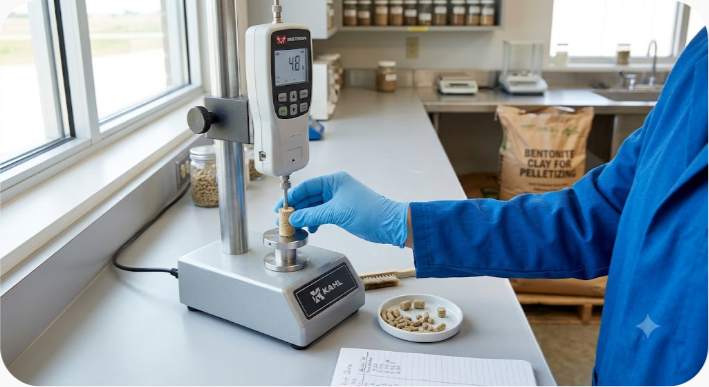
Record throughput, motor load, die pressure where available, and any changes in production stability. A binder that increases PDI but creates an unacceptable production penalty may not be an appropriate solution.
One successful batch is not enough to establish a reliable production setting. Repeat testing across representative formulations and, where practical, different production conditions.
A binder should earn its place in the process through repeatable performance, not through one favorable result.
Bentonite is one of several materials used to improve pellet quality. Depending on the feed formulation and desired result, manufacturers may also use starches, lignosulfonates, proteins, gums, cellulose derivatives, or combinations of binding systems.
The most useful comparison isn't simply which binder produces the highest PDI. A feed mill should also consider inclusion rate, cost per tonne of finished feed, fines, hardness, energy consumption, throughput, ingredient compatibility, regulatory status, and any effect on the nutritional formulation.
| Binder type | Main binding mechanism | Potential advantage | Key consideration |
|---|---|---|---|
| Bentonite | Mineral hydration and particle cohesion | Useful physical binding and moisture interaction | Feed-grade specification is essential |
| Starch | Gelatinization and matrix formation | Can strengthen pellets while contributing nutritional value | Response depends on starch source and conditioning |
| Lignosulfonate | Organic binding and matrix effects | Established pellet-binder option | May affect formulation and process behavior |
| Protein | Heat and moisture-related matrix formation | Can contribute to nutritional and physical quality | Depends strongly on protein source and processing |
| Gums or cellulose derivatives | Polymer-based binding | Can provide strong binding at relatively low inclusion in some systems | Cost and process compatibility matter |
Bentonite can be attractive where a mineral-based binder is appropriate and the product has the required feed-grade status. Even then, the material should be evaluated against the alternatives already available to the mill.
This is a serious mistake. A clay that performs successfully in drilling, foundry, construction, sealing, or another industrial application is not automatically suitable for animal feed.
Animal-food ingredients are subject to requirements based on their intended use. In the United States, the Food and Drug Administration explains that substances added to or expected to become components of animal food generally need an applicable food-additive status, GRAS status for the intended use, or another recognized regulatory basis. Feed labeling also involves federal and state requirements.
Always verify the regulatory status and intended use of the exact product before introducing it into an animal-feed formulation.
More binder isn't necessarily better. Higher clay inclusion can change the physical characteristics of the feed and affect formulation economics and nutrient density.
EFSA's assessment included a 2% maximum level within the evaluated broad use context, while also identifying relevant considerations concerning interactions with certain feed additives. The permitted level for a particular product and market must be established from the applicable regulatory framework rather than from a general internet recommendation.
Bentonite needs water to hydrate, but uncontrolled water addition can create new pelletizing problems.
If the mash is too dry, the clay may not develop the desired hydrated structure. If the mash is too wet, pellets may leave the die with excessive moisture and require additional cooling or drying.
Moisture should therefore be monitored as part of the complete conditioning process.
Suppose a mill adds bentonite, increases steam, reduces production rate, and changes the die during the same trial. If PDI improves, there is no reliable way to know which change caused the improvement.
Controlled trials are much more informative. Keep the major process variables stable and change one important variable at a time whenever production conditions allow it.
A very hard pellet isn't necessarily the ideal pellet. Pellet hardness and durability measure different aspects of physical quality, and the appropriate balance depends on the feed and feeding system.
PDI, fines, hardness, moisture, throughput, and energy use should be considered together. A single number rarely describes the complete performance of a pellet.
Bentonite is a broad mineral category, not one standardized material. Mineralogy, montmorillonite content, exchangeable cations, particle size, moisture, processing history, and impurities can all influence performance.
Two bentonites can therefore behave differently at the same inclusion rate. Product selection should be based on specification and application testing rather than the word bentonite alone.
It can, which is another reason feed-grade selection and inclusion control matter.
Bentonite isn't simply an inert mechanical binder. Clay minerals can interact with substances in the gastrointestinal tract. Scientific reviews of montmorillonite in animal feed have discussed its potential interactions with mycotoxins and other compounds while also noting that clay binding isn't completely specific and may affect the availability or absorption of some nutrients or pharmaceutical compounds.
This becomes especially important when bentonite is being used for more than one purpose, such as pellet binding and mycotoxin management. Those functions should not automatically be treated as interchangeable.
For example, evidence that a particular clay adsorbs one mycotoxin does not establish that the same product will bind every contaminant to the same degree. Published research has reported differences in adsorption among mycotoxins and among bentonite types.
The practical approach is to select the product for the intended feed application and evaluate its compatibility with the complete formulation, including other additives and any compounds whose absorption could be affected.
Yes. Bentonite can be evaluated as a pellet binder in poultry-feed applications when the product is suitable and its intended use is permitted in the relevant market.
Poultry feed can be sensitive to changes in physical quality because starch content, added oils, particle size, moisture, conditioning, and die settings all influence pellet formation. A binder trial should therefore be performed under the same production conditions used for the normal feed.
Compare the control and bentonite-treated batches using PDI and fines after cooling. Hardness, moisture, throughput, and energy use can provide additional information about whether the change is beneficial at production scale.
The useful inclusion level should be established from the product's permitted use and the results of controlled testing rather than assuming that a poultry feed requires the same dosage as another animal-feed formulation.
Bentonite can support pellet binding in livestock feeds as well. The underlying principle is similar: hydrated clay particles can contribute to cohesion and help reduce weak points within the compacted pellet.
Cattle, pig, poultry, and other livestock feeds can have very different formulations, though. Fiber, moisture, protein, starch, oil, particle size, and processing temperature all affect how the feed responds to a binder.
A supplier recommendation should therefore be treated as a starting point for technical evaluation, not as a universal production formula. The feed mill's own formulation and equipment determine the final result.
If a mill is producing excessive fines, increasing the binder dosage should not be the first response. Start by identifying where the pellet is losing integrity.
Ask the following questions:
These checks can reveal process problems that a higher binder dosage would only mask temporarily.
Pellet quality is a system property. Bentonite can strengthen that system when it is correctly selected and processed, but it can't compensate indefinitely for poor conditioning, unsuitable equipment, excessive throughput, or inadequate cooling.
Before introducing a new bentonite product, confirm the following:
The final point is easy to overlook. Fine mineral powders can create dust during unloading, conveying, and addition. Appropriate engineering controls, handling procedures, and worker-protection practices should be used according to the site's risk assessment and applicable requirements.
If you're buying bentonite for an animal-feed pelletizing operation, don't stop at a generic product name. Ask for information that allows your technical team to evaluate the material properly.
Useful questions include:
For an international feed manufacturer, consistency matters as much as headline performance. A binder that behaves predictably from one shipment to the next is easier to incorporate into a controlled production process.
Axewelledge supplies bentonite for industrial and agricultural applications and can discuss product specifications for customers evaluating mineral performance in feed-related applications. The important step is to match the material specification to the intended feed use and destination-market requirements rather than selecting a clay solely by price.
So, can bentonite improve pelletizing of animal feed? Yes. Evidence supports its use as a mineral binder that can improve pellet durability, with approximately 1% to 2% representing an evaluated inclusion range in complete feed within the relevant EFSA assessment.
That doesn't make 1% or 2% a universal production prescription. Feed formulation, clay properties, moisture, steam conditioning, particle size, die conditions, cooling, and handling all influence the final result.
If you're troubleshooting fragile pellets, establish a baseline first. Test a suitable feed-grade bentonite under controlled conditions. Measure PDI, fines, hardness, moisture, throughput, and energy use where practical. Repeat the trial across representative formulations before establishing a routine process setting.
Most importantly, verify that the product is specifically suitable for animal feed and confirm the regulatory requirements for the destination market. In the United States, FDA requirements concerning animal-food ingredients and labeling make intended use and regulatory status important parts of supplier qualification.
The right bentonite can contribute to better pellet durability and handling. Consistent pellet quality comes from matching that material to a well-controlled formulation and pelleting process.













Have questions about our products? We're here to help!