Axewelledge, a leading exporter from India, specializes in high-quality Bentonite. With a commitment to excellence, we supply premium Bentonite to the Middle East and Southeast Asia markets.


North Angle Complex, 304,
150 Feet Ring Rd, Opposite Ambedkar Nagar BRTS Stop,
Madhav Park, Punit Nagar,
Mavdi, Rajkot, Gujarat 360004
© Axewelledge 2026, All Rights Reserved.
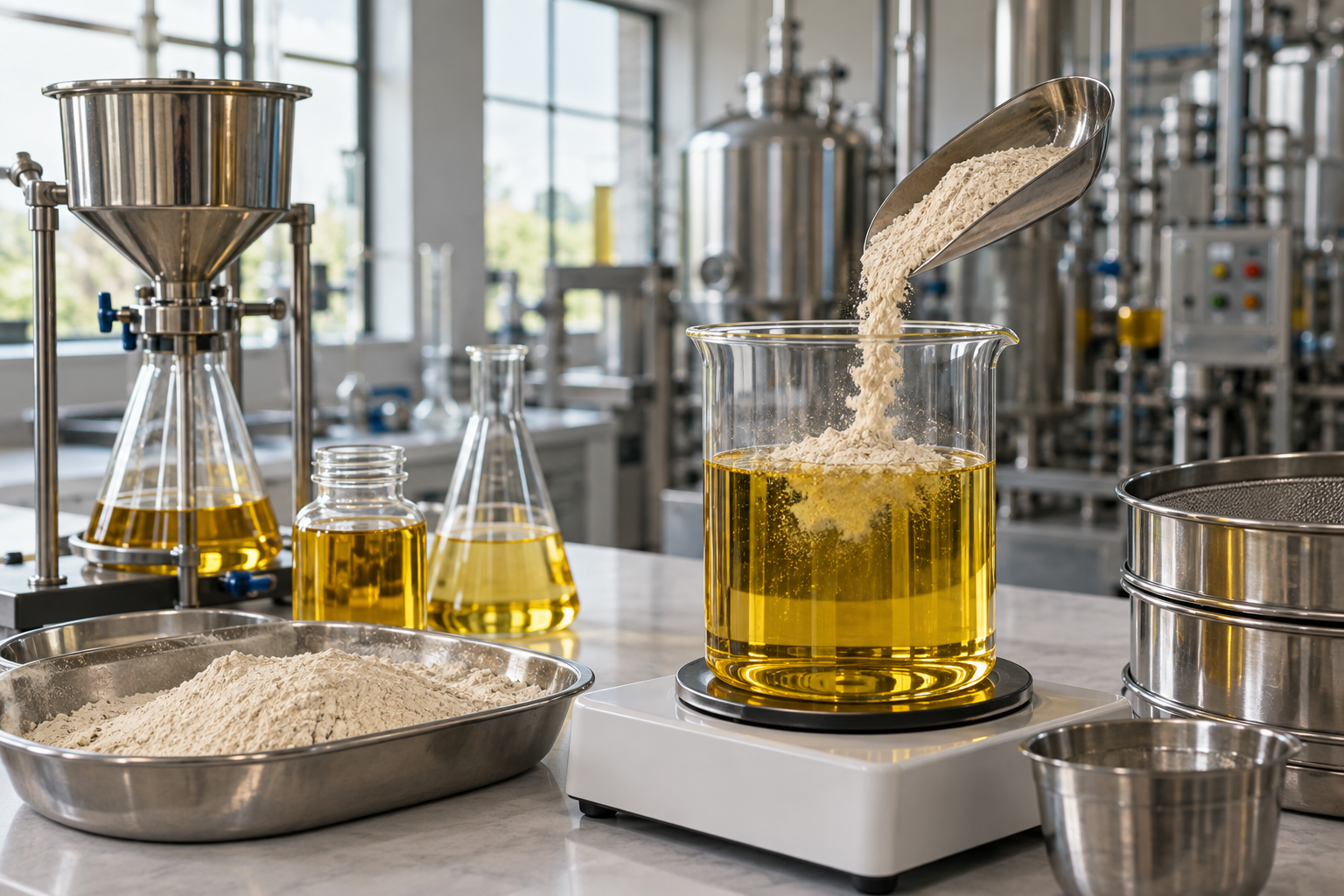
Bentonite for edible oil bleaching is used primarily as an adsorbent: it helps remove pigments and other trace impurities after earlier refining steps and before deodorization. The right clay, dosage, temperature, contact time, and filtration conditions matter just as much as the clay itself. Get those variables right, and a refinery can achieve the required color reduction without unnecessarily increasing clay consumption or oil loss.
Bleaching is also easy to misunderstand. Despite its name, the process doesn't bleach oil with a chemical whitening reaction. Instead, specially prepared bleaching earth contacts the oil and adsorbs unwanted compounds onto its large, active surface. The spent clay is then separated by filtration.
This guide explains how the process works, which operating variables deserve the most attention, how to select a suitable bentonite grade, and where common mistakes can affect yield and finished-oil quality.
Bleaching earth is a finely processed adsorbent used in the refining of edible and industrial oils. It is commonly made from naturally occurring clay minerals, including bentonite and other smectite-rich materials, and may be acid activated to improve its adsorption performance.
Natural and activated grades don't behave identically. Their mineral composition, pore structure, surface chemistry, particle size, moisture, acidity, and processing history all influence how they perform in an oil refinery. For that reason, a clay that works well with one oil may not be the most economical choice for another.
Acid activation generally involves treating a suitable clay with a mineral acid under controlled processing conditions. The treatment alters the clay structure, removes or exchanges some mineral components, and creates a more porous material with a higher accessible surface area. The resulting adsorbent can be particularly effective at removing pigments and other polar compounds.
The exact performance depends on the raw clay and activation process. A larger surface area alone doesn't guarantee better bleaching. Filtration behavior, oil retention, acidity, and selectivity are also important when choosing a commercial grade.
Bentonite belongs to the smectite family of clay minerals. Its layered structure and surface properties make bentonite-based materials useful adsorbents when they are processed for a particular application.
During oil bleaching, the clay is dispersed through heated oil. Pigments and other compounds move from the oil to the surface and pore network of the bleaching earth. After sufficient contact time, the solid clay is removed by filtration, taking the adsorbed material with it.
The objective isn't simply to make the oil look lighter. A well-designed bleaching stage can also help reduce residual soaps, phospholipids, trace metals, oxidation-related compounds, and other substances that remain after upstream refining. The exact removal depends on the oil, its previous treatment, and the bleaching earth selected.
Bentonite-based bleaching earth can therefore contribute to several quality targets at once:
It is important not to treat bleaching earth as a substitute for every other refining step. Degumming, neutralization or physical refining, washing where applicable, drying, bleaching, and deodorization each have different purposes. Poor upstream refining can make the bleaching stage work harder than necessary.
Chlorophyll is responsible for much of the green color found in some crude vegetable oils. It is an important target during bleaching because residual chlorophyll and related pigments can affect appearance and oxidative stability.
Carotenoids are another major pigment group. They contribute yellow, orange, and red tones and are especially relevant when refining oils with naturally high pigment levels. Bleaching earth can reduce these pigments through adsorption, although the required dosage depends strongly on the starting oil and the target color.
Proper degumming should remove most readily removable phospholipids before bleaching. However, some residual phospholipids and related compounds may remain in the oil. Bleaching earth can adsorb part of this remaining material.
Keeping these compounds under control is useful because residual gums can interfere with downstream processing and contribute to deposits or quality problems during high-temperature treatment.
Iron and copper are particularly important because they can catalyze oxidation reactions. Bleaching earth may remove a portion of these metals, especially when they are present in forms that are readily adsorbed. The result depends on the oil matrix and the clay's surface chemistry.
For this reason, metal removal shouldn't be assumed from color results alone. If trace-metal control is important, measure it directly with an appropriate laboratory method.
Bleaching can influence peroxide value and other oxidation-related measurements, but it isn't accurate to describe bentonite as simply destroying all peroxides. The clay can adsorb certain oxidation products and may also affect unstable compounds during processing.
Peroxide value can change during the bleaching operation because temperature, vacuum, contact time, and the condition of the oil all matter. A lower peroxide value after bleaching doesn't by itself prove that the oil has undergone no further oxidation. Use a broader quality-control program when evaluating oxidative stability.
Bleaching earth isn't primarily a free-fatty-acid removal agent. Some acid-activated clays can influence free fatty acid levels or promote hydrolytic reactions under unsuitable conditions, but the main purpose of the bleaching stage is adsorption of pigments and other impurities.
Free fatty acid control should therefore be addressed through the appropriate refining process rather than relying on higher bleaching-earth dosage.
The exact refining sequence differs according to the oil and refinery design, but bleaching generally sits after key pretreatment steps and before deodorization.
A simplified sequence is:
The process isn't identical for every refinery. Palm oil, soybean oil, sunflower oil, canola oil, cottonseed oil, and specialty oils can have very different pigment loads and refining requirements. Trial work should therefore be based on the actual feedstock rather than a generic recipe.
Start with a representative sample of the oil. Record the properties that will determine bleaching performance, including initial color, moisture, phosphorus or residual phospholipid level where relevant, free fatty acids, peroxide value, and trace metals when required.
The starting condition matters. Two batches of the same oil can need different treatment if their pigment load or upstream refining quality differs.
Excess water can interfere with the contact between oil and bleaching earth and can affect filtration. The oil should therefore be sufficiently dry before clay addition.
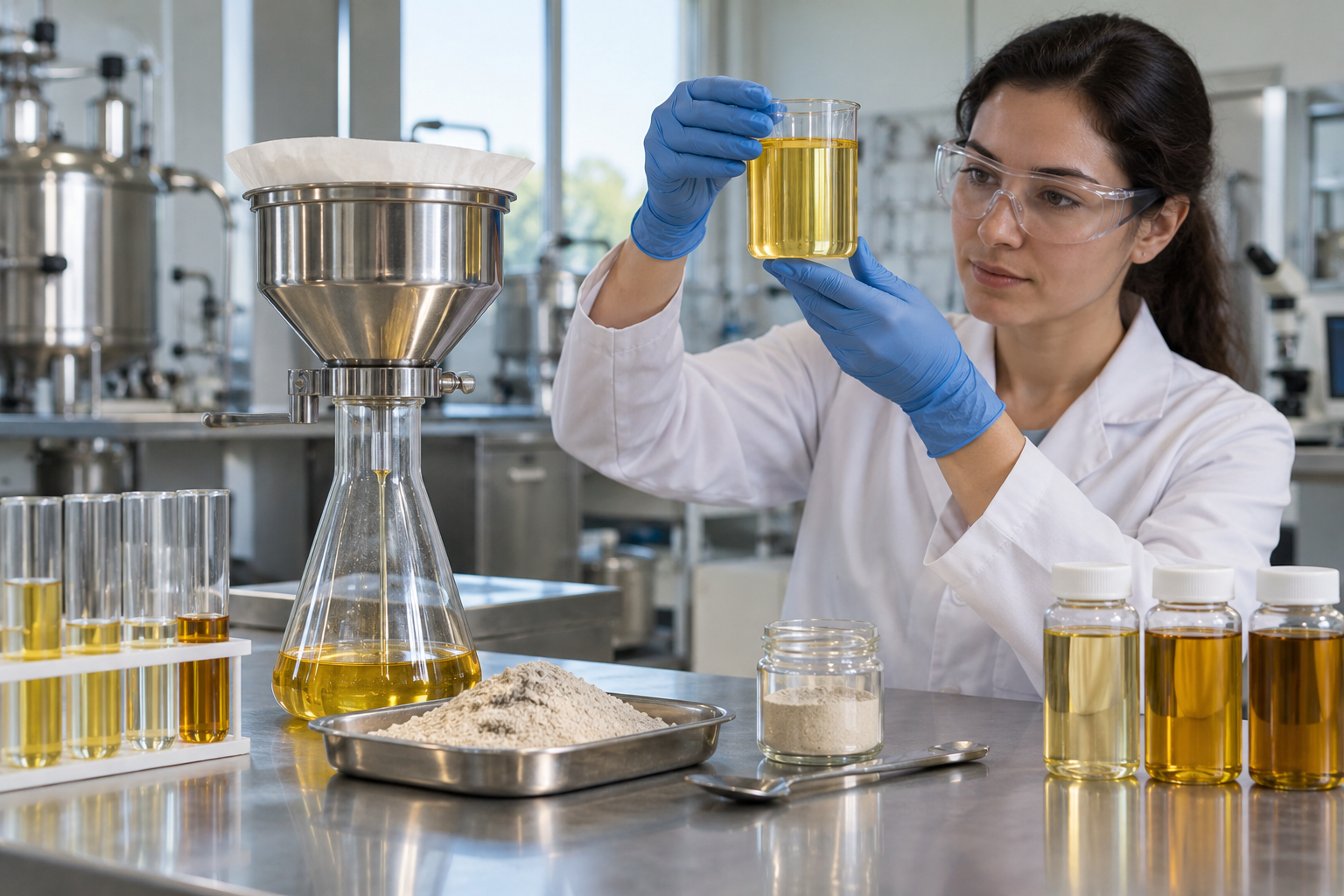
A value below 0.1 percent moisture is often used as a practical process target, but the correct specification should come from the refinery's process design, oil type, and clay supplier's technical recommendations. Don't treat one number as universal.
Choose the clay according to the oil being processed and the required performance. Important characteristics include adsorption capacity, bleachability, acidity, moisture, particle-size distribution, filtration behavior, and oil retention.
Food-contact applications also require appropriate regulatory and supplier documentation for the intended market. A material described simply as "bentonite" isn't automatically suitable for edible oil refining.
The dried oil is transferred to the bleaching vessel, where the clay is introduced at a controlled rate. Many industrial systems operate under vacuum to limit contact with oxygen while the oil is hot.
Good dispersion is essential. The clay must contact the oil uniformly rather than forming dry pockets or poorly mixed agglomerates. Mechanical agitation and the vessel's design have a direct effect on this step.
Bleaching commonly takes place at approximately 90 to 110 degrees Celsius, although the optimum temperature depends on the oil, clay, equipment, and process objective.
Heating lowers oil viscosity and can improve mass transfer between the oil and clay. Excessive temperature, however, can increase thermal stress and oxidation risk if oxygen isn't well controlled.
Contact time also needs optimization. Too little time may leave adsorption incomplete. Excessively long exposure can increase energy use and may not produce a meaningful improvement in final color.
After the required contact period, the oil-clay slurry is sent to a suitable filtration system. Vertical leaf filters, pressure leaf filters, and plate-and-frame presses are among the equipment configurations used in industry.
Filtration performance affects both product clarity and yield. The filter should retain the spent bleaching earth without creating excessive pressure drop or allowing clay fines to pass into the finished oil.
A secondary polishing filter can capture fine particles that remain after primary filtration. The filtered oil should then be tested against the refinery's specifications.
Useful checks may include color, moisture, phosphorus, free fatty acids, peroxide value, soap or insoluble content where relevant, and particle carryover. The appropriate test panel depends on the oil and the refinery's quality system.
There is no single set of bleaching conditions that fits every edible oil. The following ranges are useful starting points for process development, not universal specifications.
| Parameter | Common Starting Range | Why It Matters |
|---|---|---|
| Bleaching-earth dosage | About 0.5% to 2.0% by oil weight | Controls adsorption capacity and influences oil loss |
| Temperature | About 90 to 110 degrees Celsius | Affects viscosity, mass transfer, adsorption, and filtration |
| Contact time | About 20 to 45 minutes | Provides time for adsorption to occur |
| Operating atmosphere | Vacuum or controlled inert atmosphere | Limits oxygen exposure during hot processing |
| Oil moisture | Often below 0.1% | Helps maintain effective clay performance and filtration |
| Agitation | Continuous and adequate for uniform dispersion | Keeps clay suspended and improves oil-clay contact |
These values should be confirmed through laboratory or pilot trials. The optimum point is the lowest clay dosage and practical contact time that consistently meets the required oil specifications without creating unacceptable filtration or yield losses.
Dosage is one of the most important economic variables in the process. Increasing clay addition can improve color reduction up to a point, but the relationship isn't linear. Once the most readily adsorbed compounds have been removed, additional clay may deliver diminishing returns.
A practical approach is to run a dosage study using representative oil. For example, a laboratory trial might compare 0.5%, 0.75%, 1.0%, 1.5%, and 2.0% clay under otherwise controlled conditions. The exact test points should reflect the oil and the supplier's recommended operating window.
Measure the results at each dosage rather than choosing the highest rate automatically. Compare final color, filtration behavior, oil retained in the cake, peroxide value, and other relevant quality parameters.
The best dosage is usually the point where the required product quality is achieved economically. If increasing clay from 1.0% to 1.5% produces only a small additional color improvement but substantially increases oil loss and filtration load, the higher rate may not make commercial sense.
Temperature affects both the oil and the adsorption process. Warmer oil has lower viscosity, which generally improves contact between the liquid and the fine clay particles and can make filtration easier.
A common operating window is around 90 to 110 degrees Celsius. Some processes may use different conditions depending on the feedstock, equipment, and bleaching-earth grade.
Higher isn't automatically better. Excessive heat can accelerate unwanted oxidation or other degradation, particularly when oxygen is present. The objective is to find the lowest practical temperature that provides effective adsorption, manageable viscosity, and good filtration.
Vacuum operation is often used during bleaching to reduce oxygen exposure and help remove moisture. The actual vacuum level should be selected according to the equipment and process design rather than copied from another plant without validation.
Moisture deserves attention because water can change how the clay behaves and can interfere with adsorption and filtration. Wet clay may also create handling and dosing problems, while excessive moisture in the oil can affect the bleaching vessel's operating conditions.
Store bleaching earth in dry, sealed packaging or appropriately controlled bulk storage. Avoid exposing opened material to humid air for extended periods.
For the oil, measure moisture rather than relying on appearance. A process target such as below 0.1% can be useful, but the refinery should establish its own specification through validation with the selected clay and feedstock.
Bleaching performance doesn't end when adsorption is complete. The clay must also be removed efficiently.
Spent bleaching earth holds oil inside its porous structure and filter cake. The more clay used, and the more oil retained in that cake, the greater the potential yield loss. A grade that gives excellent color reduction but filters poorly may therefore be less economical than a slightly less aggressive grade that provides better overall plant performance.
Watch the filter for rising differential pressure, slow throughput, cake cracking, and visible fines in the filtered oil. Filter-cloth condition, cake depth, feed temperature, slurry concentration, and filtration pressure can all affect performance.
A polishing filter provides an additional safeguard, but it shouldn't be used to compensate indefinitely for a poorly performing primary filtration stage.
Different feedstocks have different pigment loads and impurity profiles. Applying a fixed dosage without testing can lead to either incomplete bleaching or unnecessary clay consumption.
Better approach: establish the dosage through laboratory or pilot trials using representative oil.
A visually lighter oil isn't necessarily a better-refined oil. Color should be considered alongside moisture, phosphorus, oxidation indicators, trace metals, filtration quality, and other specifications relevant to the product.
Better approach: define a complete quality panel before optimizing the bleaching stage.
If degumming or other pretreatment leaves excessive gums and impurities in the oil, bleaching earth has to handle a heavier load. Increasing clay dosage may mask the problem without fixing its cause.
Better approach: review the entire refining sequence when bleaching performance deteriorates.
Raising temperature simply because higher temperature can improve mass transfer isn't a sound optimization strategy. Excessive heat can increase degradation risk.
Better approach: determine the minimum effective temperature for the specific oil and clay combination.
Humidity can change the moisture content and handling characteristics of bleaching earth before it reaches the bleaching vessel.
Better approach: keep the product protected from moisture and monitor incoming material against its specification.
A clay that performs well analytically can still be expensive if it leaves excessive oil in the filter cake.
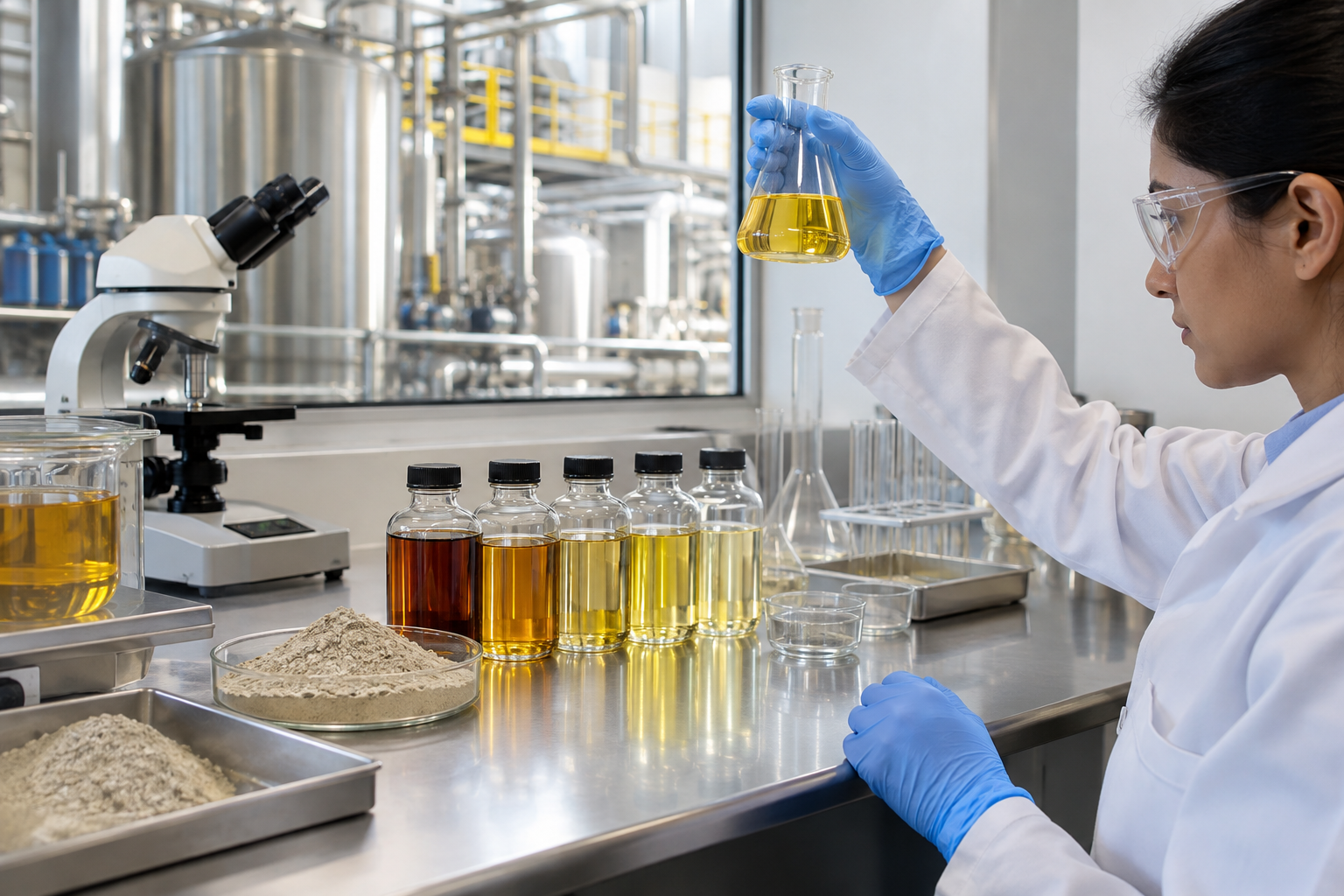
Better approach: include oil retention and filtration rate in supplier and grade evaluations.
A technical data sheet is useful, but laboratory performance with the refinery's actual oil is more informative. Clay behavior can vary with feedstock and process conditions.
Better approach: conduct comparative trials before making a large-scale grade change.
Bleaching results can appear inconsistent when laboratories use different test methods, clay-to-oil ratios, temperatures, contact times, or color measurement procedures.
Better approach: use a standardized test protocol when comparing suppliers or batches. Keep the oil sample, dosage, temperature, contact time, mixing conditions, and analytical method consistent.
Price per metric ton is only one part of the purchasing decision. A lower-priced clay can become more expensive if it requires a higher dosage, filters slowly, retains more oil, or produces inconsistent results between shipments.
When assessing a supplier, request technical information covering:
The most useful supplier comparison is performance-based. Test candidate grades against the same oil and under the same laboratory conditions, then compare the complete cost and quality result.
Natural bentonite and acid-activated bleaching earth should not be treated as interchangeable materials.
| Feature | Natural Bentonite | Acid-Activated Bleaching Earth |
|---|---|---|
| Processing | Mined, dried, milled, and classified | Further treated with controlled acid activation |
| Surface properties | Depend strongly on mineralogy | Modified to increase adsorption performance |
| Typical oil-bleaching role | Application-specific | Commonly used where strong pigment adsorption is required |
| Acidity | Generally lower or mineral-dependent | Typically higher after activation |
| Selection priority | Mineral composition and application fit | Adsorption, filtration, acidity, and oil-retention balance |
The correct choice depends on the oil and the desired refining result. A refinery shouldn't select a clay solely because it is labeled "activated" or because its surface-area figure is higher.
After filtration, the bleaching earth becomes a waste or byproduct stream containing adsorbed pigments and other compounds along with residual oil. The amount of retained oil varies considerably with clay grade, dosage, filtration conditions, and operating practice, so a fixed percentage shouldn't be assumed for every plant.
Spent bleaching earth requires careful handling because residual oil can oxidize and generate heat. Under unfavorable storage conditions, this can create a spontaneous-combustion hazard, particularly with oil-rich, porous material exposed to air.
Use the storage and disposal procedures required by local regulations and the site's fire-safety program. Avoid uncontrolled piles and poorly ventilated storage. Facilities should assess their own material characteristics and risk controls rather than relying on a generic storage rule.
Some operations recover oil from spent bleaching earth through processes such as solvent extraction or thermal treatment. Whether recovery is practical depends on the scale, equipment, economics, recovered-oil specification, and local environmental requirements.
Spent clay should therefore be treated as a process-management issue, not simply as ordinary dry waste.
A reliable bleaching operation needs repeatable testing from incoming raw material through finished oil. At minimum, establish specifications for the bleaching earth and monitor the treated oil against defined process targets.
Useful controls include:
Trend data is particularly valuable. A gradual increase in clay dosage, filtration pressure, or residual color can point to a change upstream before it becomes a major production problem.
Before introducing a new commercial clay, a controlled laboratory trial can narrow down the most suitable grades.
Use a representative oil sample and keep the test conditions consistent. Record the starting color and other relevant properties. Add a defined amount of each bleaching-earth candidate, heat the samples to the selected test temperature, mix for the same contact period, and filter them using a consistent laboratory method.
Compare the treated samples using the same analytical methods. Record final color, filtration behavior, oil retention where measurable, and other quality indicators that matter to the refinery.
The test should answer a practical question: Which clay achieves the required result at the lowest total process cost while maintaining reliable filtration and product quality?
Laboratory results aren't a guarantee of full-scale performance, but they provide a much better basis for scale-up than relying on a generic dosage recommendation.
If color removal is poor, increasing dosage is only one possible response. First identify the limiting factor.
Check whether the oil was adequately dried. Confirm that the clay is being dispersed uniformly. Review the actual process temperature rather than the temperature set point. Verify contact time and mixing performance. Inspect the filter for pressure problems or clay breakthrough. Finally, check whether the crude oil itself has changed.
If all process conditions are within specification, compare the current bleaching earth with an alternative grade. A clay with better adsorption selectivity or filtration performance may achieve the same result at a lower dosage.
Optimization should consider the entire system rather than a single laboratory number. The goal is consistent finished-oil quality with sensible clay consumption, acceptable oil loss, stable filtration, and predictable operating costs.
Soybean oil can contain pigments, phospholipids, trace metals, and oxidation products that require control during refining. The bleaching demand depends on the crude-oil quality and the effectiveness of upstream degumming and pretreatment.
Sunflower oil contains naturally occurring pigments, including carotenoids. Bleaching-earth selection should balance color reduction with filtration and oil retention.
Palm oil can have a substantial pigment load, particularly carotenoids. Refining conditions vary according to the desired final product, and bleaching-earth dosage should be established through trials rather than assumed from another oil.
Canola oil generally requires careful control of pigments and residual impurities during refining. The selected bleaching earth should be evaluated against the actual crude-oil characteristics and the refinery's target specifications.
Some specialty oils present different pigment or impurity challenges from the common feedstocks above. For these oils, supplier recommendations are a useful starting point, but plant-specific testing remains important.
Bentonite-based bleaching earth primarily acts as an adsorbent. During controlled contact with heated oil, it captures pigments such as chlorophyll and carotenoids along with some phospholipids, trace metals, soaps, and oxidation-related compounds. The spent clay is then removed by filtration. Its exact removal performance depends on the oil, clay grade, dosage, and operating conditions.
Acid activation changes the mineral's surface and pore structure, generally increasing its adsorption capacity for compounds targeted during oil bleaching. However, activation doesn't automatically make one clay better than another. Bleachability, filtration rate, oil retention, acidity, and consistency should all be evaluated with the intended oil before selecting a commercial grade.
There is no universal ideal dosage. A practical starting range for many edible-oil applications is about 0.5% to 2.0% by oil weight, but actual requirements vary with feedstock, pigment concentration, pretreatment quality, clay performance, and final specifications. Laboratory trials should identify the lowest dosage that consistently achieves the required result without excessive oil loss.
Many industrial bleaching processes operate around 90 to 110 degrees Celsius, but the optimum depends on the oil, bleaching earth, equipment, and process design. Higher temperature can reduce viscosity and improve mass transfer, yet excessive heat can increase degradation risk. Establish the operating point through controlled trials and keep oxygen exposure under control.
Excess moisture can interfere with oil-clay contact, change adsorption behavior, and complicate filtration. For this reason, refineries commonly keep the oil sufficiently dry before bleaching, with below 0.1% often used as a process target. Bleaching earth should also be protected from humid storage conditions. The final moisture specification should be validated for the selected clay and oil.
Spent bleaching earth can present a fire hazard because it contains residual oil and adsorbed oxidation-sensitive compounds. Heat generated by oxidation can accumulate under unfavorable storage conditions and, in some circumstances, lead to spontaneous combustion. Facilities should follow applicable fire-safety and environmental requirements, use controlled storage, and establish an approved route for recovery, treatment, or disposal.
Bentonite for edible oil bleaching works through adsorption, not simply by chemically whitening the oil. The best result comes from matching the bleaching earth to the feedstock and controlling the complete process.
Keep these principles in mind:
For refineries, the most useful measure of bleaching-earth quality isn't a single specification on a product sheet. It's consistent performance under the conditions that matter in the plant: required color reduction, efficient filtration, low oil retention, stable quality, and predictable cost. Suppliers such as Axewelledge can be evaluated on those practical criteria alongside their mineral specifications, quality controls, documentation, and supply reliability.













Have questions about our products? We're here to help!