Axewelledge, a leading exporter from India, specializes in high-quality Bentonite. With a commitment to excellence, we supply premium Bentonite to the Middle East and Southeast Asia markets.


North Angle Complex, 304,
150 Feet Ring Rd, Opposite Ambedkar Nagar BRTS Stop,
Madhav Park, Punit Nagar,
Mavdi, Rajkot, Gujarat 360004
© Axewelledge 2026, All Rights Reserved.
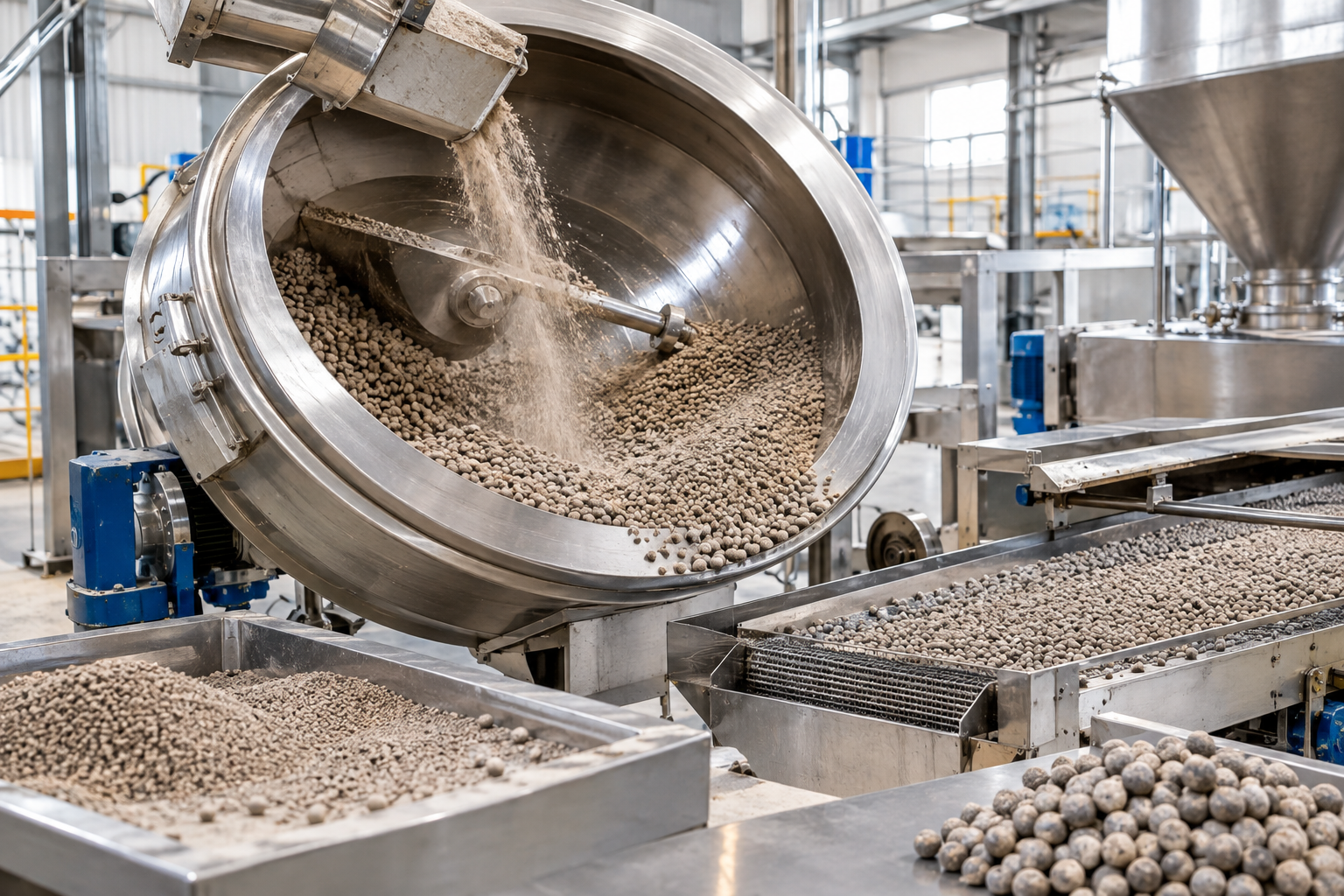
Bentonite can improve fertilizer granule strength by helping fine particles bind into more cohesive agglomerates during wet granulation. It can support granule formation, reduce fines, and improve resistance to crushing and abrasion. But adding more bentonite isn't automatically the solution to weak granules. The result depends on bentonite grade, dosage, moisture, particle size, mixing, granulator conditions, drying, and the chemistry of the fertilizer blend.
That distinction matters because a commercially useful fertilizer granule isn't simply the hardest granule possible. It needs enough mechanical strength to survive screening, conveying, bagging, transport, and storage without creating excessive dust or compromising nutrient concentration and dissolution. Bentonite can be an effective mineral binder for fertilizer granulation, including some NPK and potassium-based systems, but the right formulation has to be established for the specific process.
Fertilizer powders are difficult to handle consistently. Fine particles can separate from coarser material, generate dust, bridge in equipment, and produce an uneven particle-size distribution. Granulation converts those powders into larger particles that are easier to transport and apply, but the finished granules still have to withstand considerable physical stress.
A fertilizer granule may experience compression in a bulk bag, impacts during conveying, vibration during transport, abrasion during screening, and repeated contact with neighboring particles. If its internal bonds are weak, it can fracture into smaller pieces and generate fines.
That creates several practical problems:
For these reasons, fertilizer producers commonly evaluate crushing strength, abrasion resistance, particle-size distribution, moisture, bulk density, and flowability rather than judging granule quality from appearance alone.
A published compound-fertilizer study illustrates how strongly formulation can affect mechanical strength. The study reported granule compressive-strength values ranging from 5.25 N to 46.15 N as bentonite concentration changed under the tested conditions. Those values should not be treated as universal targets for fertilizer production. They show something more useful: binder level can have a substantial effect, so the optimum dosage needs to be established for the particular formulation and process.
Bentonite is a fine clay material dominated by smectite minerals, particularly montmorillonite. Its usefulness in granulation comes from its fine particle size, surface properties, interaction with water, and ability to contribute to cohesion between particles.
During wet granulation, water creates liquid bridges between fertilizer particles. As the wet mass is mixed and compacted, particles move closer together. Bentonite can absorb water, swell, and form a cohesive clay-rich phase that helps hold fine fertilizer particles together.
As drying proceeds, temporary liquid bridges are replaced by stronger solid contacts. When the formulation and process are properly balanced, the finished granule can have a more coherent internal structure and better resistance to crushing and abrasion.
The process can be viewed in seven practical stages:
Bentonite therefore does more than make a fertilizer mixture sticky. Its value comes from how it changes the structure and cohesion of the wet mass and the dried granule.
A fertilizer granule can be thought of as a network of particles joined at many contact points. If those contacts are weak or too limited, the granule fractures easily under load. When the internal structure is well developed, forces can be distributed through the particle before it breaks.
Bentonite can contribute to this structure because its fine particles can occupy spaces between larger fertilizer particles. In a suitable formulation, the clay contributes cohesion while the primary fertilizer ingredients provide most of the nutrient content.
Water is critical to the process. Too little moisture can prevent adequate wetting and bonding. Too much can create an overly plastic mass, excessive agglomeration, sticking, difficult screening, or granules that shrink or crack during drying.
This is why bentonite dosage and moisture should be managed together rather than treated as independent process settings.
Fine particles have a large total surface area relative to their mass. That can be useful for blending and chemical processing, but it also creates handling challenges. Very fine powders can generate dust, segregate from larger particles, and behave differently in a granulator than coarser feed material.
A fine clay binder can help bring those particles into larger agglomerates. Bentonite itself is a fine material, but when it is distributed properly through a wet granulation system, it can help connect fertilizer fines into more stable granules.
Research into NPK wet granulation has reported that increasing bentonite quantities reduced the amount of fines under the tested conditions and helped optimize the target fertilizer granule size. The important point is not that more bentonite always produces better fertilizer. It is that binder level can shift the balance between granule growth, fines formation, and process behavior.
The useful question is therefore not, "How much bentonite can we add?" It is, "What bentonite level gives us the required granule quality without creating new process or product problems?"
Weak fertilizer granules are often treated as a simple binder-deficiency problem. In a production plant, that diagnosis can be wrong.
Granule weakness can result from:
If moisture is too low, increasing bentonite may not solve the problem because the wet mass still lacks sufficient liquid for effective agglomeration. If moisture is already excessive, adding more bentonite may make the material harder to process or change its drying behavior.
Before changing the binder level, identify where the granule is actually failing. That simple step can prevent an unnecessary formulation change when the real issue is equipment, moisture, mixing, or drying.
Bentonite has been investigated or used as a binder in several granular fertilizer systems, including compound fertilizers and formulations based on urea or potassium chloride.
Its suitability depends on the formulation rather than the fertilizer label alone. A phosphate-rich NPK blend can behave very differently from a potassium chloride formulation or a coated urea product. The same bentonite grade can therefore produce different results in two otherwise well-controlled processes.
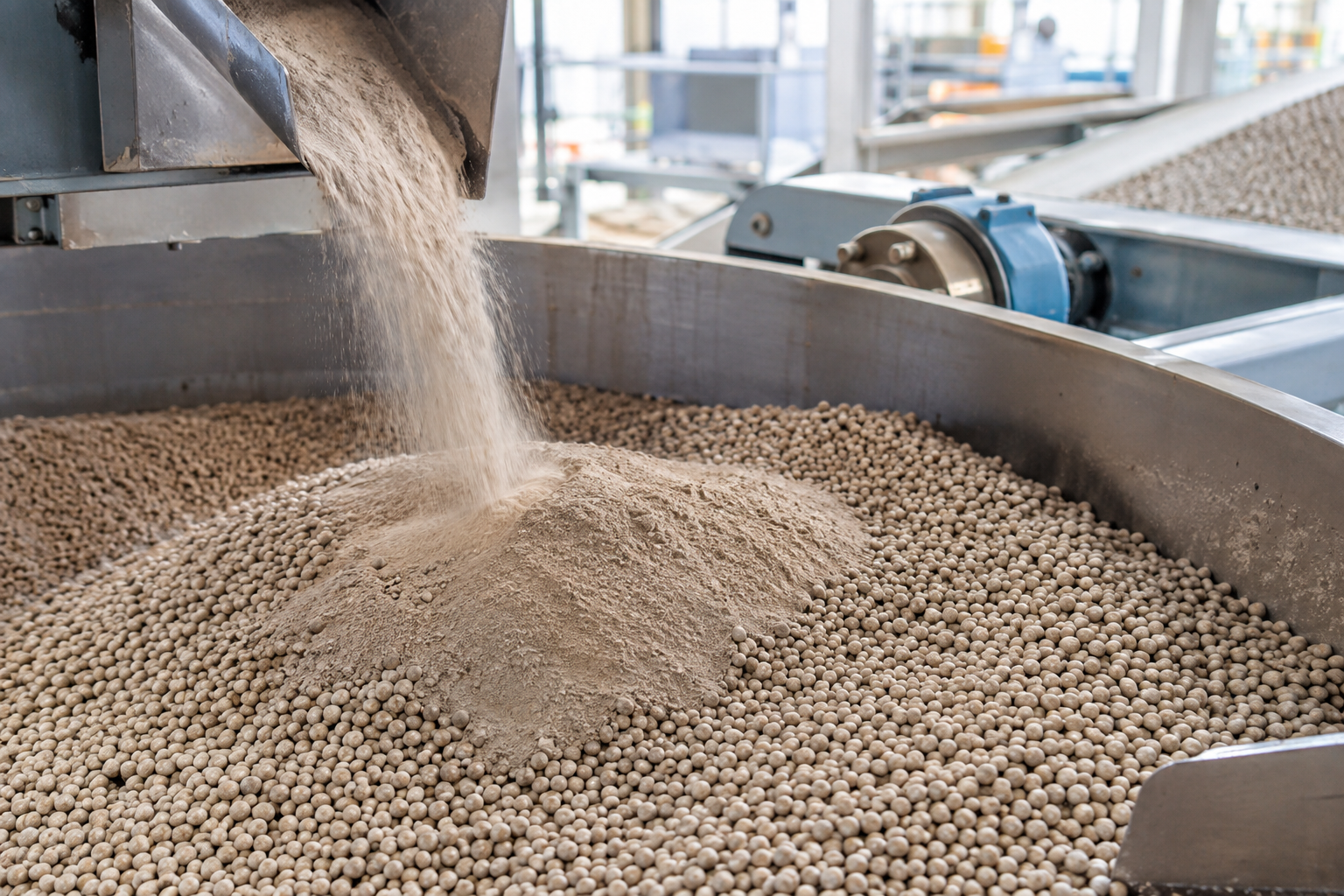
Research on continuous rotary-drum granulation has examined urea and potassium chloride with bentonite as a binder, including the effects of moisture and feed rate on granulation behavior. Such work reinforces the need to evaluate binder performance together with the rest of the granulation system.
Another study on potassium fertilizer evaluated a combination of urea-formaldehyde and bentonite and reported improvements in granulation rate, surface smoothness, and particle hardness under its experimental conditions. The tested formulation used 6 to 8% bentonite with 4 to 8% urea-formaldehyde. Those figures belong to that specific controlled-release potassium system and should not be presented as a universal fertilizer dosage.
Bentonite has also been studied as a binder in zeolite-coated urea systems, where structural stability and crushing strength were among the measured properties. Again, the formulation and intended product function determine how the binder should be used.
Not all bentonite behaves in the same way. Sodium-dominant bentonite generally has greater swelling capacity and stronger interaction with water than calcium-dominant bentonite. That difference can influence wet granulation behavior, moisture demand, and the cohesion of the wet mass.
Higher swelling, however, isn't automatically better. A fertilizer manufacturer needs a binder that disperses predictably and provides the required cohesion without making the wet mass excessively sticky or difficult to dry.
| Property | Sodium bentonite | Calcium bentonite |
|---|---|---|
| Water interaction | Generally higher swelling | Generally lower swelling |
| Binding potential | Often strong in wet systems | Can provide useful binding depending on grade |
| Moisture sensitivity | Requires careful process control | Can behave differently at the same moisture level |
| Typical consideration | Strong cohesion and swelling | Controlled binding where lower swelling is preferred |
| Selection priority | Actual granulation performance | Actual granulation performance |
For industrial fertilizer production, the practical question isn't simply which mineral name appears on the specification sheet. The better question is how the specific grade performs in the actual fertilizer formulation, at the required moisture level, and on the intended granulation equipment.
There is no single bentonite dosage that works for every fertilizer granulation process.
Published and commercial examples show that bentonite can be used at very different levels depending on the formulation and its intended function. Some fertilizer processes may require a relatively small binder addition, while specialty formulations or composite binder systems can use considerably more.
For example, one controlled-release potassium study reported 6 to 8% bentonite as part of a double-binder system. A separate slow-release urea study tested bentonite at 10 to 25% as part of a coating formulation. These are different applications with different objectives, which is precisely why copying a percentage from another process can lead to poor results.
A better approach is to establish a formulation window through controlled trials.
Start with several controlled binder levels rather than making one large production change. For example, a laboratory or pilot program might compare low, medium, and high bentonite additions while keeping the fertilizer formulation, moisture target, granulator conditions, and drying conditions as constant as possible.
Measure:
The best formulation is the one that meets the complete product specification. It isn't necessarily the formulation that produces the hardest individual granule.
Bentonite needs water to develop its binding behavior, but fertilizer granulation is highly sensitive to moisture balance.
Too little moisture can lead to poor particle wetting, weak agglomeration, and excessive fines. Too much can produce sticky material, oversized agglomerates, poor screening, and difficult drying.
The correct moisture window depends on fertilizer chemistry, raw materials, bentonite grade, equipment, temperature, and residence time. A moisture level that works on one production line may perform poorly on another.
Experienced operators therefore don't look at water addition in isolation. They watch wet-mass behavior, check measured moisture, and connect those observations with finished-granule performance.
A process may show several clues when the wet mass is too dry:
An overly wet system may show:
Don't use bentonite as a substitute for moisture control. The binder and water system have to work together.
A binder can only work effectively if it is distributed throughout the fertilizer mixture.
If the bentonite contains excessive coarse particles or has a broad, inconsistent size distribution, the same nominal addition rate can produce different results from batch to batch. Fine, consistent material generally gives better opportunity for uniform distribution, but extremely fine material can also affect dust behavior and moisture demand.
For this reason, fertilizer manufacturers should specify more than the product name. Depending on the process, useful incoming checks can include particle-size distribution, moisture, swelling or water-absorption behavior, bulk density, and other application-specific properties.
Consistency is particularly important for high-throughput plants. A binder that performs well in one trial but varies substantially between shipments can introduce process drift even when the recipe hasn't changed.
If fertilizer granules are breaking too easily, don't immediately increase the bentonite dose. Use a structured troubleshooting sequence instead.
This sequence helps separate a binder problem from an equipment, moisture, or drying problem before the production recipe is changed.
The exact test method depends on the fertilizer and customer specification, but crushing strength is one of the most useful indicators for individual granules.
A typical test applies increasing force to a granule until it fractures. The measured force is often reported in newtons. Higher force generally indicates a harder granule, but the result has to be interpreted alongside abrasion resistance and the actual handling requirements of the product.
You should also test the material after realistic handling. A granule that performs well in a single-point compression test can still generate fines during repeated impacts, conveying, screening, or bagging.
Useful quality-control measurements include:
| Test | What it tells you | Why it matters |
|---|---|---|
| Crushing strength | Force required to fracture a granule | Indicates resistance to compression |
| Abrasion or attrition | Tendency to generate fines | Useful for transport and handling durability |
| Particle-size distribution | Share of target, undersize, and oversize particles | Indicates granulation consistency |
| Moisture | Water remaining after drying | Influences storage and physical stability |
| Bulk density | Mass per unit volume | Important for packaging and handling |
| Flowability | How easily the granules move | Relevant to conveying, blending, and spreading |
Published fertilizer research commonly uses crushing strength and structural stability alongside particle-size measurements. That is a useful reminder that no single test captures every aspect of granule quality.
This is one of the easiest mistakes to make in fertilizer development.
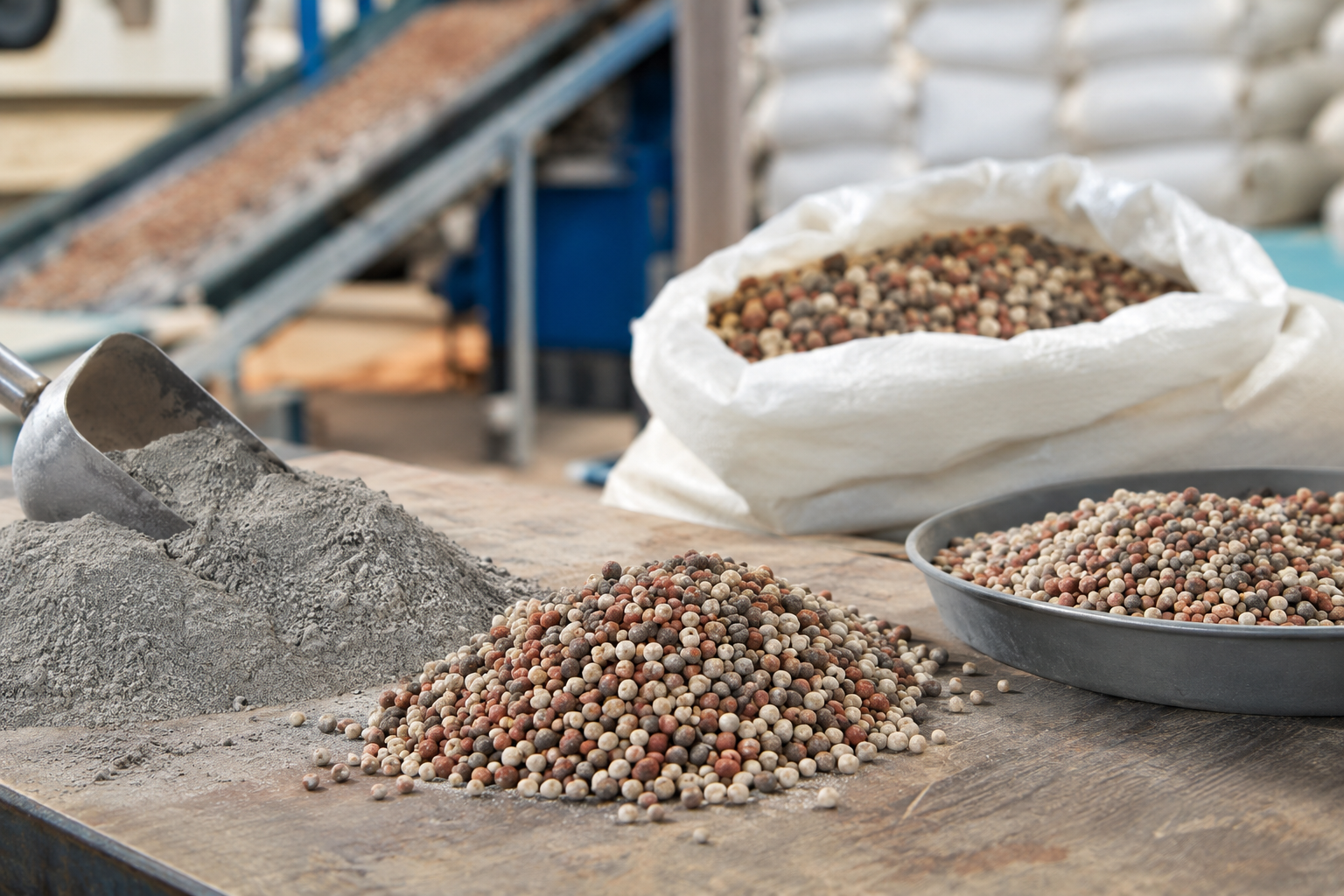
Suppose two formulations produce granules with similar crushing strength. One contains more binder and therefore has a lower nutrient concentration. It may also dissolve differently or behave differently during field application. A higher strength value alone doesn't make it the better commercial product.
The goal is adequate mechanical durability at the lowest practical binder and process cost that meets the product specification.
Nutrient release also deserves attention. A binder that changes the granule's internal structure or interaction with water can influence how quickly water penetrates the particle. That may be desirable in a controlled-release product but undesirable in a conventional fertilizer intended to dissolve readily.
The physical specification should therefore be considered alongside nutrient content, dissolution behavior, production cost, and the intended use of the fertilizer.
Bentonite is only one option. Depending on the formulation, manufacturers may also consider lignosulfonates, starches, polymers, humic materials, mineral binders, or combinations of different binder types.
| Binder type | Potential advantage | Main consideration |
|---|---|---|
| Bentonite | Mineral binder with water interaction and fine-particle cohesion | Can affect moisture demand and nutrient concentration |
| Starch | Strong organic binding potential | Thermal and moisture behavior must be controlled |
| Lignosulfonate | Useful binding and pelletizing properties | Formulation chemistry and cost need evaluation |
| Polymer binder | Can provide strong controlled binding | Often higher material cost and formulation complexity |
| Composite binder | Can combine different binding mechanisms | More variables to control |
The right choice depends on what the fertilizer needs to do after it leaves the plant. A binder that performs well in a laboratory compression test may not be the best fit for storage, coating, dissolution, or field spreading.
When granules are weak, increasing the binder can seem like the obvious solution. But the original problem may actually be moisture, mixing, drying, or raw-material variability.
Run a controlled trial first. Otherwise, you may increase clay consumption without fixing the actual failure point.
Urea, DAP, MAP, KCl, phosphate blends, micronutrient formulations, and organic-inorganic fertilizers don't behave identically.
A binder percentage copied from another plant can produce very different results in your process because the raw materials, moisture requirements, granulator, and drying conditions may all differ.
Crushing strength tells you how an individual granule responds to a particular load. It doesn't necessarily predict how much dust the complete product will generate during conveying or transport.
Combine strength testing with abrasion, fines, and particle-size measurements. The combination gives a much clearer picture of handling durability.
A well-formed wet granule can still become a poor finished granule if drying is too aggressive or uneven. Rapid moisture removal can contribute to cracks or weak zones within the particle.
Review dryer temperature, residence time, airflow, and final moisture together rather than changing only one setting without checking the others.
Even the right amount of bentonite won't perform consistently if it isn't dispersed uniformly. Poor mixing can create areas with too little binder and other areas containing excessive clay.
Check the mixing sequence, feed points, and residence time before changing the formulation.
Two bentonite products can have different swelling, moisture, particle-size, and binding characteristics. A lower purchase price can lose its advantage if the material generates more fines or requires additional process adjustments.
Evaluate the binder based on cost per tonne of acceptable finished fertilizer, not only the purchase price per tonne of bentonite.
For a commercial fertilizer operation, ask the supplier for application-specific information rather than relying on a generic mineral specification.
Useful questions include:
A capable supplier should be able to discuss the material in terms of your process, not simply provide a mineral name and a generic product sheet.
For manufacturers evaluating bulk bentonite for fertilizer production, Axewelledge can be considered as a supply partner when consistent mineral quality, processing capability, and export logistics are important. The practical next step remains a formulation trial using the exact fertilizer blend and process conditions you intend to run.
A useful trial changes one major variable at a time wherever practical. If you simultaneously change bentonite dosage, moisture, granulator speed, feed rate, and drying temperature, you may improve the result without knowing which change produced it.
A simple trial matrix can compare three or four bentonite levels while maintaining the same fertilizer formulation and core process conditions.
Record the following for each run:
Then repeat the most promising formulation under normal production conditions. Laboratory success is useful, but commercial fertilizer has to survive the real process, including handling between the granulator and the final package.
Yes, it can, provided the formulation and process are properly balanced.
Bentonite can help convert fine fertilizer particles into larger, more coherent granules during wet granulation. Research on NPK wet granulation has reported lower fines with increased bentonite quantities under the tested conditions.
The benefit isn't simply cosmetic. A more stable particle-size distribution can make conveying, screening, packaging, and storage easier to control.
But fines can also form through mechanical abrasion after granulation. If granules leave the dryer intact and arrive at the bagging machine with excessive dust, the problem may be handling rather than granule formation.
Trace the product through the entire line before changing the binder.
Bentonite remains a mineral after it has served as a manufacturing binder. Its water interaction and cation-exchange properties can influence the behavior of a finished fertilizer, but any agronomic effect depends heavily on the fertilizer formulation, soil, application rate, and properties of the bentonite.
Claims about improved nutrient retention or soil conditioning should therefore be kept separate from the mechanical question of granule strength. A binder can improve manufacturing performance without automatically producing a measurable agronomic benefit in every soil or crop system.
If the immediate goal is stronger fertilizer granules, first establish the physical performance of the product. Agronomic effects should then be evaluated separately under appropriate soil and crop conditions.
If you're trying to improve fertilizer granule strength with bentonite, keep these points in view:
Bentonite improves fertilizer granule strength primarily by helping fine particles form cohesive, mechanically stable agglomerates during granulation. Its fine particle size, interaction with water, and binding behavior can reduce fines and improve granule durability, but the result depends on the complete process rather than the binder alone.
The most reliable route is to test the bentonite within the actual fertilizer formulation, establish a suitable moisture and dosage window, and measure strength alongside abrasion, particle size, and final moisture. That approach replaces guesswork with measurable process control.
If you're sourcing bentonite for commercial fertilizer granulation, Axewelledge can discuss bulk material requirements and help evaluate a suitable grade for the application. The key is to match the mineral to the process and validate it with the actual fertilizer blend before moving to regular supply.













Have questions about our products? We're here to help!