Axewelledge, a leading exporter from India, specializes in high-quality Bentonite. With a commitment to excellence, we supply premium Bentonite to the Middle East and Southeast Asia markets.


North Angle Complex, 304,
150 Feet Ring Rd, Opposite Ambedkar Nagar BRTS Stop,
Madhav Park, Punit Nagar,
Mavdi, Rajkot, Gujarat 360004
© Axewelledge 2026, All Rights Reserved.
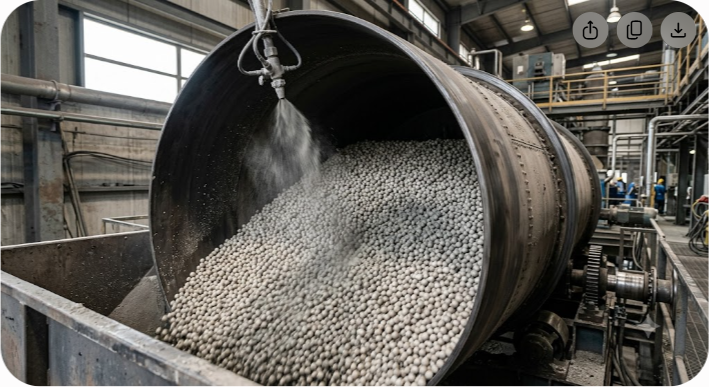
Bentonite is used in fertilizer production mainly as a binder, conditioning agent, absorbent carrier, and functional component in sulfur-bentonite fertilizers. The right grade can help manufacturers produce stronger granules, improve handling, reduce caking, and control how certain nutrients disperse after application. Its performance depends heavily on mineralogy, swelling behavior, particle size, moisture, and the fertilizer process itself.
That last point matters. There is no single bentonite specification that works for every fertilizer plant. A high-swelling sodium bentonite can be excellent for sulfur-bentonite pastilles, while a lower-swelling calcium bentonite may be better suited to an absorbent carrier or surface-conditioning application. The formulation, equipment, moisture level, and required finished-product properties should determine the grade and dosage.
This guide explains how bentonite works in fertilizer manufacturing, where it fits into NPK and sulfur formulations, how sodium and calcium bentonite differ, what manufacturers should test before buying bulk material, and which processing mistakes can undermine otherwise good clay.
Bentonite is a natural clay dominated by minerals from the smectite group, particularly montmorillonite. Its layered structure gives it a combination of swelling, adsorption, plasticity, and cation-exchange properties that can be useful in industrial fertilizer processing.
Montmorillonite has a net negative layer charge created by substitutions within its crystal structure. Exchangeable cations such as sodium, calcium, magnesium, and potassium occupy spaces between the clay layers and help balance that charge. When water enters the interlayer region, the clay can hydrate and expand, with the extent of swelling depending on mineral composition and the dominant exchangeable cation.
For fertilizer manufacturers, the important question is not simply whether a clay is called bentonite. The useful question is how that particular bentonite behaves under the plant's operating conditions.
A fertilizer-grade bentonite may be selected to provide one or more of these functions:
The dosage should be established through formulation trials rather than copied from a generic percentage. Too little clay may provide little measurable benefit, while too much can change bulk density, nutrient analysis, moisture demand, drying requirements, or granule size distribution.
Bentonite is not a single chemically uniform material. Deposits vary in mineral composition, exchangeable cations, moisture, particle size, and levels of associated minerals. Those differences can have a direct effect on processing performance.
Montmorillonite has a 2:1 layered structure consisting of one octahedral sheet between two tetrahedral sheets. Water and exchangeable cations occupy the interlayer region. This structure is responsible for many of the properties that make bentonite useful in fertilizer manufacturing.
The distinction between sodium and calcium bentonite is particularly important when choosing a fertilizer additive.
Sodium bentonite generally has higher water-swelling capacity because sodium is a highly hydrated exchangeable cation. When exposed to water, suitable sodium bentonite can expand substantially and form a cohesive gel. This behavior makes it useful where hydration, dispersion, and strong binding are required. It is widely considered for sulfur-bentonite formulations and selected granulation processes.
Calcium bentonite generally has lower free swelling but can provide useful adsorption, surface activity, and conditioning properties. It can be suitable where excessive swelling would be undesirable, including some carrier and anti-caking applications.
These categories should not be treated as absolute performance labels. Natural bentonites can have mixed exchangeable cations, and processed or activated products can behave differently from untreated material. Laboratory testing is therefore more reliable than relying on the sodium or calcium label alone.
Several properties are more useful to a fertilizer plant than a generic statement that a bentonite is high quality.
Bentonite has several industrial uses in fertilizer production, but the function changes from one formulation to another. A manufacturer producing NPK granules does not necessarily need the same bentonite as a plant making sulfur-bentonite pastilles.
Bentonite can improve the cohesion of fertilizer particles during wet granulation, pelletization, or compaction. When moisture is introduced, suitable clay hydrates and helps form cohesive bridges between particles. Mechanical movement then brings the particles together into larger aggregates.
During drying, the resulting structure becomes more stable. The final improvement depends on the fertilizer chemistry, clay grade, dosage, moisture level, residence time, and granulator design.
This is useful for formulations containing materials that are difficult to granulate on their own. A small amount of suitable bentonite can help reduce weak granules and improve resistance to handling damage.
However, bentonite should not be viewed as a universal cure for poor granulation. Excess moisture, an unsuitable recycle ratio, poor particle-size distribution, or incorrect spray placement can still produce weak or oversized granules even when the clay is appropriate.
Many fertilizers contain hygroscopic salts that interact strongly with atmospheric moisture. Urea, ammonium salts, and some NPK products can become difficult to handle when storage conditions allow moisture uptake followed by partial dissolution and recrystallization.
Bentonite can contribute to physical conditioning by absorbing or adsorbing moisture and modifying the contact between fertilizer particles. In some formulations, fine mineral material is applied to the granule surface as part of a broader anti-caking system.
The exact result depends on the fertilizer chemistry and coating formulation. Bentonite alone should not be assumed to prevent caking under every humidity and storage condition. Plant trials should evaluate flowability, caking strength, moisture uptake, and storage stability under representative conditions.
A practical anti-caking program may combine several measures, including controlled product moisture, adequate cooling before storage, appropriate particle-size distribution, suitable coating materials, and proper warehouse conditions.
Fertilizer formulations sometimes require small quantities of liquid nutrients, micronutrients, biological materials, or other active ingredients. Applying these liquids directly to a dry granular blend can create localized wet spots and promote agglomeration.
A suitable bentonite can act as an absorbent mineral carrier. Its internal surface area and layered structure allow it to hold liquid components and distribute them through a dry formulation.
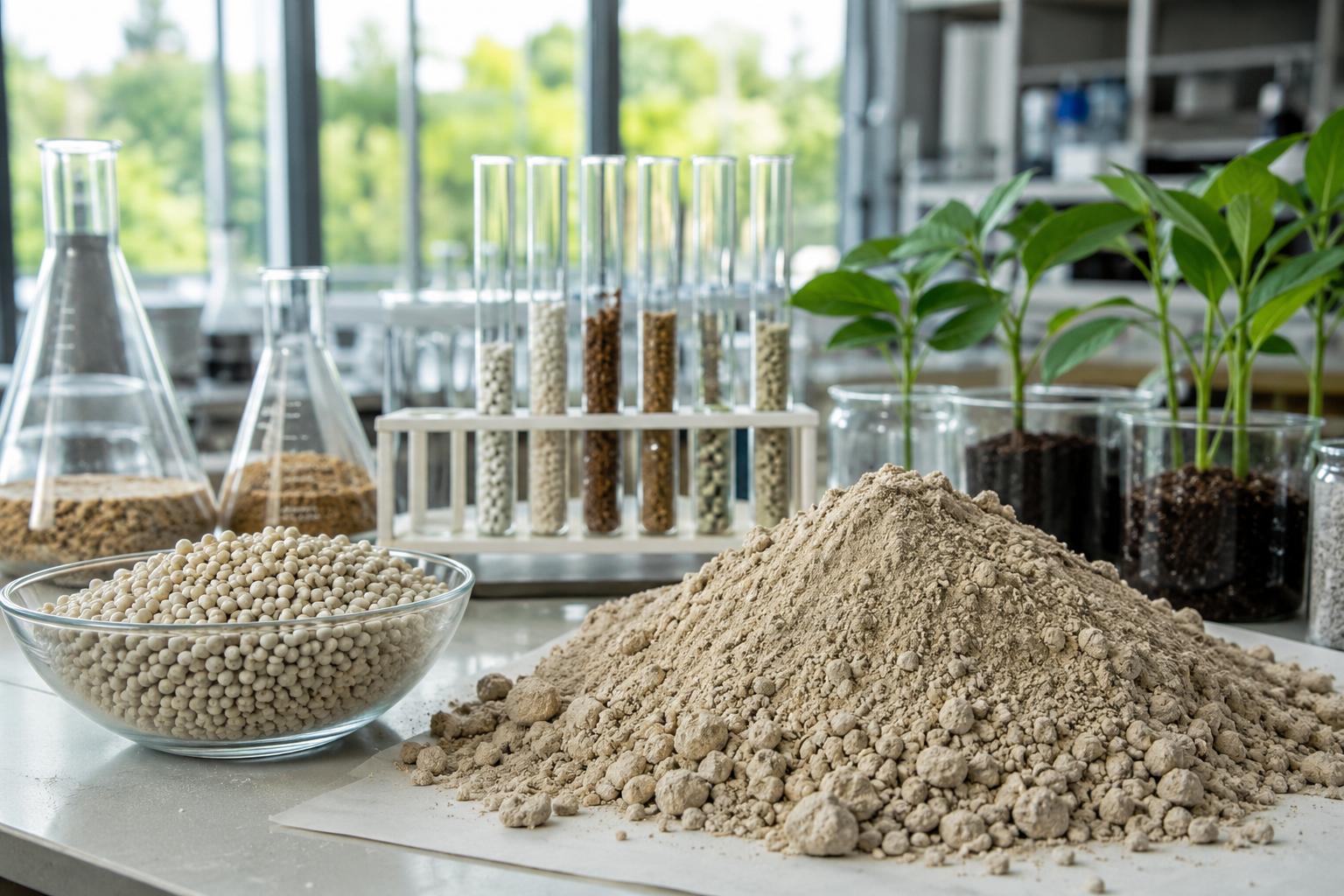
For example, a manufacturer may use a clay carrier to incorporate a liquid micronutrient into a dry fertilizer blend. The clay grade should be selected according to the liquid's chemistry, the target moisture level, the required flowability, and the desired release behavior.
For biological fertilizers, compatibility requires additional testing. High-temperature drying, strong acids, salts, preservatives, or other processing conditions can affect microbial viability. Bentonite's suitability as a carrier does not automatically mean that it is suitable for every living inoculant.
Sulfur-bentonite is one of the best-known fertilizer applications for high-swelling sodium bentonite. In these products, bentonite is not simply a filler. It is part of the physical design that helps disperse elemental sulfur after the product encounters soil moisture.
Elemental sulfur must generally be oxidized by soil microorganisms before plants can take it up as sulfate. Finely divided sulfur has much more surface area available for microbial activity than a large sulfur particle. Sulfur-bentonite products are designed to break into smaller sulfur particles as the bentonite hydrates and expands.
This makes bentonite selection especially important. A sulfur-bentonite manufacturer needs a clay with consistent swelling behavior, suitable particle size, controlled moisture, and good dispersion in the molten sulfur phase.
Bentonite can also be used as a mineral component when a formulation needs additional bulk, absorption, or physical conditioning. This can be relevant to specialty fertilizers, organic nutrient products, and blends that require a dry carrier.
The term filler can be misleading because bentonite may influence several physical properties at once. Adding clay can alter bulk density, water demand, granule hardness, flowability, and nutrient concentration on a weight basis.
For that reason, a formulator should calculate the effect of bentonite on the complete product specification rather than treating it as a simple inert addition.
A typical wet-granulation process involves dry feed preparation, controlled liquid addition, granule growth, drying, cooling, screening, and recycling. Bentonite can participate in several of these stages.
Store the clay in a dry environment and protect it from rain and excessive humidity. Bentonite can absorb moisture during storage, which may reduce feeder accuracy and cause bridging in hoppers or silos.
Use a controlled feeder to maintain a consistent addition rate. Gravimetric feeding is useful where the process requires tight control of clay dosage.
Before full-scale production, confirm that the clay's moisture and particle size match the formulation trial. A change in incoming material can change the water requirement and granulation behavior even when the nominal product specification appears similar.
Bentonite should be distributed uniformly through the dry feed before substantial liquid addition occurs. Poor dry mixing can create clay-rich pockets and clay-deficient areas, resulting in inconsistent granule properties.
A ribbon blender, paddle mixer, or another suitable industrial mixer may be used depending on plant capacity and feed characteristics. The required mixing time should be established through testing rather than assumed to be identical for every line.
Water, steam, or another process liquid may be introduced during granulation. The correct liquid rate depends on the fertilizer chemistry and equipment.
As the clay hydrates, it can contribute to the formation of cohesive wet aggregates. If too little liquid is added, granule growth may be poor. If too much is added, the material may become sticky, produce oversized granules, or overload the dryer.
Spray distribution matters just as much as total liquid quantity. Nozzles should wet the moving bed consistently rather than creating isolated wet zones.
Green granules must be dried enough to meet the finished-product moisture specification without damaging the product or creating unnecessary energy consumption.
Dryer conditions should be established for the specific fertilizer. Air temperature and product temperature are not the same measurement, and operators should avoid relying on a single generic temperature range for every formulation.
The clay remains part of the dried granule structure. The final strength is influenced by the clay grade, moisture history, particle-size distribution, fertilizer salts, and drying conditions.
Finished granules should be cooled before bulk storage or packaging. Warm product placed into a closed package or silo can encourage moisture migration and condensation.
Screening separates the product into size fractions. Oversize material is commonly crushed and recycled, while undersize material may return to the granulator as recycle feed. The correct recycle ratio depends on the process design.
A stable recycle stream is important. Sudden changes in recycle load can alter the residence time, moisture balance, and granule growth pattern inside the granulator.
Sulfur-bentonite production requires a different approach from conventional wet granulation. Elemental sulfur is melted, mixed with bentonite, formed into small solid particles, and cooled.
Commercial sulfur-bentonite products commonly contain a high proportion of elemental sulfur with a smaller proportion of bentonite. Exact composition varies by product design and manufacturer.
High-swelling sodium bentonite is useful because it can hydrate and expand when the sulfur-bentonite particle encounters soil moisture. The expanding clay helps disrupt the sulfur matrix and produce smaller sulfur particles.
The agronomic purpose is to increase the surface area of elemental sulfur available for microbial oxidation. The rate of sulfur oxidation depends on particle size, temperature, moisture, aeration, soil properties, microbial activity, and other field conditions. It should not be described as an automatic or uniform release rate.
Poor dispersion is one of the most common formulation concerns. If bentonite settles or forms agglomerates in the molten sulfur system, the finished pastilles may vary significantly in swelling behavior.
Excess moisture in the clay can also create serious processing problems. Bentonite should be dried and handled according to the plant's documented process-safety requirements before it enters a molten sulfur system.
Another issue is inconsistent clay quality. Two materials with similar appearance can have very different free swell, mineralogy, and particle-size characteristics. Incoming quality control is therefore essential.
Bentonite is not always the best choice. The correct additive depends on the formulation, equipment, cost target, and required product properties.
| Mineral / Material | Primary Function | Swelling Behavior | CEC | Binding Potential | Typical Fertilizer Role |
|---|---|---|---|---|---|
| Sodium bentonite | Binder and sulfur dispersant | High | High | High | Granulation and sulfur-bentonite products |
| Calcium bentonite | Absorbent and conditioner | Lower than sodium bentonite | Moderate to high | Moderate | Carrier and conditioning applications |
| Kaolin | Filler and carrier | Very low | Low | Low to moderate | Filler and specialty formulations |
| Talc | Lubricant and surface conditioner | None | Very low | Low | Selected anti-caking and flow applications |
| Diatomaceous earth | Absorbent carrier | None | Low | Low | Liquid carrier and conditioning applications |
| Starch | Organic binder | None | Not applicable | High in suitable systems | Selected granulation processes |
| Synthetic polymers | Strong binder or coating | Depends on polymer | Not applicable | High | Specialty controlled-release and binding systems |
This comparison doesn't mean one material is universally superior. For example, a polymer may provide stronger binding at a lower dosage, while bentonite can provide additional mineral functionality. A manufacturer should compare the complete formulation cost, not just the price per tonne of additive.
There is no universal dosage for all fertilizer products. Conventional fertilizer granulation may use a few percent bentonite by weight, while sulfur-bentonite products commonly contain a much higher clay proportion because the bentonite is part of the sulfur dispersion mechanism.
A practical formulation study should test several dosage levels and measure the effect on:
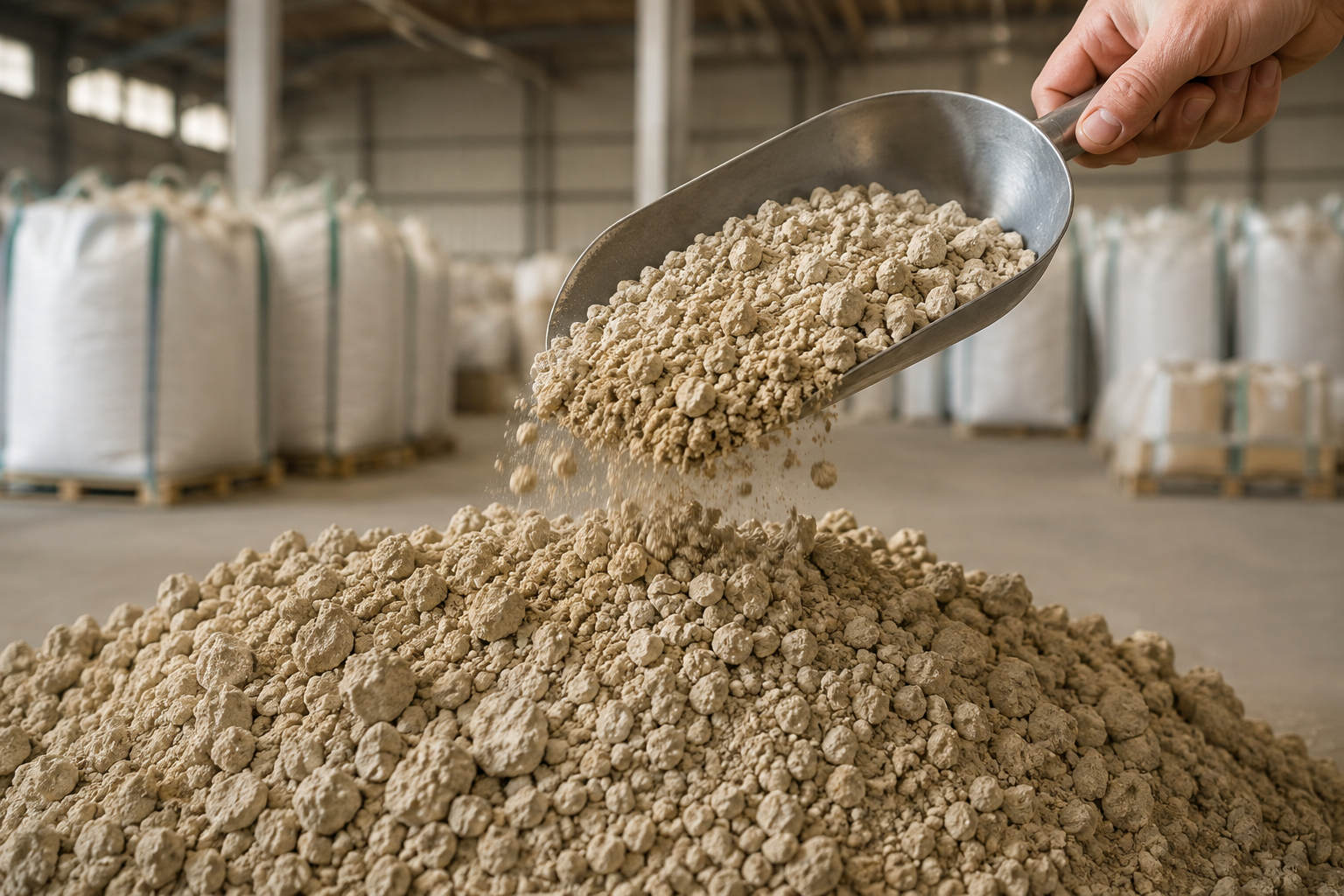
The optimum percentage is the lowest addition rate that delivers the required physical performance without creating unacceptable changes elsewhere in the process.
Bentonite can affect soil physical and chemical behavior, but fertilizer manufacturers should avoid promising field results that depend on conditions outside the product's control.
Montmorillonite has a relatively high cation exchange capacity compared with many other common soil minerals. Exchange sites can retain positively charged nutrients such as ammonium and potassium.
However, the presence of bentonite in a fertilizer does not automatically produce a large increase in the CEC of an entire field. The amount of clay applied, its distribution, the existing soil mineralogy, and the application frequency all matter.
A fertilizer containing a small percentage of bentonite should therefore not be marketed as though it will transform the CEC of a large soil area after one application.
Bentonite can hold substantial amounts of water, especially under suitable moisture conditions. This property is one reason swelling clays are considered for improving water retention in coarse-textured soils.
The actual agronomic benefit depends on the amount applied and how well the clay is distributed through the soil. A small quantity carried with a fertilizer granule may provide a localized effect, but it should not be assumed to function like a large soil amendment application.
Bentonite's exchange sites can retain some positively charged nutrients and reduce their mobility compared with nutrients remaining entirely in solution. This can be useful in formulations designed to improve nutrient-use efficiency.
Still, bentonite does not make a soluble fertilizer automatically slow release. Nutrient release is controlled by many variables, including fertilizer chemistry, granule structure, soil moisture, temperature, microbial activity, and nutrient concentration.
A reliable raw-material specification should combine mineralogical, physical, chemical, and safety parameters. The exact limits should be based on the finished fertilizer and process requirements.
Montmorillonite content is a useful indicator of clay quality, but the testing method matters. X-ray diffraction, methylene blue methods, and other analytical approaches measure different aspects of the material and should not be treated as interchangeable without understanding the method.
Rather than relying on a single headline percentage, buyers should establish an accepted range based on production trials and supplier consistency.
Free swell is particularly important when sodium bentonite is being used in sulfur-bentonite products. It provides an indication of how strongly the clay responds to water under a defined test procedure.
The test method, sample preparation, water quality, and reporting units should always be specified. A supplier's free-swell number is only meaningful when the testing method is known.
Fine bentonite generally disperses more easily than coarse material. Many fertilizer processes use finely ground clay, but the required specification should be selected around the actual mixing and granulation equipment.
Very fine material can increase dust and create feeding challenges. The objective is not simply to obtain the smallest possible particles; it is to achieve the particle-size distribution that gives consistent process performance.
Moisture should be controlled because wet clay can bridge in storage equipment, alter dosing, and increase the load on downstream dryers.
The acceptable moisture range should reflect the plant's storage conditions, feeder design, and process. A supplier and buyer should use the same test method when comparing results.
Fertilizer raw materials should comply with the applicable regulations and customer requirements for contaminants. Depending on the market, testing may include lead, cadmium, arsenic, mercury, and other regulated elements.
The specification should be based on the finished product's intended market rather than on a generic claim that the clay is suitable for agriculture. Export manufacturers should confirm the applicable requirements in each destination market.
Calling a material sodium bentonite or calcium bentonite doesn't provide enough information to predict plant performance. Swelling, mineralogy, moisture, particle size, and impurities can vary considerably.
More bentonite does not automatically mean stronger or better fertilizer. Excess clay can increase water demand, change bulk density, reduce nutrient concentration, and complicate drying or screening.
Clay changes the way a granulation system responds to water. Operators should consider the moisture already present in the incoming bentonite rather than calculating spray water as though the clay were completely dry.
Caking is affected by fertilizer composition, humidity, temperature, storage time, particle size, product temperature, moisture, pressure, and coating. Bentonite may help, but the entire storage system needs to be evaluated.
A clay that performs well in sulfur-bentonite pastilles may not be the best choice for a urea-based granulation process. Formulation-specific trials are the safer route.
Laboratory data can identify promising material, but industrial equipment introduces shear, residence time, recycle load, drying behavior, and feeding conditions that a small test may not reproduce. Pilot or controlled plant trials should confirm the final formulation before a major change is introduced.
For fertilizer manufacturers, supplier selection should go beyond price per tonne. Consistency is often more valuable than a small difference in raw-material cost.
Ask potential suppliers for:
For long-term supply contracts, buyers should also define acceptable variation ranges. A material that meets the specification on paper but fluctuates widely between shipments can force operators to continually adjust water, feeder rates, or granulation conditions.
Bentonite can be a useful part of a fertilizer formulation when its mineral properties are matched to the manufacturing process. The most reliable approach is to start with the product requirement and work backward to the clay specification.
For NPK and other wet-granulated fertilizers, focus on binding performance, particle size, moisture, and the effect of clay dosage on granule strength and dryer load.
For sulfur-bentonite products, give particular attention to sodium bentonite swelling behavior, moisture control, particle-size distribution, dispersion in molten sulfur, and finished-particle breakdown in soil.
For anti-caking and carrier applications, evaluate moisture adsorption, flowability, compatibility with the fertilizer salts, and storage stability rather than assuming that every bentonite grade will behave the same way.
The best formulation is usually the one that delivers the required physical performance at the lowest practical clay addition while maintaining nutrient concentration, production efficiency, and product stability.
Bentonite has a broad role in fertilizer manufacturing, but its value comes from specific mineral properties rather than from the word bentonite alone.
If you're sourcing bentonite for fertilizer manufacturing, ask for a representative sample and technical specification before committing to a large shipment. A controlled formulation trial can show whether the material delivers the required swelling, binding, absorption, or conditioning performance on your actual production line.













Have questions about our products? We're here to help!