Axewelledge, a leading exporter from India, specializes in high-quality Bentonite. With a commitment to excellence, we supply premium Bentonite to the Middle East and Southeast Asia markets.


North Angle Complex, 304,
150 Feet Ring Rd, Opposite Ambedkar Nagar BRTS Stop,
Madhav Park, Punit Nagar,
Mavdi, Rajkot, Gujarat 360004
© Axewelledge 2026, All Rights Reserved.
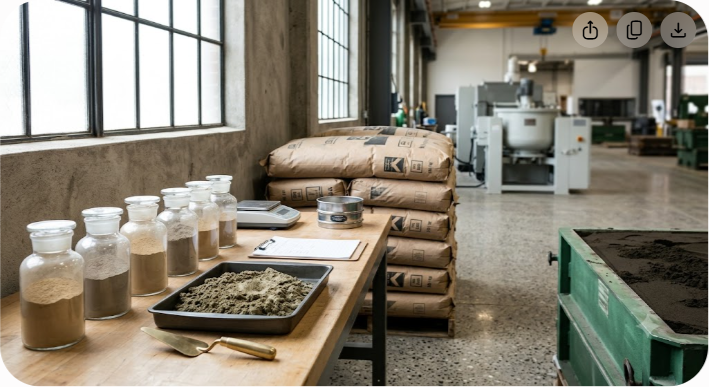
Bentonite is one of the key binders used in green sand casting because it gives molding sand the cohesion it needs to hold a pattern, survive handling, and resist erosion when molten metal enters the mold. But adding more bentonite isn't automatically the answer to a weak or unstable sand system. The grade of clay, active-clay level, moisture, mulling, sand condition, and thermal history all affect performance.
For most foundries, the practical goal is simple: maintain enough active bentonite to produce the required mold strength without adding so much clay and water that permeability, gas evolution, or shakeout performance suffers. Getting that balance right can improve casting consistency and reduce avoidable sand-related defects.
This guide explains how bentonite works in foundry sand, how sodium and calcium bentonite differ, which properties matter when buying foundry-grade clay, how active clay is tested, and how to troubleshoot common defects. It also covers sand preparation, reclamation, supplier evaluation, and the mistakes that can undermine an otherwise well-designed green sand system.
Bentonite is a naturally occurring clay dominated by montmorillonite, a member of the smectite clay group. It forms mainly through the alteration of volcanic ash and is valued for its ability to interact with water, swell, and develop cohesive and plastic properties.
In green sand casting, bentonite acts primarily as a binder. A typical molding system combines refractory sand with bentonite, water, and, depending on the casting process, carbonaceous or other additives. During mixing and mulling, water activates the clay. The hydrated clay develops a film around the sand grains and helps the prepared sand compact into a stable mold.
The term "green sand" can cause confusion. It doesn't mean the sand is green in color or that the process is necessarily environmentally friendly. In foundry terminology, green refers to a mold that contains moisture and is used without being dried or chemically cured before pouring.
Bentonite does more than simply make wet sand sticky. Its swelling behavior, surface chemistry, and interaction with water influence green strength, moldability, wet tensile strength, permeability, and the way the mold responds to thermal stress.
Montmorillonite has a layered structure with a large surface area and the ability to accommodate water and exchangeable ions between its layers. When water is introduced, the clay hydrates and expands. Mechanical mulling then distributes the hydrated clay across the surfaces of the sand grains.
The result is a cohesive sand-clay network. During molding, this network allows the sand to compact around the pattern and retain its shape after pattern withdrawal. During pouring, the binder must also resist the mechanical and thermal stresses created as molten metal enters the cavity.
That is why foundry bentonite shouldn't be evaluated only by how much it swells. A clay with high swelling may still perform poorly if its rheology, purity, activation behavior, or thermal performance doesn't match the foundry's sand system.
Green sand is an engineered molding material rather than a simple mixture of sand and clay. The exact formulation varies with the metal, casting size, molding equipment, sand system, and required surface finish.
A simplified green sand system commonly contains:
The percentages should not be treated as a universal recipe. A foundry might run different active-clay and moisture targets for different alloys, molding methods, sand grain sizes, and casting geometries. The right formulation is the one that produces the required mold properties consistently while keeping gas generation, permeability, and material consumption under control.
Too little active bentonite can leave the mold weak, friable, or difficult to compact. Too much active clay can increase the amount of fine material in the system and may reduce permeability or change the sand's moisture response.
Water creates a similar balancing act. The clay needs sufficient water to hydrate and develop its binding properties, but excess moisture can increase gas generation and make the sand difficult to control.
For that reason, experienced foundries manage active clay, moisture, compactability, permeability, and related properties together rather than adjusting one number in isolation.
The terms sodium bentonite and calcium bentonite describe bentonite in which sodium or calcium is the dominant exchangeable cation. Their hydration and swelling behavior can differ significantly, which affects their usefulness in different molding systems.
Sodium bentonite generally has greater swelling capacity than calcium bentonite and can develop strong binding characteristics when properly hydrated and mulled. It is widely used in green sand systems, including applications involving ferrous castings.
Typical advantages include:
The actual performance still depends on mineralogy, processing, moisture, mulling, sand condition, and the proportion of active clay in the circulating system. A product labeled sodium bentonite isn't automatically equivalent to every other sodium bentonite on the market.
Calcium bentonite generally swells less than sodium bentonite and has different hydration characteristics. Calcium-based clays can be useful in some molding formulations and may be incorporated into blends where their particular green-sand behavior is desirable.
Potential characteristics include:
It would be misleading to say that calcium bentonite is simply an aluminum-casting clay while sodium bentonite is an iron-casting clay. Foundries select binders according to the entire process, not the alloy name alone.
Some foundries use blends of sodium and calcium bentonite to achieve a balance of properties. The blend ratio shouldn't be copied from another plant without testing because sand grain size, molding pressure, moisture, equipment, alloy, casting geometry, and reclamation conditions all influence the result.
The better approach is to establish the required green strength, compactability, permeability, wet tensile strength, and other process targets, then validate the clay blend against those targets through controlled trials.
Bentonite remains important in green sand molding because it combines useful binding performance with a practical recycling system. Its value is not tied to one property; it comes from how several properties work together.
Green strength is the strength of the moist molding sand in its prepared state. Adequate green strength helps the mold withstand pattern withdrawal, handling, closing, and pouring without cracking or collapsing.
Bentonite contributes to this strength by forming a cohesive hydrated clay network around the sand grains. The required level depends on the molding equipment and casting geometry. High-pressure molding lines, for example, place different demands on prepared sand than manually compacted molds.
The mold face is exposed to intense thermal and mechanical stress as molten metal enters the cavity. Moisture near the interface moves and evaporates, while the sand experiences rapid heating.
A suitable bentonite system can maintain enough dry and hot strength to resist erosion and preserve the mold cavity. Sodium bentonite is often valued for this reason, particularly in demanding ferrous applications.
Silica sand expands as it heats. If the mold surface cannot accommodate that movement, thermal expansion can contribute to defects such as rat tails, buckles, and scabs.
Bentonite doesn't eliminate thermal expansion, but a properly designed green sand system can help the mold respond to thermal stress without excessive cracking. The result depends on more than clay alone. Sand grain distribution, additives, moisture, compactability, mold hardness, and pouring conditions all matter.
A well-conditioned bentonite system helps molding sand compact around the pattern and reproduce its geometry. This matters when castings contain narrow sections, ribs, corners, deep pockets, or other features that require good mold definition.
The objective isn't maximum clay content. Excessive clay can make the sand difficult to aerate and may increase fines. The objective is enough effective binder to achieve the required mold properties.
One of the major practical advantages of a bentonite-based green sand system is that much of the molding sand can be returned to the process after shakeout.
The circulating sand is conditioned with water, fresh bentonite, and other additions as required. Some clay becomes thermally altered near the casting surface and loses its original binding activity. Other material remains useful and continues through the system.
This is why sand reclamation and control are central to bentonite performance. A foundry isn't simply adding new clay to fresh sand every time it makes a mold; it's managing a continuously changing material stream.
Molds need enough permeability for air, steam, and other gases to move through the compacted sand. A highly impermeable mold can contribute to gas-related casting defects.
Bentonite supports cohesion without completely filling the spaces between sand grains. However, excessive fines, excessive clay, excessive moisture, or overly tight compaction can still reduce permeability.
Bentonite is widely available and comparatively economical as a molding binder. Its ability to function within a circulating green sand system also reduces the need to replace the entire sand charge after each mold.
The real economic benefit comes from process stability. A slightly more expensive clay that provides consistent active-clay performance may be more economical than a cheaper material that requires higher additions or creates unstable moisture and strength conditions.
Bentonite needs proper mechanical activation. Simply mixing dry clay, sand, and water for a short period isn't enough to guarantee uniform performance.
A muller applies mechanical energy that breaks up clay agglomerates, distributes moisture, and works the activated binder onto the sand grains. The exact sequence varies by equipment, but the principle is consistent: the clay needs enough time and energy to become properly integrated into the sand system.
Under-mulled sand may contain clay that hasn't been adequately distributed or hydrated. The result can be inconsistent mold strength even when the total clay addition looks correct on paper.
Over-mulling isn't automatically better either. Excessive mechanical treatment can change the sand system, increase fines, and consume unnecessary energy. The correct mulling cycle is the one established through testing for the specific equipment and formulation.
A supplier's technical data sheet should provide more information than a generic statement that the material is "high quality." Foundries should compare properties that are relevant to their own process.
Important specifications may include:
| Property | Why it matters in a foundry system |
|---|---|
| Montmorillonite content | Indicates the proportion of the clay mineral responsible for much of the binder behavior |
| Swelling index | Helps indicate hydration and expansion behavior |
| Moisture content | Affects storage stability and the amount of water required during sand preparation |
| Particle-size distribution | Influences dispersion, dust, and consistency during handling |
| pH | Can be useful when evaluating material compatibility and process behavior |
| Gel strength or rheological properties | Helps characterize the clay's interaction with water |
| Methyleneblue value | Used in relevant clay and sand-testing methods to assess active clay behavior |
| Residue or grit | Excess coarse impurities can affect sand performance and equipment wear |
| Loss on ignition | Helps characterize changes in circulating sand and combustible or clay-related material |
No single specification predicts complete foundry performance. The most useful supplier comparison combines laboratory data with plant trials and actual sand-system results.
A controlled green sand system relies on regular testing. The exact test frequency should reflect the plant's process and quality requirements, but waiting until a casting defect appears is rarely an effective control strategy.
The methylene blue test is commonly used to estimate active clay in foundry sand. The method is based on the ability of active clay minerals to adsorb methylene blue. The result helps distinguish useful active clay from material that has become inactive or otherwise contributes to the fines population.
Active-clay results should be interpreted alongside moisture and compactability. A target that works for one sand system may not be appropriate for another.
Wet tensile strength is important because the region immediately beneath the hot mold surface experiences a moisture gradient during pouring. As heat moves through the mold, water migrates and can create a weakened zone.
If that zone lacks sufficient strength, the mold surface can deform or lift under thermal stress. Wet tensile strength testing therefore provides useful information when investigating expansion-related defects.
Water activates bentonite, but the correct moisture level is process-specific. Too little water can leave the clay insufficiently hydrated and reduce molding performance. Too much water can increase gas generation and alter compactability.
Moisture should be evaluated together with active clay and compactability rather than treated as an independent number.
Compactability indicates how the prepared sand responds to a standardized compaction condition. It is particularly useful as a practical control measure because it reflects the interaction of moisture, clay, sand condition, and mulling.
A sudden change in compactability can be an early warning that the sand system needs investigation before the problem becomes a casting-quality issue.
Permeability measures the ability of gas to pass through a compacted sand specimen. Falling permeability can indicate excessive fines, excessive clay, changes in sand grading, over-compaction, or other process changes.
A good green sand system doesn't simply maximize permeability. It balances permeability with the strength needed to make and pour a sound mold.
Bentonite can contribute to defect prevention, but it shouldn't be treated as the sole cause or cure for every sand-related defect. Pouring temperature, gating, venting, mold hardness, pattern design, sand grain distribution, additives, and metal chemistry can all contribute.
What they look like: These defects can appear as rough projections, raised ridges, or irregular folds on the casting surface.
What can cause them: Thermal expansion of the molding sand is a major factor. Weakness in the mold's hot or wet layer can allow the surface to crack or deform. Sand grain characteristics, mold hardness, moisture, bentonite condition, and additives can all influence the outcome.
How to investigate: Check wet tensile strength, compactability, moisture, active clay, sand grain distribution, and mulling conditions. If the test data indicate inadequate binder performance, review the bentonite grade or addition rate. Don't increase clay blindly; excessive additions can create other problems.
What they look like: Metal has eroded part of the mold surface, leaving an unwanted projection or rough area on the casting.
What can cause them: Low mold strength, poor sand compaction, high metal velocity, unsuitable gating, or inadequate resistance at the mold face can contribute.
How to investigate: Review green, dry, and hot strength where relevant. Check the molding pressure and mold hardness, then inspect the gating system and pouring practice. If the sand is weak, verify active clay, moisture, and mulling before changing the binder formulation.
What they look like: Sand particles or pieces of mold material become embedded in the casting.
What can cause them: Mold-face damage, poor green strength, erosion, cracking, or inadequate mold handling can all produce inclusions.
How to investigate: Check the sand's strength and compactability, inspect pattern withdrawal, review mold handling, and verify that the gating system isn't directing excessive metal velocity toward vulnerable mold surfaces.
What they look like: Gas defects can appear as rounded cavities or holes in the casting, either internally or near the surface.
What can cause them: Excess moisture, insufficient permeability, inadequate venting, excessive organic material, or other sources of gas can contribute.
How to investigate: Start with moisture and permeability. Then review active clay, fines, compactability, additives, mold venting, and pouring conditions. Adding more bentonite to a gas problem without identifying the underlying cause can make permeability worse.
If sand properties are drifting, make changes systematically rather than adjusting several variables at once.
A low purchase price doesn't necessarily mean a low cost per casting. If a lower-activity clay requires higher additions, increases fines, or produces less consistent sand properties, the apparent saving can disappear elsewhere in the process.
Compare cost per unit of useful performance, not just cost per tonne of delivered material.
Two sodium bentonites can behave differently because of differences in mineralogy, montmorillonite content, exchangeable ions, processing, particle size, and impurities.
Always evaluate the supplier's technical specifications and confirm performance in the actual foundry system.
A strength problem can come from poor hydration, inadequate mulling, incorrect moisture, sand breakdown, or a change in the base sand. Adding more clay may temporarily increase one measurement while worsening permeability or moisture control.
Find the cause before changing the formulation.
Recycled sand contains material that has changed through repeated heating. If fines accumulate, permeability and other sand properties can shift even when the fresh bentonite addition remains unchanged.
A stable sand system requires control of both what enters the system and what leaves it.
Published ranges can provide useful starting points, but there is no single active-clay, moisture, or compactability target that fits every foundry.
Targets should be established for the specific sand, alloy, molding process, equipment, and casting requirements.
When evaluating a bentonite supplier, ask for a current technical data sheet and a certificate of analysis for delivered material. Compare the information with the requirements of your own sand system.
Useful questions include:
For international procurement, logistics matter as well. A technically suitable bentonite isn't much use if supply interruptions force the foundry to switch grades without enough time to qualify the replacement.
Bentonite is sensitive to moisture during storage because unwanted hydration can affect handling and product consistency. Keep bags or bulk material protected from rain, standing water, and unnecessary humidity.
Use a first-in, first-out inventory system where practical, and keep product identification and batch information available for quality investigations. Good storage won't compensate for poor clay, but poor storage can undermine a good product.
Green sand is designed around repeated circulation. After shakeout, the sand can be returned to the preparation system, cooled and conditioned, and then reused.
Not every component survives the cycle unchanged. Some bentonite is thermally degraded, additives are consumed or altered, and sand grains can fracture after repeated exposure to molding and pouring. These changes create fines and affect the balance of the circulating system.
The purpose of reclamation and dust extraction is therefore not simply to remove as much material as possible. The foundry needs to remove unwanted material while retaining as much useful sand and active binder as the process allows.
A material-balance approach is useful. Track new sand, bentonite, water, additives, dust losses, casting losses, and other additions. Over time, these records can reveal why the sand system is consuming more binder than expected.
Bentonite is often treated as a commodity because its purchase price is visible and easy to compare. The larger cost, however, sits in the performance of the complete molding system.
Suppose one clay requires a higher addition rate to reach the same active-clay target as another. The purchase price per tonne may look attractive, but the foundry is consuming more material. If the additional fines also reduce permeability, operators may compensate with other process changes, creating further instability.
The opposite can happen with a consistent, higher-activity material. If the clay reaches the required performance at a lower addition rate and produces stable sand properties, the effective cost per mold may be competitive even when the price per tonne is higher.
The most useful procurement metric is therefore not simply purchase price. Track binder consumption, sand properties, scrap associated with sand defects, downtime, and the stability of the molding process.
A reliable foundry-bentonite supply depends on more than geological reserves. Mining consistency, mineral processing, quality control, packaging, logistics, technical support, and batch traceability all affect what eventually reaches the molding line.
When evaluating a supplier, request representative samples and technical documentation, then conduct a controlled trial against the incumbent material. Compare the materials under the same sand conditions and record the results rather than relying solely on marketing descriptions.
Axewelledge is one supplier of bentonite products for industrial applications, including foundry-related uses. If its material is being considered for a production sand system, procurement and technical teams should evaluate the relevant product specification, sample performance, quality documentation, supply capability, and commercial terms against their own requirements.
For international buyers, it is also worth checking whether the supplier can maintain consistent specifications across shipments and provide the documentation needed for incoming quality control. Long-term supply reliability is part of product quality when a foundry depends on a narrow process window.
Ferrous foundries place substantial thermal demands on molding materials. Iron and steel castings can require high pouring temperatures, and the mold must maintain sufficient integrity while dealing with moisture movement, thermal expansion, metal flow, and gas generation.
Sodium bentonite is widely used in ferrous green sand systems because of its swelling and binding characteristics. But the clay grade should be selected alongside the sand grain distribution, molding process, additives, moisture target, and casting requirements.
Steel foundries may also use different molding technologies and refractory materials than conventional iron foundries. In those cases, a bentonite specification that performs well in one iron casting line shouldn't be assumed to be suitable for every steel application.
Bentonite is a naturally occurring mineral, but calling it "non-toxic" doesn't remove the need for sensible workplace controls. Fine mineral dust can be hazardous when inhaled, and foundries already have multiple airborne contaminants associated with sand handling, shakeout, pouring, and finishing.
Use appropriate local ventilation, dust collection, housekeeping, and personal protective equipment according to the material's safety data sheet and applicable workplace requirements.
Green sand can also offer material-efficiency advantages because a large portion of the molding sand can circulate through the process. That doesn't make every green sand system automatically low-impact. Energy consumption, dust generation, waste management, additive emissions, and the handling of spent material still need to be managed.
Use the following checklist when reviewing a green sand system:
Bentonite for foundry casting works best when it is treated as one part of a controlled sand system rather than as a standalone additive. The clay must be compatible with the base sand, properly hydrated and mulled, and maintained within a process-specific operating window.
Sodium bentonite is widely used because of its strong swelling and binding behavior, particularly in many ferrous green sand systems. Calcium bentonite and blended clays can also have useful roles when their properties fit the process. The right choice depends on measured performance, not the product label alone.
The most important controls are straightforward: monitor active clay, moisture, compactability, permeability, and relevant strength properties; maintain the muller; manage fines and thermal degradation; and evaluate supplier consistency over time.
When a casting defect appears, resist the temptation to make a large binder adjustment immediately. Check the data first. A stable green sand system comes from disciplined control of several variables working together.
For procurement teams, the same principle applies. Compare bentonite on effective performance, consistency, documentation, and supply reliability rather than purchase price alone. A dependable clay supply can support more predictable sand preparation and make it easier for the foundry to hold a narrow process window.













Have questions about our products? We're here to help!