Axewelledge, a leading exporter from India, specializes in high-quality Bentonite. With a commitment to excellence, we supply premium Bentonite to the Middle East and Southeast Asia markets.


North Angle Complex, 304,
150 Feet Ring Rd, Opposite Ambedkar Nagar BRTS Stop,
Madhav Park, Punit Nagar,
Mavdi, Rajkot, Gujarat 360004
© Axewelledge 2026, All Rights Reserved.
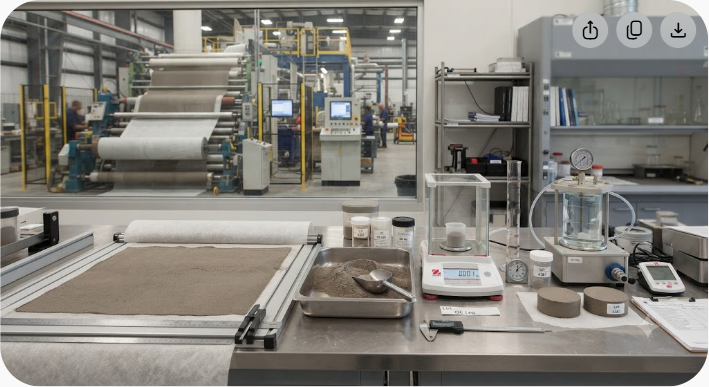
A geosynthetic clay liner may contain only a relatively thin layer of bentonite, but that layer is responsible for much of the liner's ability to restrict water flow. For GCL manufacturers, the important question isn't simply whether a material is sold as sodium bentonite. The real question is whether its mineral quality, swelling behaviour, fluid-loss performance, particle size, moisture, and batch consistency can support the required performance after the clay is incorporated into the finished liner.
The main bentonite quality factors for GCL manufacturing are swell index, fluid loss, mineral composition, particle-size distribution, moisture content, clay mass consistency, hydration behaviour, and batch-to-batch uniformity. These properties should be evaluated together and connected to the hydraulic requirements of the finished GCL rather than treated as unrelated numbers.
ASTM D5890 evaluates the swelling properties of the clay mineral component used in GCLs, while ASTM D5891/D5891M evaluates fluid-loss behaviour. Those tests are useful quality-control tools, but neither should be treated as a complete substitute for testing the finished GCL.
That distinction matters. A bentonite can produce an impressive laboratory report and still behave differently when it is distributed between geotextiles, hydrated under confinement, exposed to site-specific water chemistry, or processed through a particular manufacturing line.
A geosynthetic clay liner, or GCL, is a factory-manufactured hydraulic barrier that combines bentonite with geosynthetic components, commonly geotextiles. Some GCL designs also incorporate geomembrane or geofilm components. The bentonite provides the primary mineral sealing layer.
When the clay hydrates, its smectite-rich particles interact with water and expand. Under suitable conditions, the hydrated clay develops a low-permeability structure that restricts water movement through the liner.
The bentonite is therefore not simply filler between two fabrics. It is the functional mineral component of the GCL, and variation in clay quality can affect the hydraulic behaviour of the composite.
In production, the bentonite needs to perform several jobs at once:
A useful specification connects these mineral characteristics to the finished GCL rather than treating raw bentonite as a commodity that can be swapped without validation.
Sodium-rich bentonite is widely associated with GCL applications because sodium-dominated montmorillonite can hydrate and swell strongly. That swelling can help the clay develop a dense, low-permeability structure when the GCL is properly hydrated and confined.
But the words sodium bentonite aren't enough to qualify a material.
Natural bentonite deposits contain mixtures of clay and non-clay minerals. The amount and type of smectite, exchangeable cations, quartz, feldspar, carbonates, and other minerals can vary by deposit and, in some cases, within the same deposit. Processing can also change the material's particle-size distribution and physical behaviour.
Two materials can therefore both be marketed as sodium bentonite while producing noticeably different test results and manufacturing behaviour.
For GCL production, the more useful question isn't, "Is this sodium bentonite?" It is, "Does this particular bentonite consistently deliver the hydraulic and manufacturing performance we require?"
That is why performance testing should sit alongside mineralogical information and routine physical quality control.
If you're qualifying a new bentonite supplier or reviewing an existing source, start with these eight factors. They cover the main raw-material characteristics that can influence both manufacturing behaviour and finished GCL performance.
Swell index is one of the most familiar indicators of bentonite performance in GCL applications. ASTM D5890 is designed to determine the swelling properties of the clay mineral component used in GCLs under a prescribed laboratory procedure.
The basic concept is straightforward. A prepared clay sample is dispersed in water, allowed to hydrate under the specified conditions, and the resulting swollen volume is measured.
Higher swelling can be useful because hydrated clay can occupy pore spaces and create a more restrictive path for water. But swell index shouldn't be treated as a complete prediction of finished GCL performance.
The test is an index property. It describes how the prepared clay behaves under a controlled laboratory condition, not how every manufactured GCL will behave in every field environment.
For purchasing teams, that leads to a practical rule: use swell index as an important screening and quality-control parameter, but don't make it the only acceptance criterion.
When comparing suppliers, look beyond a single headline result. Review the normal range, the variation between production lots, the test method used, and how the raw bentonite results correlate with the finished GCL's hydraulic performance.
Fluid loss measures how much liquid passes through a clay filter cake under a specified test condition. ASTM D5891/D5891M evaluates the fluid-loss properties of clay intended for GCL applications using a defined slurry concentration and pressure condition.
Why does this matter for a GCL?
A bentonite that forms an effective, low-permeability filter cake can provide useful information about its sealing behaviour. Fluid loss therefore gives manufacturers another window into the clay's performance.
The same caution applies here as with swell index. A strong fluid-loss result doesn't automatically guarantee that the finished GCL will meet its hydraulic specification under every field condition.
For quality control, look for consistency as well as absolute performance. If incoming bentonite shows an unexplained change in fluid loss, investigate it before assuming that the production process is unchanged.
It is also useful to compare incoming bentonite data with finished-GCL index-flux results over time. That historical relationship can tell a manufacturer much more than an isolated supplier certificate.
Smectite, including montmorillonite, is the mineral fraction responsible for much of bentonite's swelling and hydration behaviour. A source containing a high proportion of useful swelling clay generally has greater potential for GCL production than a material containing a large amount of relatively inert mineral matter.
Mineralogical testing can help explain why two materials with similar appearance behave differently. Depending on the manufacturer's quality system and specification, useful techniques may include X-ray diffraction, X-ray fluorescence, cation exchange measurements, methylene blue testing, and other agreed analytical methods.
The goal, however, shouldn't be to collect a long list of laboratory numbers simply because they look technical.
Ask what the data explains. If a production lot shows a change in mineral composition, does that change also appear in swell index, fluid loss, particle size, hydration behaviour, or finished GCL performance?
That connection is more valuable than a mineralogical report considered in isolation.
Mineralogy can also help when investigating a sudden process change. If the incoming bentonite certificate is stable but finished-GCL performance has moved outside the normal range, mineralogical information may help distinguish raw-material variation from manufacturing variation.
Particle size affects how bentonite behaves during feeding, spreading, handling, and hydration.
Fine material can disperse and hydrate readily, while coarse particles may require more time to hydrate. Excessively fine material can also increase dust during handling and change the way the clay moves through feeders and distribution equipment. Granular products may be easier to handle, but their behaviour still needs to be assessed against the actual GCL manufacturing process.
ASTM D5890 and D5891/D5891M include sample-preparation requirements for granular clay so that materials can be evaluated using a consistent laboratory procedure. Those preparation requirements should not be confused with a universal commercial particle-size specification for every GCL plant.
For manufacturing, the better question is whether the supplier's particle-size distribution is stable and compatible with your feeding, spreading, and encapsulation equipment.
A change in particle size can sometimes look like a formulation problem when the real issue is process behaviour. If feeder output, dust generation, web coverage, or hydration time changes, compare the incoming particle-size data before changing the clay dosage.
Moisture is easy to overlook because it isn't the active clay itself. It can still influence storage, handling, feeding accuracy, bulk density, and the apparent mass of material entering the production line.
Consider a simple example. Suppose your process is designed around a specified dry bentonite loading per square metre. If incoming material contains substantially different moisture from one shipment to another, the same wet mass doesn't represent the same dry clay mass.
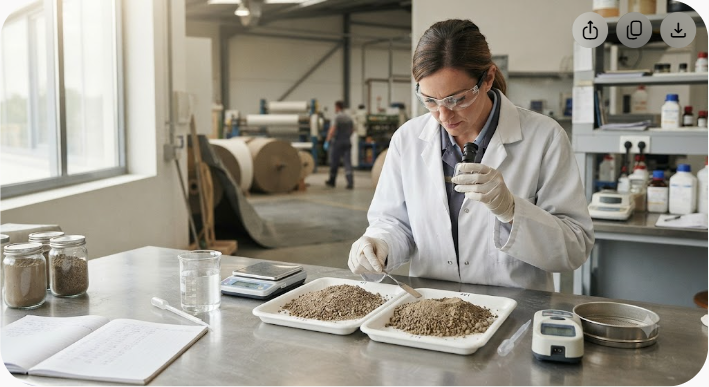
Moisture can also contribute to caking during storage. Very dry material may generate more dust, while material exposed to humid conditions can absorb water and change its physical behaviour.
There isn't one universal moisture target that automatically suits every GCL plant. Establish a plant-specific operating range based on the bentonite formulation, packaging, storage conditions, conveying system, and dosing equipment.
ASTM D5993 can be used to determine the mass per unit area of a GCL on a dry basis and to determine moisture content from the difference between initial and dried mass under the specified procedure.
For incoming bentonite, manufacturers should also make sure their dosing calculations distinguish wet material mass from dry clay mass whenever moisture variation could affect the target loading.
This is where raw bentonite quality meets manufacturing discipline.
A GCL cannot perform uniformly if the amount of clay varies significantly across the roll. Even excellent bentonite can produce a poor liner if the spreading system creates thin areas, segregation, or uneven coverage.
ASTM D5993 provides a method for measuring GCL mass per unit area and determining dry clay mass. The target clay loading itself should come from the product specification and intended application. There isn't one universal loading that makes every GCL suitable for every project.
Manufacturers should monitor:
The important point is consistency. A narrow, controlled process window is often more useful than an impressive one-time laboratory result.
Bentonite doesn't hydrate in isolation. The chemistry of the water surrounding it can have a major effect on swelling and hydraulic behaviour.
Low-ionic-strength water can produce different swelling behaviour from water containing elevated concentrations of dissolved salts. Multivalent cations can also influence clay swelling by compressing the diffuse double layer around clay particles.
This matters for GCLs used around waste containment, mining facilities, saline environments, or other sites where pore water may differ substantially from the water used in a standard laboratory test.
A bentonite that performs well in reagent water may not produce the same hydraulic response in a chemically aggressive solution. ASTM D6766/D6766M provides a method for evaluating the hydraulic properties of GCLs permeated with potentially incompatible aqueous solutions, illustrating why application-specific testing can be important.
This is one of the strongest reasons not to select bentonite from a single swell-index number. If the intended application involves unusual or aggressive water chemistry, test the actual GCL under representative conditions where appropriate.
Consistency is the quality factor that quietly controls everything else.
A supplier may provide an excellent first sample. The real test is whether shipment 2, shipment 10, and shipment 20 remain within the agreed specification.
For a GCL manufacturer, variation in incoming bentonite can create changes in:
A stable mine source, controlled processing, representative sampling, and traceable lot testing can therefore be just as important as a high headline test value.
When qualifying a supplier, ask for historical quality data rather than looking only at the latest certificate. A useful supplier should be able to explain how it defines production lots, how samples are collected, how often key tests are performed, and how out-of-specification material is handled.
A practical incoming-quality program should combine several types of testing rather than rely on one certificate of analysis.
At minimum, discuss the following with your bentonite supplier:
| Property | Why it matters | Typical test or evaluation approach |
|---|---|---|
| Swell index | Indicates swelling potential of the clay | ASTM D5890 |
| Fluid loss | Indicates clay filter-cake and fluid-loss behaviour | ASTM D5891/D5891M |
| Particle-size distribution | Affects feeding, spreading, and hydration | Sieve analysis or an agreed particle-size method |
| Moisture content | Affects handling and dry-mass calculations | Oven drying or a validated plant method |
| Mineral composition | Helps explain changes in clay behaviour | XRD, XRF, and related mineralogical tests |
| Active clay indicators | Helps assess swelling-clay content and consistency | An agreed laboratory method |
| Finished GCL clay mass | Confirms product loading | ASTM D5993 |
| Finished GCL index flux | Directly checks hydraulic performance under a prescribed test condition | ASTM D5887/D5887M |
A quality-control program should define not only which properties are tested but also how often they are tested, how samples are collected, which laboratory performs the work, and what happens when a result falls outside the agreed range.
The finished GCL deserves particular attention. Raw bentonite tests tell you about the clay. Finished-product tests tell you whether that clay, in combination with the selected geotextiles and manufacturing process, has produced the required liner.
A supplier certificate is useful evidence, but it isn't a substitute for the GCL manufacturer's own quality-control plan.
It's tempting to rank bentonite solely by whichever number looks better on a laboratory report. That's rarely the right way to select material.
Think of swell index and fluid loss as two different windows into clay behaviour.
Swell index describes the volume expansion of prepared clay under a defined test condition. Fluid loss describes how a clay slurry behaves when it forms a filter cake under another defined test condition.
A strong GCL raw material should provide a useful combination of properties rather than one isolated standout number.
For example, suppose Supplier A provides a very high swell value but inconsistent fluid-loss results, while Supplier B provides slightly lower swelling but much tighter control from batch to batch and consistently strong finished-GCL index-flux results. The swell numbers alone don't establish which material is more suitable.
The selection should instead consider the product specification, validation testing, manufacturing behaviour, cost, supply reliability, and hydraulic requirements of the project.
This is also why historical data matters. If a supplier can demonstrate stable results over multiple production lots, the manufacturer has a better basis for estimating how the material will behave at commercial scale.
One of the most important principles in GCL manufacturing is that raw bentonite tests and finished-product tests answer different questions.
A raw-material test asks, "How does this clay behave under a standardized laboratory procedure?"
A finished-GCL test asks, "How does the manufactured composite behave under a specified hydraulic test condition?"
ASTM D5887/D5887M measures index flux through saturated GCL specimens using a flexible-wall permeameter. It can be used for manufacturing quality control and conformance testing, but the measured value is obtained under prescribed laboratory conditions and should not automatically be treated as the exact flux that will occur in service.
That qualification matters because field performance depends on factors such as confinement, hydration, water chemistry, loading, interfaces, defects, installation quality, and site conditions.
Finished-GCL testing still provides something that a raw bentonite certificate cannot: direct evidence about the actual manufactured composite.
For a manufacturer, that distinction is useful when investigating changes in production. If the incoming bentonite results are stable but finished-GCL index flux has changed, the investigation can move toward clay distribution, clay loading, geotextile interaction, hydration, test conditions, or other process variables rather than automatically blaming the supplier.
If you're evaluating a new bentonite source, don't jump straight from a supplier sample to a full production contract. A staged qualification process gives you much better information.
Start with the liner, not the mine.
Define the intended GCL construction, clay loading, backing materials, target hydraulic performance, and project-specific chemical exposure. Identify the relevant ASTM methods and project requirements before selecting the raw material.
This prevents the common mistake of choosing a bentonite first and trying to make the finished specification fit it later.
Create a written specification covering the properties that actually control your process. This may include swell index, fluid loss, moisture, particle size, mineralogical indicators, and other internal parameters.
Don't copy a generic specification without checking whether it matches your equipment, finished product, and customer requirements.
The specification should also define the sampling frequency, acceptable variation, certificate requirements, and procedure for handling results that fall outside the agreed limits.
A laboratory sample should represent the commercial material you expect to receive. Ask for the production lot, sampling method, date, source, and relevant certificate information.
A small hand-selected sample from a stockpile tells you much less than a properly representative sample collected according to an agreed procedure.
One successful sample proves that one sample was successful.
Testing several production lots gives you an early view of natural variability. This becomes especially important when purchasing large volumes for continuous GCL production, where a small difference in raw-material behaviour can affect process settings over time.
Where practical, repeat key tests in your own laboratory or through an independent laboratory using agreed methods. This helps identify differences caused by sample preparation, equipment, operator technique, or laboratory procedures.
The objective isn't to create unnecessary duplicate testing. It is to make sure that supplier data and your own quality system are measuring the same material in a comparable way.
Introduce the bentonite into the actual manufacturing process. Monitor feeding, spreading, dust, segregation, web coverage, moisture behaviour, and production stability.
A material that performs well in a laboratory beaker but feeds poorly through your equipment may not be commercially suitable.

During the trial, record process settings rather than relying only on operator observations. That gives you a useful baseline if the same supplier is approved for regular production.
Measure the finished product against your internal specification and relevant project requirements. Include dry clay mass per unit area and appropriate hydraulic-performance testing.
Where the application warrants it, consider additional testing under representative chemical or environmental conditions rather than relying entirely on standard laboratory water.
Agree in advance on the specification, certificate requirements, sampling procedure, lot identification, retesting process, and action to take when a shipment falls outside specification.
This prevents quality disputes after material has already entered production and makes the purchasing process easier to manage.
If a previously stable product suddenly produces a higher index flux or inconsistent production results, don't assume the bentonite itself is automatically the problem.
Several variables can shift at the same time. A structured investigation is usually more useful than immediately changing the formulation.
Mineral composition can change within a source deposit. Changes in the clay fraction or exchangeable cation balance can affect hydration and swelling.
Compare the current lot with historical data. If swell index, fluid loss, moisture, particle size, and mineralogical indicators have all moved together, the incoming material deserves closer attention.
Changes in milling, drying, or classification can alter particle-size distribution. That can affect handling, feeder behaviour, dust generation, and hydration.
If a supplier has changed its processing equipment or production settings, ask whether the change could affect the agreed specification.
Wet material can cake, while changes in bulk density can affect feeder calibration. If your dosing system measures volume rather than mass, moisture and bulk-density changes deserve particular attention.
A change in moisture can therefore create an apparent change in clay loading even when the formulation itself hasn't changed.
A change in process water or test water can produce a change in bentonite behaviour. If laboratory results suddenly shift, verify the water chemistry before changing the formulation.
For projects involving saline or chemically aggressive water, compare test conditions with the actual expected service environment.
The same bentonite can behave differently when the GCL is manufactured, hydrated, and confined compared with a loose laboratory sample.
This is one reason finished-product testing remains important even when incoming bentonite results are within specification.
A raw material can be excellent while the finished GCL still contains local areas of insufficient clay coverage. Check the manufacturing process before blaming the mineral.
Inspect feeder performance, spreading uniformity, web speed, clay mass per unit area, and any points where segregation could occur.
High swelling can indicate useful hydration and expansion potential, but it doesn't capture every property that controls GCL performance. Combine swell index with fluid loss, mineralogical information, manufacturing trials, and finished-product testing.
Sodium bentonite describes a material category, not a complete performance grade. The actual mineral composition, exchangeable cations, processing history, particle size, and consistency still matter.
A supplier's use of the term sodium bentonite should therefore be the starting point for evaluation, not the final acceptance decision.
A laboratory result obtained with reagent water may not predict behaviour in saline or chemically aggressive site conditions. Application-specific testing can be necessary when the expected pore water differs significantly from standard laboratory conditions.
A supplier can provide a good sample from a good lot. Your production line needs material that remains within specification across many lots.
Review historical data and test multiple representative lots before approving a source for sustained commercial production.
Finished GCL performance is what ultimately matters. Raw-material quality control and finished-product quality control should support each other.
A bentonite that meets the paperwork specification may still behave differently in your feeder, mixer, spreader, or encapsulation line. Validate the material under real manufacturing conditions before making a full-scale change.
Landfill liners, mining containment systems, wastewater applications, and other hydraulic barriers can have different chemical and performance requirements. Your specification should reflect the actual project and finished GCL design.
A useful supplier specification should be short enough for purchasing teams to use and detailed enough for quality engineers to enforce.
A practical document might contain:
The exact numerical limits should come from the GCL design, production process, customer specification, applicable standards, and validation data. Avoid creating arbitrary limits simply because they appear on another supplier's product sheet.
A strong specification should also distinguish between supplier qualification limits and routine production limits. The values used to qualify a new source may be more detailed than the smaller set of properties monitored for every incoming shipment.
Even good bentonite can become difficult to use if it is poorly stored.
Keep the material protected from water and uncontrolled humidity. Packaging should limit contamination and moisture pickup. Storage areas should also allow proper lot segregation so older and newer material aren't mixed without traceability.
For bulk material, pay attention to:
If a batch looks physically different from the normal material, don't simply adjust the feeder and continue production. Hold the material long enough to determine whether the difference is cosmetic, handling-related, or a genuine change in mineral performance.
Storage conditions also matter during international transport. Moisture exposure during transit can change the physical behaviour of the product before it reaches the plant, so packaging, container loading, protection from water, and inspection on receipt should be part of the quality-control process.
Before approving a source for GCL production, ask questions that reveal how seriously the supplier controls variability.
Useful questions include:
The answers can tell you almost as much as the test results. A supplier that understands variability, sampling, traceability, and process control is easier to qualify than one that only provides a single specification sheet.
For an international buyer, logistics also deserve attention. A technically suitable bentonite is only useful if the supplier can maintain the agreed quality during packaging, loading, transport, and delivery.
For GCL manufacturers evaluating bentonite from India, the useful starting point is a documented technical specification rather than a generic product description.
Axewelledge supplies sodium bentonite for industrial applications and has mineral-supply and processing capabilities intended to support consistent bulk supply. For a GCL application, the important next step is to match the material to the manufacturer's required swell, fluid-loss, particle-size, moisture, and finished-GCL performance criteria rather than assuming that one general-purpose bentonite grade will suit every liner design.
Ask for the relevant technical data, representative samples, and lot information, then validate the material through your own qualification process. That approach gives engineering and purchasing teams evidence they can use rather than relying on marketing language.
For a commercial qualification, the most useful supplier discussion should cover the intended GCL construction, required clay loading, target hydraulic performance, water chemistry, production process, test methods, and expected annual volume. Those details provide a much better basis for evaluating a bentonite source than a generic product label.
Before signing off a new source, make sure you can answer yes to these questions:
If several of these answers are unclear, the supplier hasn't really been qualified yet.
The right bentonite for GCL manufacturing isn't necessarily the material with the highest swelling number or the lowest price per tonne. It is the material that consistently produces the required finished-GCL performance within a controlled manufacturing process.
Start with the application and finished-product specification. Then evaluate swell index, fluid loss, mineral composition, particle size, moisture, hydration behaviour, and consistency. Finally, confirm the result through production trials and finished-GCL testing.
Raw bentonite tests and finished-product tests serve different purposes. The first helps control the incoming mineral. The second verifies what the manufacturing process actually produced.
For manufacturers buying internationally, supplier consistency and traceability should sit alongside laboratory performance. A reliable bentonite source gives your production team something more useful than a strong first test result: confidence that subsequent shipments will behave within the agreed specification.
If you're evaluating sodium bentonite for GCL production, Axewelledge can provide technical information and samples for qualification against your application's requirements. The most productive conversation starts with your target specification, production process, and required finished-GCL performance.













Have questions about our products? We're here to help!