Axewelledge, a leading exporter from India, specializes in high-quality Bentonite. With a commitment to excellence, we supply premium Bentonite to the Middle East and Southeast Asia markets.


North Angle Complex, 304,
150 Feet Ring Rd, Opposite Ambedkar Nagar BRTS Stop,
Madhav Park, Punit Nagar,
Mavdi, Rajkot, Gujarat 360004
© Axewelledge 2026, All Rights Reserved.
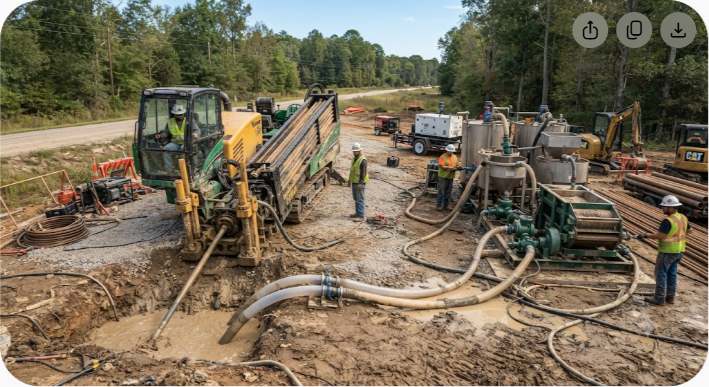
Bentonite for horizontal directional drilling does far more than make water viscous. A well-designed bentonite slurry helps transport cuttings, control filtration, reduce friction, support the borehole wall, and keep the drilling system workable as ground conditions change. The right product and concentration depend on the soil, water chemistry, drilling method, hole size, circulation rate, and the performance targets for the job.
For that reason, choosing bentonite by product name alone isn't enough. Two sodium bentonite products can behave quite differently at the same dosage because mineral composition, montmorillonite content, particle-size distribution, yield, and water chemistry all affect the finished mud.
In horizontal directional drilling (HDD), bentonite is primarily used to build a stable drilling fluid that can circulate through the pilot bore, carry drilled solids to the surface, and provide support to the formation. Sodium bentonite is commonly selected because its montmorillonite-rich structure hydrates and develops useful viscosity and gel strength when dispersed in water.
The drilling fluid performs several jobs at once:
These functions are connected. A slurry with excessive solids, inadequate hydration, or poorly controlled rheology can lose its ability to perform one or several of them effectively.
Sodium bentonite is a naturally occurring clay dominated by the smectite mineral montmorillonite. Its layered structure allows water to enter between clay platelets and promotes dispersion when the material is properly hydrated. That hydration is responsible for much of the viscosity, swelling, suspension, and filtration behavior valued in drilling fluids.
The term sodium bentonite describes a bentonite in which sodium is the dominant exchangeable cation; it doesn't mean that every sodium bentonite product will produce the same mud. Grade selection still matters. A drilling-grade material should be evaluated using the performance properties relevant to the application rather than relying only on the word "sodium" on the specification sheet.
Calcium bentonite generally has lower free swelling and different rheological behavior than sodium-dominant bentonite. However, saying that sodium bentonite is always the right choice oversimplifies HDD fluid design. The actual requirement depends on formation conditions, available water, drilling equipment, and the fluid program established for the project.
Dry bentonite doesn't reach its useful drilling performance the moment it touches water. The particles need to disperse and hydrate. If powder is introduced too quickly or into poorly agitated water, partially hydrated lumps can form. These are often called fish eyes because a hydrated outer layer can surround dry material inside.
Poor hydration wastes product and makes test results misleading. A slurry can appear thick because of incompletely dispersed particles while still lacking the stable rheology and filtration control expected from properly hydrated bentonite.
Good mixing therefore starts with water quality, sufficient agitation, controlled powder addition, and enough hydration time for the selected product. The exact procedure should follow the bentonite supplier's technical data and the requirements of the drilling-fluid program.
A drilling-fluid specification should focus on measurable performance. The most useful properties vary with the formation and drilling stage, but several deserve close attention.
Viscosity describes the resistance of the fluid to flow. In HDD, the target isn't simply "higher is better." Excessive viscosity can increase pumping pressure, make solids separation more difficult, and raise the risk of undesirable fluid pressures in sensitive formations.
Insufficient viscosity creates the opposite problem. Cuttings can settle in the annulus, especially when circulation slows or stops. Settled solids can increase torque and drag, restrict circulation, and contribute to difficult reaming or pullback conditions.
Field measurements such as Marsh funnel time provide a quick indication of fluid consistency, but Marsh funnel viscosity is only one measurement. It shouldn't be treated as a complete description of drilling-fluid rheology.
Gel strength indicates how strongly the fluid develops structure when it is static or nearly static. This property matters when circulation pauses because the fluid needs enough structure to help suspend cuttings rather than allowing them to settle immediately.
Too little gel strength can lead to solids settling. Excessive gel strength can make restarting circulation more difficult and may increase pressure requirements. The appropriate balance depends on hole geometry, formation, solids loading, and operating conditions.
Yield point and plastic viscosity are commonly used to describe drilling-fluid behavior, particularly when measured with a rotational viscometer.
Plastic viscosity is associated primarily with the concentration and size of solids and the continuous phase's resistance to flow. Yield point reflects the attractive forces within the fluid system and provides an indication of its ability to carry suspended solids.
A useful drilling-fluid design doesn't chase a high yield point in isolation. The objective is to achieve enough carrying capacity without creating unnecessary pressure losses or making the mud difficult to process at the surface.
Filtration control becomes particularly important when drilling through permeable formations. If water leaves the drilling fluid too readily and enters the formation, the remaining mud can change in concentration while the surrounding formation may become more susceptible to instability or erosion.
A well-dispersed bentonite system can deposit a thin filter cake on the formation wall. The quality of that cake matters as much as the amount of bentonite in the tank. A thick, weak, or poorly formed cake isn't necessarily better than a thin, low-permeability one.
Fluid-loss testing should therefore be interpreted alongside rheology, sand content, solids loading, and the actual ground conditions. A single laboratory value can't predict every field condition.
The best bentonite grade is the one that provides the required drilling-fluid performance under the project's actual conditions. Start with the formation and work backward toward the fluid specification.
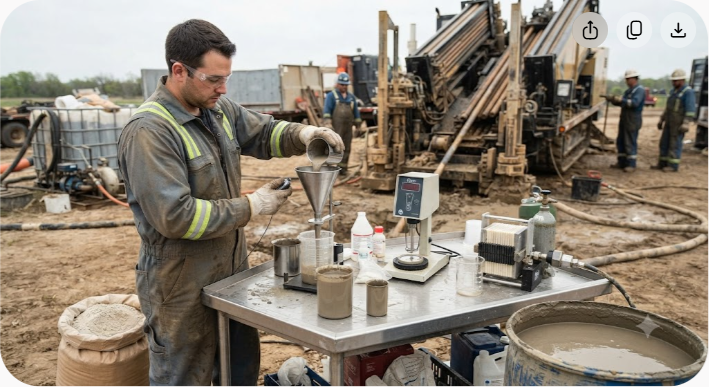
Soil type is one of the first variables to consider. Loose sand, gravel, reactive clay, weathered rock, and competent rock place different demands on the fluid.
Sandy formations can require stronger filtration control because they readily accept water. Reactive clays may create excessive native solids and can make the fluid progressively thicker as drilling continues. Gravel and fractured formations can present circulation-loss problems that aren't solved simply by adding more bentonite.
The same mud recipe shouldn't automatically be carried from one section of a bore to another.
High-yield bentonite can develop useful viscosity and suspension at a relatively low product concentration. Yield is therefore important when estimating consumption, tank capacity, mixing time, and fluid properties.
However, yield shouldn't be confused with overall suitability. A product that performs well in a laboratory test may still require adjustment when mixed with hard water or exposed to a formation that contributes large quantities of native solids.
Ask suppliers for relevant test data and, where the project is critical, conduct a controlled field or laboratory trial using the actual makeup water.
Water quality can have a major effect on bentonite hydration. Calcium and magnesium ions can interfere with the dispersion and swelling behavior of sodium bentonite. High salinity and other dissolved minerals can also change the way the clay interacts with water.
This is why a bentonite specification without a water-quality assessment is incomplete.
The amount of fluid required isn't determined by bentonite concentration alone. Pilot-hole diameter, reamer diameter, product-pipe size, and annular clearance affect circulation and cuttings transport.
A narrow annulus can create high flow velocities and pressure losses. A large annulus may require sufficient fluid volume and carrying capacity to prevent cuttings from settling. Fluid design should account for the complete circulation path rather than just the mixing tank.
A good bentonite product still needs adequate mixing and pumping equipment. High-shear jet mixing, venturi-style hoppers, mechanical agitation, and recirculation systems can all influence how efficiently the dry clay becomes dispersed.
The drilling-fluid program should be compatible with the pump's operating envelope. Increasing viscosity without considering pressure, flow rate, and equipment capacity can create a problem rather than solve one.
Field testing provides the feedback needed to adjust a drilling-fluid system before a small problem becomes a bore failure. The exact testing schedule should be established for the project, but the following measurements are commonly useful.
| Property | Why it matters | How it is commonly assessed |
|---|---|---|
| Marsh funnel viscosity | Provides a quick field indication of fluid consistency | Marsh funnel test |
| Density | Indicates total fluid and solids loading | Mud balance |
| Sand content | Shows the amount of abrasive, retained solids | Sand-content kit |
| pH | Helps monitor water and chemical conditions | pH meter or suitable test method |
| Rheology | Helps assess flow behavior, suspension, and solids loading | Rotational viscometer |
| Gel strength | Indicates static suspension characteristics | Rotational viscometer |
| Fluid loss | Assesses filtration behavior | Appropriate filtration test |
There is no universal set of target numbers that works for every HDD project. A value that is appropriate for a large reaming operation in one formation may be unsuitable for a small pilot bore in another.
No. Marsh funnel time is useful because it is quick and inexpensive, but it reduces complex fluid behavior to a single flow-time measurement.
Two fluids can have similar Marsh funnel times while behaving differently under low-shear and high-shear conditions. For larger, more demanding, or technically sensitive projects, rotational rheology and other fluid tests provide a more complete picture.
The Marsh funnel is best treated as a field-control tool, not as a substitute for fluid engineering.
Water hardness deserves attention before the first bag of bentonite enters the hopper. Hard water commonly contains calcium and magnesium ions that can interfere with clay dispersion and reduce the performance obtained from a given dosage.
A common field approach is to evaluate the makeup water before mixing and, where appropriate, use soda ash to reduce the effect of hardness. The required treatment should be based on measured water chemistry and the drilling-fluid supplier's recommendations rather than a fixed dose applied to every site.
The sequence matters. Water treatment is generally carried out before bentonite addition so that the clay is introduced into water that is more suitable for hydration.
Other water-quality variables can matter as well. Salinity, dissolved solids, temperature, and contamination from previous drilling fluids may all affect performance. If the water source changes during a project, recheck the fluid instead of assuming the original mix will behave identically.
A controlled mixing sequence helps the bentonite reach its expected yield and reduces undispersed material.
Check the water used for mixing, including relevant hardness and pH parameters. If the water is unsuitable for the selected bentonite grade, treat it according to the fluid program before adding clay.
Start the mixing system and confirm that the hopper or mixing tank is producing sufficient turbulence. The objective is to distribute each particle through the water rather than allowing powder to collect in one location.
Feed the powder at a controlled rate into the high-shear mixing zone. Avoid dumping an entire bag into stagnant water. Rapid addition can produce hydrated lumps with dry material trapped inside.
Continue circulation and agitation for the period recommended for the selected bentonite grade. Hydration time varies with product characteristics, water chemistry, temperature, and mixing intensity, so a universal time should not be treated as a specification.
Measure the relevant field properties before sending the fluid into the bore. At minimum, this may include viscosity, density, sand content, and pH, with additional rheological or filtration tests where the application requires them.
If the slurry is outside the operating target, determine why before adding more bentonite. The problem could be excess native solids, poor hydration, unsuitable water, polymer interaction, or excessive fluid loss. Adding clay blindly can push viscosity and solids concentration in the wrong direction.
Consider two HDD sites using the same nominal bentonite concentration. Site A has relatively clean, low-hardness water and a sandy formation. Site B uses harder water and drills through a clay-rich formation.
The slurry at Site A may hydrate efficiently and provide the intended filtration control. At Site B, calcium in the water may reduce hydration while native clay and drilled solids progressively increase the total solids concentration.
If both crews respond by adding the same amount of bentonite, they may end up with very different fluids. Site B may need water treatment, solids management, or a change in the fluid program rather than simply a higher bentonite concentration.
That example illustrates an important HDD principle: mud design is a system, not a recipe printed on a bag.
Sand content deserves regular attention because quartz-rich particles are abrasive. As drilling progresses, cuttings enter the fluid and can remain in circulation unless they are removed at the surface.
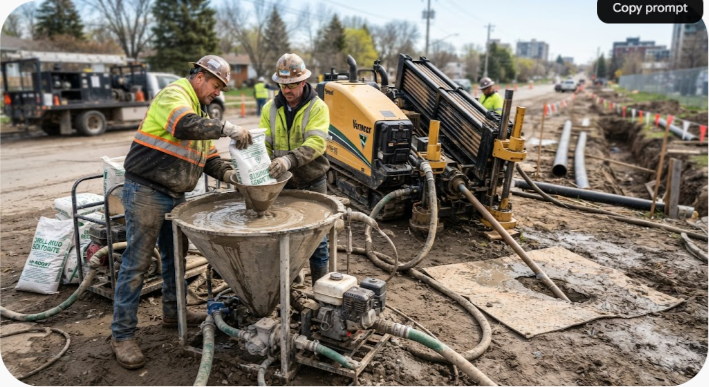
Useful solids-control practices may include settling tanks, sand traps, desanders, or other separation equipment appropriate to the rig and project. The goal is to remove unwanted drilled solids while retaining enough active fluid for continued circulation.
High sand content can increase fluid density and abrasion, change rheology, increase pump wear, and reduce the effective performance of the bentonite system. A fluid that started with excellent properties can deteriorate significantly after repeated circulation if solids aren't controlled.
Operators should therefore test circulating mud, not only freshly mixed mud. Fresh-tank results tell you what was prepared. Circulating-fluid results tell you what the bore is actually doing to the system.
Bentonite contributes to borehole stability, but it doesn't guarantee that a bore will remain open under every condition.
Borehole behavior depends on formation strength, in-situ stresses, groundwater, fluid pressure, drilling rate, annular flow, hole geometry, and the interaction between the drilling fluid and the surrounding soil or rock.
In suitable formations, a properly designed slurry can reduce uncontrolled fluid invasion and provide hydraulic support while cuttings are removed. In weak or highly permeable ground, additional measures may be necessary.
This distinction matters because increasing bentonite concentration isn't a universal solution to bore instability. If the real problem is excessive downhole pressure, poor cuttings removal, an unstable formation, or circulation loss, simply making the mud thicker may worsen the situation.
When drilling through permeable sand or gravel, the fluid can enter the formation faster than the circulation system can replace it. This can lead to declining returns, loss of hydraulic support, or inadvertent surface fluid releases where pressure and ground conditions allow fluid to migrate.
Bentonite helps by forming a filter cake, but the formation itself determines how challenging filtration control will be. Fluid-loss polymers or other additives may be incorporated when the base bentonite system doesn't provide sufficient performance.
The choice of additive should consider compatibility with the bentonite, water chemistry, temperature, formation, and disposal requirements. More additive isn't automatically better.
Bentonite provides the foundation for many HDD fluid systems, but difficult ground can require additional chemistry.
Polymers may be used to modify viscosity, improve fluid-loss control, encapsulate reactive clay, or enhance cuttings transport. Different polymers behave differently, so the selection should be based on the problem being solved.
For example, a polymer used primarily for filtration control shouldn't be selected solely because it increases viscosity. Likewise, a high-viscosity polymer may be counterproductive if the primary problem is excessive pump pressure.
Mixing order can affect performance. Some products should be hydrated or dispersed separately before entering the active mud system, while others are designed for direct addition under specified conditions.
Always follow the additive supplier's technical guidance and run a small compatibility test when introducing a new chemical into an established fluid program. Uncontrolled combinations can produce unexpected viscosity changes, flocculation, or poor filtration behavior.
Fluid loss isn't always caused by insufficient bentonite. A formation can accept fluid through natural fractures, large pores, voids, or pathways created by excessive pressure.
In such cases, loss-circulation materials may be considered. Depending on the application, these can include fibrous, granular, or other bridging materials selected for the size and nature of the loss zone.
The first response should be diagnosis. Increasing pump pressure or adding more bentonite without understanding the loss mechanism can make the situation worse.
HDD operators also need to consider inadvertent returns, sometimes called frac-outs, particularly when drilling beneath environmentally sensitive areas. Managing fluid pressure and circulation according to the formation and drilling plan is an important part of responsible HDD execution.
Two products may both be marketed as sodium bentonite but deliver different yield, rheology, filtration, and hydration behavior. Request product data relevant to drilling and compare performance under representative water conditions.
A carefully selected bentonite can underperform when mixed with unsuitable water. Test the water before designing the final mix.
Marsh funnel testing is valuable for quick field checks, but it doesn't describe every aspect of drilling-fluid behavior. Use additional measurements when project conditions justify them.
If circulating mud becomes thick, the problem may be accumulated drilled solids rather than insufficient bentonite. Solids control can be more effective than adding more clay.
Fast addition into weakly agitated water creates undispersed lumps and reduces the amount of bentonite that actually contributes to the fluid system.
A pilot bore through clean sand, a clay-rich soil, and fractured rock can require different fluid strategies. Adjust the program based on observed formation response.
A thicker mud may improve cuttings suspension but can also increase pressure losses. Fluid design has to balance carrying capacity with pumpability and formation pressure limits.
Effective mud optimization is an iterative process rather than a one-time calculation.
For a commercial HDD project, supply consistency matters almost as much as the nominal specification. A change in bentonite performance from one delivery to the next can complicate mud control, particularly on long bores where large quantities of product are consumed.
When evaluating a supplier, ask for technical documentation covering the relevant drilling-grade properties. Depending on the application, useful information may include viscosity or yield data, moisture content, particle-size information, swelling or filtration performance, packaging details, and quality-control procedures.
It is also worth checking whether the supplier can provide representative samples for testing with the project's actual makeup water. Laboratory results generated with different water chemistry may not translate directly to field performance.
Axewelledge Bentonite can be considered as one potential source when evaluating sodium bentonite for drilling applications. The appropriate grade should still be selected against the project's fluid specification and verified through testing rather than assumed from the supplier name alone.
Before approving a bentonite product, review these questions:
These questions are more useful than selecting a product based solely on a high swelling figure or a generic "premium" label.
Bentonite for horizontal directional drilling should be treated as part of an engineered fluid system. Sodium bentonite provides the clay base for viscosity, suspension, filtration control, and bore support, but its field performance depends heavily on water chemistry, mixing, formation conditions, solids loading, and operating pressure.
The most important points are straightforward:
A successful HDD fluid program isn't about making the mud as thick as possible. It's about producing the right fluid for the ground, the equipment, and the stage of the bore, then measuring it often enough to keep those properties under control.













Have questions about our products? We're here to help!