Axewelledge, a leading exporter from India, specializes in high-quality Bentonite. With a commitment to excellence, we supply premium Bentonite to the Middle East and Southeast Asia markets.


North Angle Complex, 304,
150 Feet Ring Rd, Opposite Ambedkar Nagar BRTS Stop,
Madhav Park, Punit Nagar,
Mavdi, Rajkot, Gujarat 360004
© Axewelledge 2026, All Rights Reserved.
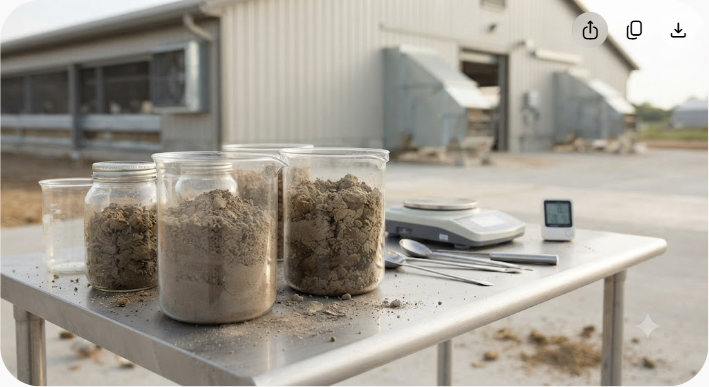
Bentonite can help with manure odor control, but it should not be treated as a universal deodorizer. Its clearest role is in reducing ammonia volatilization, particularly in poultry litter, where bentonite can retain ammonium on clay exchange sites and help manage moisture.
That distinction is important because manure odor is a mixture, not a single gas. Ammonia may be prominent, but hydrogen sulfide, volatile fatty acids, amines, phenols, sulfur compounds and other volatile substances can also contribute. Reducing ammonia can make a noticeable difference without eliminating the entire odor profile.
Research supports the basic mechanism, but the numbers need context. One controlled poultry-litter study reported a substantial reduction in ammonia volatilization after sodium bentonite treatment. The strongest treatment reduced cumulative ammonia volatilization by 76 percent under the study conditions. However, the bentonite dose was about 127 percent of the dry litter mass, which is far too high to treat as a routine farm application rate. The study is therefore more useful as evidence that bentonite can affect ammonia release than as a commercial dosing recipe.
So, does bentonite work for manure odor control? Yes, it can, especially when ammonia is a major part of the problem. The actual result depends on manure type, moisture, pH, temperature, application rate, contact time, clay properties and the other odor-control practices used alongside it.
Manure odor comes from the biological breakdown of urine, feces, bedding, feed residues and other organic material. Microbial activity produces a wide range of volatile compounds, and the balance between those compounds changes with storage and handling conditions.
Ammonia is one of the most familiar manure odors, particularly around poultry houses and manure containing substantial amounts of nitrogen from urine or uric acid. Other important odorants include hydrogen sulfide, volatile fatty acids, phenols, indoles, amines, mercaptans and other sulfur-containing compounds. US EPA technical material describes animal manure odor as a complex mixture rather than a single-gas problem.
Conditions within the manure can change that mixture considerably. Moisture, temperature, pH, oxygen availability, solids concentration, storage time and microbial activity all influence which compounds form and how readily they move into the air.
This explains why an amendment can produce a clear improvement in one manure system and a modest change in another. If ammonia volatilization is the main issue, an ammonia-retaining clay may be useful. If the dominant odor comes from hydrogen sulfide or volatile fatty acids generated under anaerobic conditions, another control method may have a larger effect.
The first step, then, isn't choosing an additive. It's identifying the source of the odor.
Bentonite is a clay rich in smectite minerals, commonly montmorillonite. Its usefulness in manure management comes from its surface chemistry, ion-exchange capacity and ability to interact with water. It doesn't work like a conventional fragrance or chemical deodorizer.
The most relevant mechanism is cation exchange.
When nitrogen in manure is present as ammonium, NH4+, the positively charged ion can interact with negatively charged sites on clay minerals. Bentonite has a relatively high cation exchange capacity, so ammonium can be retained on those exchange sites rather than remaining entirely in the liquid or readily available for volatilization.
The chemistry is worth stating clearly: the odor-producing ammonia molecule is NH3, while ammonium is NH4+. Bentonite does not simply make ammonia disappear. Under suitable conditions, it can retain part of the ammonium pool and reduce the amount of nitrogen that is lost as gaseous ammonia.
This distinction also explains why bentonite performance depends on pH. The balance between ammonium and ammonia changes with pH and temperature. A clay amendment can influence nitrogen retention, but it cannot be evaluated independently of the chemistry of the manure.
Controlled poultry-litter research has linked reductions in ammonia volatilization to the ability of bentonite to retain ammonium through exchange sites. That evidence supports using bentonite as an ammonia-management amendment, rather than describing it as a complete odor remover.
Bentonite also interacts strongly with water. Depending on its mineralogy and grade, it can absorb and retain water and change the physical condition of a manure or litter mixture.
Moisture management matters because wet and dry litter behave differently. Water affects microbial activity, ion movement, gas diffusion and the physical transport of volatile compounds. A wet area around a drinker, for example, can become a persistent problem even when the rest of a poultry house has reasonably dry litter.
UGA Cooperative Extension has discussed absorbent clay products as drying agents for wet floors and spill areas and notes that their water-holding capacity can be substantially greater than that of lime.
That does not mean that more clay automatically means better odor control. Excessive amendment can create handling, dust or cost problems. The useful question is whether the selected bentonite changes the moisture condition enough to improve litter management without creating a new operational problem.
Bentonite can also be used as one component of a formulated manure-treatment system. Research has investigated bentonite and perlite as mineral carriers for microorganisms used in poultry-manure deodorization.
Some laboratory studies of microbial-mineral formulations containing bentonite reported reductions in ammonia and hydrogen sulfide in exhaust air. Other work has examined reductions in several volatile organic compounds, although effects can change over time.
These studies are useful, but they need to be interpreted accurately. A microbial formulation containing bentonite is not the same thing as applying untreated bentonite to manure. Results from one formulation should not be used to claim that ordinary sodium bentonite alone will remove every manure odor.
The most useful way to interpret bentonite research is to look at the test conditions, dosage and measured outcome rather than focus on a single percentage.
One poultry-litter study examined sodium bentonite added to saturated spent litter under controlled laboratory conditions. The litter was maintained at about 25 degrees C while air was continuously passed through the test vessels for 64 days. Untreated litter lost a large proportion of its nitrogen through volatilization during the experiment, while bentonite treatments significantly reduced ammonia volatilization.
The saturated bentonite treatment produced a reported 76 percent reduction in ammonia volatilization compared with the untreated condition. An unsaturated treatment produced a reported 45 percent reduction. The researchers discussed ammonium retention, moisture and pH as factors contributing to the observed effect.
There is, however, a major practical qualification. The strongest treatment used bentonite at approximately 127 percent of the dry litter mass. That is an extremely high dosage for routine manure treatment. The researchers themselves noted the economic limitation and suggested that such a treatment would make more sense in applications where the amended litter was being used as part of a fertilizer product.
A separate study investigated aluminosilicate materials as ammonia sorbents for poultry manure. Sodium bentonite and zeolite both showed ammonia-absorbing properties, and the experiment identified measurable ammonia reductions at tested application rates. The reported reductions varied with the material and treatment conditions.
Taken together, the studies support a narrower but useful conclusion: bentonite can reduce ammonia release from manure under suitable conditions, but there is no single application rate that can be transferred directly from a laboratory experiment to every poultry house, livestock operation or manure-storage system.
That is why a small controlled trial is more valuable than copying a number from a research paper.

For practical purposes, think of bentonite as an odor-source management material rather than a complete deodorizer.
Ammonia is only one part of manure odor. EPA material identifies several groups of odor-producing compounds associated with animal manure, including ammonia, amines, sulfides, mercaptans, organic acids and phenolic compounds.
If ammonia makes up a substantial part of the odor problem, reducing ammonia volatilization can improve air quality and reduce the intensity of that particular odor. But if hydrogen sulfide, volatile fatty acids or other compounds dominate, bentonite alone may have a limited effect.
The manure system matters, too. A poultry house with relatively dry litter is not chemically or physically equivalent to a deep-pit swine facility, a dairy manure lagoon, a compost pile or an open stockpile. The same clay product can behave differently in each environment.
Before deciding how much bentonite to use, ask:
Those questions turn a vague odor-control project into a testable process.
When swelling, water absorption and cation exchange are important, sodium bentonite is often the first material worth investigating. Sodium-dominant bentonite generally has greater swelling capacity than calcium-dominant bentonite because of differences in the dominant exchangeable cations and the resulting interaction with water.
That doesn't mean every sodium bentonite is automatically better for manure treatment. Mineral composition, montmorillonite content, cation exchange capacity, particle size, moisture, soluble salts and processing history can all affect performance.
| Property | Sodium bentonite | Calcium bentonite |
|---|---|---|
| Swelling tendency | Generally higher | Generally lower |
| Water interaction | Generally strong | Variable, often lower swelling |
| Cation exchange | Useful for ammonium retention | Also useful; performance depends on chemistry |
| Applications to investigate | Moisture management and ammonium retention | Applications where lower swelling is acceptable |
| Main consideration | Strong swelling can affect handling and mixing | Lower swelling may provide different moisture-management behavior |
For a commercial manure-treatment program, the mineral name should be only the starting point. Actual product testing is more informative than assuming that every product sold as sodium or calcium bentonite will behave identically.
Poultry litter is one of the more relevant applications for bentonite because ammonia volatilization can become a significant air-quality and odor issue in enclosed poultry housing.
Even here, litter management comes first. Bentonite cannot compensate for severe ventilation problems, persistent leaks, poor litter quality or inadequate manure management.
UGA Cooperative Extension emphasizes that litter amendments should not be used as a reason to reduce minimum ventilation. House preparation, application technique, moisture management and adequate air exchange remain essential.
A sensible evaluation process looks like this:
This approach is more defensible than spreading a large amount of clay simply because it is absorbent.
Potentially, but the evidence and practical conditions are less straightforward than they are for poultry litter.
Cattle and swine manure can contain substantial liquid fractions. Odor can develop in pits, tanks, lagoons, holding areas and during agitation or land application. EPA material identifies ammonia, hydrogen sulfide, volatile fatty acids, phenols, amines and other compounds among the substances associated with animal-manure odor.
Adding bentonite to a relatively dry poultry litter is very different from dispersing clay through thousands of gallons of liquid manure. In a liquid system, the required quantity can become substantial, while mixing, pumping, storage and eventual land application all need to be considered.
For liquid manure, first examine the larger management system. Storage design, covers, solids separation, controlled agitation, dilution where appropriate, aeration, anaerobic digestion and improved land-application practices can all influence odor.
EPA guidance also identifies incorporation or injection during land application as ways to reduce odor exposure. Composting and anaerobic digestion can change manure characteristics and reduce odor potential when properly managed.
Bentonite can be considered as one tool within that system, but it shouldn't be treated as a substitute for sound manure handling.
Composting changes the manure environment because organic material is decomposed under managed aerobic conditions. When moisture, aeration, temperature and carbon-to-nitrogen balance are properly controlled, composting can stabilize manure and reduce many of the problems associated with unmanaged storage.
Poorly managed compost can still smell strongly. Excess moisture, inadequate aeration and an unsuitable carbon-to-nitrogen balance can encourage conditions that increase odor.
EPA identifies composting as a manure treatment approach that can reduce odors while stabilizing the material for handling and later use.
Modified bentonite has also been investigated in chicken-manure composting. One study examined tertiary-amine-modified bentonite added at rates from 2 to 10 percent to mixtures of chicken manure and wheat straw. The reported treatments reduced ammonia volatilization and odor under the study conditions, with the size of the reduction varying by treatment level.
The important detail is the word "modified." Tertiary-amine-modified bentonite is chemically different from ordinary sodium bentonite. Those findings should therefore not be presented as proof that untreated commercial bentonite will produce the same odor reduction.
For a composting operation, bentonite may be worth testing as part of a formulation, but basic compost management still controls much of the outcome.
There isn't one treatment that fits every manure system. Different methods act at different points in the odor-generation and emission process.
| Method | Main purpose | Where it can help | Important limitation |
|---|---|---|---|
| Bentonite | Ammonium retention and moisture management | Poultry litter and selected manure amendments | Performance depends on dose and conditions; does not address every odorant |
| Alum | Lowers litter pH and reduces ammonia release | Poultry houses | Requires careful management and can affect phosphorus chemistry |
| Zeolite | Ammonium adsorption | Poultry litter and selected manure systems | Performance depends on mineral properties and application rate |
| Composting | Biological stabilization | Solid manure and litter | Requires suitable moisture, aeration and carbon balance |
| Anaerobic digestion | Processes organic matter and captures biogas | Larger liquid manure systems | Requires capital, equipment and operating management |
| Covers | Limits direct emissions | Lagoons and manure storage | Controls emissions without treating the manure itself |
| Aeration | Changes biological conditions | Selected liquid manure systems | Requires energy and suitable equipment |
| Injection or incorporation | Reduces exposed manure during field application | Agricultural land application | Requires suitable equipment and soil conditions |
In practice, effective odor management often combines source control with one or more treatments. For example, a poultry operation might address leaking drinkers and ventilation first, then evaluate a litter amendment. A large liquid-manure operation may gain more from storage covers and improved land application than from adding clay to the entire manure volume.
It isn't.
The poultry-litter research mentioned earlier is a useful warning. The strongest treatment used roughly 127 percent of dry litter mass. That may demonstrate a strong laboratory effect, but it is not a sensible basis for routine commercial dosing.
A practical operation should establish a tested application rate based on its own manure characteristics, equipment and economics.
Ammonia is important, but it isn't the whole story. If hydrogen sulfide, volatile fatty acids or other compounds dominate the odor, retaining ammonium may produce less improvement than expected.
When possible, identify the dominant emission before selecting the amendment. A treatment should match the problem.
Bentonite can interact strongly with water, so moisture has a direct bearing on how the material behaves.
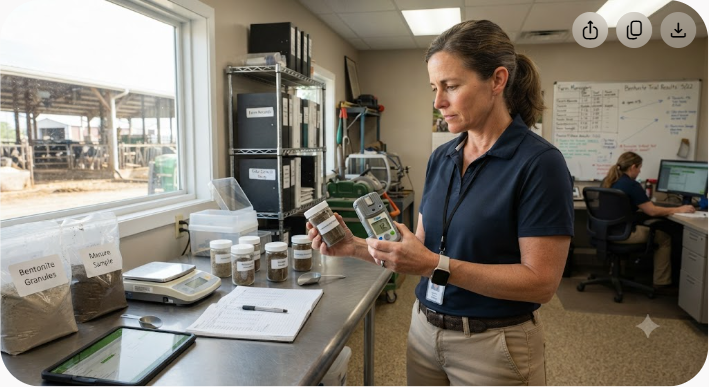
Dry litter, damp litter and saturated manure are different treatment environments. Water affects ion movement, gas diffusion, microbial activity and the physical mixing of the clay. Record moisture conditions when comparing trials; otherwise, a change in moisture may be mistaken for a change caused by the bentonite.
In poultry housing, ventilation remains fundamental. A litter amendment should never be treated as a reason to reduce fresh-air exchange.
UGA Cooperative Extension makes this point clearly: litter amendments are supplementary management tools, not replacements for appropriate ventilation and house management.
Smell is useful for identifying a problem, but it isn't a reliable quantitative measurement. Odor perception changes with temperature, wind, humidity, individual sensitivity and exposure history.
If the objective is ammonia reduction, measure ammonia. If the objective is broader odor reduction, use a consistent monitoring method and compare treated and untreated conditions under similar circumstances.
Manure isn't simply a waste material. It can contain nitrogen, phosphorus, potassium and organic matter with agricultural value when properly managed.
An amendment that reduces nitrogen losses may therefore have value beyond odor control. At the same time, the added clay changes the composition and handling characteristics of the final material. The nutrient, spreading and economic consequences should be considered before full-scale treatment.
A controlled trial can tell you much more than a supplier brochure or a visual inspection. The aim is to separate the effect of bentonite from changes in weather, manure age, moisture or ventilation.
Measure ammonia concentration, litter moisture and pH before treatment. If practical, establish a consistent odor-monitoring method as well.
A baseline matters because people often remember a strong odor more clearly than a mild one. Measurements give you something to compare later.
Use similar manure depth, age, moisture and ventilation conditions. Keep an untreated control area whenever possible.
For a commercial operation, replicated test areas are even more useful because they reduce the chance that a single wet spot or airflow pattern will distort the result.
Record the exact amount applied per unit of manure, litter or floor area. Record the product batch as well.
Avoid vague application descriptions such as "a light coating." A useful trial should be repeatable.
Check results shortly after application and again later. A treatment that produces a temporary reduction tells you something different from one that continues to influence ammonia release for several weeks.
The monitoring schedule should reflect the manure system. A poultry-house litter amendment may need a different observation period from a composting treatment or liquid-manure additive.
Look beyond odor. Check dust, clumping, moisture, crust formation, litter handling and equipment performance.
A treatment that reduces ammonia but creates excessive dust or makes manure difficult to handle may not be a practical improvement.
Calculate the material cost per ton of manure, per ton of litter or per unit of animal housing. Then compare the cost with the measured reduction and any secondary benefit, such as improved litter condition or reduced nitrogen loss.
For commercial buyers, this trial also provides a practical way to compare bentonite grades from different suppliers. Two products can share the same mineral name while behaving differently because of differences in mineralogy, particle size, moisture and processing.
The lowest-cost bentonite isn't necessarily the most economical choice. Consistency matters because an amendment needs to perform predictably from batch to batch.
Depending on the application, buyers may want to evaluate:
Particle size deserves particular attention. Fine bentonite can disperse and interact with moisture more readily, but excessive fines can also increase dust during handling. The appropriate particle-size distribution depends on whether the product is mixed into litter, spread over a surface, incorporated into compost or used in another formulation.
Moisture content also matters commercially. A product that arrives with inconsistent moisture can change the amount of usable dry clay delivered and may behave differently during storage and application.
For agricultural or livestock applications, consider the final destination of the treated manure as well. An amendment that improves odor but makes the material difficult to spread, changes its handling characteristics or adds unnecessary cost may not be a practical solution.
A technical specification sheet and representative batch testing are useful starting points for commercial sourcing.
Bentonite is a naturally occurring clay mineral, but the word "natural" does not mean that every bentonite grade is automatically suitable for every agricultural application.
Product suitability depends on mineralogy, impurities, processing, intended use and applicable local requirements. Buyers should request a technical specification sheet and, where appropriate, analytical information for the material being supplied.
The treated manure must also be managed responsibly. Bentonite should not be viewed as a way to make poorly managed manure safe for unrestricted handling, storage or disposal.
Odor control is only one part of manure management. Nutrient runoff, pathogens, air emissions, worker exposure, storage integrity and land-application practices remain important regardless of whether an amendment is used.
If the treated manure will be sold, composted, transported or applied to agricultural land, check the requirements that apply to that final use before establishing a commercial treatment program.
Bentonite is worth investigating when the odor problem has a strong ammonia or moisture-management component and the operation can apply the clay consistently.
It may be particularly relevant for:
It is less convincing as a standalone solution for a large liquid-manure lagoon containing a complex mixture of odorants. In that situation, storage design, covers, solids management, digestion, aeration and land-application practices may have a much greater influence on the overall odor profile.
The same principle applies to large-scale manure treatment generally: the right question isn't whether bentonite works in the abstract. It's whether it improves the specific manure system at an economically reasonable application rate.
So, does bentonite work for manure odor control? Yes, under the right conditions. The clearest evidence supports its ability to reduce ammonia volatilization, particularly in poultry litter, through ammonium retention and related effects involving moisture and manure chemistry. Research has also explored bentonite in microbial-mineral odor-control formulations and modified bentonite during manure composting.
But a laboratory result shouldn't be turned into a universal farm recipe. Application rate, manure type, moisture, pH, temperature, storage method and the mixture of odorants all affect the outcome.
A practical evaluation starts with the odor source. Establish a baseline, run a controlled trial, measure ammonia when ammonia reduction is the goal, monitor moisture and handling, and compare the cost with the actual improvement. That process gives you a much stronger basis for deciding whether bentonite belongs in the manure-management program.
For commercial sourcing, ask for consistent mineral and physical specifications rather than choosing solely on price. A reliable bentonite grade should be selected around the requirements of the process, not simply around its product name.
Axewelledge supplies processed bentonite for agricultural and industrial applications and can help buyers assess a grade against the performance requirements of a specific formulation or manure-management use. The objective is a consistent material that fits the process being operated, not simply a larger quantity of clay.













Have questions about our products? We're here to help!