Axewelledge, a leading exporter from India, specializes in high-quality Bentonite. With a commitment to excellence, we supply premium Bentonite to the Middle East and Southeast Asia markets.


North Angle Complex, 304,
150 Feet Ring Rd, Opposite Ambedkar Nagar BRTS Stop,
Madhav Park, Punit Nagar,
Mavdi, Rajkot, Gujarat 360004
© Axewelledge 2026, All Rights Reserved.
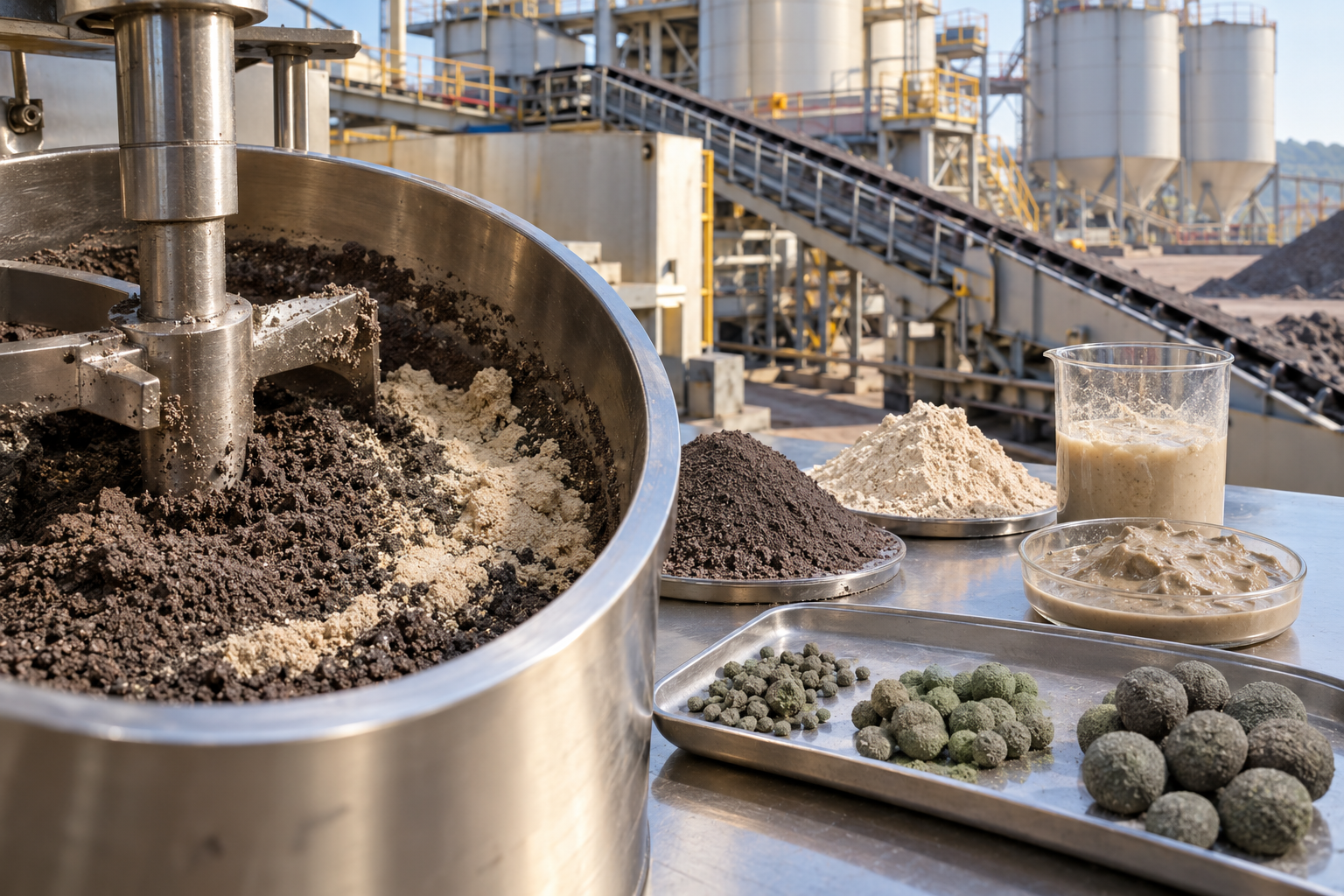
Bentonite for mineral processing is used mainly to bind fine particles, support agglomeration, and change how water interacts with mineral mixtures. The most familiar application is iron ore pelletizing, where a controlled amount of bentonite helps fine concentrate form stronger green pellets before drying and firing.
Its role goes beyond simply absorbing water. Depending on the process, bentonite can influence pellet strength, moisture distribution, slurry viscosity, suspension behavior, and the handling of fine mineral material. The effect depends on the clay itself and on the conditions in which it is used.
That distinction is important. There is no single bentonite grade or dosage that works for every mineral-processing circuit. Mineralogy, particle size, moisture, process-water chemistry, mixing conditions, and downstream product requirements all affect performance. Too little binder may produce weak agglomerates, while too much can increase clay content, alter rheology, or affect final product chemistry.
For processors, the practical question isn't simply whether bentonite works. It's whether a particular grade can deliver the required process performance at a suitable dosage and without creating problems elsewhere in the circuit.
Bentonite is a naturally occurring clay in which smectite minerals, particularly montmorillonite, are major components. Many bentonite deposits originate from the alteration of volcanic ash or related volcanic material under suitable geological conditions.
The structure of smectite helps explain why bentonite has useful industrial properties. Its layered particles can interact strongly with water and exchangeable ions. Depending on composition and test conditions, bentonite may swell, absorb water, form a gel, bind particles, and change the flow behavior of a suspension.
Two broad commercial types are commonly encountered:
Natural bentonite is rarely a chemically pure clay. Deposits can contain quartz, feldspar, carbonates, iron-bearing minerals, and other accessory materials. Even products sold under the same general bentonite name can therefore behave differently in a mineral-processing application.
For that reason, a processor should look beyond the product name. Relevant laboratory data, consistency, particle size, chemical composition, and application testing provide a much better basis for selection.
The simplest answer is that bentonite helps fine mineral particles bind together and changes the way the mineral-water mixture behaves.
Its potential functions include:
The exact role depends on the application. Bentonite used to make iron ore pellets is being asked to perform a different job from bentonite used to modify a mineral slurry.
This is why swelling capacity should not be treated as the only measure of quality. A highly swelling clay may be useful in one application and unsuitable in another if it changes viscosity too much, contributes undesirable minerals, or requires an impractical dosage.
The useful question is: What process property needs to change, and what bentonite characteristics can produce that change without creating a new problem?
Fine mineral particles are often harder to handle than coarse particles because their large surface area relative to mass changes how they interact with water, air, and neighboring particles.
Depending on the material and process, fine particles can retain moisture, remain suspended in water, create dust, resist mechanical handling, or make separation more difficult. When a process needs those fines to behave as a larger, more manageable mass, agglomeration becomes useful.
Bentonite can contribute to that agglomeration by interacting with water and particle surfaces. During mixing, the hydrated clay becomes distributed through the fine mineral feed. Mechanical action then brings particles into contact and helps form a coherent agglomerate.
The objective isn't simply to maximise binding. A practical process must balance several properties, including moisture, agglomerate size, green strength, permeability, downstream handling, and final product quality.
That balance explains why a small change in bentonite grade or dosage can sometimes have a noticeable effect on a plant process.
Iron ore pelletizing is one of the most established examples of bentonite use in mineral processing.
Beneficiation can produce an iron ore concentrate containing a large amount of fine material. Pelletizing converts that fine concentrate into relatively uniform pellets that can be handled and processed in downstream ironmaking operations.
Bentonite is commonly added as a binder during green pellet formation. It helps the wet mixture develop enough cohesion to form pellets and withstand handling before the pellets are dried and fired.
A simplified pelletizing sequence includes these stages:
The binder is particularly important before firing because green pellets must survive transfer, screening, drying, and charging into the induration process.
If green pellets are too weak, they can break during handling and generate additional fines. Increasing bentonite indefinitely isn't a solution, however. Bentonite is itself mineral matter, so excessive addition can affect the chemistry and iron concentration of the finished product. It can also change moisture demand and other operating characteristics.
The practical goal is therefore an optimised binder dosage, not the highest possible dosage.
When bentonite contacts water, its smectite particles hydrate and interact with the surrounding material. During mixing and pellet formation, this hydrated clay contributes to cohesion within the fine mineral mass.
The result can be a green pellet with greater resistance to handling and mechanical stress than an otherwise comparable pellet made without an effective binder.
Several factors influence the result:
These variables interact. A change in feed fineness, for example, can alter water demand and binder requirements even when the bentonite grade remains unchanged.
A useful distinction is between binder quality and binder dosage. Increasing the dosage of an inconsistent or poorly matched bentonite doesn't necessarily compensate for the problem. A well-controlled grade that suits the feed can sometimes deliver the required performance at a lower addition rate.
Not necessarily.
Sodium bentonite generally offers strong swelling and water interaction, properties that can be useful when hydration and binding are important. But mineral processing is highly application-specific, so sodium classification alone cannot establish whether a particular grade is suitable.
An iron ore pelletizing operation may focus on green pellet strength, drop resistance, fired pellet strength, moisture requirements, permeability, and the amount of mineral matter introduced by the binder. A slurry application may place more emphasis on viscosity, suspension behavior, settling, filtration, and compatibility with process water.
The right grade is the one that meets the actual process requirements at a practical dosage and remains compatible with downstream operations.
Before making a purchasing decision, compare actual performance under representative conditions rather than relying on a single swelling figure or a broad product description.
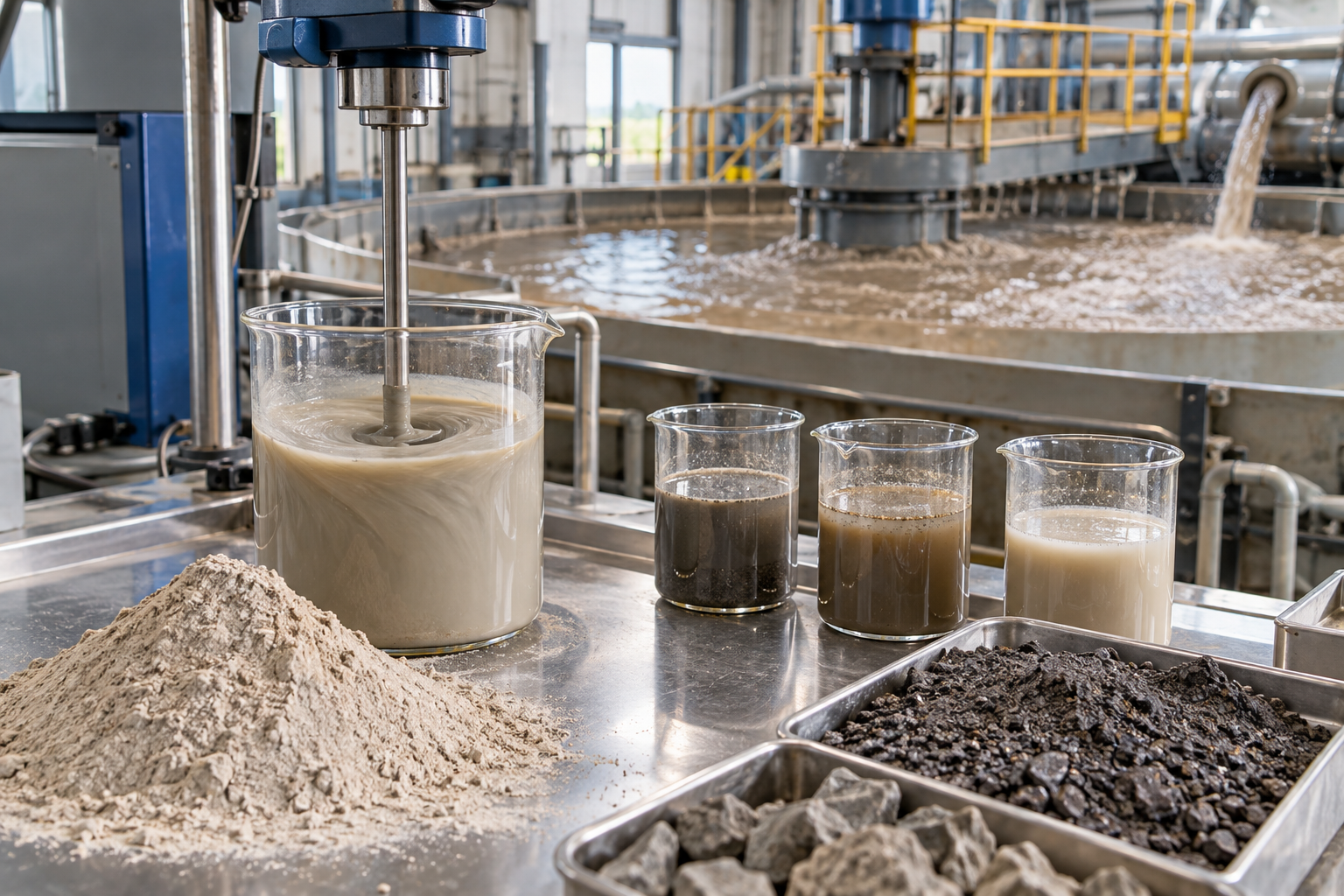
There is no universal bentonite dosage for mineral processing.
The required addition depends on the feed material, clay characteristics, moisture, particle size, mixing efficiency, process chemistry, and the performance target. Even two iron ore concentrates can require different binder levels because their mineralogy and surface characteristics may differ.
A sensible approach is to establish a dosage range through laboratory testing and then confirm the result in controlled plant trials.
A pelletizing test program might compare several binder levels while measuring:
The optimum dosage is not necessarily the level that produces the strongest green pellet. A formulation that gives excellent green strength but introduces too much unwanted mineral matter may be unsuitable for the final product.
Likewise, a small increase in binder that improves handling may not justify a significant increase in operating cost if the process already meets its performance targets.
Excess bentonite can affect both process performance and product quality.
First, the clay becomes part of the material being processed. Where target-mineral concentration or final chemistry is tightly controlled, unnecessary binder addition can dilute the desired product.
Second, additional clay can increase water demand or change rheology. In a slurry system, excessive viscosity can make pumping, mixing, filtration, or settling more difficult.
Third, poor control of moisture and clay addition can affect pellet formation and drying behavior.
There is also a straightforward economic issue. If increasing the dosage produces little additional process benefit, the extra material becomes an avoidable operating cost.
The answer isn't to minimise bentonite at all costs. It is to identify the lowest practical dosage that consistently meets the process target.
Many mineral-processing plants handle slurries containing finely ground minerals suspended in water. In these systems, bentonite can alter the interaction between solid particles and the liquid phase.
Because smectite particles interact strongly with water and dissolved ions, bentonite can increase viscosity and influence suspension stability at suitable concentrations. That can be useful in some processes and undesirable in others.
Process-water chemistry deserves particular attention. Water containing dissolved salts, metals, reagents, or other contaminants can behave differently from clean laboratory water. Ionic conditions can affect clay hydration and the interactions between clay particles and mineral surfaces.
For that reason, slurry testing should use water that reasonably represents the plant environment whenever possible. A bentonite that performs well in clean water may produce a different result in recycled process water.
Relevant measurements can include viscosity, settling behavior, filtration performance, solids concentration, and suspension stability. The right tests depend on what the plant needs the clay to accomplish.
Agglomeration brings many small mineral particles together to form larger units that are easier to handle, transport, feed, or process.
Bentonite can contribute cohesion to these agglomerates by interacting with water and particle surfaces. The strength and structure of the resulting agglomerate depend on more than the clay itself. Particle shape, mineralogy, moisture, mixing, and mechanical treatment all influence the outcome.
A practical agglomeration sequence should pay attention to six areas:
This is why changing the binder alone doesn't always solve an agglomeration problem. Mixing, moisture, feed preparation, and equipment settings can be equally important.
Bentonite is one of several materials that can be considered for binding mineral fines. Depending on the application, processors may evaluate organic binders, inorganic binders, polymers, or combinations of materials.
Each option has different effects on process performance, product chemistry, thermal behavior, handling, and cost.
| Factor | Bentonite | Organic binders | Other inorganic binders |
|---|---|---|---|
| Main role | Mineral binder and water-interacting clay | Particle binding or conditioning | Application-dependent binding or conditioning |
| Water interaction | Strong and grade-dependent | Varies by chemistry | Varies by chemistry |
| Mineral addition to product | Yes | Often lower mineral or ash contribution | Depends on material |
| Thermal behavior | Mineral component remains through processing according to its composition | Depends on binder chemistry and process temperature | Depends on material and process conditions |
| Cost considerations | Often practical at controlled dosage | Can vary significantly | Highly application-specific |
| Selection method | Process testing | Process testing | Process testing |
There isn't a universal winner across all applications. The comparison should be based on the plant's actual objective.
For iron ore pelletizing, for example, a binder should be evaluated against green pellet performance, fired pellet quality, final chemistry, dosage, and operating conditions rather than judged solely by purchase price.
Start with the process, not the product catalogue.
Before selecting a grade, define what the clay needs to accomplish and what limits the process places on its use.
Iron ore, manganese ore, industrial minerals, foundry-related materials, and other mineral feeds can respond differently to the same bentonite.
Mineralogy matters because mineral surfaces, particle shape, moisture demand, and chemical interactions influence how the binder behaves.
Particle size affects surface area, water demand, mixing, agglomeration, and separation behavior. A very fine feed may require different conditioning from a relatively coarse material.
If water contains dissolved salts, metals, reagents, or recycled process chemicals, include those conditions in testing. Clay behavior can change when the chemical environment changes.
Define measurable targets before choosing a product. For pelletizing, these might include green strength, drop resistance, fired strength, pellet size, moisture, and final chemistry. For slurry applications, viscosity, settling, filtration, and suspension behavior may be more important.
A grade that performs only at a high addition rate may be less practical than one that delivers the required result at a lower dosage.
A material that performs well in one shipment and differently in the next can create process instability. Consistency should be treated as a technical requirement, not simply a purchasing preference.
Look for relevant specifications, test data, quality-control information, particle-size information, packaging options, and clear communication about the product's intended use.
Different mineral-processing applications call for different tests, but several properties can help when comparing bentonite grades.
Montmorillonite content indicates the proportion of a major swelling clay mineral, but it should not be treated as a complete prediction of process performance. The rest of the mineral composition also matters.
Swelling capacity describes water interaction under a defined test method. Results are meaningful only when the test methods and conditions are comparable.
Moisture content affects storage, transport, dosing, and calculations based on dry material.
Particle size affects dispersion, hydration, mixing, and the rate at which the clay becomes active in the process.
Chemical composition becomes particularly important when the bentonite remains associated with the final mineral product. Silica, alumina, calcium, sodium, magnesium, iron, and other components may matter depending on product specifications.
Rheological behavior is important when bentonite is used in a slurry. A clay that creates useful suspension can also produce excessive viscosity if the concentration or water chemistry is unsuitable.
Consistency between batches is equally important. Laboratory performance is useful only if the material supplied to the plant remains reasonably consistent with the material that was tested.
No single laboratory value tells the whole story. Application testing connects the specification to actual process performance.
Testing a new bentonite grade before committing to large-scale use can help identify problems while they are still inexpensive to correct.
Record the mineral composition, particle-size distribution, moisture, and relevant chemistry of the material being processed.
For a pelletizing application, understand the concentrate properties that influence green pellet formation. For a slurry application, document solids concentration and water chemistry as well.
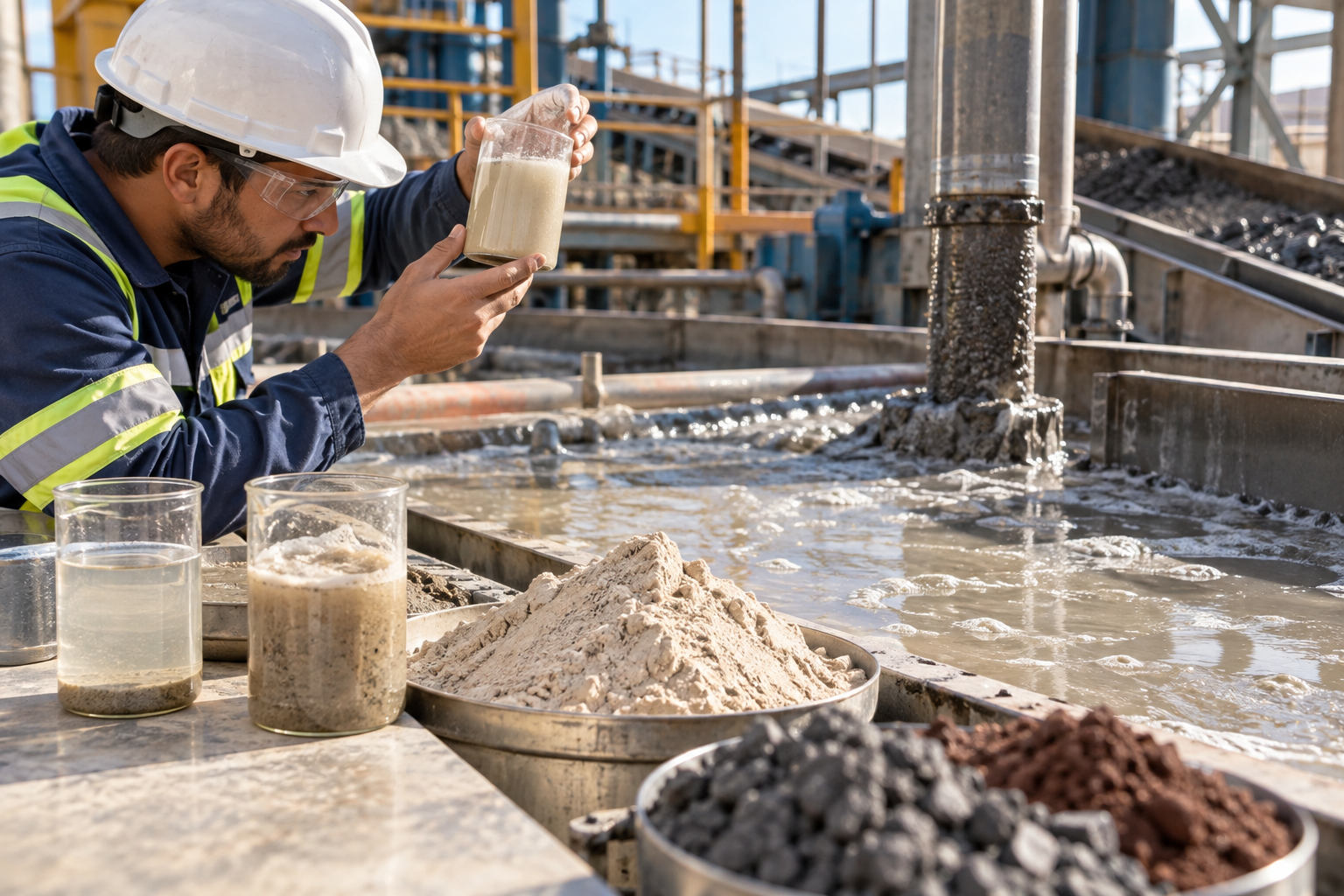
Decide exactly what the bentonite needs to accomplish.
For pelletizing, targets might include green strength, handling resistance, fired strength, pellet size, permeability, and final chemistry. For slurry processing, targets may include viscosity, settling, filtration, or suspension stability.
Avoid testing only one dosage. A small dosage series can reveal whether performance improves, reaches a plateau, or begins to decline as clay addition increases.
This also helps identify whether a higher-quality grade can achieve the same result at a lower addition rate.
Where possible, test with process water that reflects actual plant conditions. This is particularly important for slurry applications and operations that rely heavily on recycled water.
A strong result in one test can hide a problem elsewhere. Consider handling, moisture, strength, rheology, chemistry, fines generation, and downstream behavior as a group.
Repeatability matters. If a result cannot be reproduced under the same conditions, it is difficult to use as a reliable basis for plant operation.
Once laboratory testing identifies a practical grade and dosage range, move to a controlled production trial. Keep the test conditions documented and compare the results with the same indicators used in laboratory work.
High swelling can be useful, but it does not guarantee good performance in every application. Binding behavior, mineral composition, dosage response, particle size, and water compatibility also matter.
Two mineral feeds can look similar and still respond differently to the same binder. Differences in mineralogy, surface area, particle size, moisture, and equipment can change the required dosage.
Bentonite is not chemically invisible. If it remains in the finished product, its mineral components can affect product specifications. This is particularly important in applications where target-mineral concentration is tightly controlled.
Even a suitable clay cannot perform consistently if it is poorly distributed. Inadequate mixing can produce areas that are over-treated and others that receive too little binder.
Clean laboratory water may not represent plant conditions. Recycled or chemically treated water can alter clay behavior, so representative process water should be included when it is relevant to the application.
If bentonite grade, dosage, moisture, mixing time, and equipment settings all change together, it becomes difficult to identify what caused the result. Controlled trials are much easier to interpret when variables are changed systematically.
A certificate of analysis describes measurements made under specified conditions. It doesn't replace application testing. Product specifications and process trials should be used together.
Iron ore pelletizing is one of the best-known uses for bentonite, but it isn't the only mineral-processing application where the clay can be useful.
Bentonite may be considered when fine particles need controlled agglomeration, when suspension behavior needs to be modified, or when water interaction is an important part of the process.
Potential areas include:
These are application areas, not guarantees of suitability. A bentonite that works well for one material may perform poorly for another. The value comes from matching the clay's physical and chemical behavior to a defined process requirement.
Even a well-selected bentonite can create operational problems if it is stored or handled poorly.
Keep dry bentonite protected from moisture before use. Uncontrolled moisture exposure can affect flow characteristics and make accurate dosing more difficult. Storage should also protect the material from contamination by other powders.
Powdered bentonite can generate airborne dust during handling. Facilities should use appropriate engineering controls, housekeeping procedures, and personal protective equipment based on their workplace risk assessment and applicable safety requirements.
For automated dosing systems, consistent particle size and moisture can make feeding more predictable. This is another reason supplier consistency matters beyond the laboratory certificate.
Purchase price per ton is only one part of the calculation.
A more useful comparison considers the cost of achieving the required process result. A lower-priced bentonite may require a higher dosage or produce greater variation in process performance. A product with a higher purchase price may be more economical if it consistently achieves the target at a lower addition rate.
When comparing suppliers, consider:
For international buyers, supply continuity deserves particular attention. A mineral-processing plant needs predictable raw-material quality because frequent changes in feed additives can complicate process control.
A supplier should also be able to explain which properties are controlled during production and which specifications are relevant to the intended application.
A laboratory optimisation program assumes that the material tested is representative of the material that will be supplied repeatedly.
If bentonite properties vary significantly between shipments, operators may see changes in moisture demand, pellet strength, slurry behavior, or final product quality. The resulting instability can be difficult to diagnose if incoming material is not checked.
A reliable supply program therefore needs more than a product name. It should include clear specifications, appropriate quality control, and communication between the buyer and supplier.
For high-volume applications, an incoming-material testing routine can provide an additional layer of process control. The exact tests should reflect the application, but routine checks can help identify meaningful changes before they affect an entire production campaign.
If you're deciding whether bentonite is appropriate for a mineral-processing application, start with five questions:
This approach keeps bentonite selection focused on process performance rather than marketing terminology.
Yes. Bentonite is used in several mineral-processing applications, especially as a binder for fine particles and in iron ore pelletizing. It can also modify slurry behavior and support selected agglomeration processes. The suitable grade and dosage depend on the mineral, particle size, moisture, water chemistry, equipment, and required product performance.
Bentonite acts primarily as a binder for fine iron ore concentrate. It helps the concentrate form coherent green pellets with enough strength for handling before drying and firing. The addition level must be controlled because excessive bentonite can introduce additional mineral matter and affect final product chemistry, moisture requirements, or downstream pellet performance.
There is no universal dosage because the requirement depends on the feed material, bentonite grade, moisture, particle size, mixing conditions, water chemistry, and target properties. In iron ore pelletizing, binder addition is generally a relatively small fraction of the dry feed. The appropriate level should be established through application testing.
Sodium bentonite can be useful when strong water interaction, swelling, and binding are desirable, but sodium classification alone doesn't establish suitability. Processors should also evaluate mineralogy, chemical composition, particle size, rheology, dosage response, water chemistry, and downstream effects before selecting a grade for a specific application.
Yes. Bentonite can help fine mineral particles form stronger agglomerates by interacting with water and particle surfaces. Its effectiveness depends on moisture, mixing, particle-size distribution, clay properties, and dosage. Uniform dispersion is important because uneven binder distribution can produce inconsistent agglomerates even when the selected bentonite is otherwise suitable.
It can. Bentonite is itself a mineral material, so components of the clay can remain associated with the processed product. This is particularly important when target-mineral concentration or final chemistry is tightly controlled. Binder selection should therefore consider both processing performance and the chemical contribution of the bentonite to the finished product.
Start with representative mineral feed and process water, then compare several bentonite grades and dosage levels. Measure the properties that matter to the application, such as green strength, moisture, pellet size, slurry viscosity, settling, filtration, fired strength, or final chemistry. Repeat promising results before moving to a controlled plant trial.
Bentonite for mineral processing is more than a water-absorbing clay. Its ability to hydrate, bind fine particles, and modify mineral-water interactions makes it useful in applications ranging from iron ore pelletizing to selected agglomeration and slurry processes.
The strongest results come from matching the bentonite to the feed and operating conditions. Test the grade, establish a practical dosage range, monitor downstream effects, and judge performance using measurable process results rather than relying on one specification.
For industrial buyers, supplier consistency matters just as much as the initial laboratory result. A grade that performs predictably from shipment to shipment is easier to manage at plant scale and provides a more reliable basis for process control.
If you're evaluating bentonite for an industrial mineral-processing application, Axewelledge supplies bentonite from India for industrial use. Share your application, mineral type, required specification, and approximate volume so the appropriate material can be evaluated against the process requirements.













Have questions about our products? We're here to help!