Axewelledge, a leading exporter from India, specializes in high-quality Bentonite. With a commitment to excellence, we supply premium Bentonite to the Middle East and Southeast Asia markets.


North Angle Complex, 304,
150 Feet Ring Rd, Opposite Ambedkar Nagar BRTS Stop,
Madhav Park, Punit Nagar,
Mavdi, Rajkot, Gujarat 360004
© Axewelledge 2026, All Rights Reserved.
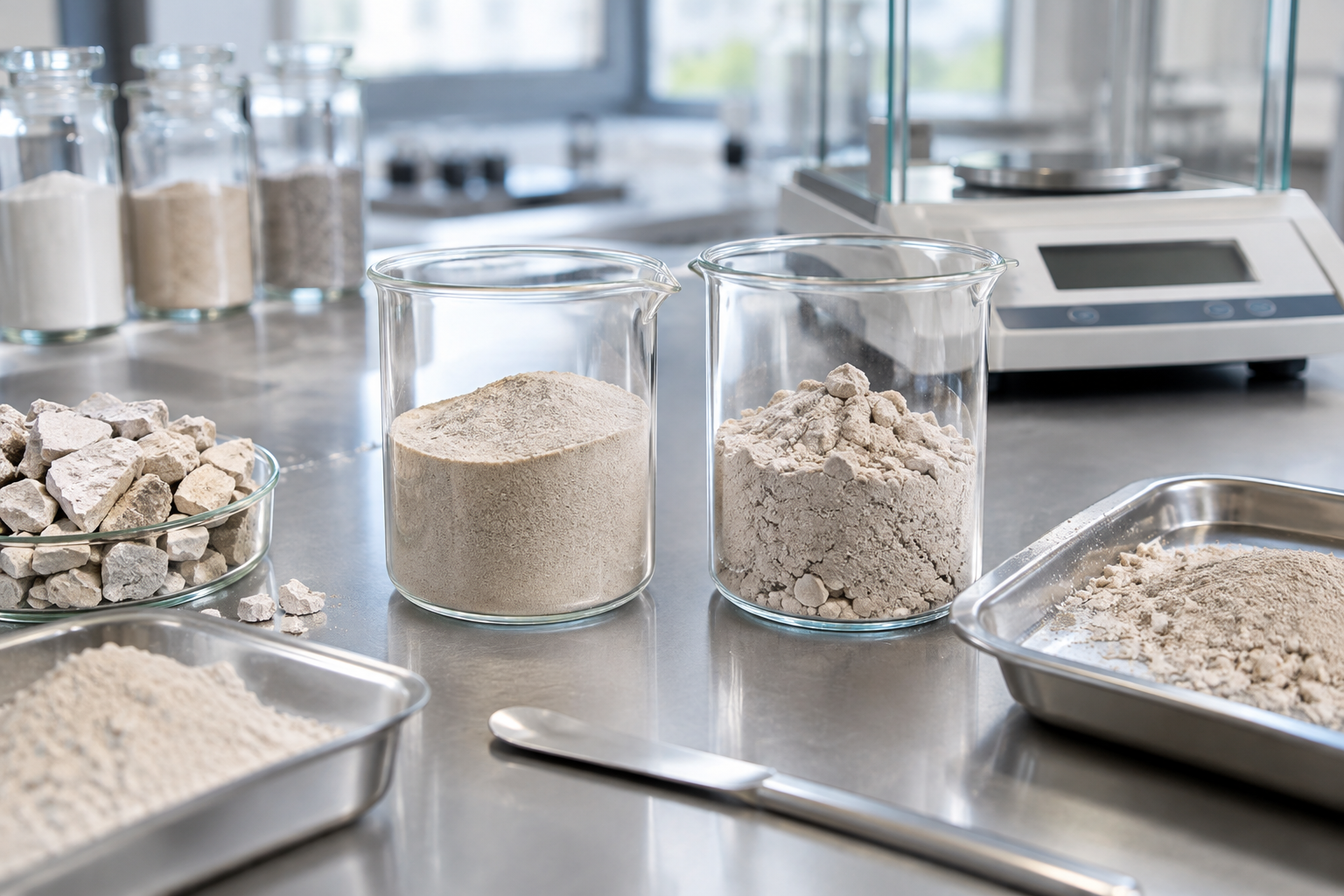
Moisture control in a powdered product isn't simply a matter of keeping the powder dry. The real challenge is controlling how water interacts with particles during processing, storage, transport, and use.
Bentonite can help in some formulations because its smectite-rich structure interacts strongly with water. Depending on its mineralogy, particle size, processing, dosage, and the rest of the formulation, it can bind or adsorb moisture and reduce some of the conditions that contribute to caking and poor flow.
That doesn't make bentonite a universal moisture absorber. A grade that performs well in a liquid-water test may behave quite differently when incorporated into a dry powder and exposed to humid air. The practical question is therefore not simply how much water the bentonite can hold. It is whether the selected grade improves the finished product under the conditions it will actually experience.
For manufacturers, the best approach is to treat bentonite as one part of a moisture-control system. Grade selection, dosage, blending, processing conditions, packaging, and storage all matter.
Bentonite is a naturally occurring clay material dominated by smectite minerals, particularly montmorillonite. Its particles are extremely fine and have a layered structure with surfaces that interact readily with water.
When water comes into contact with bentonite, several things can happen. Water can associate with particle surfaces, and in suitable grades and conditions it can enter the spaces between clay layers. Depending on the mineral composition and surrounding chemistry, this can produce adsorption, absorption, swelling, or a combination of these effects.
The distinction between grades matters. Sodium bentonite generally shows greater swelling in water than calcium bentonite. Calcium bentonite can still provide useful absorbent and moisture-interaction properties, but its behavior is different. Processing, particle-size distribution, exchangeable cations, purity, and moisture content can further change how a particular grade behaves.
For that reason, saying that bentonite absorbs moisture is only the beginning of the technical discussion. When selecting a material for a powdered product, manufacturers should consider:
A successful formulation is not necessarily the one with the highest moisture capacity. It is the one that controls the relevant moisture problem without introducing unacceptable changes elsewhere in the product.
Bentonite can influence moisture behavior through interactions at particle surfaces and, depending on the grade, through water entering the clay structure. In a dry powder, this may reduce the amount of mobile moisture available to form sticky contacts between particles.
That can matter when moisture is contributing to caking, loss of flow, or changes in handling behavior.
Caking often develops when moisture creates stronger connections between particles. A small amount of water can form liquid bridges, dissolve soluble material at particle surfaces, or create conditions that encourage particles to adhere. Storage pressure and repeated temperature or humidity changes can make those bonds stronger over time.
A suitable bentonite may take up part of the available moisture and reduce the likelihood of those interactions becoming severe. The effect depends on the complete formulation, however. Bentonite cannot compensate indefinitely for moisture entering through a poorly selected package or for a process that exposes the powder to excessive humidity.
This is why formulation and environmental controls should be considered together. If the primary moisture source is the storage environment, improving the package or warehouse conditions may provide more benefit than simply increasing the bentonite concentration.
The terms adsorption and absorption are often used loosely in discussions about clay materials, but they describe different mechanisms.
Adsorption involves water associating with surfaces. Absorption generally refers to water entering into the bulk structure or being taken up within a material. Bentonite can exhibit both types of interaction depending on its mineralogy and the conditions around it.
There is another important distinction between exposure to humid air and contact with liquid water.
A powder stored at elevated relative humidity may take up a relatively small amount of water over time. The amount depends on humidity, temperature, surface area, composition, and the moisture sorption characteristics of the individual ingredients.
A laboratory test in which bentonite is placed directly in water measures a much different situation. Swelling and liquid-water uptake can be substantial, but those results do not automatically predict performance in a dry powder exposed to atmospheric humidity.
For product development, testing should therefore reproduce the moisture exposure that the finished product is expected to encounter.
Before adding a moisture-control material, it helps to identify why the powder is caking in the first place. Moisture is a frequent contributor, but caking can also result from pressure, temperature changes, particle properties, chemical composition, or a combination of these factors.
When moisture reaches a powder, a thin liquid film can develop at contact points between particles. These liquid bridges increase adhesion. If soluble components dissolve and later crystallize as the moisture moves or evaporates, the resulting solid bridges can become stronger.
This mechanism is especially relevant to powders containing salts, sugars, minerals, or other water-soluble components.
Bentonite may help by interacting with some of the available moisture, but its effectiveness depends on whether the clay can access that moisture and whether its addition changes the powder's physical structure in a useful way.
Some ingredients naturally attract water from the surrounding air. A formulation containing a strongly hygroscopic material may begin gaining moisture even when its initial moisture content is low.
In this situation, simply adding bentonite may not solve the entire problem. The formulation may also need better environmental control, a more effective moisture barrier, or a change in the hygroscopic component.
Powders stored in large bags, drums, sacks, or bulk containers experience pressure from the material above them. If moisture has already increased particle adhesion, this pressure can compact the lower layers and make the resulting cake harder to break apart.
This explains why a powder can leave the production line in good condition but become difficult to discharge after several weeks in storage.
Repeated changes in temperature can alter the way moisture moves through a package. Warm and cool conditions can create local changes in relative humidity and, in some circumstances, condensation.
A product moving through warehouses, trucks, shipping containers, and outdoor loading areas may experience much wider temperature swings than it does during controlled production.
Fine particles have a large surface area relative to their mass. That can increase their interaction with moisture and with neighboring particles. Very fine powders may therefore have different caking and flow behavior from coarser materials made from the same chemistry.
Adding a fine clay to such a system can change the particle-size distribution again. This is one reason the effect of bentonite on flowability should always be measured in the finished formulation.
Bentonite is used across many industrial applications, but that does not mean every powder will benefit from the same grade or dosage. The intended use, regulatory requirements, formulation chemistry, and required physical properties all influence material selection.

Potential applications include mineral powders, industrial absorbents, agricultural formulations, construction materials, foundry-related products, animal-related products, and selected dry formulations where clay addition is compatible with the finished product.
The suitability of bentonite should be assessed for the actual application rather than inferred from the material's performance in another industry.
For example, an industrial mineral blend may tolerate a relatively high clay addition, while a specialty formulation may have strict limits on color, impurities, particle size, pH, or mineral composition. In a product with a defined active ingredient, even a modest amount of added clay can affect concentration on a mass basis.
| Powder type | Typical moisture concern | What bentonite may help with | Important consideration |
|---|---|---|---|
| Mineral powders | Humidity pickup and caking | Moisture interaction and handling stability | Added clay changes the overall composition |
| Agricultural powders | Humidity and poor discharge | Moisture management and physical stability | Compatibility with active ingredients must be evaluated |
| Industrial absorbent powders | Moisture during storage | Absorption and handling characteristics | Grade, particle size, and bulk density matter |
| Construction powders | Moisture pickup and lump formation | Moisture interaction and selected flow properties | Excess clay can alter application performance |
| Foundry-related powders | Storage and handling moisture | Moisture management in compatible blends | Binder and process chemistry must be considered |
| Dry formulated products | Caking and loss of flow | Moisture control where clay is permitted | Product specifications and regulatory requirements apply |
This table is a screening guide rather than a formulation specification. The final decision should come from testing the actual product with the selected bentonite grade.
The question of whether sodium or calcium bentonite is better for moisture control comes up frequently. There isn't a universal answer because the two materials have different mineralogical and physical characteristics.
Sodium bentonite generally has a higher swelling capacity when exposed to water. Calcium bentonite generally exhibits less swelling in water but can provide useful adsorption and absorbent behavior in applications where high swelling isn't required.
For a dry powder, the more important question is what type of moisture response the formulation needs.
| Property | Sodium bentonite | Calcium bentonite |
|---|---|---|
| Water swelling | Generally higher | Generally lower |
| Interaction with water | Strong | Strong, with different behavior |
| Common functional advantage | Swelling and sealing | Absorption and selected rheological or absorbent applications |
| Suitability for moisture control | Application-dependent | Application-dependent |
| Key selection factor | Required swelling and moisture response | Required absorption and physical response |
| Recommended evaluation | Test in the finished powder | Test in the finished powder |
A supplier's sodium or calcium designation should therefore not be the only selection criterion. Technical data for the specific grade, supported by application testing, provides a much stronger basis for formulation decisions.
There is no universal dosage because powder formulations differ in composition, moisture sensitivity, processing conditions, and acceptable clay loading.
A sensible development program usually begins with a controlled screening range rather than a large formulation change. Depending on the application, a formulator might compare levels such as 0.5%, 1%, 2%, and 5% by weight.
These values are trial levels, not general recommendations. Some products may require less, while others may not tolerate that much clay at all.
The goal is to find the lowest practical concentration that produces the required improvement. Adding more bentonite can create its own problems, including increased bulk density, altered flow, changes in color, dilution of active ingredients, greater dust generation, or unwanted changes when the powder is later mixed with water.
This approach provides more useful information than choosing a dosage solely from a generic water-absorption value.
Even a suitable bentonite grade can perform inconsistently if it isn't distributed evenly through the formulation. Mixing strategy matters, particularly when the clay is used at a low concentration.
Before blending, check the moisture content, particle-size distribution, and bulk density of the bentonite and the main powder. Large differences between the materials can increase the risk of segregation during conveying, filling, or storage.
Record the bentonite's moisture content, particle-size distribution, bulk density, and general appearance. Check for visible lumps or agglomerates before it enters production.
Where practical, collect the same basic information for the base powder. This gives the development team a better picture of the physical differences between the materials being blended.
Low-dose additives are difficult to distribute uniformly when a small quantity is added directly to a large batch.
A premix can often improve distribution. The bentonite is first blended with a portion of the main powder, and that intermediate blend is then incorporated into the larger batch.
The best sequence depends on the mixer, batch size, powder density, particle size, and formulation. The objective is uniform distribution, not a particular mixing recipe.
Longer mixing isn't automatically better. Excessive mixing can generate heat, alter fragile particles, or create segregation once the mixer stops.
Use enough mixing to achieve a consistent blend, then verify that uniformity rather than assuming that additional mixing will improve it.
Collect samples from different locations in the batch and compare them using an appropriate analytical or physical measurement.
For commercial equipment, the sampling plan should represent the actual mixer, batch size, discharge sequence, conveying system, and filling process. A single sample from the top of a container can't reliably demonstrate uniformity across a production batch.
It can, particularly when moisture is a major cause of sticking and caking, but the effect isn't guaranteed.
If bentonite reduces the amount of mobile moisture available at particle contacts, the powder may remain easier to move through equipment. However, bentonite is itself a fine mineral powder. At higher concentrations, fine particles can increase cohesion, change bulk density, or create other flow problems.
That is why flowability should be measured rather than inferred from moisture-absorption performance.
Useful evaluations may include angle of repose, bulk and tapped density, flow-rate measurements, shear testing, or another standardized powder-flow method suited to the application.
The most useful test is usually the one that reflects the actual production problem. If the powder must discharge from a hopper, pass through an auger, move through a feeder, or enter a filling machine, testing should reproduce those conditions as closely as practical.
A powder that pours easily from a laboratory container can still bridge inside a production hopper. Small differences in moisture, compaction, particle size, and equipment geometry can change the result.
A formulation that performs well immediately after blending may behave differently after weeks or months of storage. Moisture exposure, pressure, temperature changes, and package performance all influence the final result.
Consider a powder that leaves production with a controlled moisture level. If it is packed in a material with high moisture transmission and stored in a humid warehouse, moisture can enter over time. The original moisture specification does not prevent later moisture uptake.
Packaging should therefore be evaluated alongside the bentonite addition.
Important storage variables include:
This becomes especially important for products moving through international supply chains. A powder may encounter very different climates between the manufacturing facility, port, shipping container, warehouse, distributor, and final customer.
A laboratory test conducted under stable indoor conditions may not represent the conditions experienced during a long shipment. Packaging and stability studies should account for the actual distribution route whenever possible.
A useful moisture-control test should answer a practical question: does the bentonite improve the finished powder under conditions that resemble real storage and handling?
Start with a baseline. Measure the untreated powder's initial moisture content, flow properties, bulk density, and physical condition. Then prepare matched samples containing different bentonite concentrations.
Expose those samples to defined temperature and humidity conditions and assess them at predetermined intervals. Depending on the application, the study may cover 24 hours, several days, one week, or a longer storage period.
Don't measure moisture alone. A sample can have a lower moisture value and still have unacceptable flow or caking behavior.
A useful test program may include:
Moisture content tells you how much water is present in a material. Water activity describes how available that water is for certain physical, chemical, and microbiological processes.
The measurements are related, but they are not interchangeable.
For products whose stability depends strongly on available water, water activity can provide useful information that moisture content alone may not capture. Whether it belongs in the routine specification depends on the product, its ingredients, and its intended use.
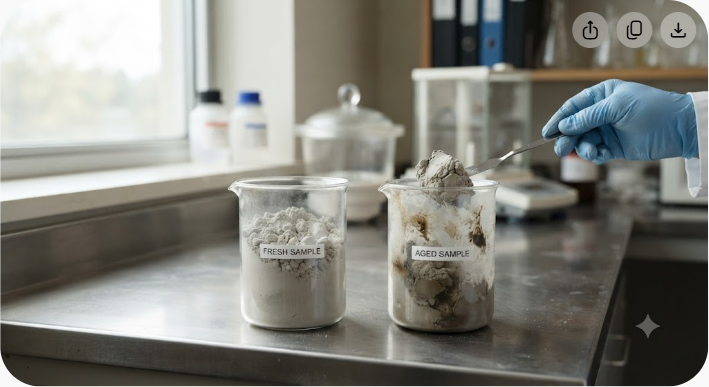
Bentonite is one option among several ways to manage moisture in powdered products. Other approaches include silica-based desiccants, calcium-based absorbents, moisture-barrier packaging, lower-humidity processing environments, and formulation changes.
The right strategy depends on where the moisture comes from and what the product can tolerate.
| Approach | Main function | Potential advantage | Potential limitation |
|---|---|---|---|
| Bentonite | Interacts with moisture within the powder | Mineral-based option with useful water interaction | Can change composition, density, and flow |
| Silica-based desiccant | Removes moisture from enclosed package headspace | Useful for reducing package-level humidity | Doesn't directly correct every formulation problem |
| Moisture-barrier packaging | Limits moisture entering the package | Protects the product throughout storage | May increase packaging cost or complexity |
| Lower-humidity processing | Reduces moisture exposure during production | Addresses moisture before packaging | Requires environmental controls |
| Formulation adjustment | Reduces hygroscopicity or caking tendency | Can address an underlying formulation issue | May change product performance |
| Combined approach | Uses several controls together | Can provide more robust protection | Requires additional development and validation |
The useful question isn't which material absorbs the most water under a laboratory condition. Ask where moisture enters the system, how much moisture the product can tolerate, and what happens to the powder after the moisture is taken up.
They aren't. Mineralogy, exchangeable cations, particle size, purity, processing history, and initial moisture can all affect performance.
A grade selected for drilling, civil construction, absorbent applications, or another industrial use shouldn't automatically be transferred to a different powder formulation without testing.
Evaluate the specific commercial grade that will actually be used in production.
A high liquid-water absorption result can be useful information, but it doesn't necessarily predict how a powder will behave at a particular relative humidity.
Application testing should reproduce the moisture exposure that matters to the finished product. If the problem occurs during warehouse storage, for example, a humidity-controlled storage test is more informative than a simple immersion test.
More clay does not automatically produce better moisture control.
Excessive addition can change density, flow, color, active-ingredient concentration, dust generation, or downstream processing behavior. It can also create a new flow problem if the fine clay increases cohesion.
Start with controlled trials and identify the minimum effective level.
A moisture-control additive cannot compensate indefinitely for substantial moisture entering through the package.
If packaging allows significant moisture transmission, the formulation may eventually reach a moisture level at which caking occurs regardless of the initial bentonite addition.
Evaluate the formulation and package as one system.
A fresh blend can look excellent immediately after production and still develop caking later.
Storage studies should consider humidity exposure, temperature changes, stacking pressure, transportation, and the expected shelf life. Accelerated testing can help identify potential weaknesses, while real-time studies provide confirmation under actual storage conditions.
If bentonite and the base powder have substantially different particle sizes, shapes, or densities, the blend may separate during conveying or filling.
This is especially important when the clay is used at a low concentration. Sample different parts of the batch and, where relevant, evaluate the material after representative handling.
A moisture number doesn't tell the entire story. The product may meet a moisture specification and still have poor flow, hard caking, or unacceptable discharge behavior.
Pair moisture measurements with physical performance tests that reflect the actual product requirements.
The answer depends on the application, but several material characteristics deserve attention during qualification.
Lot-to-lot consistency matters because changes in mineral composition can change moisture interaction and physical behavior. A formulation developed with one grade should be validated against the material supplied for routine production.
Particle size affects dispersion, dust generation, flow, and the interaction between the clay and the base powder. Very coarse material may distribute poorly, while excessive fines can increase dust or cohesion.
The bentonite itself enters the formulation as part of the overall moisture balance. Its incoming moisture should therefore be known and controlled within an appropriate specification.
Some applications require tight limits on impurities, color, pH, or specific mineral components. The required specification should be based on the finished product and its regulatory or technical requirements.
A strong laboratory result is useful only if the commercial material can reproduce it. Buyers should look for a supplier capable of maintaining consistent material characteristics and providing appropriate technical documentation.
Depending on the application, a technical data sheet and certificate of analysis may include information on moisture, particle size, swelling, pH, bulk density, mineral composition, and other relevant properties.
For manufacturers evaluating bentonite for moisture-sensitive powders, consistency is as important as the clay's basic moisture-interaction properties.
Axewelledge supplies bentonite for industrial applications and focuses on mineral quality, processing, and reliable supply from India. For a new formulation, the most useful starting point is not simply the question of which bentonite is available. It is a clear description of what the powder needs to do and what properties the clay is expected to provide.
That information can help narrow the appropriate grade, particle size, dosage range, and testing requirements before a production-scale decision is made.
The evaluation should remain application-specific. A bentonite that works well in one industrial powder may not be the right choice for another formulation with different humidity exposure, particle characteristics, or regulatory requirements.
Before approving bentonite for a powdered product, review the following questions:
If several of these questions remain unanswered, more formulation or stability testing is usually warranted before scale-up.
Yes. Bentonite can interact strongly with water and may adsorb or absorb moisture depending on its mineralogy and the surrounding conditions. In a powdered product, this interaction can reduce moisture available for some caking and sticking mechanisms. The actual effect depends on grade, dosage, humidity, temperature, particle size, and the other ingredients in the formulation.
Bentonite can help reduce caking in some powder formulations by interacting with moisture that would otherwise contribute to particle adhesion. It isn't automatically suitable for every powder. Grade, concentration, particle size, formulation chemistry, and storage conditions all matter. Excessive fine clay can also increase cohesion, so the finished product should be tested rather than assuming an anti-caking effect.
Neither type is universally better. Sodium bentonite generally has greater swelling capacity in water, while calcium bentonite has different absorption and physical characteristics. The appropriate choice depends on the powder's moisture exposure, required flow properties, formulation compatibility, and product specifications. Testing the actual finished formulation is the most reliable way to select between grades.
There is no universal dosage because powders differ in composition, moisture sensitivity, and acceptable clay loading. A development study can screen levels such as 0.5%, 1%, 2%, and 5% where technically appropriate. The final concentration should be the lowest level that provides the required moisture and handling performance without causing unwanted changes to density, flow, color, or formulation strength.
Bentonite can reduce some conditions that contribute to moisture-related caking, but it cannot guarantee that a powder will remain completely free-flowing. Humidity, temperature cycling, storage pressure, hygroscopic ingredients, particle size, processing, and packaging all influence caking. Reliable control usually combines suitable formulation, controlled processing, moisture-resistant packaging, and appropriate storage conditions.
It can improve flow when moisture is a major cause of sticking and caking, but the result depends on the formulation. Bentonite is also a fine powder and may increase cohesion or alter bulk density at higher concentrations. Flow should therefore be measured in the finished product using a test that reflects the intended handling equipment rather than being inferred from moisture-absorption data alone.
Begin with an untreated control and several bentonite concentrations. Measure initial moisture and physical properties, then expose matched samples to controlled humidity and temperature conditions. Monitor moisture, caking, flowability, bulk density, and ease of de-lumping over time. For moisture-sensitive products, water activity and packaging studies can provide additional information about storage stability and moisture ingress.
Bentonite can be a useful component in moisture-control strategies for powdered products because its smectite-rich structure interacts strongly with water. In a suitable formulation, that interaction may help reduce caking, maintain handling properties, and improve consistency during storage.
The key is not to choose a clay simply because it has a high water-absorption value. The useful grade is the one that matches the actual moisture problem and works within the physical and chemical limits of the finished product.
Start with a controlled formulation trial. Compare relevant bentonite grades, screen practical dosage levels, measure moisture and flow, and expose the product to realistic storage conditions. Then evaluate packaging and transport alongside the additive rather than treating them as separate issues.
For manufacturers looking for a consistent bentonite supply for industrial applications, Axewelledge can support material evaluation around the intended powder formulation, performance requirements, and supply needs.













Have questions about our products? We're here to help!