Axewelledge, a leading exporter from India, specializes in high-quality Bentonite. With a commitment to excellence, we supply premium Bentonite to the Middle East and Southeast Asia markets.


North Angle Complex, 304,
150 Feet Ring Rd, Opposite Ambedkar Nagar BRTS Stop,
Madhav Park, Punit Nagar,
Mavdi, Rajkot, Gujarat 360004
© Axewelledge 2026, All Rights Reserved.
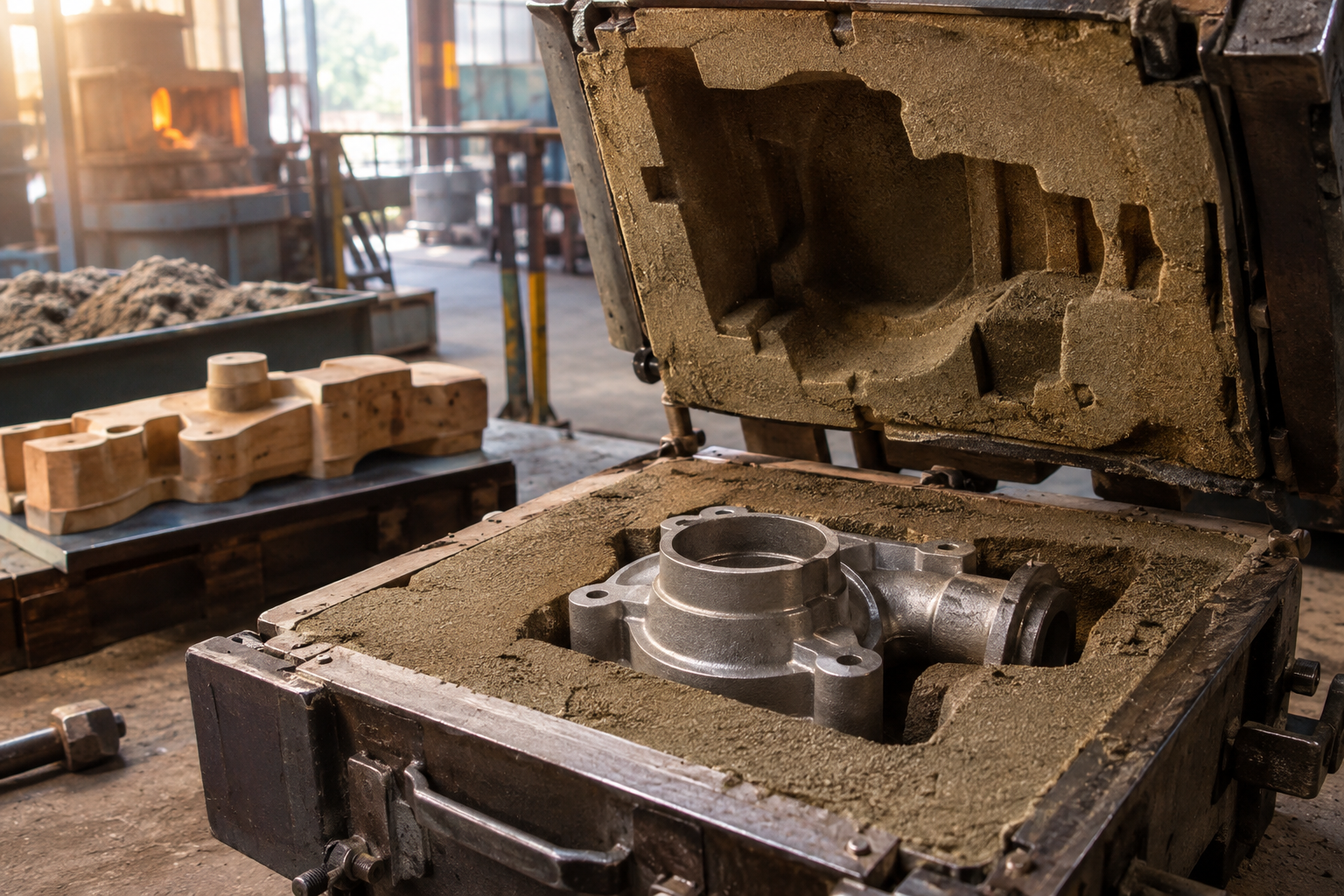
Bentonite can improve mold release in industrial casting, but it doesn't work like a conventional release agent. In green sand casting, bentonite is primarily a binder. Its job is to help loose sand form a stable, compactable mold that holds its shape during pattern withdrawal and pouring, then breaks down sufficiently during shakeout.
That distinction is important when a foundry is troubleshooting sticking, difficult pattern withdrawal, poor shakeout, or inconsistent casting surfaces. Adding more bentonite isn't automatically the answer. Release performance depends on the interaction between active bentonite, moisture, sand grain distribution, mixing, compactability, mold hardness, permeability, temperature, and the condition of reclaimed sand.
A well-controlled green sand system needs a balance: enough bonding strength to keep the mold intact, but enough controlled breakdown to separate the casting from the sand after solidification. Bentonite is one of the materials that makes that balance possible.
Bentonite is primarily used as a binder in green sand molding. When finely ground bentonite is mixed with molding sand and water, its clay minerals hydrate and develop bonding between the individual sand grains. This gives the molding mixture enough cohesion and plasticity to be compacted around a pattern and retain the shape of the mold cavity.
A typical green sand system contains molding sand, bentonite, water, and, depending on the process and casting requirements, carbonaceous or other specialized additives. The exact recipe varies between foundries because alloy, casting geometry, molding equipment, sand characteristics, production rate, and reclamation practice all affect the required balance.
Bentonite influences several properties that matter directly to mold release and casting quality:
The key point is that bentonite isn't added simply to make sand stick together. A foundry needs the sand to behave differently at different stages of the process. The mold must be strong before and during pouring, yet it must eventually release the casting and break down during knockout.
No. Bentonite normally isn't a spray-on or surface-applied mold-release product.
A conventional release agent is placed on a mold or pattern surface to reduce direct adhesion between the mold and the cast material. Bentonite serves a different purpose. In green sand casting, it is incorporated into the molding sand and helps create the physical properties required for reliable molding and release.
Its effect on release is therefore indirect. When the bentonite, water, sand, and mixing conditions are properly balanced, the resulting molding material can provide stable cavity walls, consistent compaction, suitable permeability, and controlled breakdown. Those properties make pattern withdrawal and casting shakeout more predictable.
This is why a difficult release problem shouldn't automatically lead to a higher bentonite addition. If the real issue is excessive moisture, poor hydration, high mold hardness, degraded reclaimed clay, unsuitable sand distribution, or an inappropriate additive balance, additional bentonite may make the system harder to control.
The useful question is not simply, "How much bentonite should we add?" It is, "Which sand property is causing the release problem, and what is controlling that property?"
Bentonite contributes to mold release through several connected mechanisms. None of them should be considered in isolation because changing one sand property often affects several others.
Loose sand grains cannot form a durable mold cavity on their own. Hydrated bentonite develops bonding between the grains, allowing the mixture to be compacted into a coherent mold.
That cohesion matters as soon as the pattern is withdrawn. If the cavity wall is weak, edges can break away, fine details can collapse, and loose sand can fall into the mold. Those failures can produce dimensional problems, fins, inclusions, rough surfaces, or other casting defects.
A stable mold wall gives the pattern a cleaner path out of the cavity. This becomes especially important around deep pockets, narrow ribs, sharp corners, and other features where weak or poorly conditioned sand is more likely to tear.
The amount and activity of bentonite influence the strength and hardness of compacted green sand. However, maximum hardness isn't the objective.
An excessively hard mold can be difficult to break down after casting. It may also affect permeability and increase the mechanical effort required during shakeout. At the other extreme, a mold with insufficient strength can deform or erode before the metal has solidified.
The practical target is a mold that holds its geometry under the stresses of molding and pouring without becoming unnecessarily resistant to breakdown.
Mold hardness should therefore be considered alongside compactability, moisture, permeability, binder activity, and the casting's thermal and mechanical requirements.
Water activates bentonite and allows the clay to develop its bonding behavior. Too little water can leave the sand weak, difficult to compact, or inadequately hydrated. Too much water can increase stickiness, reduce permeability, increase moisture-related gas problems, and alter mold hardness.
This is why bentonite and moisture can't be managed as completely separate variables.
When a foundry changes bentonite addition, it may also need to review water addition and mixing conditions. A new clay grade can have different water demand or activation behavior even when the nominal addition rate looks similar.
There is no universal moisture percentage that works for every green sand operation. The appropriate operating window depends on the sand, bentonite, molding method, equipment, alloy, casting geometry, and established process controls.
The mold must retain enough integrity when exposed to molten metal to prevent erosion, deformation, and other failures. At the same time, the binder system eventually needs to lose enough of its strength for effective shakeout.
Thermal exposure changes the hydrated clay structure. In a foundry that continually reclaims and reuses sand, repeated heating can also reduce the activity of part of the bentonite system.
This is one reason why a fixed bentonite addition rate doesn't always produce identical results throughout a production cycle. The condition of return sand changes over time, so the active binder balance needs to be monitored rather than assumed.
After the metal has solidified, the foundry needs the mold to break down without requiring excessive mechanical force.
This creates an important contrast. Before pouring, strong bonding is desirable. After solidification, controlled breakdown is desirable.
A good green sand system is designed around both requirements. If the mold is too weak, it may fail prematurely. If it is too resistant to breakdown, shakeout becomes more difficult and may increase the risk of damage, excessive sand retention, or unnecessary equipment load.
Bentonite therefore contributes to mold release as part of a complete process rather than as a standalone release material.
Green sand is more than sand mixed with water. It is an engineered molding material whose behavior depends on the interaction of several ingredients and process variables.
In a typical green sand system, bentonite provides the clay-based bonding needed to turn loose sand into a moldable material. Water activates the clay, while the sand provides the granular structure. Other additives can be used to modify surface behavior, thermal response, or other properties.
The system is attractive for industrial production because molds can be formed rapidly, used without a separate baking step, and broken down after casting. Reclaimed sand can then be processed and returned to the molding system, subject to the foundry's reclamation and quality-control practices.
For a foundry, the important properties include:
These properties are connected. A change made to improve one can create an unwanted change somewhere else.
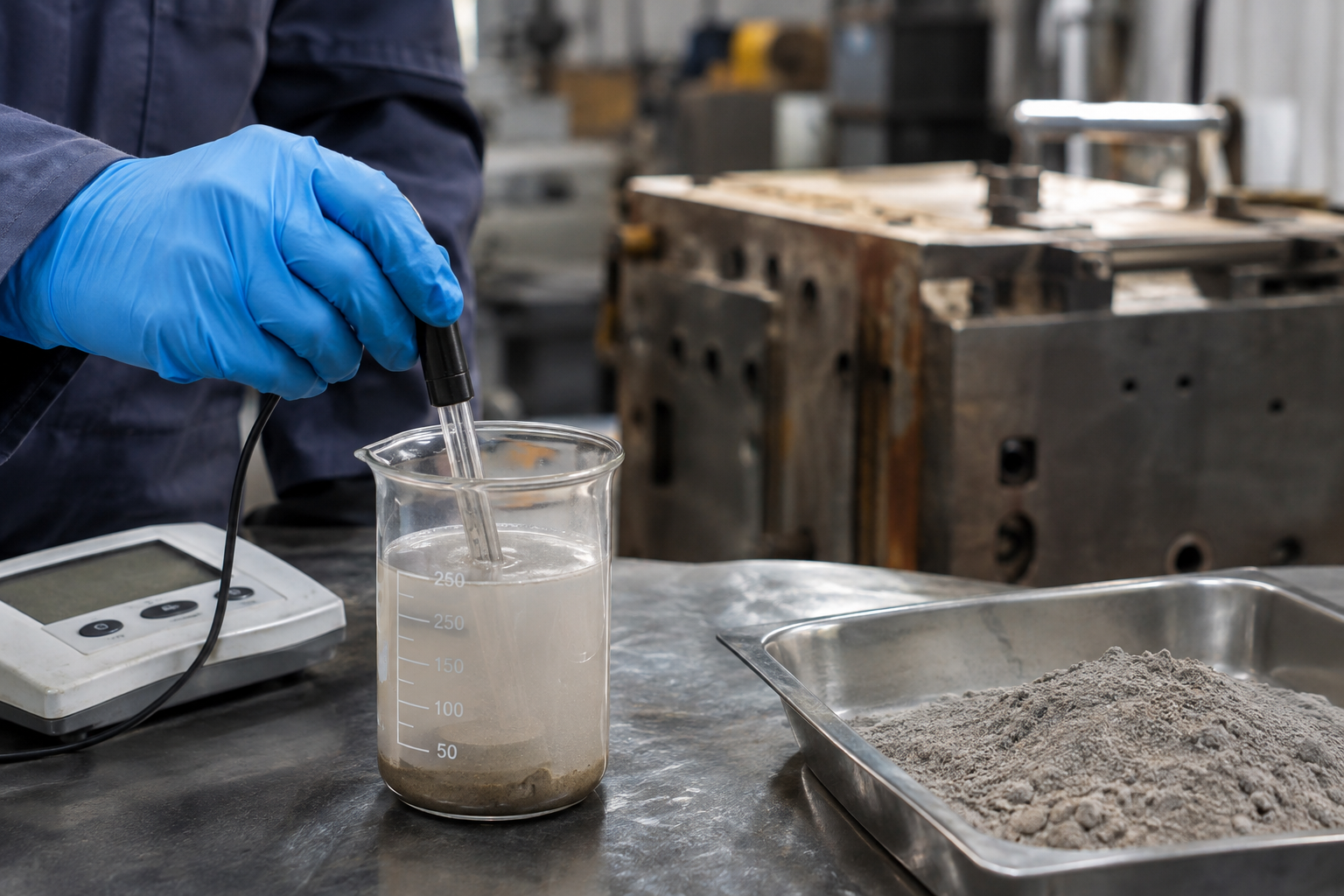
That is why experienced foundries evaluate bentonite through the performance of the complete sand system rather than relying on one specification, such as swelling value, in isolation.
Bentonite type matters because sodium and calcium bentonites have different mineral and hydration characteristics.
Natural sodium bentonite generally has a higher swelling tendency than calcium bentonite and can provide strong bonding in suitable green sand systems. Calcium bentonite has a different balance of swelling, plasticity, strength, and other molding properties. Some calcium bentonites can also be chemically activated with sodium carbonate to modify their behavior.
That doesn't make one type universally better for foundry casting. The useful comparison is how a particular bentonite performs in the actual sand system, at the required moisture level and under the relevant molding and thermal conditions.
| Property | Sodium bentonite | Calcium bentonite |
|---|---|---|
| Swelling tendency | Generally higher | Generally lower |
| Bonding potential | Strong in suitable systems | Good, depending on grade and activation |
| Natural behavior | Often selected where strong swelling and bonding are useful | Used in suitable green sand systems |
| Activation | May be naturally sodium-rich or processed | Can be soda-activated for modified performance |
| Mold release behavior | Depends on the complete sand formulation | Depends on the complete sand formulation |
| Selection method | Compare application-specific test results | Compare application-specific test results |
For procurement, don't choose a material simply because its label says sodium bentonite or calcium bentonite. Ask for technical data that is relevant to foundry use, then run a controlled trial against the current material.
A bentonite with a strong laboratory swelling result may still perform poorly in a particular sand system if its moisture demand, mixing behavior, thermal response, or interaction with other additives isn't suitable.
Too little active bentonite can leave the molding sand under-bound.
The mold may be weak during handling, corners may break, and the pattern can pull sand away from the cavity wall during withdrawal. Fine details are particularly vulnerable because they have less supporting sand structure.
During pouring, weak molding sand can also be more susceptible to erosion. Loose material may enter the casting and contribute to sand inclusions or surface defects.
Increasing bentonite may correct the problem if insufficient active binder is actually the cause. But several other variables should be checked at the same time:
Adding more binder to compensate for poor mixing is a common mistake. Even a suitable bentonite can't deliver consistent bonding if it hasn't been properly distributed and hydrated.
More bentonite does not automatically produce better mold release.
An excessive clay load can increase the fines content of the molding sand and change its water requirement, permeability, compactability, hardness, and shakeout behavior. The foundry may then add more water to recover the desired working condition, creating another set of process changes.
Higher moisture can increase gas-related risks and may also change how the mold responds during pattern withdrawal and pouring.
The better approach is to control active binder rather than simply maximize total clay. This distinction becomes especially important in reclaimed sand, where measured clay may include material that has been thermally altered and no longer contributes the same bonding performance as fresh active bentonite.
If a foundry is already experiencing high fines, poor permeability, difficult shakeout, or increasing moisture demand, blindly increasing bentonite can move the process farther from its target rather than closer to it.
Moisture is one of the most influential variables in a bentonite-bonded green sand system.
Bentonite needs water to hydrate and develop its bonding behavior. The mold also needs sufficient permeability so gases generated during pouring can escape. Those requirements have to be balanced carefully.
Too little moisture can produce weak, crumbly, or poorly compacted sand. Too much can make the mixture sticky, reduce permeability, increase steam generation, and change mold hardness.
For that reason, moisture should be measured rather than judged only by touch or appearance.
A practical green sand control routine can include:
The exact targets should come from the foundry's process data rather than a generic number copied from another operation. A high-pressure molding line producing complex iron castings can require a different sand condition from a smaller operation using a different molding method and alloy.
A suitable bentonite can appear ineffective when the mixing process is poor.
During sand preparation, bentonite needs to be distributed throughout the sand and exposed to enough water and mixing energy to hydrate properly. Inadequate mixing can leave some areas under-bound while others contain excessive clay or moisture.
The resulting inconsistency may show up as variable mold hardness, irregular pattern withdrawal, changing casting surface quality, or different defect rates between batches.
If laboratory results appear acceptable but production performance remains inconsistent, inspect the mixing process before immediately changing the bentonite supplier.
Useful questions include:
Good release performance begins with consistent sand preparation.
Pattern withdrawal is the first major release event in the molding process.
The pattern creates the cavity, and the compacted sand must hold that cavity accurately while the pattern is removed. If the sand is too weak, the cavity wall can crumble. If the sand is excessively sticky or improperly conditioned, the pattern may pull material away from the surface.
Bentonite helps by giving the molding sand the cohesion and plasticity needed to form a stable cavity around the pattern.
The goal isn't simply to make the pattern easier to pull. The goal is predictable pattern withdrawal with minimal cavity damage.
That distinction becomes particularly important in automated molding. An experienced operator may compensate for small variations in sand behavior through handling and process adjustments. Automated equipment has much less tolerance for inconsistent material properties.
When pattern withdrawal problems appear repeatedly, examine the sand condition and molding process before assuming the pattern itself is the only cause.
Pattern withdrawal and casting shakeout are related, but they aren't the same problem.
Pattern withdrawal happens before metal enters the mold. Shakeout happens after the metal has solidified. The sand therefore experiences very different conditions during each stage.
After pouring, the mold needs to withstand thermal and mechanical stresses long enough to protect the casting. Once the casting has solidified sufficiently, the mold should break down so the metal can be separated from the surrounding sand.
A well-controlled bentonite system helps the foundry achieve that sequence without requiring unnecessary mechanical force during knockout.
If shakeout becomes difficult, don't look only at bentonite dosage. Check mold hardness, thermal history, reclaimed-sand condition, carbonaceous additives, casting temperature, moisture, and active clay condition. Several of these factors can affect how strongly the mold holds together after exposure to molten metal.
Bentonite can contribute to a molding system that releases cleanly, but it shouldn't be treated as a universal cure for sand sticking.
Sand adhesion or fusion can have several causes, including metal penetration, excessive thermal exposure, mold-surface condition, insufficient mold strength, unsuitable additives, poor permeability, or an inappropriate sand formulation.
Some green sand systems also use carbonaceous additives to influence the interface between molten metal and molding sand. These additives can help reduce direct contact between the metal and sand under suitable process conditions.
So when a casting comes out with adhered sand, first identify what actually happened. Is the problem:
These problems can look similar after shakeout but require different corrective actions.
When release problems appear, resist the temptation to change several variables at once. A controlled troubleshooting process makes it easier to identify the real cause.
First determine whether the problem happens during pattern withdrawal, pouring, solidification, or shakeout.
A cavity that tears when the pattern is removed is a different problem from a casting that emerges covered in fused sand after solidification. The corrective action should follow the failure mechanism.
Measure the moisture content and compare it with the established process range. Don't rely only on how the sand feels in the operator's hand.
Record the result with the production batch so it can be compared with compactability, hardness, permeability, and casting quality.
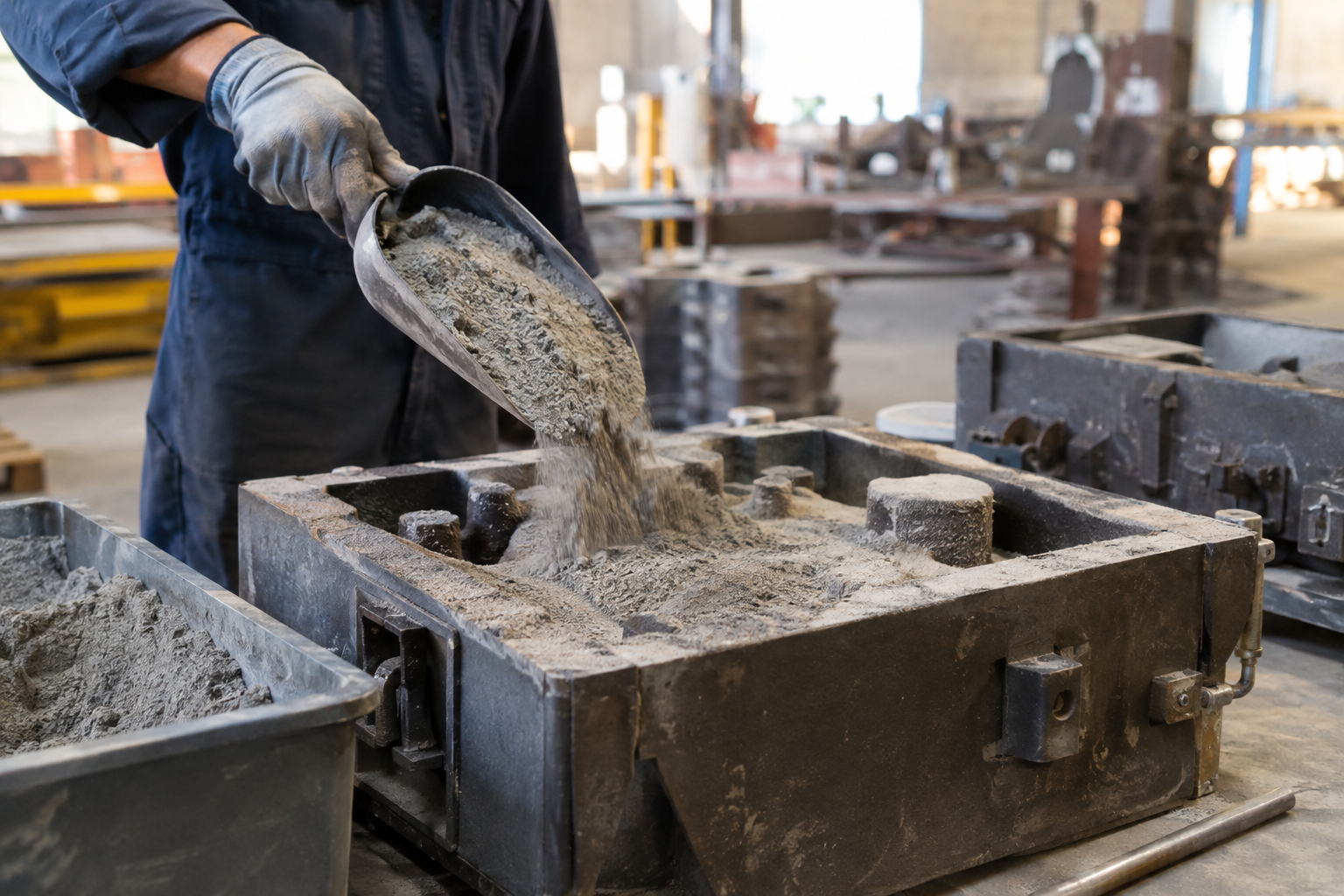
Compactability and mold hardness provide useful evidence about how the sand is responding to its current moisture and binder condition.
A sudden change can point to altered moisture, clay activity, sand distribution, mixing, or temperature. Look for trends rather than treating one measurement as the entire diagnosis.
Total clay isn't necessarily the same as effective binder.
Reclaimed sand can contain clay that has been exposed to casting temperatures and has lost part of its original bonding behavior. A system can therefore show an apparently adequate total clay level while still requiring adjustment to maintain the desired molding properties.
Confirm the actual addition rate, product identity, batch information, storage condition, and particle characteristics.
If the foundry has changed suppliers, compare the candidate and existing materials through controlled trials. Don't assume that two products with similar names or headline specifications will behave identically in production.
Review mixing time, addition sequence, water distribution, sand temperature, and mixer condition.
Poor hydration can make a good bentonite look ineffective. If the material isn't properly distributed through the sand, increasing its dosage won't necessarily solve the problem.
Look for tearing, cracking, erosion, scabbing, excessive hardness, roughness, or other visible signs of mold instability.
The appearance of the mold often provides useful clues about whether the problem is mechanical, moisture-related, thermal, or related to the binder system.
Review sand-test results alongside actual casting defects. Track moisture, compactability, hardness, permeability, binder condition, and relevant strength measurements against pattern withdrawal and shakeout performance.
A trend across several batches is more useful than a single isolated result.
Bentonite normally belongs in the molding sand rather than on the mold surface as a conventional release coating.
If the problem is pattern adhesion, start by checking the sand properties and molding conditions. A release problem caused by excessive moisture or poor compactability won't necessarily disappear after applying or adding more clay.
Additional bentonite can change moisture demand, permeability, hardness, compactability, and shakeout behavior.
Before increasing the addition rate, identify which property is outside the process range. If the actual issue is poor hydration, reclaimed-sand degradation, or incorrect moisture, more bentonite may only mask the symptom temporarily.
Reclaimed green sand has already experienced the thermal and mechanical conditions of previous casting cycles.
Its clay system can therefore behave differently from fresh material. If the reclamation process, return-sand temperature, or fresh-bentonite addition changes, the overall binder balance can change with it.
Experienced operators can learn a useful tactile sense for molding sand, but production control should still rely on measurement.
Small moisture changes can affect several properties at once, and visual or tactile assessment may not detect those changes early enough to prevent casting variation.
Swelling is useful information, but it isn't a complete measure of foundry performance.
A foundry also needs to consider bonding behavior, moisture demand, plasticity, permeability, thermal response, mixing behavior, and consistency between batches. A material with high swelling may not be the best fit if the rest of its behavior doesn't suit the sand system.
If a foundry changes bentonite, water, carbonaceous additive, sand blend, mixing time, and molding pressure simultaneously, it becomes difficult to determine what actually changed the result.
Where production conditions permit, run controlled trials and keep as many other variables stable as possible.
For an industrial buyer, a useful bentonite specification should contain more than a product name and a general statement about swelling.
Ask the supplier for technical data that relates to the intended foundry application. Depending on the process, relevant information may include:
The best specification is the one that helps the foundry predict how the material will behave in its own sand system.
A plant producing iron castings on an automated high-pressure molding line may require a different balance of properties from a smaller operation producing non-ferrous castings with a different sand blend and molding method.
For that reason, supplier discussions should begin with the process requirements rather than a generic request for the strongest or highest-swelling bentonite available.
Not necessarily.
The required binder behavior can change with casting alloy, molding pressure, sand grain distribution, casting size, pattern geometry, reclamation practice, production speed, and equipment.
Ferrous foundries expose molding materials to particularly demanding thermal conditions. Non-ferrous operations may work at lower pouring temperatures but can have their own requirements for surface finish, dimensional accuracy, mold strength, and production speed.
Even two foundries producing the same alloy can need different bentonite performance because their molding equipment, sand characteristics, and reclamation systems differ.
The better procurement question isn't, "Which bentonite is strongest?" It is, "Which bentonite provides the required performance in this particular molding system?"
That question leads naturally to application-specific testing rather than relying on a generic grade description.
Replacing the existing binder across an entire production line without a controlled evaluation creates unnecessary risk. A structured trial gives the foundry a clearer comparison.
A practical evaluation can follow these steps:
This process helps separate genuine binder performance from normal day-to-day variation.
It also gives the foundry useful information for future troubleshooting. Once baseline relationships between moisture, compactability, hardness, binder activity, and casting defects are documented, changes in production become easier to diagnose.
A green sand system can be sensitive to changes in raw-material behavior. If one bentonite batch performs differently from the next, operators may compensate by adjusting water or binder addition. Those adjustments can then affect permeability, hardness, compactability, and casting quality.
Consistency is therefore part of product performance for an industrial foundry.
For buyers evaluating Axewelledge bentonite, the useful starting point is the foundry's technical requirement. The material should be assessed against the existing sand system and the properties that matter to the actual process, rather than selected solely from a general product description.
For international buyers, the same principle applies regardless of market. Test methods, units, documentation, and purchasing specifications can differ between regions, but the material still has to perform consistently in the foundry's own molding process.
A reliable supply program should therefore address both material quality and repeatability between shipments.
One of the most persistent misconceptions is that bentonite makes castings release because it is slippery. That's not how it works.
Bentonite contributes to mold release by helping the green sand achieve the properties required before, during, and after casting. It binds sand grains, supports mold integrity, interacts with moisture, influences compactability and permeability, and contributes to controlled breakdown during shakeout.
The best result comes from balance.
Too little active binder can produce fragile molds. Too much can change permeability and moisture demand. Too little water can limit clay hydration. Too much can increase stickiness and gas-related risks. A mold that is too hard may resist breakdown, while a weak mold may fail before the metal has properly solidified.
These aren't separate problems. They're connected parts of one sand-control system.
That is why a foundry should look at release performance together with moisture, compactability, hardness, permeability, active binder condition, mixing, reclaimed-sand quality, and other additives.
Bentonite can improve mold release in industrial casting, but its value goes well beyond release alone. In green sand molding, it is a working binder that helps determine mold strength, compactability, permeability, surface condition, thermal response, pattern withdrawal, and shakeout behavior.
If a foundry is experiencing difficult pattern withdrawal, sand sticking, poor shakeout, or inconsistent casting surfaces, adding more bentonite shouldn't be the first automatic response. Start by checking the complete sand system: active binder, moisture, mixing, compactability, mold hardness, permeability, reclaimed-sand condition, and the interaction between bentonite and other additives.
For buyers sourcing foundry-grade bentonite, the practical goal is a consistent material that can be evaluated against those process requirements. Axewelledge supplies bentonite for industrial applications and can discuss material selection around the performance requirements of a specific foundry rather than assuming every casting operation needs the same grade.
A better mold-release result usually starts well before the casting reaches the knockout station. It starts with a controlled green sand system and a binder that behaves predictably within it.













Have questions about our products? We're here to help!