Axewelledge, a leading exporter from India, specializes in high-quality Bentonite. With a commitment to excellence, we supply premium Bentonite to the Middle East and Southeast Asia markets.


North Angle Complex, 304,
150 Feet Ring Rd, Opposite Ambedkar Nagar BRTS Stop,
Madhav Park, Punit Nagar,
Mavdi, Rajkot, Gujarat 360004
© Axewelledge 2026, All Rights Reserved.
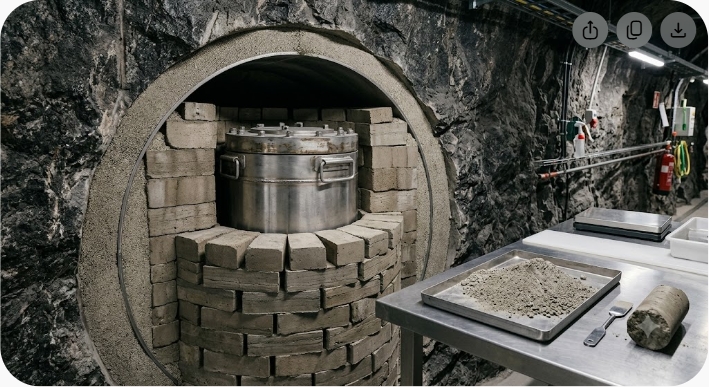
Bentonite can help contain radioactive waste, but it isn't a stand-alone solution and it doesn't make nuclear waste harmless. Its value in deep geological disposal comes from several properties working together: compacted smectite-rich bentonite can swell when hydrated, develop very low permeability, seal small gaps around a waste container, and slow the movement of some dissolved radionuclides.
The basic arrangement is relatively simple. A sealed waste container is surrounded by engineered barrier materials, which can include compacted bentonite, and the entire system is placed deep underground in a carefully characterized host formation. As groundwater enters the engineered barrier, the bentonite hydrates and swells. This reduces connected pore space, restricts water movement, and creates conditions that can retard the transport of certain radionuclides.
The engineering behind that arrangement is much more demanding than the basic description suggests. Bentonite performance depends on mineral composition, dry density, groundwater chemistry, temperature, swelling pressure, saturation history, container geometry, and interaction with the surrounding rock. Nuclear-waste programs therefore use carefully characterized and qualified clay rather than treating ordinary commercial bentonite as automatically suitable.
Bentonite is attractive for radioactive-waste repositories because several useful properties complement one another.
A swelling bentonite can absorb water into its smectite structure and expand. When the clay is compacted around a waste container, that expansion can help close construction gaps and small discontinuities within the buffer. As hydration progresses, the clay develops a dense pore structure with very restricted water flow.
Bentonite also has a large reactive mineral surface, particularly when it contains a high proportion of smectite such as montmorillonite. Depending on the radionuclide and the surrounding chemistry, interactions between clay minerals and dissolved species can slow radionuclide migration.
Its main functions can be grouped into four areas:
The key point is that bentonite forms part of a multi-barrier system. It isn't expected to carry the entire safety function on its own.
A deep geological repository is designed around multiple barriers. Depending on the repository concept, these can include the waste form, a corrosion-resistant metal container, a bentonite buffer or backfill, engineered plugs and seals, and the surrounding geological formation.
Bentonite commonly sits between the waste package and the host rock. In some designs, compacted blocks are installed around the container. Other concepts use pellets or bentonite-rich backfill to fill spaces in tunnels, shafts, gaps, or other parts of the underground facility.
Its role also changes as the repository evolves.
Immediately after emplacement, the bentonite may be relatively dry and highly compacted. Groundwater from the surrounding rock then begins to enter the buffer. Hydration takes place gradually, and the clay swells as water enters its pore system.
Once sufficiently hydrated, the bentonite develops the characteristics engineers want from a buffer: low permeability, swelling pressure, limited groundwater movement, and a chemically active clay environment.
That is why repository engineers don't simply ask whether a clay is absorbent or whether it swells in water. They need to understand how it behaves after compaction, hydration, heating, chemical exposure, and long-term confinement.
It helps to separate the word "contain" into several mechanisms. Bentonite doesn't destroy radioactivity. Instead, it helps slow the movement of radioactive contaminants away from the waste package if radionuclides are eventually released.
Sodium-rich bentonite is particularly well known for strong swelling behaviour. When water enters compacted clay, smectite minerals hydrate and expand.
In a repository, this expansion can help close voids between individual bentonite blocks and between the buffer and surrounding surfaces. A dense, continuous buffer offers much less opportunity for preferential water pathways than a system with large connected gaps.
Swelling behaviour is strongly influenced by dry density and water chemistry. A material that performs well in a freshwater laboratory test can behave differently when groundwater contains substantial concentrations of dissolved salts.
Groundwater is an important pathway considered in radioactive-waste safety assessments. If water can move rapidly through a barrier, dissolved radionuclides may be transported more efficiently.
Compacted bentonite creates a dense network of very small pores. At suitable dry densities, water movement through saturated clay can be strongly restricted. This makes the buffer an important barrier in which diffusion can become more significant than rapid advective flow.
That distinction matters. Repository assessments consider diffusion and advection alongside container degradation, radionuclide release, chemical reactions, and transport through the host rock.
Smectite minerals have a high specific surface area and significant cation-exchange capacity. These characteristics allow bentonite to interact with dissolved ions.
Some radionuclides can be sorbed or otherwise retained by clay minerals, although the strength and reversibility of that retention vary. Chemical speciation, pH, ionic strength, competing ions, and mineral composition all influence the outcome.
For that reason, it would be misleading to say that bentonite simply "absorbs radiation." Radiation isn't being absorbed in the same sense that a porous material absorbs water or oil. The relevant processes concern radionuclide retention and retardation through physical and geochemical mechanisms.
A bentonite buffer can also provide mechanical separation around a waste package. It keeps the container from direct contact with the host rock and contributes to a controlled environment around the package.
In repository concepts that use copper or steel containers, for example, the surrounding buffer forms part of the engineered environment considered in long-term corrosion and radionuclide-transport assessments.
The exact function depends on the repository design and waste type. Material specifications therefore can't simply be transferred from one project to another without appropriate testing.
The word "bentonite" covers a family of clay materials, and their performance can differ considerably.
Sodium bentonite is commonly associated with high swelling capacity and strong sealing behaviour. Those characteristics can be useful where an engineered barrier needs to hydrate, expand, close gaps, and develop low permeability.
Calcium bentonite generally swells less than sodium bentonite under comparable conditions. Even so, the choice isn't as simple as selecting sodium bentonite whenever maximum swelling is desired. Repository engineers consider mineralogy, exchangeable cations, dry density, groundwater chemistry, thermal conditions, and long-term stability together.
A bentonite with strong free-swell performance in freshwater may not behave the same way in saline groundwater. That difference matters in deep geological disposal because groundwater chemistry varies from one repository site to another.
A better question is, "Does this specific bentonite maintain the required mineralogical, hydraulic, mechanical, and chemical performance under the repository's expected conditions?"
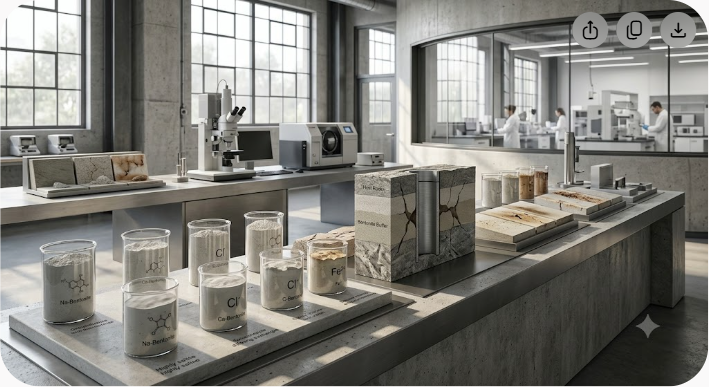
For an ordinary industrial application, you might start with swelling index, moisture content, particle size, and purity. Nuclear-waste engineering requires a much deeper material-characterization program.
Important properties can include:
| Property | Why it matters in a repository |
|---|---|
| Smectite content | Influences swelling, surface area, and clay reactivity |
| Montmorillonite composition | Helps characterize the dominant swelling clay phase |
| Dry density | Strongly affects permeability, swelling pressure, and pore structure |
| Swelling pressure | Indicates how hydrated clay responds under confinement |
| Hydraulic conductivity | Measures resistance to water movement |
| Water retention | Helps describe hydration and unsaturated behaviour |
| Cation exchange capacity | Provides information about ion-exchange behaviour |
| Thermal conductivity | Matters because waste packages can generate heat |
| Mineral stability | Indicates whether the clay remains suitable under expected conditions |
| Groundwater compatibility | Shows how salinity and ionic composition affect performance |
| Erosion resistance | Matters where flowing water could interact with exposed clay |
| Particle-size distribution | Influences compaction, handling, and hydration behaviour |
These properties are interconnected. Increasing dry density, for example, can increase swelling pressure and reduce hydraulic conductivity, while also changing how water enters the buffer and how quickly saturation develops.
The right specification is therefore a performance envelope, not a single target number.
A repository is designed for isolation periods far longer than the normal service life of most industrial products. The evolution of the bentonite therefore matters as much as its initial properties.
Bentonite blocks, pellets, granules, or engineered mixtures are placed around the waste package or within repository openings. The material is installed at a specified density and moisture condition.
At this point, the buffer may not yet be fully saturated.
Groundwater gradually moves from the host rock into the unsaturated bentonite. Water uptake causes the smectite minerals to hydrate and swell.
Hydration rate depends on factors such as dry density, block geometry, water availability, and groundwater chemistry.
As hydration progresses, bentonite expands into available voids. This reduces open pathways and increases contact with surrounding surfaces.
The resulting buffer can develop substantial swelling pressure under confinement. Engineers measure this behaviour because it is closely related to the mechanical and hydraulic performance of the buffer.
Heat from radioactive decay raises the temperature around the waste package. At the same time, the bentonite interacts with groundwater, container materials, and surrounding rock.
The repository must be designed so these processes don't degrade the clay's required performance beyond the limits established by the safety case.
A repository safety case doesn't depend on the assumption that a waste package will remain intact indefinitely. It evaluates how the system behaves if radionuclides are eventually released.
A dense bentonite buffer can slow transport through low permeability, diffusion-dominated movement, and sorption or ion-exchange processes. The surrounding host rock provides another barrier.
This layered approach is fundamental to deep geological disposal.
Deep geological disposal is an approach for isolating long-lived radioactive waste deep underground in a carefully characterized geological formation.
The concept uses both engineered barriers and natural barriers. Engineered barriers may include the waste form, container, bentonite buffer, and repository seals. The natural barrier is the surrounding host rock.
Suitable host formations can include crystalline rock, clay-rich formations, or salt, depending on the country's repository concept, geology, and regulatory framework.
Bentonite is especially relevant to repository concepts that use a clay buffer around waste packages. The clay isn't intended to replace the geological formation. Instead, it adds another controlled barrier between the waste and the accessible environment.
That distinction matters because radioactive-waste isolation is a systems-engineering problem. A material can have excellent laboratory properties and still be unsuitable if the wider repository environment isn't compatible with those properties.
No. This is one of the most common misunderstandings about bentonite and nuclear waste.
Bentonite doesn't neutralize radioactivity, stop radioactive decay, or turn nuclear waste into a non-radioactive material.
Its role is to limit the movement of radionuclides after they are released from a waste form or container. It does this through physical and chemical mechanisms such as swelling, low permeability, diffusion control, and interaction with dissolved species.
Think of bentonite as a barrier material, not a radiation sponge.
This distinction is important when evaluating product specifications or reading claims about radioactive-waste containment. A supplier's ordinary absorption or swelling data cannot, by itself, demonstrate suitability for a nuclear application.
Bentonite isn't immune to its environment. Several conditions can change how the clay behaves.
High concentrations of dissolved salts can reduce the swelling of some bentonites. Cations such as calcium and magnesium can alter the clay's hydration behaviour and influence its swelling response.
A repository located in a saline environment therefore requires groundwater-specific testing rather than relying only on freshwater swelling data.
Spent nuclear fuel and some other radioactive wastes generate heat. Bentonite must therefore operate within the temperature range allowed by the repository design.
Temperature affects hydration, mineral reactions, water movement, and chemical processes. Long-term thermal behaviour is consequently an important part of engineered-barrier research.
Bentonite isn't a single pure mineral. Natural deposits contain mixtures of smectite and accessory minerals. Under certain temperature and chemical conditions, mineral transformations may affect long-term performance.
This is why mineralogical characterization matters alongside swelling and permeability measurements.
If bentonite is exposed to flowing groundwater before the buffer reaches its intended condition, erosion can become a concern. Under some conditions, clay particles or colloids may also influence radionuclide transport.
Repository designs account for groundwater flow, buffer geometry, saturation, and erosion resistance rather than assuming that swelling alone solves every problem.
The best clay can't compensate for poor installation. Large voids, uneven compaction, or inappropriate material placement can change local water pathways and stress distributions.
This is why engineered bentonite products are manufactured and installed to controlled specifications rather than simply placed around a container without density or geometry requirements.
The physical form of bentonite matters because it determines how the material can be installed and how it hydrates.
Compacted blocks can be manufactured to controlled dimensions and densities. They're useful where the repository design calls for a defined buffer around a waste package.
Pellets can fill irregular spaces more effectively than rigid blocks. A pellet-based system may be useful where filling small voids or complicated geometries is important.
Granular bentonite can be used as backfill or as part of engineered mixtures. Its performance depends heavily on particle-size distribution, dry density, and compaction.

There isn't one universally correct form. Repository geometry and installation requirements determine which material form and specification are appropriate.
Testing starts long before a bentonite reaches a repository. Engineers first establish the material's baseline characteristics, then examine how those characteristics change under representative repository conditions.
A practical qualification program may include the following steps:
The last point is easy to overlook. A repository program can't rely on one laboratory sample. Material consistency matters because engineered barriers must be installed across a large underground facility.
Not without qualification.
A commercial bentonite may have excellent swelling, sealing, or absorbency properties and still be unsuitable for a nuclear repository. Nuclear applications require a much more detailed understanding of mineralogy, impurities, thermal behaviour, chemical stability, density, and long-term performance.
For example, a product sold for drilling mud may be optimized for rheology and filtration control. A product intended for a repository buffer is evaluated against a different performance envelope.
That doesn't make one material better for every application. It means each material is selected and controlled for a particular job.
For suppliers, this distinction is important. Nuclear-sector customers may need traceable raw-material characterization, controlled processing, batch consistency, and extensive technical documentation rather than a general commercial specification sheet.
Bentonite is one component in a broader family of engineered and natural barriers. Comparing the roles of those materials helps explain why repository designs use several layers.
| Barrier material | Main role | Important strength | Key limitation or consideration |
|---|---|---|---|
| Bentonite | Buffer and seal | Swelling and very low permeability | Performance depends strongly on density and water chemistry |
| Metal container | Waste isolation | Physical containment | Long-term corrosion must be assessed |
| Cementitious materials | Plugs, seals, and structures | Mechanical strength | Chemical evolution can affect nearby materials |
| Host rock | Natural barrier | Large-scale geological isolation | Site geology must remain suitable |
| Salt formations | Host formation in some concepts | Very low permeability and self-healing behaviour | Repository design differs from clay-buffer systems |
| Clay-rich host rock | Natural barrier | Low permeability and diffusion-dominated transport | Site-specific mineral and mechanical behaviour must be assessed |
The comparison also shows why saying "bentonite contains nuclear waste" is incomplete. A repository relies on the combined performance of several barriers, not one material acting alone.
Suppose two bentonite samples have the same mineral composition but are compacted to different dry densities.
The denser sample generally has less connected pore space. Under suitable conditions, it can develop higher swelling pressure and lower hydraulic conductivity than a looser sample.
But higher density also affects hydration kinetics. Water may take longer to penetrate a highly compacted buffer, particularly when the only water supply comes from the surrounding rock.
So engineers don't simply maximize density. They select a density range that provides the required combination of swelling, hydraulic, mechanical, and hydration behaviour.
This is a recurring principle in repository engineering: one property can't be optimized in isolation.
When evaluating bentonite for a demanding containment application, several shortcuts can lead to the wrong material choice.
High free swelling is useful information, but it doesn't tell you everything about permeability, swelling pressure under confinement, mineral stability, or long-term chemical behaviour.
Sodium-rich bentonite can provide strong swelling performance, but repository suitability depends on the complete material and the environment in which it will operate.
Repository groundwater may have very different chemistry. Salinity and cation composition can significantly influence swelling and hydraulic properties.
The same bentonite can behave very differently at different densities. Test conditions need to reflect the intended installation density.
Nuclear-waste repositories require long-term coupled thermal, hydraulic, mechanical, and chemical assessments. A conventional pond-liner or drilling-fluid specification isn't enough.
Even a material with strong laboratory performance can create problems if mineralogy or processing varies significantly between production lots.
For conventional industrial customers, a certificate of analysis may cover the main physical and chemical specifications. For research, nuclear, or other safety-critical programs, documentation requirements can be considerably more extensive.
A supplier should be prepared to discuss:
The exact specification should come from the repository developer or qualified engineering organization. A supplier shouldn't define nuclear-grade acceptance criteria on its own.
For Axewelledge, this distinction is important. Its broader bentonite business serves industrial applications such as drilling, sealing, construction, water treatment, and other uses. Nuclear-waste containment is a specialized engineering application where material selection has to be driven by project-specific qualification rather than a generic commercial grade.
Bentonite has been extensively investigated as an engineered barrier material in deep geological disposal concepts in several countries.
Repository programs have studied compacted bentonite buffers around waste containers, bentonite-based backfills and sealing materials, and the long-term behaviour of smectite-rich clays under thermal, hydraulic, mechanical, and chemical conditions.
The exact design varies by country because waste forms, container concepts, host geology, and regulatory requirements differ.
For example, a repository designed for spent nuclear fuel in crystalline rock can use a different engineered-barrier arrangement from a facility designed for another waste category in a clay-rich host formation.
The common engineering principle is to use multiple barriers to isolate long-lived radioactive material and reduce the rate at which radionuclides could reach the accessible environment.
No. Bentonite is one part of a larger containment strategy.
A repository must account for the waste form, container performance, bentonite behaviour, host-rock characteristics, groundwater movement, geochemical conditions, thermal effects, mechanical stability, and long-term radionuclide transport.
The clay buffer is valuable because it addresses several of these challenges at once. It can swell, seal, restrict water flow, and retard certain dissolved species. None of those functions removes the need for the other barriers.
This is also why repository safety can't be judged from a single laboratory test or one material specification.
Nuclear-waste containment shows how far bentonite engineering extends beyond familiar industrial applications.
For a mineral producer, the challenge isn't simply mining a clay with good swelling properties. The important questions are whether the deposit is consistent, whether processing preserves the required mineral characteristics, whether impurities can be controlled, and whether the finished material can be documented and reproduced from batch to batch.
Those requirements reinforce the value of disciplined mineral processing and quality control. They also explain why end users in demanding industries often want more than a product name. They need measurable properties, defined test methods, traceability, and technical support.
For companies exploring bentonite for specialized research or engineered-barrier applications, the sensible starting point is a technical discussion about target performance requirements rather than selecting a grade from a catalogue.
Before selecting bentonite for an engineered-barrier study, ask these questions:
If several of these questions can't be answered, the material isn't ready for a serious repository qualification program.
Yes. Bentonite can be a useful engineered barrier in deep geological disposal because compacted smectite-rich clay can swell when hydrated, develop very low permeability, seal small gaps, and retard the movement of some radionuclides.
But bentonite doesn't eliminate radioactivity, and it isn't a complete nuclear-waste containment system. Its performance depends on mineralogy, density, groundwater chemistry, temperature, mechanical confinement, and long-term chemical stability.
That combination of strengths and limitations is why bentonite is treated as one part of a carefully engineered multi-barrier repository rather than as a complete solution by itself.
For organizations evaluating bentonite for specialized sealing, containment, or research applications, Axewelledge can provide technical information on its bentonite materials and the relevant physical and mineralogical properties for further evaluation. For nuclear-waste applications in particular, final selection should always be based on project-specific testing and the requirements established by the responsible repository and regulatory organizations.













Have questions about our products? We're here to help!