Axewelledge, a leading exporter from India, specializes in high-quality Bentonite. With a commitment to excellence, we supply premium Bentonite to the Middle East and Southeast Asia markets.


North Angle Complex, 304,
150 Feet Ring Rd, Opposite Ambedkar Nagar BRTS Stop,
Madhav Park, Punit Nagar,
Mavdi, Rajkot, Gujarat 360004
© Axewelledge 2026, All Rights Reserved.
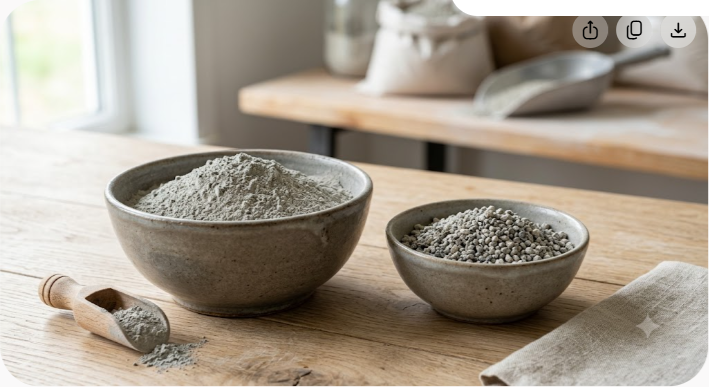
Bentonite for pet waste management is mainly valued for one practical property: it takes up liquid and, when the right grade of sodium bentonite is used, turns that moisture into a firm clump that can be removed without replacing the entire litter bed. That combination makes bentonite particularly useful in clumping cat litter and other moisture-control products.
The performance, however, depends on more than simply buying a bag of bentonite. Mineral composition, montmorillonite content, exchangeable cations, particle size, moisture content, granule strength, dust generation, and swelling behavior all affect how the finished product performs. A clay that swells strongly in a laboratory test may still perform poorly in a litter formulation if its granules are too fine, too dusty, too wet, or poorly graded.
For manufacturers and bulk buyers, the useful question is therefore not just whether bentonite absorbs water. It is whether the selected grade absorbs urine quickly enough, forms a cohesive clump, limits liquid migration through the litter, and remains practical to handle during manufacturing and use.
Bentonite is a naturally occurring clay dominated by smectite minerals, particularly montmorillonite. Sodium-rich bentonite is especially useful for clumping applications because water can enter the spaces between its clay layers, causing the particles to hydrate and expand.
When urine contacts suitable sodium bentonite granules, several things happen at once. The granules wet, water moves into the clay structure, the particles swell, and the wetted material becomes more cohesive. The result is a concentrated mass that can be lifted from the litter box while much of the surrounding dry litter remains available for continued use.
That behavior is fundamentally different from an absorbent that simply holds liquid inside individual particles without producing a cohesive clump. For litter manufacturers, clump strength is just as important as total absorption because weak clumps break during scooping and leave wet material behind.
Bentonite can also help manage moisture in animal bedding and designated waste areas, but the product must be selected for the specific application. A grade designed for drilling fluids, for example, isn't automatically suitable for a consumer pet product. Processing, particle size, dust characteristics, purity, and regulatory requirements all need to be considered.
At the microscopic level, bentonite consists of very fine layered silicate particles. Montmorillonite has a permanent negative charge within its layered structure, balanced by exchangeable cations such as sodium, calcium, and magnesium. The type and distribution of these exchangeable ions influence how the clay interacts with water.
Sodium-dominant montmorillonite generally hydrates and swells more extensively than calcium-dominant material in fresh water. Water enters the spaces associated with the clay layers, increasing the separation between particles. The clay can therefore occupy substantially more volume after hydration than it did in its dry state.
This swelling is useful in pet litter because the material doesn't merely become wet. It can develop a cohesive, gel-like structure around the absorbed liquid. The exact behavior depends on mineralogy, particle size, water chemistry, compaction, and processing conditions.
The distinction between sodium and calcium bentonite matters when the end product depends on rapid swelling and firm clumping.
Sodium bentonite generally has greater free-swelling behavior and is widely used in clumping cat litter. Calcium bentonite can absorb moisture effectively, but it normally exhibits less swelling and does not produce the same type of strong clump under comparable conditions.
Neither material is universally better. The correct choice depends on the product's purpose. A non-clumping absorbent may not need the same swelling behavior as a clumping litter. Likewise, a manufacturer may blend different minerals to balance absorption, cost, dust, bulk density, and handling properties.
Free swelling is a useful screening measurement, but it shouldn't be treated as a complete measure of litter performance. A clay can show strong expansion in a standardized water test and still produce disappointing clumps if the granule structure breaks down too easily or the particle-size distribution isn't suited to the finished litter.
For procurement, swelling results should be considered alongside absorption capacity, clump strength, moisture content, particle-size distribution, dust generation, bulk density, and performance in the actual litter formulation.
The practical sequence is straightforward:
The speed of this process depends on granule size and formulation. Very coarse particles may take longer to hydrate internally, while excessive fines can increase dust and may produce undesirable handling characteristics. The best commercial formulation is usually a controlled particle-size distribution rather than simply the finest possible powder.
These terms are often used interchangeably in marketing, but they describe different properties.
Absorption describes how much liquid the material takes up or retains under a defined test condition. Swelling describes the increase in volume caused by hydration. A bentonite can absorb liquid without producing the same degree of visible expansion, while a highly swelling clay can produce a large volume increase without necessarily delivering the desired clump strength in a finished product.
For this reason, buyers should ask suppliers for the actual test method and result rather than relying on a single headline percentage.
Odor control is one of the main reasons consumers prefer effective clumping litter, but it is important to describe what bentonite can and cannot do.
Bentonite does not chemically neutralize every odor compound, and it shouldn't be presented as a guaranteed ammonia neutralizer. Its primary contribution is physical moisture management. By rapidly incorporating urine into a localized clump, bentonite reduces the amount of free liquid spread through the litter bed. Removing that clump also removes a concentrated source of odor-producing material.
Drying and moisture control can influence microbial activity, but odor development in pet waste depends on several factors, including urine composition, temperature, litter-box ventilation, cleaning frequency, and the presence of organic matter. A bentonite litter can therefore support odor control without being an odor-neutralizing chemical in its own right.
Some commercial litters combine bentonite with activated carbon, zeolite, fragrance, or other odor-control ingredients. Those additions should be evaluated separately because they provide different mechanisms of action.
A slow-forming clump gives liquid more time to migrate through the litter bed. Once urine reaches the bottom of a litter box, cleaning becomes harder and residual moisture can contribute to persistent odor.
Fast hydration helps keep the affected area localized. Strong clumps also matter because a clump that breaks during scooping leaves contaminated fragments behind. In practice, good odor management is therefore partly a result of good clumping and regular removal, not simply the clay's chemistry.
No absorbent is ideal for every household or animal-care setting. Product developers typically balance liquid uptake, clumping, dust, weight, cost, sourcing, disposal requirements, and consumer preferences.
| Material | Moisture Handling | Clumping | Typical Dust Consideration | Main Strength | Common Limitation |
|---|---|---|---|---|---|
| Sodium bentonite | High, with strong swelling in suitable grades | Excellent in clumping formulations | Depends strongly on processing and granulation | Firm, removable clumps | Mineral mining and disposal considerations |
| Calcium bentonite | Moderate to high | Usually weaker than sodium bentonite | Depends on grade | Absorbency and availability | Lower swelling for clumping applications |
| Silica gel | High moisture uptake | Does not normally form clay-like clumps | Generally low, depending on product | Long service life and low moisture content | Different disposal and consumer-preference profile |
| Recycled paper | Moderate | Usually non-clumping | Generally low | Renewable recycled feedstock | Lower density and different liquid-handling behavior |
| Wood or plant-based fibers | Varies by material | Usually limited unless specially processed | Varies | Renewable feedstock options | Performance can vary with formulation and moisture |
| Zeolite | Moderate moisture adsorption | Limited by itself | Varies by grade | Can contribute to odor adsorption | Does not provide the same swelling-based clumping |
The comparison isn't a ranking. It shows why sodium bentonite remains attractive when the product brief calls for rapid liquid capture and firm clumps, while other materials may be preferable when low weight, renewable feedstocks, or different disposal characteristics are more important.
The largest and most established pet-care application for sodium bentonite is clumping cat litter. Here, the mineral is processed into granules with controlled particle size and blended with other ingredients when required.
Bentonite can also be considered for selected animal-bedding and moisture-control applications. These uses require more care than household litter because the animal may have prolonged contact with the material, and the bedding must meet the physical and safety requirements of the species and environment.
For clumping litter, manufacturers typically look for a combination of high swelling, fast liquid uptake, good granule integrity, controlled dust, and predictable clump strength. A strong mineral specification should therefore cover both the raw material and its behavior after processing.
The finished litter may contain bentonite as the principal absorbent or as part of a broader formulation. Granulation can be used to control particle size and reduce the handling problems associated with very fine clay powders.
Particle-size distribution also affects how urine moves through the litter. If the formulation contains too many fines, permeability and dust behavior may change. If it contains too many coarse particles, wetting and clumping may become slower. Consistent grading is therefore a manufacturing control, not simply a cosmetic specification.
Shelters and kennels have different requirements from household litter boxes. Large areas, frequent cleaning, and variable waste volumes make labor efficiency particularly important.
Bentonite may be useful in designated moisture-control products, but simply spreading loose bentonite across a large animal area isn't a substitute for proper sanitation. Absorbent minerals should be incorporated into a product or cleaning system designed for the specific environment, with attention to dust exposure, animal behavior, ventilation, and disposal procedures.
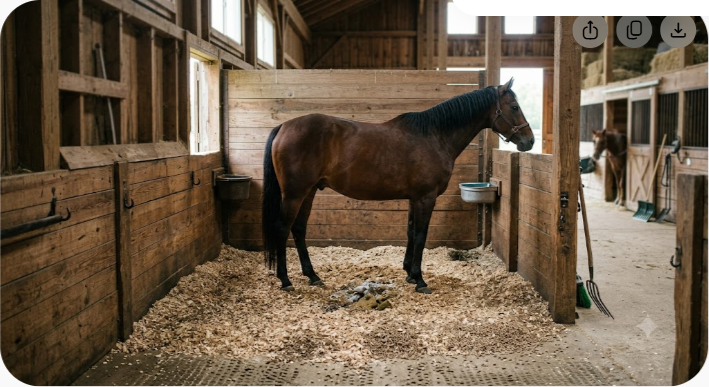
Bentonite and other mineral absorbents may be incorporated into selected bedding systems to help manage localized moisture. The choice must account for the animal's exposure route, bedding composition, dust, hoof or paw contact, and waste-disposal practices.
Claims about preventing hoof disease, respiratory illness, or other health outcomes should not be made solely on the basis of bentonite's absorbency. Dry bedding is one part of animal husbandry; it doesn't replace ventilation, cleaning, drainage, or veterinary care.
A reliable procurement specification starts with the finished product, not with a generic request for "high-grade bentonite." The supplier should understand whether the material is intended for clumping litter, non-clumping absorbent products, bedding, or another application.
The following properties deserve attention.
Higher montmorillonite content can support stronger swelling and water interaction, but mineral purity alone doesn't determine finished-litter performance. Other minerals, processing conditions, particle structure, and exchangeable cations also matter.
Free swelling provides a useful indication of how strongly the clay expands in water. ASTM D5890 is commonly used for determining the free swell index of bentonitic clays in specified conditions. Buyers should always compare results generated by the same method because test conditions can materially affect the result.
Ask for the test method, sample preparation, liquid used, contact time, and calculation basis. A statement such as "absorbs 800 percent" is difficult to evaluate without knowing exactly how the number was obtained.
Particle size influences hydration speed, dust, bulk density, transport behavior, and clump formation. The correct range depends on the finished product and granulation process.
Incoming bentonite that contains excessive free moisture can cake during storage and alter the consistency of a finished litter blend. Moisture should therefore be controlled at receiving and during production rather than treated as an afterthought.
Dust is a major product-quality concern in consumer litter. Processing and granulation should aim for a controlled fine fraction rather than assuming that finer material is automatically better at absorbing liquid.
These properties affect packaging, shipping, filling equipment, and the way the litter behaves in a box. Fragile granules can create additional fines during transport, changing the product before it reaches the consumer.
For a commercial purchase, request a current technical data sheet and certificate of analysis. At minimum, the specification should identify the material type and relevant performance parameters.
A useful purchasing checklist includes:
This last step is particularly important. A raw mineral can look excellent on paper and still behave differently after drying, granulation, blending, fragrance addition, or other processing.
A practical quality-control program should combine mineral characterization with functional testing.
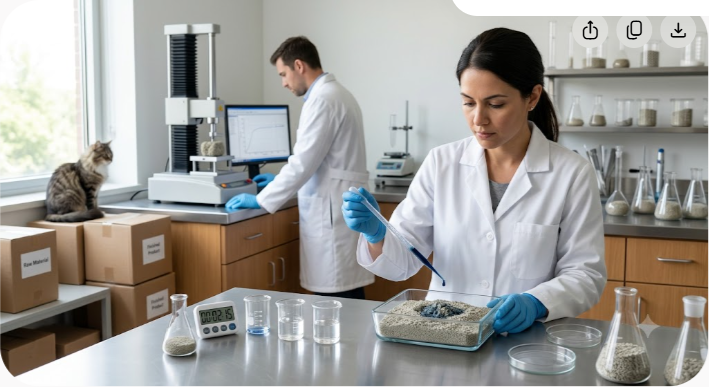
X-ray diffraction can help identify the mineral phases present in a bentonite. X-ray fluorescence can provide elemental composition information. Together, these techniques give buyers a clearer picture of the raw material than a generic product name alone.
Free swelling is useful for screening incoming lots and monitoring consistency. Significant changes between shipments may indicate changes in mineralogy, processing, or the source material.
Moisture can be measured using an oven-based loss-on-drying approach or suitable rapid moisture instrumentation. The selected method should be validated for the specific material and correlated with the reference method used by the quality team.
The most meaningful test is often application-specific. Manufacturers can evaluate clump formation using a controlled volume of liquid, standardized contact time, clump strength after a defined waiting period, and the amount of loose wet material remaining after removal.
Testing should be repeatable. The liquid volume, litter depth, particle-size distribution, temperature, contact time, and handling method should be controlled so that different mineral lots can be compared fairly.
A high swelling figure is useful, but it doesn't tell the whole story. Clump strength, dust, particle size, moisture, and granule durability can make a major difference in actual use.
Sodium bentonite from different deposits can behave differently. Mineralogy, exchangeable ions, processing history, drying conditions, and granulation can all affect performance.
A bentonite sold for drilling, foundry, civil engineering, or another industrial application may have properties that aren't appropriate for pet products. Application-specific quality requirements should be established before purchase.
High absorption doesn't compensate for a dusty finished litter. Fine particles can create handling problems during filling and consumer complaints during pouring or cleaning. Dust performance should be evaluated on the finished granulated product.
Bulk procurement without a controlled trial creates unnecessary risk. A small production trial can reveal problems with clumping, odor performance, dust, packaging, or processing before a full shipment is accepted.
Bentonite is a naturally occurring mineral, but mining, drying, transportation, packaging, and disposal all have environmental impacts. A credible sustainability assessment should consider the complete product life cycle rather than treating the word "natural" as proof of environmental superiority.
Bentonite's mineral origin makes it attractive to manufacturers looking for mineral-based absorbents, but disposal claims need to remain specific and realistic.
Used pet litter contains urine, feces, microorganisms, and other biological material. It should therefore be handled according to local waste-management requirements. Used bentonite litter should not automatically be described as biodegradable or suitable for composting simply because the unused mineral occurs naturally.
The clay itself is generally stable, but environmental performance depends on the full formulation and disposal route. Fragrances, binders, dyes, deodorizing additives, and other ingredients can change the characteristics of the finished product.
For manufacturers evaluating sustainability, useful questions include where the clay is mined, how far it travels, how much thermal energy is required for processing, what packaging is used, and how the used product is disposed of. These questions produce a more meaningful environmental assessment than a simple natural-versus-synthetic comparison.
Good litter performance starts with consistent raw material, but formulation and processing matter just as much.
First, control the incoming mineral. Set specifications for moisture, swelling, particle size, fines, and other properties that influence production. Second, maintain consistent granulation so the finished product has a predictable particle-size distribution. Third, test clump formation using a repeatable application method.
Manufacturers should also monitor the mineral after transportation. Granules can generate fines through mechanical handling, and moisture can change during storage. Periodic checks of incoming and finished material help identify these shifts before they become customer complaints.
Odor-control ingredients should be evaluated separately from the bentonite's absorbency. If a formulation uses activated carbon, zeolite, fragrance, or another additive, test the complete formulation as well as the base clay. This prevents a supplier from being credited for a performance effect that actually comes from another component.
Bentonite and silica gel solve the moisture problem differently.
Bentonite hydrates and swells, which makes it well suited to clumping litter. Silica gel, also called crystalline silica in some litter products, adsorbs moisture onto its internal surface and typically does not form the same removable clay clump.
For consumers who prefer daily removal of urine clumps, sodium bentonite has a clear functional advantage. Silica-based products can offer different moisture-management and maintenance characteristics, including the ability to remain usable while crystals change appearance as they take up moisture.
The choice should be based on the desired product behavior rather than a blanket claim that one mineral is universally superior.
Bentonite should be protected from unnecessary moisture before processing. Exposure to humid air can alter free moisture and encourage caking, particularly when fine material is stored for extended periods.
Bulk bags and other packaging should provide an appropriate moisture barrier for the intended storage conditions. Warehouses should be clean, dry, and protected from rain and condensation. Bags should be stored in a way that limits direct contact with wet floors and prevents contamination from other materials.
Stock rotation also matters. First-in, first-out inventory practices reduce the time that material spends in storage and make lot traceability easier.
During manufacturing, dust-control measures should be appropriate for the equipment and workplace. Enclosed transfer systems, local exhaust ventilation, and suitable housekeeping practices can reduce airborne dust. Safety controls should follow the supplier's safety data sheet and the requirements of the facility.
A dependable supplier should be able to provide more than a price per metric ton. Ask for a technical data sheet, certificate of analysis, typical test values, packaging options, particle-size specifications, moisture limits, and batch or lot traceability.
For large-volume procurement, consistency between shipments is often more valuable than an unusually high result from one sample. Buyers should define acceptance limits before placing the order and agree on the sampling procedure for incoming shipments.
Supplier qualification can also include a production trial, site or process audit where appropriate, and periodic requalification. These measures are particularly useful when the bentonite is a major functional ingredient in a consumer product.
Companies such as Axewelledge may be considered as potential mineral suppliers, but buyers should evaluate any supplier against their own technical specification, sample performance, documentation, quality system, logistics capability, and regulatory requirements rather than relying on a brand name alone.
Sodium bentonite is effective for pet waste management because its smectite-rich structure can hydrate, swell, and hold liquid in a cohesive mass. In clumping cat litter, that behavior makes it possible to remove concentrated wet waste while leaving much of the unused litter in place.
The strongest products don't depend on one impressive laboratory number. They combine suitable mineralogy with controlled particle size, consistent moisture, manageable dust, good granule integrity, and reliable clump formation.
For buyers, the safest approach is to specify the properties that actually determine finished-product performance and verify them with representative samples and application testing. For manufacturers, consistent raw material and disciplined quality control are the foundation of a litter product that performs the same way from one batch to the next.
Bentonite is a useful mineral, but it isn't a complete sanitation system by itself. Effective pet waste management still depends on appropriate litter depth, regular removal, clean containers, ventilation, responsible disposal, and good animal-care practices.













Have questions about our products? We're here to help!