Axewelledge, a leading exporter from India, specializes in high-quality Bentonite. With a commitment to excellence, we supply premium Bentonite to the Middle East and Southeast Asia markets.


North Angle Complex, 304,
150 Feet Ring Rd, Opposite Ambedkar Nagar BRTS Stop,
Madhav Park, Punit Nagar,
Mavdi, Rajkot, Gujarat 360004
© Axewelledge 2026, All Rights Reserved.
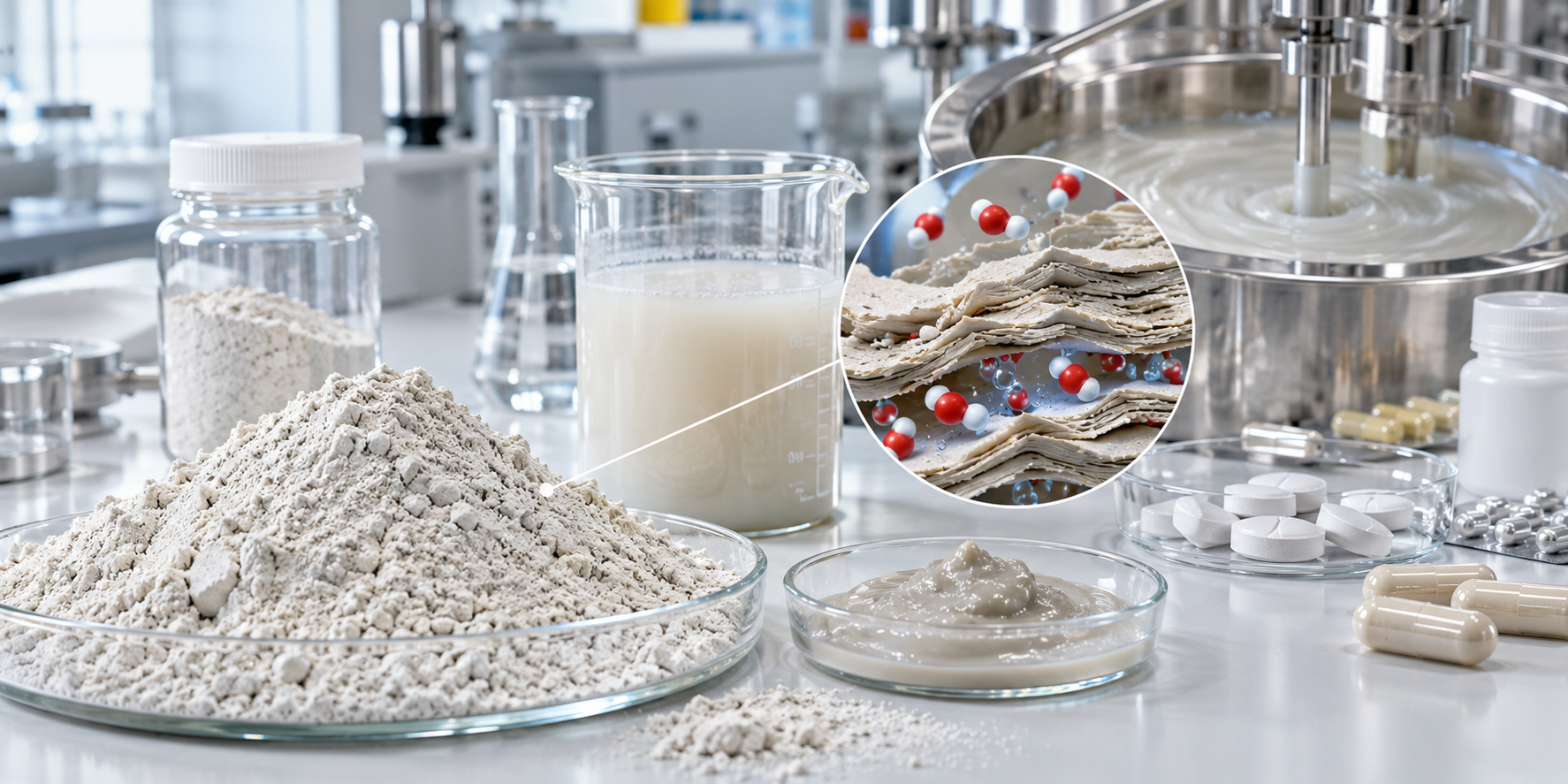
Bentonite can do much more in pharmaceutical formulation than simply increase viscosity. Its swelling, adsorption, ion-exchange, and colloidal properties make it useful in selected suspensions, semisolid products, tablets, and experimental drug-delivery systems. The important point is that pharmaceutical performance depends on the specific clay, its processing and quality, the active pharmaceutical ingredient (API), and the rest of the formulation.
For pharmaceutical manufacturers, the first question should not be whether bentonite is useful in general. It should be whether a particular bentonite grade provides the required function without creating problems with drug release, stability, processing, safety, or regulatory compliance.
Bentonite is a naturally occurring clay material associated primarily with smectite minerals, especially montmorillonite. Its layered structure and charged surfaces give it the ability to interact with water, ions, and certain molecules. Those properties explain why bentonite has attracted interest as a pharmaceutical excipient and as a component of drug-delivery systems.
The United States Pharmacopeia (USP) recognizes bentonite as a pharmaceutical material and separately describes purified bentonite. Purified bentonite is processed to remove grit and nonswellable ore components, making the distinction between a general mineral product and a controlled pharmaceutical material particularly important.
A pharmaceutical manufacturer should never assume that a bentonite sold for an industrial application is suitable for a medicine. The raw material must be evaluated against the quality requirements relevant to its intended use, including identity, purity, mineral composition, microbial quality, elemental impurities, physical properties, and consistency between lots.
In practical formulation work, bentonite may contribute to:
These functions are not interchangeable. A grade that works well as a suspending material may not be the right choice for a controlled-release tablet. Formulation performance has to be established for the actual API and dosage form.
The answer lies in the structure of montmorillonite and the way that structure behaves in a formulation.
Montmorillonite has a layered structure with charged surfaces and exchangeable ions. When suitable bentonite is exposed to water, the clay can hydrate and swell. The particles can form a structured dispersion, changing the flow and settling behavior of the liquid system.
That behavior can be useful when a formulation contains insoluble or poorly soluble particles. Instead of allowing the particles to settle rapidly into a dense sediment, a properly designed clay dispersion can provide enough structure to slow settling and support redispersion.
Bentonite also has a high surface area and active sites that can interact with selected molecules. Depending on the API and formulation environment, those interactions may influence adsorption, dissolution, and release. Factors such as drug charge, molecular size, pH, ionic strength, solubility, and clay chemistry can all change the result.
This is why bentonite shouldn't be treated as a simple thickening powder. Its formulation behavior comes from the interaction between the clay, water, ions, API, and other excipients.
Suspension stabilization is one of the most practical applications for bentonite.
A pharmaceutical suspension contains finely divided solid particles distributed through a liquid. Because gravity acts on those particles, they tend to settle over time. A poorly designed suspension may develop a compact sediment that is difficult to redisperse, creating problems with dose uniformity.
When appropriately hydrated, bentonite can form a structured colloidal dispersion and increase the resistance of the continuous phase to particle movement. This can reduce settling and improve the physical stability of a suspension.
The target, however, isn't maximum viscosity. A formulation that becomes too thick can be difficult to pour, pump, fill, or administer. It may also create an unpleasant mouthfeel in an oral product. The formulator has to find the point at which the clay provides useful structure without making the product impractical.
Important development variables include:
A useful suspension should be evaluated as a complete formulation. A good-looking dispersion in a laboratory beaker isn't enough evidence of pharmaceutical performance.
Bentonite can be investigated as a functional excipient in oral liquids where suspension stability is a major concern.
An oral suspension typically contains much more than the API and water. It may include buffers, sweeteners, flavors, preservatives, salts, wetting agents, viscosity modifiers, and other functional ingredients. Each one can affect the hydration and dispersion of clay.
Electrolytes are particularly important because ions can alter colloidal behavior. Changes in pH can also influence the charge state of the API and the interactions between the API and clay surface.
For that reason, formulation screening should include the complete ingredient system. A bentonite concentration that performs well in purified water may behave differently after the addition of salts, buffers, or other excipients.
For oral formulations, developers should pay attention to more than physical stability. They should also evaluate dose uniformity, redispersibility, viscosity, sediment characteristics, dissolution or drug release where relevant, microbial quality, taste and mouthfeel, and storage stability.
Adsorption is one of bentonite's most interesting properties from a drug-delivery perspective.
Certain drug molecules can associate with clay surfaces or enter interlayer regions. Electrostatic interactions can be important for positively charged compounds because many montmorillonite surfaces carry a net negative charge. Other interactions can also contribute, depending on the API and the chemical environment.
Once a drug is associated with bentonite, the surrounding formulation can influence how readily it is released. Changes in pH, ionic strength, solvent composition, and competing ions may alter the strength of the interaction.
This has led researchers to investigate bentonite and montmorillonite as carriers for modified drug delivery. The approach is highly API-specific. A clay system that gives useful release characteristics with one drug may bind another drug too strongly or too weakly.
For development teams, several variables deserve attention:
The practical lesson is straightforward: adsorption can be useful, but uncontrolled adsorption can also reduce the amount of drug available for release.
Bentonite has also been studied as an excipient in tablets designed to alter drug-release behavior.
Research on sodium bentonite-containing directly compressed tablets has examined model drugs including paracetamol, diclofenac sodium, and metformin hydrochloride. The results demonstrate an important point for formulators: the release effect depends on the API and formulation rather than on the presence of bentonite alone. Different drug systems can show different release profiles under the same general clay-based approach.
That makes bentonite interesting for modified-release development, but it isn't a shortcut to sustained release.

A sensible development program may include:
The desired release profile should be defined first. Bentonite concentration and processing conditions should then be optimized to achieve that target.
Bentonite and montmorillonite-based materials can also provide useful physical properties in topical and semisolid systems.
Their interaction with water, ability to form structured dispersions, surface properties, and rheological effects can influence the consistency and behavior of creams, gels, ointments, and related formulations. Depending on the composition, clay may affect spreadability, water handling, viscosity, and the structure of the finished product.
Research has also examined purified and sodium-activated bentonite in topical barrier applications. Experimental work has evaluated properties such as surface area, swelling, cation-exchange capacity, and colloidal stability alongside topical performance.
These studies are useful for formulation research, but they shouldn't be treated as proof that any commercial bentonite is suitable for a medicinal topical product. Topical pharmaceutical use requires appropriate control of impurities, microbial quality, particle characteristics, skin compatibility, formulation stability, and finished-product performance.
The distinction matters. A material can have promising laboratory properties while still requiring substantial development before it can be used in a regulated pharmaceutical product.
Bentonite's layered structure has also made it interesting for more specialized delivery technologies.
Researchers have incorporated montmorillonite and bentonite into polymer composites, hydrogels, films, matrix systems, and other structured materials. In these systems, the clay can contribute adsorption sites or structural characteristics while the polymer provides complementary mechanical or release properties.
The objective may be to load an API, protect it from its environment, modify its release rate, or create a material with specific physical characteristics.
This area is more specialized than conventional excipient use. Much of the work remains at the research and development stage, and successful laboratory performance doesn't automatically translate into commercial pharmaceutical use. Nevertheless, clay-polymer systems show how bentonite's mineral properties can be combined with other materials to address specific formulation challenges.
The terms bentonite and purified bentonite shouldn't be treated as interchangeable when sourcing material for pharmaceutical development.
Natural bentonite is a geological material, and its composition can vary with the deposit, mineralogy, extraction method, processing, and activation history. It may contain nonswellable minerals, grit, and trace constituents that need to be controlled for a particular pharmaceutical application.
Purified bentonite is processed to remove grit and nonswellable ore components. USP-NF has a separate monograph for purified bentonite, which reinforces the importance of distinguishing a controlled pharmaceutical material from a general mineral product.
| Property | General Bentonite | Purified Bentonite | Pharmaceutical Development Consideration |
|---|---|---|---|
| Mineral composition | Can vary with geological source | More controlled after processing | Confirm identity and composition |
| Grit and nonswellable material | May be present | Specifically reduced through processing | Important for pharmaceutical processing |
| Swelling behavior | Source and processing dependent | More controlled, but still grade dependent | Relevant to suspensions and gels |
| Microbial quality | Must be evaluated for intended use | Must still be evaluated | Important for applicable products |
| Trace elements | Can vary with source | Requires appropriate control and testing | Relevant to safety and quality |
| Intended use | Often broad industrial applications | More specialized | Match the material to the intended pharmaceutical use |
For a pharmaceutical buyer, material selection should therefore begin with the dosage form, required performance, and applicable quality standard. The mineral name alone isn't enough.
There isn't one test that turns ordinary bentonite into pharmaceutical-grade material.
Pharmaceutical suitability is based on a set of quality attributes and controls appropriate to the material and intended use. These may include identity, mineral composition, purity, physicochemical properties, microbial quality, elemental impurities, particle characteristics, swelling behavior, and consistency between batches.
The applicable pharmacopeial requirements should be identified before procurement. A supplier's use of the phrase "pharmaceutical grade" should support, rather than replace, the manufacturer's own qualification process.
Useful supplier questions include:
A pharmaceutical manufacturer should also confirm which pharmacopeial and regulatory requirements apply to its specific product. Requirements can differ according to dosage form, route of administration, jurisdiction, and regulatory pathway.
Sodium and calcium bentonites can show different hydration and dispersion behavior because the exchangeable cations influence the way clay particles interact with water.
Sodium-rich bentonite is generally associated with greater swelling and stronger colloidal behavior in water than many calcium-rich materials. Calcium bentonite can have different hydration and dispersion characteristics. Even so, the labels sodium bentonite and calcium bentonite don't provide enough information to predict pharmaceutical performance.
Processing matters. Sodium activation can change properties such as swelling, dispersion, surface behavior, and cation-exchange characteristics. The starting mineral, activation method, purification process, particle size, and final specifications all contribute to the finished material's behavior.
For formulation development, the practical approach is to define the required performance first. The selected material should then be tested against those requirements rather than chosen solely because it carries a particular mineral classification.
Bentonite's interaction with an API deserves careful attention because the same property that helps a formulation can create a problem if it isn't controlled.
Because montmorillonite surfaces carry charge and contain exchangeable ions, certain drug molecules can associate with the clay. The strength and reversibility of that interaction can change with pH, ionic strength, drug concentration, and the presence of competing substances.
For the formulator, this creates both an opportunity and a risk.
The opportunity is controlled interaction. If a drug associates with the clay at a useful strength, the system may help modify dissolution or release. Clay-based carriers can also be investigated for APIs that benefit from a structured delivery environment.
The risk is excessive adsorption. If the drug binds too strongly, the intended dose may not be released efficiently. A suspension can therefore appear physically stable while still failing its drug-release target.
Research has explored modified bentonite-drug complexes, including systems designed to change drug release and absorption in experimental models. Such findings are valuable for formulation research, but they should not be generalized into a claim that bentonite automatically improves bioavailability.
The useful lesson is narrower: drug-clay interactions need to be characterized as part of formulation development, and both binding and release need to be measured.
If you're evaluating bentonite for a pharmaceutical product, a structured development process can prevent problems later. The goal is to connect raw-material characteristics with finished-product performance from the beginning.
Start with the actual product: oral suspension, tablet, capsule, cream, ointment, gel, or specialized drug-delivery system. Each application requires different material properties.
A suspension may prioritize hydration, rheology, and redispersibility. A tablet may place greater emphasis on powder flow, compression, compatibility, and dissolution. A topical system may require careful control of texture, spreadability, stability, and skin compatibility.
Decide what you need the bentonite to accomplish before choosing a grade.
The target could be suspension stabilization, viscosity modification, adsorption, controlled release, water management, or structural support. Clear targets make material screening much more useful because each candidate can be tested against the same requirements.
Review the supplier's technical documentation and determine whether the material is appropriate for pharmaceutical development.
Confirm mineral identity, relevant purity attributes, physical specifications, processing history, and lot consistency. Don't rely on a generic product name or a marketing description alone.
Evaluate the relationship between the bentonite and the API before moving too far into formulation development.
Depending on the system, analytical techniques such as Fourier-transform infrared spectroscopy (FTIR), differential scanning calorimetry (DSC), powder X-ray diffraction (PXRD), microscopy, adsorption studies, and dissolution testing may help identify physical or chemical interactions.
No single analytical technique answers every compatibility question. The methods should be selected according to the API, dosage form, and development objective.
Powder characterization is only the beginning. Prepare the intended dosage form and measure its real performance.
For a suspension, examine sedimentation, viscosity, particle distribution, dose uniformity, and redispersibility. For tablets, evaluate flow, compression, hardness, friability, disintegration where relevant, and dissolution. For topical products, assess texture, spreadability, rheology, stability, microbial quality, and the intended performance characteristics.

The finished product is what matters.
Bentonite behavior can change when the chemical environment changes. Evaluate the formulation across its relevant pH range and examine the effects of salts, buffers, and other charged ingredients.
This is particularly important when adsorption or colloidal behavior is central to the product's performance.
Monitor the finished formulation under appropriate accelerated and long-term storage conditions.
Depending on the dosage form, relevant observations may include viscosity, sedimentation, redispersibility, dissolution, appearance, assay, degradation products, water content, microbial quality, and other product-specific attributes.
For clay-containing systems, also watch for changes in physical structure. A product that is acceptable immediately after manufacture may behave differently after months of storage.
A pharmaceutical formulation needs predictable raw materials. Establish appropriate incoming-material specifications and supplier controls so that changes in mineral composition, processing, activation, particle size, or other critical attributes don't unexpectedly change finished-product performance.
Supplier qualification should be part of development, not an afterthought.
This is one of the most important mistakes to avoid. A bentonite that performs well in drilling fluids, foundry applications, construction materials, or other industrial products isn't automatically suitable for pharmaceutical use.
Industrial products can have different purity specifications, mineral compositions, particle characteristics, processing histories, and quality controls. Pharmaceutical suitability has to be established for the intended use.
Adding more clay can increase structure, but the relationship isn't unlimited.
Excessive bentonite may produce an unnecessarily viscous product, complicate filling and processing, affect mouthfeel, interfere with dissolution, or make a suspension harder to redisperse. Optimization is usually more useful than simply increasing concentration.
A clay that gives excellent physical stability may also interact strongly with the API.
This is especially important when the formulation depends on a specific dissolution or release profile. Drug recovery, dissolution, and relevant stability measurements should be evaluated instead of judging the formulation only by appearance.
Sodium bentonite is associated with strong swelling and colloidal behavior, but that doesn't mean every sodium bentonite formulation will provide sustained drug release.
Release depends on the API, clay properties, dosage form, concentration, processing conditions, dissolution medium, and other formulation variables. Drug-specific testing is essential.
Swelling is useful, but it is only one part of pharmaceutical performance.
Mineralogy, particle characteristics, surface chemistry, purity, elemental impurities, microbial quality, rheology, API compatibility, and batch consistency can all matter. A material with impressive swelling data may still be unsuitable for the intended product.
A formulation can work well in development and become difficult to control if the raw material changes from batch to batch.
Supplier documentation, specifications, sampling procedures, traceability, manufacturing controls, and change-notification practices should be considered early. For pharmaceutical applications, consistency is part of the product strategy, not simply a purchasing concern.
Bentonite's potential value comes from several properties working together:
These properties are useful only when they match the formulation objective. A property that helps one dosage form can create a problem in another.
If you're sourcing bentonite for pharmaceutical development, price per kilogram is only one part of the decision.
The formulation and quality teams need enough information to determine whether the material is appropriate for the intended use. Useful documentation may include a certificate of analysis, product specification, safety documentation, batch information, mineralogical characterization, processing and purification details, and available quality-control data.
Buyers should also clarify practical supply issues, including:
For US pharmaceutical buyers, the proposed material should be evaluated against the pharmacopeial and quality requirements applicable to the intended product. Those requirements can vary with dosage form, route of administration, product category, and regulatory pathway.
A supplier should be able to provide information that supports qualification. The pharmaceutical manufacturer remains responsible for determining whether the material is appropriate for its product and quality system.
Bentonite isn't a universal replacement for conventional pharmaceutical excipients. Its usefulness depends on the problem the formulation is designed to solve.
| Formulation Need | Bentonite Can Contribute | Key Consideration |
|---|---|---|
| Suspension stabilization | Structured dispersion and viscosity modification | Avoid excessive viscosity and poor redispersion |
| Modified drug release | Adsorption and matrix effects | Performance is strongly API dependent |
| Topical formulation | Structure and water interaction | Evaluate skin compatibility and finished-product performance |
| Drug adsorption | Surface and ion-exchange interactions | Binding can become too strong |
| Advanced delivery | Clay-drug and clay-polymer systems | Usually requires specialized development |
| Tablet formulation | Functional mineral excipient behavior | Compression, compatibility, and dissolution must be characterized |
The useful question isn't whether bentonite is universally better than another excipient. The question is whether its specific properties solve the formulation problem without introducing a new one.
For example, a conventional suspending agent may be preferable when the primary requirement is predictable rheology with minimal drug interaction. Bentonite may be worth investigating when its colloidal and adsorption properties provide an additional functional benefit. The choice should come from formulation data, not from the mineral's reputation alone.
Research on bentonite and montmorillonite continues beyond traditional suspension and semisolid applications.
Controlled drug delivery remains an active area. Researchers are studying how clay surfaces can load active compounds and influence their release under different pH and ionic conditions. Other work has investigated clay-containing systems for poorly water-soluble drugs and modified-release applications.
Clay-polymer composites are another area of interest. Combining bentonite with polymers can produce materials with properties that neither component provides independently. Potential research applications include hydrogels, films, matrix systems, and other structured delivery platforms.
Topical applications are also being investigated, including systems in which surface chemistry, swelling, and colloidal behavior contribute to barrier-related performance in experimental models.
These research directions are scientifically useful, but laboratory findings should be interpreted carefully. Commercial pharmaceutical adoption requires reproducible raw materials, appropriate safety and quality data, compatibility testing, regulatory suitability, and a supply chain capable of maintaining consistent specifications.
The gap between an interesting laboratory result and a commercially viable pharmaceutical ingredient can be substantial. That is why material characterization and process control remain important even as new applications are explored.
A clever formulation can't compensate for an inconsistent raw material.
Bentonite is geological in origin, so its characteristics can depend on the deposit, mineralogy, extraction, processing, activation, purification, particle size, and storage conditions. Two materials sold under the same broad mineral name can therefore behave differently in a formulation.
Experienced formulators account for this variability by characterizing incoming material and establishing specifications that are linked to finished-product performance.
For an international supplier, consistency becomes even more important. Pharmaceutical manufacturers may operate under different regulatory frameworks, but each needs reliable raw-material control and documentation appropriate to the intended use.
Axewelledge supplies bentonite from India and can support customers evaluating mineral sourcing, processing requirements, and material specifications. For pharmaceutical applications, the relevant question is not simply whether a supplier can provide bentonite in bulk. The material must be matched to the customer's formulation requirements, quality specifications, documentation needs, and intended application.
That distinction is especially important when a manufacturer is moving from laboratory screening to commercial sourcing. A suitable development sample is useful, but commercial qualification also requires confidence in lot consistency, documentation, supply capacity, and change control.
Bentonite can serve several useful roles in pharmaceutical formulation. Its swelling, adsorption, ion-exchange, surface, and colloidal properties make it relevant to suspension systems, selected topical formulations, tablets, modified-release research, and emerging drug-delivery technologies.
But bentonite isn't a one-size-fits-all excipient. The same adsorption that helps control release can limit drug availability if binding is too strong. The same swelling that improves suspension structure can make a product unnecessarily viscous. And a natural mineral that performs well in an industrial application may require additional purification, characterization, and quality controls before it can be considered for pharmaceutical use.
Successful development therefore starts with the dosage form and its performance requirements. From there, the formulator can define the required material properties, qualify an appropriate bentonite grade, test API-excipient compatibility, optimize the complete formulation, and establish stability and lot-to-lot controls.
For pharmaceutical buyers, the most useful next step is to define the intended dosage form and target performance before selecting a supplier. That approach makes it easier to compare grades, request relevant documentation, and avoid choosing a material based only on mineral name or price.
If you're evaluating bentonite for pharmaceutical development, Axewelledge can help with the mineral supply side, including material specifications, processing information, and international sourcing considerations. The final pharmaceutical qualification, however, should always be based on the manufacturer's own formulation, quality, safety, and regulatory requirements.













Have questions about our products? We're here to help!