Axewelledge, a leading exporter from India, specializes in high-quality Bentonite. With a commitment to excellence, we supply premium Bentonite to the Middle East and Southeast Asia markets.


North Angle Complex, 304,
150 Feet Ring Rd, Opposite Ambedkar Nagar BRTS Stop,
Madhav Park, Punit Nagar,
Mavdi, Rajkot, Gujarat 360004
© Axewelledge 2026, All Rights Reserved.
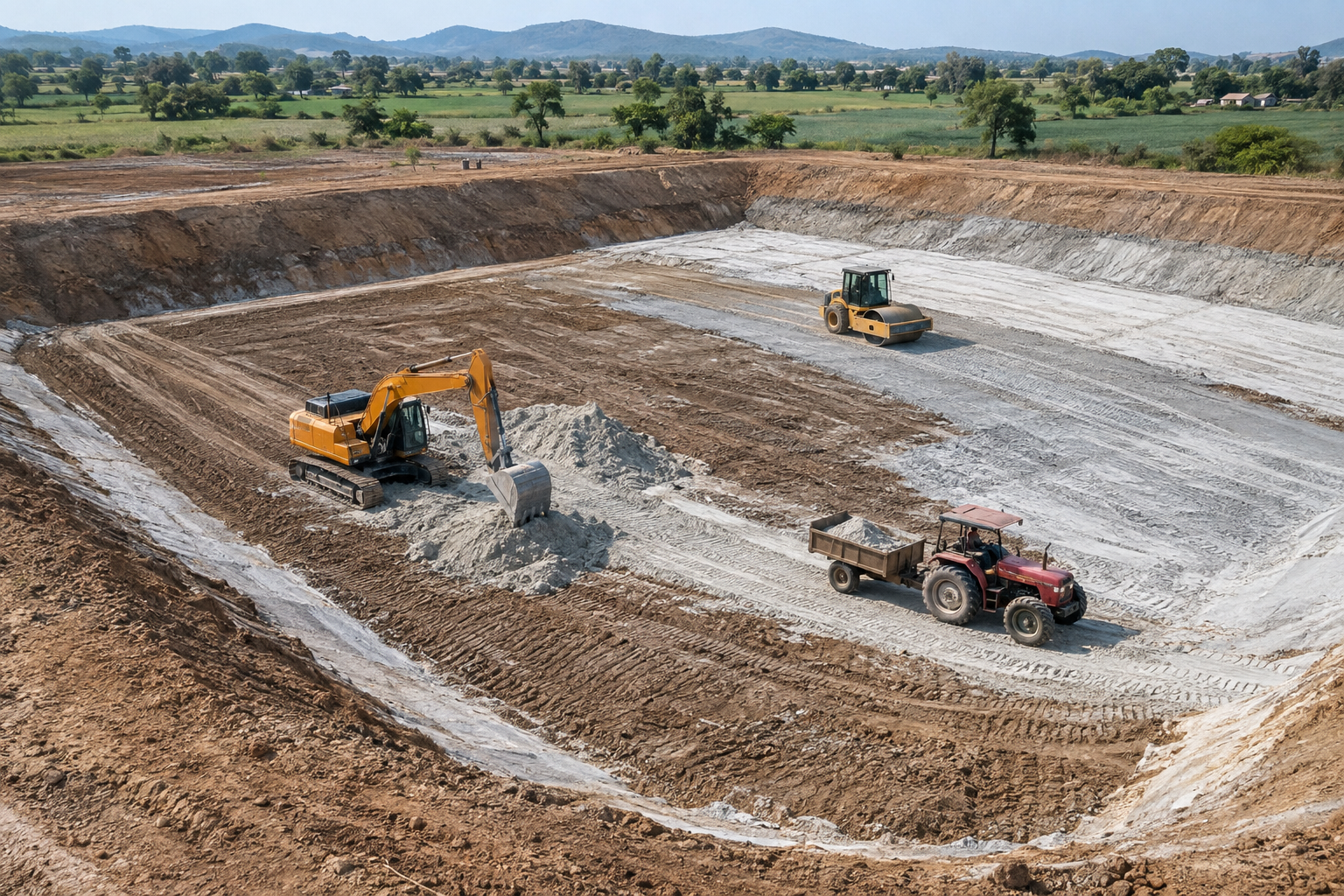
Sodium bentonite can be an effective way to reduce seepage in an earth-bottom pond, but the material only works well when the soil, application rate, moisture conditions, and compaction are right. Simply spreading bentonite over a leaking pond does not guarantee a watertight seal.
For most repair projects, the first question is not how much bentonite to buy. It is why the pond is losing water. A pond may be leaking through porous soil, cracks, animal burrows, roots, construction defects, or a damaged embankment. Some water loss is also normal because of evaporation and plant use. Identifying the cause helps determine whether bentonite is appropriate and which application method makes sense.
This guide explains how bentonite seals pond soil, how sodium bentonite differs from calcium bentonite, how to estimate the quantity required, what affects the cost, and how to install a bentonite seal correctly. It also covers the limitations of the material and the mistakes that commonly lead to failed pond-sealing projects.
Bentonite is a naturally occurring clay dominated by smectite minerals, commonly formed from altered volcanic ash. Sodium bentonite is particularly useful for sealing because it has a strong affinity for water and can expand substantially when hydrated.
When sodium bentonite is mixed into suitable soil and then wetted, the clay particles hydrate and occupy spaces between soil grains. Proper compaction brings those particles into close contact and reduces the connected pathways through which water can move. The result is a low-permeability soil layer that can substantially reduce seepage.
The sealing process is more accurately described as reducing soil permeability than as creating a completely impervious coating. The final performance depends on the quality of the bentonite, the characteristics of the existing soil, the amount applied, the thickness of the treated layer, and how thoroughly the material is mixed and compacted.
Sodium bentonite contains clay minerals with a structure that allows water to enter between microscopic layers. Sodium ions associated with the clay help promote expansion when the material becomes hydrated.
The amount of swelling varies considerably between deposits and products. Claims that bentonite always absorbs a specific number of times its weight or expands to a fixed multiple of its dry volume can be misleading. Laboratory swelling values don't automatically predict how a particular pond seal will perform in the field.
For that reason, buyers should look beyond a headline swelling figure. Product specifications, clay content, particle size, moisture content, compatibility with the site soil, and installation requirements all matter.
Bentonite is most useful when seepage is caused by porous or sandy soil and the pond can be treated as an earthwork project. It can work well for farm ponds, irrigation ponds, stock ponds, and other water-retention basins where a compacted clay-based seal is practical.
It is particularly attractive when the existing basin can be drained and prepared with earthmoving equipment. A dry basin makes it possible to inspect the soil, remove unsuitable material, distribute the bentonite accurately, mix it into the soil, and compact the treated layer.
Bentonite is not the right answer to every leak. A damaged outlet pipe, leaking concrete structure, large animal burrow, unstable embankment, sinkhole, fractured rock formation, or major structural defect may require a different repair. In those situations, adding clay may conceal the symptom without fixing the underlying problem.
Start by determining whether the observed water loss is actually abnormal. Compare the water level over several days while accounting for rainfall, evaporation, inflow, irrigation withdrawals, and livestock or other water use.
If the loss is significant, inspect the pond and embankment. Look for wet areas downstream of the dam, concentrated seepage, muddy water, animal burrows, cracks, exposed roots, and damaged pipes or spillways.
A professional assessment is worthwhile when the pond is large, the dam is important to public or downstream safety, or the source of leakage is uncertain. The repair method should follow the cause of the seepage rather than the availability of a particular clay product.
The type of bentonite matters because different bentonite products have very different swelling and sealing behavior.
| Property | Sodium Bentonite | Calcium Bentonite |
|---|---|---|
| Typical swelling behavior | High | Lower |
| Water interaction | Strong hydration and expansion | More limited expansion |
| Common sealing use | Pond and soil sealing | Often used for absorbent, binding, and other industrial applications |
| Suitability for pond sealing | Commonly preferred | Generally less suitable as the primary pond-sealing clay |
| What to verify | Product grade, swelling and gel specifications, purity, and suitability for soil sealing | Product specifications and intended application |
Sodium bentonite is generally the preferred bentonite for pond sealing because of its higher swelling potential. That does not mean every product labeled sodium bentonite will perform equally well. Mineral composition varies by deposit, and commercial products can differ in clay content and processing.
When buying material, ask the supplier for a technical data sheet and confirm that the product is intended for pond, soil, or water-retention sealing. Avoid choosing a product solely because it is the least expensive bulk clay available.
There is no single application rate that works for every pond. The required quantity depends heavily on soil texture and permeability, the design of the seal, and the installation method.
A commonly used planning range for sodium bentonite is roughly 1 to 5 pounds per square foot for treated soil, but site-specific recommendations can fall outside that range. Highly permeable soils may require more material, while soils containing substantial natural clay may require less. A qualified soil or pond-sealing specialist should determine the final rate for a large or expensive project.
The treated area also matters. For a blanket or mixed-soil treatment, calculate the actual basin area that will receive bentonite rather than simply using the pond's water-surface area. Side slopes and other treated surfaces can significantly increase the total area.
A simple planning calculation is:
For example, suppose a prepared pond has 10,000 square feet of soil requiring treatment and the selected rate is 3 pounds per square foot.
The calculation is 10,000 square feet multiplied by 3 pounds per square foot, giving 30,000 pounds. Dividing 30,000 pounds by 2,000 gives 15 short tons.
This is a material estimate, not a universal recommendation. The correct rate should come from soil conditions and the chosen sealing design.
A pond described as one acre has a water surface of approximately 43,560 square feet when it is at the reference water level. That figure does not necessarily equal the area that needs to be treated.
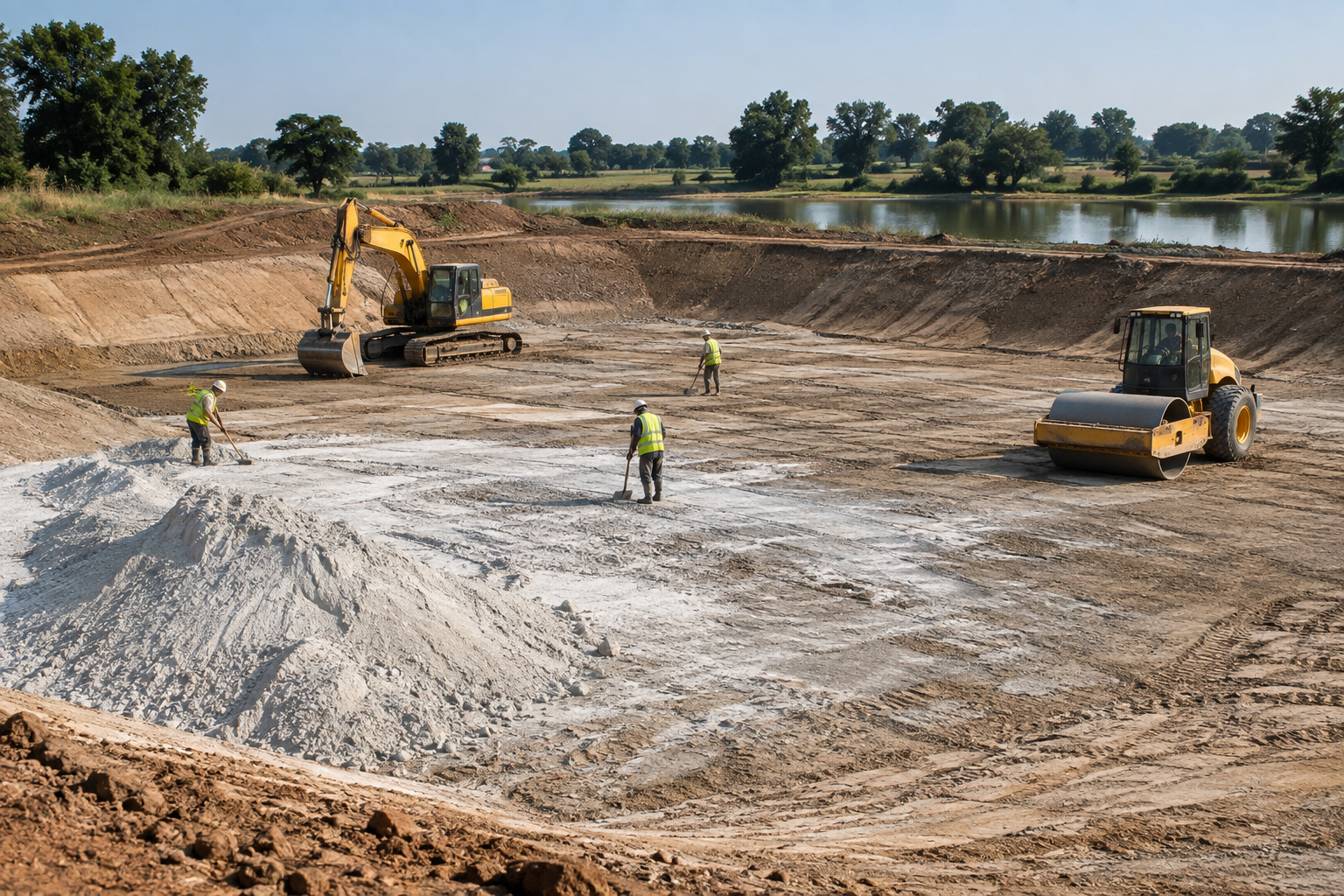
A basin with steep slopes may have a considerably larger wetted and treated surface than its horizontal water area suggests. Conversely, a repair may target only a defined area rather than the entire basin.
This is why an accurate quantity estimate should use a site plan, measured dimensions, or a survey where appropriate. Ordering material based only on the nominal acreage can lead to a serious shortfall or unnecessary excess.
The cost of a bentonite pond-sealing project has three major components: material, site preparation and equipment, and labor. Freight can also become a major expense when large quantities must travel a long distance.
Bulk sodium bentonite is normally priced by weight, but the delivered cost varies according to product grade, packaging, order volume, supplier, freight distance, and market conditions. Bags, supersacks, and bulk shipments can have very different unit costs.
For that reason, a fixed national price per ton is not a reliable budgeting figure. Request a delivered quotation for the exact quantity and product specification required for the site.
For a project requiring 15 tons, for example, compare the delivered price of 15 tons in bulk or supersacks rather than comparing only the advertised price per ton. A lower material price can be offset by higher freight or handling charges.
A dry-basin sealing project may require excavation or grading equipment, a disc harrow or tiller for mixing, a suitable roller for compaction, water-management equipment, and machinery for moving and spreading the bentonite.
Equipment costs depend on whether the owner already has suitable machinery, rents it locally, or hires a contractor. Site access also matters. A remote pond with poor road access can cost considerably more to prepare than a basin that machinery can reach easily.
Labor varies by region and by the amount of earthwork required. A straightforward treatment of an already-prepared basin is very different from a project that requires draining, excavation, grading, soil replacement, material spreading, mixing, and extensive compaction.
Instead of relying on a generic project-cost range, obtain separate estimates for material, freight, earthwork, equipment, labor, and any required testing. This makes it easier to see where the budget is going and compare contractor proposals on an equal basis.
Several factors can change the final price substantially:
A realistic budget should account for the whole repair rather than treating bentonite as the only project expense.
The right installation method depends on whether the pond can be drained, what the soil looks like, and how extensive the leakage is. The main approaches include mixed-soil treatment, a bentonite blanket, and applications made to an existing water body.
A dry-basin treatment is usually the most controllable option when a pond can be drained. The bentonite is distributed across prepared soil, mixed into a defined layer, and compacted to create a low-permeability zone.
Lower the water level as far as practical and allow the basin to dry enough for equipment to operate without excessive rutting. Inspect the exposed surface for cracks, soft zones, animal burrows, roots, organic material, and areas of unsuitable soil.
Drainage must be planned carefully. A pond should not simply be emptied without considering downstream flows, sediment release, fish and wildlife, or the stability of the embankment.
Remove vegetation, roots, organic debris, large rocks, and other material that could interfere with uniform mixing or compaction. Grade the basin where necessary.
Scarify or till the treatment zone to the depth specified by the sealing design. A commonly used treatment depth is several inches, but the appropriate depth depends on the project and soil conditions. The objective is to create a consistent soil-bentonite mixture rather than leave a thin layer of loose clay on the surface.
Distribute the calculated amount as evenly as possible over the prepared surface. Mechanical spreading generally provides better consistency on large ponds, while manual application may be practical for small repairs.
Uneven distribution can produce weak areas. A section with too little bentonite may remain highly permeable even when the surrounding soil is well sealed.
Till the bentonite thoroughly into the specified soil layer. Mixing should be consistent across the treatment area, including transitions and edges.
The exact depth and number of passes depend on the equipment and soil. Avoid creating a surface-only layer that can separate from the underlying material. The treated soil should behave as a reasonably uniform mixture before compaction begins.
Compaction works best when soil moisture is suitable for the particular material and equipment. Material that is too dry may not compact properly, while excessively wet soil can rut, smear, or lose strength.
Moisture conditioning should be based on the soil and compaction requirements rather than an arbitrary amount of water. Field testing can help confirm that the target condition is being achieved.
Compaction is one of the most important parts of the process. Use equipment appropriate for the soil and project design, such as a sheepsfoot or other suitable compactor.
Make enough passes to achieve the required density and close interconnected voids. The final result should be a dense, continuous sealing layer without obvious loose zones, cracks, or untreated strips.
Place the specified protective soil layer over the treated material where the design calls for one. Protection reduces the risk of erosion, animal disturbance, wave action, and damage from later traffic.
The thickness and material of this cover should suit the site. A protective layer isn't simply a cosmetic finishing step; it helps preserve the sealing zone after construction.
Refill the pond in a controlled manner after the sealing work is complete. Watch the banks, inlet areas, spillway, and other vulnerable locations as water levels rise.
A gradual refill can reduce the risk of disturbing newly prepared surfaces, but the appropriate filling rate depends on the soil, embankment, weather, and engineering requirements of the pond.
A bentonite blanket is a designed layer of bentonite placed between prepared soil layers. It differs from simply broadcasting clay over the ground because the bentonite is incorporated into a controlled sealing system and protected from disturbance.
The basin is first prepared and graded. Bentonite is then distributed at the specified rate, followed by the placement and compaction of the required soil layers. The design may use a dedicated bentonite layer or a soil-bentonite configuration depending on site conditions.
This method can provide consistent coverage when the basin is accessible and can be prepared properly. It is particularly useful when the project calls for a defined sealing layer rather than an informal surface treatment.
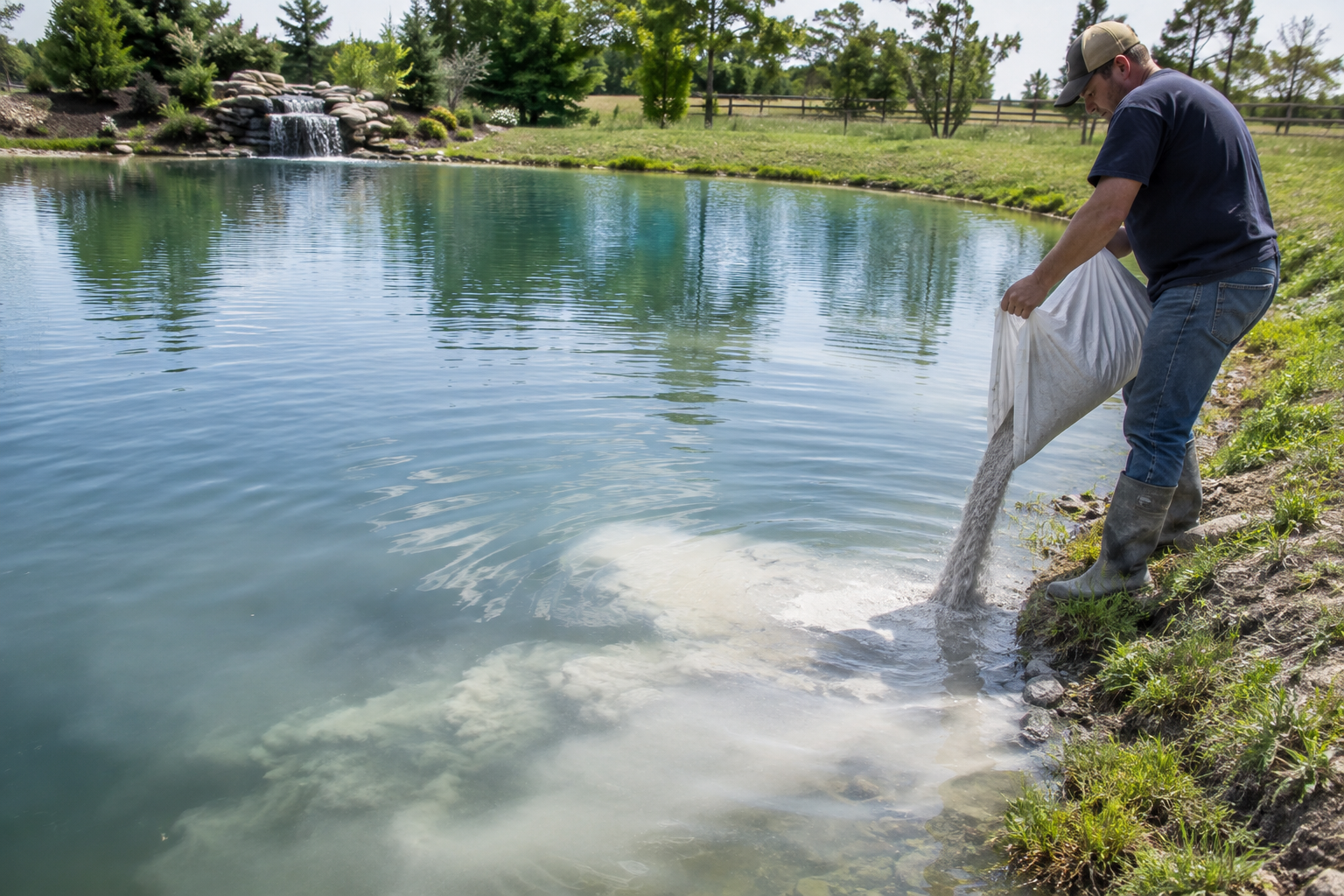
Applying dry bentonite to an existing pond is sometimes considered when draining isn't practical. However, underwater placement is much harder to control than a dry-basin installation.
The material can hydrate as it enters the water and settle into sediments, but there is no guarantee that it will reach the exact leaking pathway or form a continuous, adequately compacted seal. Wind, water movement, depth, sediment conditions, and the location of the seepage all affect the outcome.
For a significant leak, underwater broadcasting should not be treated as an automatic substitute for proper basin preparation. It may have a role in specific maintenance or localized situations, but the method should be selected with an understanding of its limitations.
Sometimes, but the answer depends on the cause and location of the leak. An existing pond can be treated with bentonite in certain circumstances, particularly when seepage is localized and the material can reach the affected area.
The challenge is that underwater application doesn't provide the same control over distribution and compaction as a dry-basin treatment. If the leak is caused by a large crack, animal tunnel, damaged pipe, unstable embankment, or permeable foundation, simply adding bentonite to the water may not solve the problem.
If the pond cannot be drained, identify the suspected leakage zone first. A qualified pond contractor or engineer can then determine whether underwater bentonite treatment is practical or whether another repair method is more appropriate.
One of the easiest mistakes is buying a clay product without confirming its mineral type and intended use. Sodium bentonite is generally preferred for pond sealing, but product quality still varies.
Check the technical specifications before ordering. Ask for information about swelling behavior, moisture content, particle size, clay content, and recommended applications where available.
A fixed pounds-per-square-foot figure is convenient for a quick estimate, but it cannot account for every soil condition. Coarse sand, sandy loam, silty soil, gravelly material, and existing clay can require different treatment strategies.
For a major pond, have the soil evaluated before purchasing the full quantity. Spending money on testing can be far less expensive than discovering after installation that the seal was under-designed.
Dry bentonite scattered over porous soil isn't equivalent to a properly constructed sealing layer. Water can move through untreated voids beneath or between areas of clay.
For a dry-basin treatment, follow the specified mixing and compaction procedure. The goal is a dense, continuous soil-bentonite zone, not a visible coating of clay on the ground.
Treating only the flat bottom can leave seepage pathways on the sides of the basin. The required treatment area should follow the actual sealing design and water-retention zone.
Don't assume that every pond needs bentonite all the way to an arbitrary height above the waterline. The correct extent depends on the basin geometry, expected water levels, soil conditions, and engineering design.
Roots, organic soil, debris, large rocks, and unstable material can create discontinuities in the sealing layer. Before applying bentonite, prepare the surface so the final treatment can be placed uniformly.
A newly prepared sealing layer can be vulnerable to erosion or disturbance. Follow the construction and moisture requirements of the selected sealing system before introducing water.
The pond should also be monitored during and after filling. Unexpected wet spots, concentrated seepage, or rapid water loss may indicate a problem that needs investigation.
Bentonite is one option among several. The best choice depends on soil conditions, pond size, construction access, leakage mechanism, expected service life, and available budget.
| Pond sealing method | Main advantage | Main limitation | Typical use |
|---|---|---|---|
| Soil-bentonite treatment | Uses natural clay-based material and can work with suitable onsite soil | Requires proper preparation and compaction | Earth-bottom ponds with suitable access |
| Bentonite blanket | Provides a defined sealing layer | Requires careful installation and protection | New construction or major rehabilitation |
| Compacted clay liner | Can provide a durable low-permeability layer | Requires suitable clay and thorough compaction | Larger engineered ponds and reservoirs |
| Synthetic liner | Predictable barrier when properly installed | Higher material and installation requirements; vulnerable to puncture | Sites where soil sealing is unsuitable |
| Concrete or masonry | Rigid and durable when correctly designed | Expensive and susceptible to cracking or structural issues | Structures and specialized water-retention applications |
Bentonite often makes the most sense when the pond is already an earth structure and suitable soil is available. A synthetic liner may be preferable where the foundation is extremely permeable, construction access is limited, or a defined manufactured barrier is required.
The supplier matters almost as much as the material specification. Large pond projects can require many tons of clay, so inconsistent product quality or poor logistics can create construction problems.
Before placing an order, ask the supplier for:
For agricultural, commercial, or industrial projects, consistency between deliveries is especially important. The contractor should know what material is arriving before the application rate is finalized.
Consider a hypothetical pond with 12,000 square feet of surface area and a larger calculated treated area of 15,000 square feet because the sealing design includes portions of the side slopes.
Suppose a site assessment results in a preliminary application rate of 3 pounds per square foot. The estimated bentonite quantity would be:
15,000 square feet multiplied by 3 pounds per square foot equals 45,000 pounds.
That is 22.5 short tons.
The owner should not immediately order 22.5 tons based on this calculation alone. The figure should be checked against the final treatment area, soil assessment, product specifications, installation method, and any allowance recommended by the contractor or engineer.
The cost estimate should then be built from the delivered bentonite price, freight, equipment, labor, site preparation, compaction, protective cover, and any testing or engineering work.
This approach produces a much more useful budget than multiplying the pond's acreage by a generic cost-per-acre figure.
There are situations where bentonite may be the wrong repair material.
If water is escaping through a failed pipe, the pipe needs to be repaired or replaced. If an embankment has a structural defect, the dam needs to be assessed and repaired appropriately. If the pond sits directly over fractured rock or a significant underground drainage feature, a conventional soil-bentonite treatment may not provide the required performance.
Similarly, a pond with extensive organic sediment may need excavation and reconstruction before any sealing treatment can be considered. Applying bentonite over unstable or unsuitable material doesn't fix the foundation.
The same principle applies to animal damage. A muskrat, nutria, or other burrowing animal can create a concentrated seepage pathway through an embankment. The burrow needs to be addressed as part of the repair rather than covered with clay alone.
A durable pond seal begins with good site preparation. Use a material that matches the intended application, determine the treated area accurately, and base the application rate on soil conditions rather than a generic online calculator.
Construction quality is just as important. Distribute the bentonite uniformly, mix it to the specified depth, condition the moisture appropriately, and compact the treated soil thoroughly. Protect the completed layer from erosion and unnecessary traffic.
After the pond is refilled, continue to inspect it. Water levels naturally fluctuate, so look for concentrated wet areas, unusual seepage, erosion, or persistent water loss rather than judging performance from a single day's water level.
For a major agricultural reservoir, commercial pond, dam, or project near downstream property, professional design and inspection are sensible safeguards. The cost of expert input is small compared with the expense of reconstructing a failed sealing system.
Bentonite can be an effective pond-sealing material, but successful results depend on more than the clay itself.
Bentonite is a useful tool for pond rehabilitation when the site conditions are suitable and the installation is treated as an engineered soil-sealing job. Choosing the right product and applying it correctly can make the difference between a temporary patch and a durable reduction in seepage.













Have questions about our products? We're here to help!