Axewelledge, a leading exporter from India, specializes in high-quality Bentonite. With a commitment to excellence, we supply premium Bentonite to the Middle East and Southeast Asia markets.


North Angle Complex, 304,
150 Feet Ring Rd, Opposite Ambedkar Nagar BRTS Stop,
Madhav Park, Punit Nagar,
Mavdi, Rajkot, Gujarat 360004
© Axewelledge 2026, All Rights Reserved.

Yes. Sodium bentonite is widely used to formulate slurry for slurry-shield and hydro-shield Tunnel Boring Machines (TBMs), particularly where the ground contains water-bearing sands, gravels, silts, or mixed formations. Its value comes from a combination of hydration, rheology, filtration, and suspension properties. When properly prepared and matched to the geology, a bentonite suspension can support the tunnel face, limit uncontrolled water inflow, transport excavated material, and reduce friction around the shield.
The important qualification is that bentonite isn't a universal tunneling fluid. The right formulation depends on ground permeability, groundwater chemistry, tunnel diameter, required face pressure, separation equipment, pipeline length, and the operating characteristics of the TBM. A slurry that works well in clean sand may behave very differently in saline groundwater or highly permeable gravel.
For that reason, tunnel slurry design is best treated as an engineering system rather than a simple matter of adding a fixed percentage of clay to water. The bentonite grade, mixing water, hydration time, concentration, additives, and recycling strategy all affect performance.
A slurry-shield TBM uses pressurized fluid in the excavation chamber to help control the ground immediately ahead of the cutterhead. Bentonite is commonly used to give that fluid the rheological and filtration properties needed for the job.
There are four main functions to keep in mind:
These functions are related, but they aren't identical. Increasing viscosity, for example, may improve suspension while also increasing pumping resistance. A higher bentonite concentration isn't automatically better. The objective is to achieve the required performance without creating unnecessary hydraulic losses, excessive solids loading, or separation problems.
The basic operating cycle is straightforward, although the fluid-management system behind it can be highly sophisticated.
The cutterhead excavates the soil or rock while the excavation chamber is maintained at a controlled pressure. Bentonite slurry circulates through the chamber and becomes loaded with excavated material. The contaminated slurry is then pumped through the return line to a surface treatment plant, where screens, hydrocyclones, desanders, desilters, and other equipment separate solids from the reusable suspension.
After cleaning, the slurry is tested and conditioned. Water, fresh bentonite, or other additives may be introduced to restore the required density and rheological properties before the fluid returns to the TBM.
The process can therefore be viewed as a continuous loop:
Good slurry management is what makes bentonite useful at TBM scale. The powder itself is only one part of the system.
A common source of confusion is the difference between slurry-shield TBMs and Earth Pressure Balance, or EPB, TBMs. Both machines control the tunnel face, but they normally do so using different conditioning systems.
A slurry-shield machine uses a pressurized liquid suspension in the excavation chamber. The slurry can be circulated between the TBM and a surface separation plant, where excavated solids are removed and the fluid is conditioned for reuse.
An EPB machine generally uses conditioned excavated soil as the pressure-supporting medium. Foams, polymers, water, or other conditioners can be injected to modify the soil's plasticity, permeability, and transport characteristics.
| Feature | Slurry Shield TBM | EPB TBM |
|---|---|---|
| Face-support medium | Pressurized liquid slurry | Conditioned excavated soil |
| Common fluid system | Bentonite-based suspension | Water, foam, polymer, or other conditioners as required |
| Separation plant | Usually an important part of the system | Generally less central to the excavation cycle |
| Strong application area | Water-bearing permeable ground | Cohesive and mixed soils suitable for pressure-controlled soil conditioning |
| Muck transport | Hydraulic pipeline | Screw conveyor or related mechanical system |
| Main fluid challenge | Rheology, filtration, density, solids control, and chemistry | Soil conditioning, plasticity, permeability, and pressure control |
Neither machine type is inherently better. Selection depends on the ground conditions and project requirements. In difficult water-bearing granular formations, slurry-shield technology can provide particularly strong control over face pressure and fluid filtration.
The effectiveness of bentonite in permeable ground is closely linked to filter-cake formation. Understanding this mechanism is more useful than simply thinking of bentonite as a thickening agent.
When slurry contacts a permeable soil face, some of the liquid phase initially attempts to enter the pore spaces. Bentonite particles are retained near the surface as the liquid filters into the formation. The retained clay particles form a relatively thin, low-permeability layer called a filter cake or filter membrane.
The quality of this cake matters. A good filter cake restricts further fluid loss while allowing the pressure in the excavation chamber to act more effectively on the soil skeleton.
This mechanism is particularly important in sands and other granular formations where pore openings are suitable for filtration. The exact behavior depends on particle-size distribution, permeability, slurry properties, pressure differential, and the interaction between the bentonite and native ground.
Very coarse gravel, cobbles, open-work deposits, and fractured formations can be more difficult. If the formation's openings are large relative to the bentonite particles, the slurry may penetrate farther before an effective filter cake develops.
That can cause rapid fluid loss and make pressure control more difficult. In these conditions, engineers may modify the bentonite concentration, add suitable polymers or bridging materials, or use other ground-treatment measures. The solution should be based on laboratory testing and field observations rather than a fixed recipe.
Bentonite also contributes to the suspension's yield stress and gel behavior. These properties help keep solids suspended when circulation slows or stops. The target isn't simply maximum viscosity. Engineers need a rheological profile that supports face control and solids transport while remaining pumpable and compatible with the separation plant.
A bentonite grade intended for tunneling should be evaluated for the actual slurry system rather than selected from one specification alone.
Sodium bentonite contains a high proportion of swelling clay minerals, principally montmorillonite. When exposed to water, the clay hydrates and develops a dispersed structure that contributes to viscosity, gel strength, and filtration control.
Free-swell measurements can provide useful information about raw-material behavior, but free swell alone doesn't predict TBM performance. Two bentonites with similar swelling results can behave differently after exposure to hard water, contaminated return slurry, or high concentrations of suspended solids.
Yield stress describes the minimum stress required for the fluid to begin flowing under a particular test model. In practical TBM operations, sufficient yield stress can help suspend excavated particles and reduce settling when the slurry is moving slowly.
Too little yield stress can allow solids to settle in pipelines or the excavation chamber. Too much can increase pressure losses and make pumping and separation more difficult. The useful target is therefore application-specific.
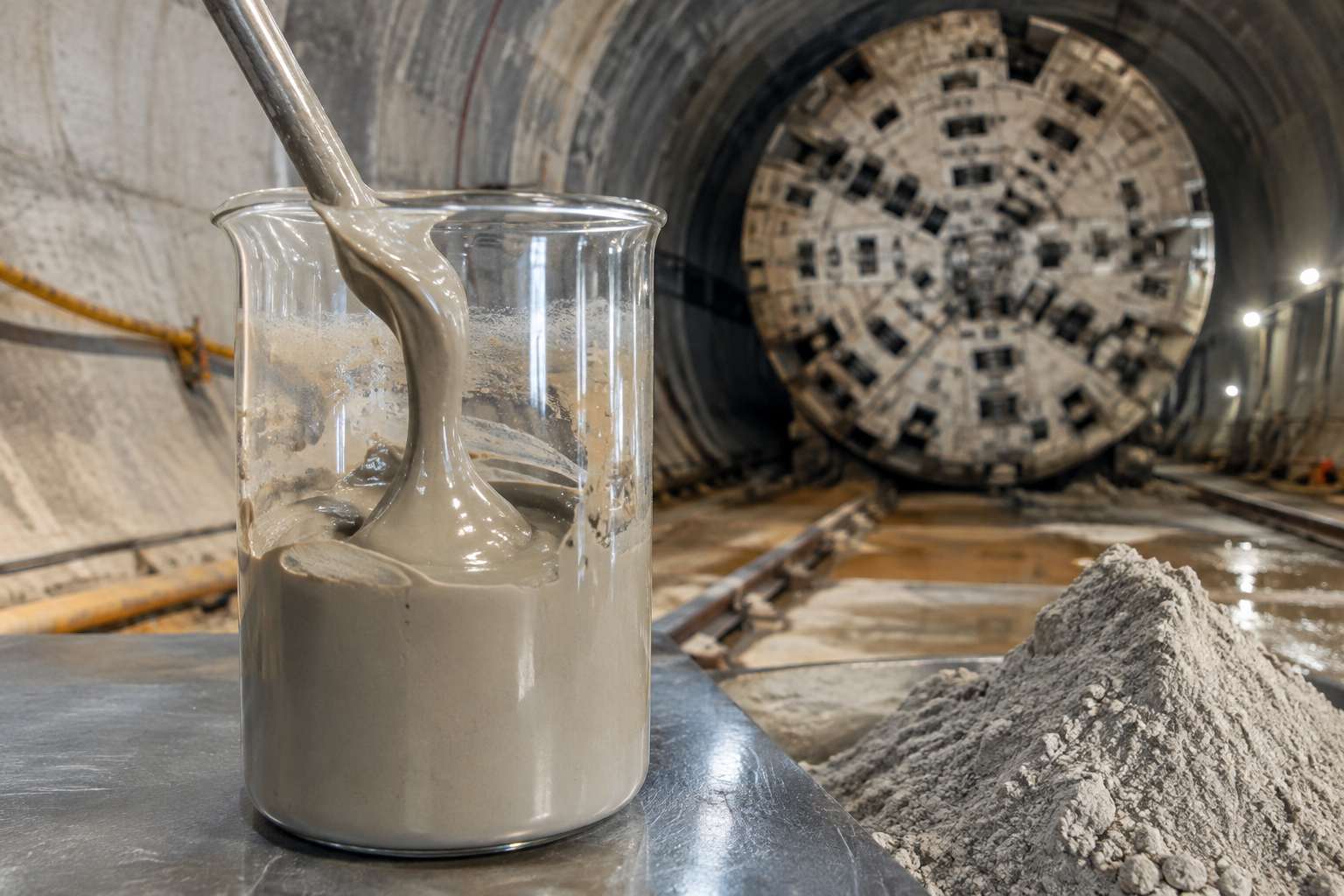
Plastic viscosity represents resistance to flow after the yield threshold has been exceeded in common rheological models. It is affected by bentonite concentration, solids loading, water chemistry, temperature, and other additives.
A rising viscosity in returned slurry can be a warning that fine solids are accumulating faster than the separation plant can remove them. This is one reason slurry testing must continue throughout a drive rather than stopping after initial commissioning.
Gel strength describes how a suspension develops structure while at rest. Controlled gel development can help keep solids suspended during planned interruptions, such as pauses associated with maintenance or ring installation.
Excessive gel strength, however, can make restart more difficult and increase the energy required to circulate the slurry. The best formulation balances suspension stability with restart behavior.
Fluid-loss testing indicates how readily the liquid phase passes through a filter medium under specified test conditions. Lower fluid loss is generally associated with better filtration control, but a laboratory fluid-loss number should never be treated as a direct guarantee of field filter-cake performance.
Tunneling specifications should therefore define the actual test method, concentration, water chemistry, and acceptance criteria. API drilling-fluid tests can provide useful reference information for some bentonite products, but tunneling projects may use project-specific methods and acceptance limits.
Slurry density increases when the fluid carries excavated material. Fine particles that remain in circulation can also accumulate over repeated cycles.
A high density may indicate inadequate separation, excessive formation fines, or insufficient slurry replacement. Density should be considered together with sand content, viscosity, yield stress, and the performance of the separation plant rather than interpreted in isolation.
There is no single worldwide bentonite specification that applies to every slurry TBM. Project requirements should be established from laboratory testing using the actual mixing water and representative soil.
The following table is best treated as a screening framework, not a universal purchasing specification.
| Property | Common evaluation approach | Why it matters |
|---|---|---|
| Montmorillonite content | Mineralogical analysis such as XRD | Indicates the principal swelling clay component |
| Free swell | Standardized swell test | Provides an initial indication of hydration and swelling behavior |
| Liquid limit | Standard geotechnical test | Helps characterize clay behavior and water interaction |
| Fluid loss | Project-defined filtration test | Indicates filtration-control performance under the selected test conditions |
| Moisture content | Oven-drying method | Important for storage, dosing, and quality control |
| Particle-size distribution | Sieve or other particle-size analysis | Affects mixing, hydration, and handling |
| Rheology after hydration | Marsh funnel and/or rotational rheometer | Helps assess viscosity, yield behavior, and suspension performance |
| Sand content | Standardized sand-content test | Helps monitor contamination and separation efficiency |
| Slurry density | Mud balance or calibrated density measurement | Supports mass-balance and operating control |
| Water chemistry | Hardness, salinity, pH, and ion analysis | Strongly influences bentonite hydration and rheology |
The most useful specification is the one that connects raw bentonite quality with the slurry properties required by the TBM. A high swelling value on a certificate is not enough if the material loses performance in the project's actual water chemistry.
Mixing is often underestimated. Bentonite particles can form hydrated skins around dry agglomerates if powder is added too quickly or dispersed poorly. Those partially hydrated lumps may take much longer to break down and can produce inconsistent slurry properties.
Test the available water before preparing the main slurry. Hardness, calcium, magnesium, salinity, suspended solids, and pH can all affect bentonite behavior.
If the water contains substantial concentrations of divalent ions, treatment may be appropriate. Soda ash is sometimes used to reduce the effect of calcium hardness, but the treatment rate should be based on water analysis rather than a blanket dosage.
Introduce bentonite through suitable mixing equipment at a controlled rate. High-shear mixers, jet mixers, or venturi-type systems can help disperse the powder efficiently.
Avoid dumping large quantities of dry bentonite directly into a stagnant tank. Poor dispersion creates lumps and makes the final slurry harder to control.
Bentonite doesn't necessarily reach its final rheological state immediately after mixing. Hydration time depends on the grade, particle size, water chemistry, mixing energy, concentration, and temperature.
Some systems require several hours of maturation, while others can reach usable properties more quickly. An eight-hour or twenty-four-hour holding period shouldn't be imposed as a universal rule without considering the actual product and project process.
The practical approach is to establish hydration behavior through laboratory and plant trials, then maintain a controlled maturation procedure.
Before slurry enters the TBM circuit, measure the properties that matter for the project. Depending on the specification, this may include density, viscosity, yield stress, gel strength, pH, filtration behavior, and sand content.
Testing gives the fluid team a baseline. Once contaminated return slurry begins entering the circuit, changes can be traced against that baseline.
Once the machine is running, bentonite management becomes a continuous control task.
Face pressure must be matched to the calculated ground and groundwater conditions while accounting for machine position, elevation, pressure losses, and operational changes. Bentonite itself doesn't determine the correct face pressure.
The slurry provides the medium through which pressure is transmitted and controlled. Instrumentation and geotechnical calculations remain essential.
The slurry needs enough carrying capacity to move excavated solids through the pipeline without excessive settling. Pipeline length, diameter, flow rate, particle size, density, and rheology all influence transport performance.
If solids settle, the problem may not be solved simply by increasing bentonite concentration. Higher viscosity can increase pumping losses. Adjustments should be made alongside checks of flow rate, separation efficiency, and the actual particle-size distribution of the muck.
The surface treatment plant is effectively part of the slurry system. If it removes too little material, solids accumulate in the circulating fluid. If it removes too much usable bentonite along with the unwanted solids, bentonite consumption and replacement costs rise.
The objective is selective separation: remove the excavated material that needs to leave the circulation loop while retaining as much useful slurry as practical.
One of the major advantages of a slurry TBM system is that the carrier fluid can often be reused.
Returned slurry first passes through coarse separation equipment that removes larger particles. Hydrocyclones can then remove finer sand fractions, while additional equipment may target still finer solids. The exact plant arrangement depends on geology and project requirements.
After separation, the recovered slurry is tested. If its properties have moved outside the operating window, the fluid can be adjusted with fresh bentonite, water, or other approved additives.
Recycling becomes more challenging as ultrafine particles accumulate. These particles can be difficult to remove economically and may gradually change density, viscosity, filtration behavior, and chemical balance. At that point, partial replacement or controlled bleed-and-feed operation may be more effective than trying to recycle every litre indefinitely.
Highly permeable gravel can accept slurry faster than a stable filter cake can develop. The result may be falling slurry levels, pressure instability, or increased bentonite consumption.
The first response should be to confirm the geology and quantify the losses. Engineers may then adjust slurry concentration or rheology and consider suitable bridging or loss-control materials. Ground improvement may also be required in extreme conditions.
Simply adding more bentonite isn't always the answer. If the pore openings are very large, increasing clay concentration may raise viscosity without adequately stopping the loss.
Calcium and magnesium ions can reduce the swelling and dispersion of sodium bentonite. High salinity can have an even stronger effect, depending on the bentonite grade and concentration.
Symptoms can include lower viscosity, weaker gel structure, and increased fluid loss. Water treatment, a more salt-tolerant bentonite, polymer modification, or a combination of measures may be considered after testing.
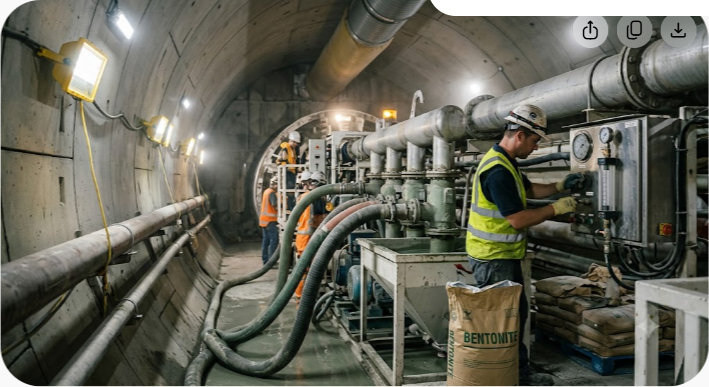
High sand content increases abrasion in pumps and pipelines and reduces the effective volume of active bentonite slurry. It may also indicate that the separation plant isn't operating efficiently.
Check hydrocyclone pressure, screen condition, feed concentration, flow rate, and solids loading before changing the bentonite formulation. The root cause is often mechanical or process-related rather than a deficiency in the clay itself.
A gradual increase in density can indicate accumulation of fine excavated solids. If density continues to rise, the slurry may become harder to pump and separate.
Compare density with viscosity, sand content, and particle-size data from the return stream. If the separation plant cannot maintain the desired solids balance, controlled slurry replacement may be necessary.
Bentonite is not automatically the best solution for every clay-related problem. Highly cohesive clay can adhere to cutterhead surfaces and interfere with excavation.
Depending on the TBM design and soil properties, engineers may modify the conditioning strategy with suitable polymers, dispersants, water, or other approved additives. The treatment should be selected through soil-conditioning trials rather than by assuming that more bentonite will solve the problem.
Polymers can play an important supporting role in tunneling fluids, but they don't simply duplicate the behavior of bentonite.
Bentonite is particularly useful when filtration control and filter-cake formation are important. Certain polymers can provide high viscosity at relatively low concentrations and can improve lubrication, suspension, or tolerance to specific water chemistries.
A polymer-modified bentonite system may therefore outperform either material used alone in a particular formation.
| Consideration | Bentonite | Polymer | Bentonite plus Polymer |
|---|---|---|---|
| Filter-cake development | Strong potential in suitable granular soils | Depends strongly on polymer type and ground conditions | Can be tailored for filtration and rheology |
| Yield behavior | Naturally develops structured rheology | Highly dependent on polymer chemistry | Adjustable over a broad operating range |
| Water chemistry tolerance | Grade-dependent | Polymer-dependent | Can be engineered for difficult water |
| Reclamation | Generally compatible with mechanical separation | Some polymers may degrade under shear | Requires project-specific evaluation |
| Typical role | Primary slurry-forming clay | Conditioning or performance modifier | Combined fluid-engineering system |
The right comparison isn't simply cost per kilogram. Engineers should consider the cost per usable cubic metre of slurry, fluid replacement rate, separation losses, transport performance, water treatment, and disposal requirements.
There is no reliable universal consumption figure based only on tunnel length. Bentonite consumption can vary substantially from one project to another.
The major factors include:
A better way to estimate consumption is to establish a material balance. Start with the volume of slurry circulating in the system, then account for bentonite retained in the formation, removed with separated solids, lost during dewatering, and deliberately discharged as part of slurry management.
For procurement planning, consumption should be calculated from site trials and expected geology rather than using a generic kilograms-per-metre figure.
Used slurry contains more than bentonite. It can also contain excavated soil, very fine mineral particles, groundwater contaminants, treatment chemicals, and other materials picked up during circulation.
That means disposal decisions should be based on the actual composition of the spent material and the environmental requirements of the project location.
Filter presses, centrifuges, and other dewatering systems can separate water from fine solids. The recovered water may be suitable for reuse after appropriate testing and treatment.
The resulting filter cake can contain concentrated fine soil and bentonite. Before reuse or disposal, it should be characterized according to applicable local requirements.
Clean mineral solids may have potential applications in fill, construction materials, or other approved uses. Reuse isn't automatically permitted, however. The material must meet the relevant engineering and environmental criteria for its intended application.
Spent bentonite slurry should not be discharged to waterways, drains, or sewers simply because bentonite itself is a naturally occurring clay. The environmental profile of the entire spent slurry must be considered.
A well-designed waste-management plan should address containment, testing, dewatering, water reuse, solids transport, and final disposal before tunneling begins.
Buying bentonite by product name alone is risky. A tunneling-grade material should be evaluated against the conditions in which it will actually operate.
Identify whether the drive will pass through clean sand, silty sand, gravel, mixed ground, cohesive soils, or fractured rock. Permeability and particle-size distribution are especially important for predicting filtration behavior.
Send representative water to the bentonite supplier or laboratory. Hardness and salinity can change the performance of a clay that looks excellent when tested in demineralized laboratory water.
Evaluate the bentonite at several concentrations using the actual water. Measure hydration, viscosity, yield behavior, filtration, density, and other parameters specified by the project.
Where possible, perform filtration or slurry-ground interaction tests using representative formation material. This gives a much more useful indication of filter-cake behavior than a raw bentonite certificate alone.
Large TBM drives can consume substantial quantities of bentonite over long periods. Consistent mineralogy, moisture, particle size, packaging, and performance are therefore important.
A supplier should be able to provide batch documentation and support a quality-control program that allows incoming material to be compared with the approved reference grade.
Ground conditions change. A concentration that performs well in one section may be excessive or inadequate in another. Slurry management should respond to measured performance and changing geology.
A bentonite that performs well during factory testing may behave poorly in calcium-rich or saline site water. Always test the actual water used for batching.
Higher viscosity can improve suspension, but it also increases pumping resistance and may make separation more difficult. The target should be controlled rheology, not maximum thickness.
API bentonite standards and drilling-fluid tests can be useful reference tools, but tunneling projects have different equipment, operating conditions, and performance requirements. Project-specific acceptance criteria should be established accordingly.
Poor slurry performance is sometimes blamed on the bentonite when the real problem is inadequate solids separation. Screens, hydrocyclones, pumps, and desilters all influence the quality of recycled slurry.
Free swell, fluid loss, viscosity, or montmorillonite content can each provide useful information, but none tells the complete story. A successful TBM slurry formulation is defined by the combined performance of the fluid system.
Before and during a slurry-shield drive, the fluid team should routinely check the following:
Bentonite for tunnel boring slurry is most valuable when it is treated as part of an engineered fluid-management system. Sodium bentonite can provide the filtration, rheology, suspension, and pressure-transmission characteristics required by many slurry-shield TBM projects, especially in permeable water-bearing ground.
The key is balance. The slurry needs enough structure to support the face and transport excavated material, but not so much that pumping and separation become inefficient. It needs effective filtration without excessive formation loss. It must remain stable in the project's actual water chemistry and tolerate repeated circulation through the separation plant.
For that reason, the best tunneling bentonite isn't simply the product with the highest swelling value or the lowest purchase price. It is the grade that delivers consistent performance with the project's water, soil, TBM, separation plant, and operating procedure.
Laboratory testing, controlled field trials, continuous slurry monitoring, and disciplined reclamation provide the foundation for that performance. When those pieces work together, bentonite slurry becomes a practical tool for maintaining face stability, controlling fluid loss, transporting muck, and keeping a slurry-shield TBM operating predictably over a long underground drive.













Have questions about our products? We're here to help!