Axewelledge, a leading exporter from India, specializes in high-quality Bentonite. With a commitment to excellence, we supply premium Bentonite to the Middle East and Southeast Asia markets.


North Angle Complex, 304,
150 Feet Ring Rd, Opposite Ambedkar Nagar BRTS Stop,
Madhav Park, Punit Nagar,
Mavdi, Rajkot, Gujarat 360004
© Axewelledge 2026, All Rights Reserved.
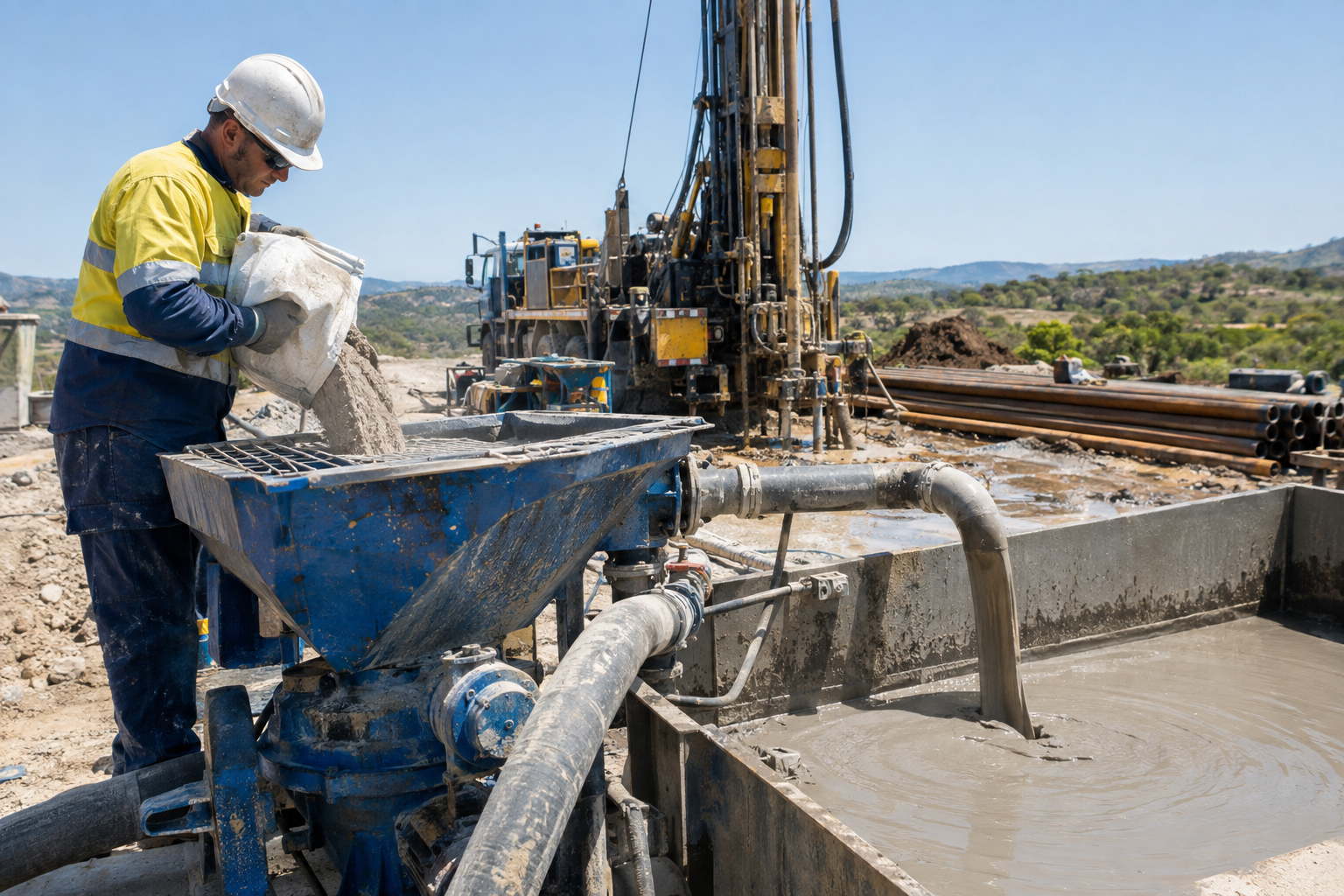
Bentonite for drilling water wells is used primarily to keep the borehole stable, control fluid loss, and transport drilled cuttings to the surface. When the right grade of sodium bentonite is properly hydrated, it gives the drilling fluid viscosity and gel strength while forming a low-permeability filter cake against permeable formations.
That combination is what makes bentonite so useful. Clear water can cool the bit and carry cuttings when circulation is fast enough, but it offers little protection against borehole collapse and has almost no ability to hold cuttings in suspension when circulation stops. In loose sand, gravel, weathered rock, or fractured formations, those limitations can quickly become a drilling problem.
A bentonite mud system addresses several of those problems at once. The hydrated clay increases the carrying capacity of the fluid, reduces uncontrolled seepage into permeable formations, and helps support the borehole wall. It can also provide useful lubrication and cooling as fluid circulates through the drill string and annulus.
The important point is that more bentonite isn't automatically better. Mud properties need to match the formation, drilling method, pump capacity, annular velocity, and well design. A mud that is too thin may fail to carry cuttings or control fluid loss; a mud that is unnecessarily thick can increase pump pressure, slow drilling, and make well development harder.
This guide explains how bentonite works in water well drilling, where it provides the most value, how to mix and test it, how it compares with polymers, and which mistakes can cause problems during drilling and well completion.
Bentonite is a clay material composed predominantly of smectite minerals, particularly montmorillonite. Many commercial bentonites originate from volcanic ash that altered over geological time. Their behaviour depends on mineralogy, exchangeable ions, particle size, moisture content, processing, and the chemistry of the water used for hydration.
For drilling fluids, sodium-dominant bentonite is commonly selected because it can hydrate strongly in fresh water and develop useful viscosity and gel strength. Calcium-dominant bentonite generally hydrates and swells less than sodium-dominant bentonite, although suitability ultimately depends on the specific product and drilling application.
The useful properties of bentonite come from its microscopic plate-like particles. When a suitable bentonite is dispersed in fresh water, water enters between the mineral layers and the particles become highly hydrated. With sufficient mixing and time, the dispersed clay forms a structured suspension rather than behaving like ordinary water.
That structure gives the drilling fluid several practical characteristics:
During rotary drilling, the mud is pumped down the drill pipe and exits near the bit. It then travels upward through the annular space between the drill string and borehole wall, carrying cuttings back to the surface. At the surface, solids are separated or allowed to settle before the fluid is recirculated.
The exact circulation system varies with the rig, drilling method, formation, and site conditions. A small water well rig may use relatively simple settling pits, while a larger project may use tanks, screens, desanders, centrifuges, or other solids-control equipment.
The main reason to use bentonite is not simply to make water thicker. A properly designed bentonite mud system manages the interaction between the drilling fluid, formation, cuttings, and drilling equipment.
The most important benefits are below.
Unconsolidated formations can be difficult to drill because the walls aren't naturally strong enough to remain open. Sand and gravel can slough into the hole, while fractured formations may allow drilling fluid to escape rapidly.
Bentonite helps in two related ways. First, the fluid column produces hydrostatic pressure against the borehole wall. The pressure depends on the density of the drilling fluid and the height of the fluid column. Second, hydrated bentonite can deposit a filter cake on permeable sections of the formation.
The filter cake is particularly important. As drilling fluid contacts a permeable formation, some of its liquid phase tends to enter the formation. The larger suspended solids are retained at the borehole wall and accumulate into a relatively low-permeability layer. Bentonite is effective at building this cake because its fine particles can pack together and restrict further fluid loss.
A good filter cake doesn't need to be excessively thick. In many cases, a thin, consistent cake is preferable to a heavy accumulation of solids. Excessive cake can complicate well development and increase the work needed to restore formation permeability around the screen.
Borehole stability therefore comes from the combined effect of hydrostatic pressure, filter-cake formation, appropriate circulation, and sensible control of drilling-fluid properties. Bentonite is an important part of that system, but it isn't a substitute for good drilling practice.
Every drilled metre produces cuttings. Those particles have to travel from the bottom of the hole to the surface without settling back onto the bit or accumulating in the annulus.
The upward velocity of the circulating fluid is a major factor. If annular velocity is too low for the size and density of the cuttings, solids can settle even when the mud has reasonable viscosity.
Bentonite improves the carrying capacity of the fluid by increasing viscosity and developing a structured suspension. This gives the circulating fluid more ability to keep particles moving toward the surface.
Gel strength is also important. Drilling doesn't continue at a perfectly constant rate. Pumps may be slowed or stopped while the crew adds drill pipe, checks equipment, changes operating parameters, or deals with a downhole issue. A properly conditioned bentonite mud can develop gel strength during static periods, helping prevent cuttings from settling rapidly.
When circulation resumes, the mud structure breaks down under shear and flows again. This behaviour is commonly described as thixotropic. The practical advantage is simple: the drilling fluid can flow during circulation while retaining some capacity to suspend solids when movement stops.
That doesn't mean cuttings will remain suspended indefinitely. Excessive solids loading, poor mud conditioning, inadequate gel strength, or a long static period can still lead to settling. Good solids control remains essential.
Fluid loss becomes a concern whenever drilling passes through a permeable formation. If large volumes of drilling fluid disappear into the formation, circulation can weaken or stop, and the fluid level in the borehole can fall.
Hydrated bentonite helps limit this loss by forming a filter cake. Fine clay particles accumulate at the formation interface and restrict the movement of the liquid phase into the formation.
The quality of the filter cake matters as much as the fact that one exists. A useful cake should control fluid loss without becoming unnecessarily thick or difficult to remove during completion.
This is one reason drilling-grade bentonite should be selected according to the actual application rather than simply by price per bag. A product with suitable hydration, yield, rheology, and solids characteristics can perform very differently from an untreated or poorly matched clay.
Drilling creates heat through friction between the bit, drill string, formation, and circulating fluid. Circulation helps transfer heat away from the cutting zone and transport it back to the surface.
Bentonite mud can also provide lubrication. The hydrated clay suspension helps reduce friction between the drill string and borehole wall, although the degree of lubrication depends on the mud formulation, formation, drilling method, and other additives present.
Lower friction can reduce mechanical stress on the drilling system. It can also make pipe movement and rotation easier in some formations.
It is worth keeping expectations realistic, though. Bentonite is primarily selected for its suspension and filtration characteristics. Where extreme lubrication is required, drillers may use compatible lubricants or other fluid additives designed for that purpose.
A column of drilling fluid exerts pressure on the formation. This hydrostatic pressure can help balance formation pressures and maintain a stable borehole.
The relationship is straightforward: greater fluid density and a taller fluid column produce greater hydrostatic pressure. In practice, the drilling fluid needs to be heavy enough to maintain control without creating excessive pressure on the formation.
This balance is particularly important when drilling into formations containing groundwater under pressure. An inappropriate mud system can contribute to unwanted inflow, lost circulation, or formation damage.
Water well drilling generally doesn't require the same mud-weight management used in oil and gas drilling. Adding weighting materials such as barite is uncommon for ordinary water well work and should never be treated as a default solution. The drilling programme and formation conditions should determine whether any density adjustment is necessary.
Loose sand and gravel are among the formations where bentonite can be especially valuable. These materials may collapse into an open borehole, absorb drilling fluid, or allow cuttings to settle rapidly.
A properly conditioned bentonite mud can create a filter cake and provide the suspension needed to keep the hole cleaner. This doesn't eliminate the need to control drilling speed, pump rate, annular velocity, and solids content. It gives the driller a better fluid system with which to manage those variables.
Bentonite is useful during drilling, but the drilling fluid is not intended to remain as a permanent barrier across the production interval. Once the casing and screen are installed, the well generally needs to be developed so that drilling-fluid residues and formation fines are removed and the aquifer can communicate properly with the screen.
This distinction matters. Bentonite used as a drilling fluid and bentonite used as a permanent annular seal are related applications, but they are not interchangeable jobs. A drilling mud is designed to circulate and be removed. A well seal is designed to remain in place and prevent unwanted vertical movement of water.
Sodium bentonite isn't the only option for water well drilling. Polymer-based drilling fluids are also used, particularly where low-solids systems, shale inhibition, lubrication, or specialised rheology are important.
The choice isn't necessarily a simple bentonite-versus-polymer decision. Some drilling programmes use bentonite alone, some use polymers, and others combine a clay-based system with compatible additives.
| Feature | Sodium Bentonite | Polymer-Based Fluid |
|---|---|---|
| Filter cake | Strong fluid-loss-control capability when properly formulated | Depends strongly on polymer type and formulation |
| Cuttings suspension | Good viscosity and gel-strength development | Can provide strong carrying capacity with suitable formulation |
| Borehole support | Useful in loose and permeable formations | Depends on fluid design and formation conditions |
| Hydration | Requires adequate dispersion and hydration time | Many products disperse rapidly, but behaviour varies by chemistry |
| Water sensitivity | Performance can be affected by hardness and salinity | Polymer performance also varies with water chemistry |
| Solids loading | Can tolerate solids, but excessive sand degrades mud performance | Often selected for low-solids systems |
| Formation interaction | Can interact strongly with reactive clays | Some polymers help reduce clay dispersion and bit balling |
| Well development | Filter cake may need effective removal | Cleanup requirements depend on the formulation |
| Cost | Often economical for conventional drilling | Can be more expensive depending on product and concentration |
For a borehole through loose, permeable sand and gravel, filter-cake performance may make bentonite particularly attractive. For reactive clay formations, a polymer system or a carefully selected bentonite-polymer formulation may provide better control.
The right question is therefore not which material is universally superior. The better question is which fluid system provides the required rheology, filtration control, solids management, and formation compatibility for the specific well.
Good bentonite can perform poorly if it is mixed badly. The most common problem is incomplete hydration caused by dumping too much dry powder into a tank or pit at once.
The following procedure provides a practical starting point, but the final concentration should be adjusted according to the bentonite manufacturer's technical data and the drilling conditions.
Water quality has a direct effect on bentonite hydration. Fresh, relatively soft water generally provides better hydration than water containing high concentrations of calcium, magnesium, or other dissolved salts.
Before mixing, check the water source when its chemistry is unknown. Pay particular attention to hardness, salinity, and pH. There is no single water-quality specification that applies to every bentonite product, so the manufacturer's recommended limits should take priority over a generic target.
If hardness is interfering with hydration, drillers may condition the water with soda ash or another suitable treatment. The amount should be determined from the measured water chemistry rather than added by guesswork.
Bentonite needs to be dispersed, not simply wetted. A venturi hopper or other suitable high-shear mixing system helps break the powder into individual particles as it enters the water stream.
The purpose of the hopper is to prevent large dry clumps from forming. Good dispersion gives water access to more clay surface area and improves the consistency of hydration.
For larger drilling operations, a dedicated mixing tank with appropriate agitation may be used. The important thing is to create enough turbulence and circulation for the powder to disperse thoroughly.
Add the powder at a controlled rate rather than emptying several bags into the water at once. The correct concentration varies with product yield and the properties required by the drilling programme.
A rough starting range for some conventional water well applications may be around 25 to 35 pounds of high-yield bentonite per 100 gallons of water, but this should not be treated as a universal recipe. Different bentonites can produce substantially different viscosity and yield at the same concentration.
If the powder is added too quickly, the outside of a clay clump can hydrate while the material inside remains dry. Drillers often call these partially hydrated clumps "fish eyes." They waste product and can interfere with circulation or clog equipment.
Hydration is not finished simply because the powder has disappeared from view. The clay needs time to develop its working properties.
Continue circulation and agitation after the initial mixing stage. The required conditioning time depends on the bentonite grade, particle size, water chemistry, shear energy, temperature, and mixing equipment. Some products hydrate relatively quickly; others need considerably longer.
Rather than relying on a fixed 15- or 20-minute rule, test the mud and follow the product manufacturer's recommended hydration procedure.
A drilling crew should monitor the properties that actually matter for the formation and drilling system. Common field measurements include funnel viscosity, density, sand content, and, where equipment is available, rheological and filtration properties.
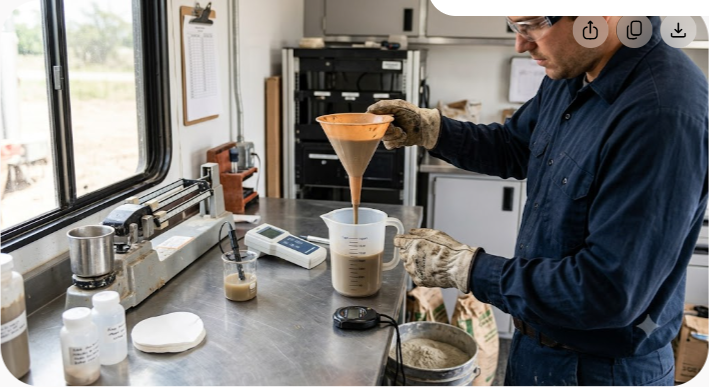
A Marsh Funnel is useful for tracking changes in apparent viscosity. The result is reported as funnel time, but it isn't a complete description of the fluid's rheology. Two muds with similar funnel times can behave differently under shear or during static periods.
Water at standard conditions has a Marsh Funnel time of roughly 26 seconds per quart, but the exact field reading can vary with temperature and equipment condition. There is also no universal 35 to 45 second target for every water well. The appropriate range depends on hole size, formation, pump capacity, annular velocity, and drilling method.
Mud density can be checked with a mud balance. Again, there is no single density that defines good water well mud. The objective is to maintain sufficient borehole control without imposing unnecessary pressure on the formation.
Consider a borehole advancing through loose sand. The crew notices that the hole is becoming unstable and that the return flow contains a large amount of fine sand.
Adding more bentonite immediately may seem like the obvious response, but it isn't necessarily the best first step.
The crew should first check whether the mud is adequately hydrated, whether the filter cake is developing, whether the circulation rate is appropriate, and whether the surface solids-control system is removing sand effectively.
If the mud is under-concentrated, the bentonite concentration can be adjusted gradually. If the mud is already highly viscous but the returns remain sandy, the bigger issue may be inadequate solids removal or unsuitable annular velocity.
The crew should also monitor fluid level and signs of fluid loss. If large volumes of mud are disappearing into the formation, simply increasing viscosity may not solve the underlying problem.
This is a useful rule for field work: diagnose the fluid system before changing it. Mud treatment works best when it responds to a measured problem rather than a guess.
More clay doesn't automatically mean a better drilling fluid. Excessive concentration can raise viscosity and gel strength beyond what the pump and borehole can handle efficiently.
An overly thick mud may require greater pumping pressure and can reduce effective circulation. In formations that are susceptible to lost circulation, excessive pressure can make the problem worse.
Start with the required fluid properties and adjust gradually. Don't use bentonite concentration as a substitute for proper solids control or formation diagnosis.
Water chemistry is one of the easiest variables to overlook. A bentonite that performs well in fresh water may yield poorly in hard or saline water.
If the mud suddenly becomes thinner after changing water sources, don't assume the bentonite itself has changed. Check the water chemistry first.
Direct dumping often creates partially hydrated clumps. Those clumps can persist for a long time and contribute less to mud performance than properly dispersed clay.
Use suitable mixing equipment and feed the powder at a controlled rate. If a hopper isn't available, use an agitation method that provides enough shear to disperse the product effectively.
Drilled sand is abrasive. If it stays in circulation, it can accelerate wear in pumps, valves, drill pipe, and other components.
Monitor sand content and maintain effective settling or solids-control equipment. Hydrocyclones, screens, settling tanks, or other equipment may be appropriate depending on the drilling system.
There is no single sand-content limit that applies to every rig and fluid system, but increasing sand content should be treated as a warning that the mud-cleaning process needs attention.
Marsh Funnel viscosity is convenient, but it tells only part of the story. It doesn't directly describe every aspect of gel strength, yield behaviour, filtration, or solids loading.
If the project requires tighter control, use additional measurements suited to the drilling programme. A field crew may need to monitor density, sand content, filtrate loss, gel strength, or other rheological properties.
A filter cake that protects the borehole during drilling can restrict formation inflow if it isn't adequately removed from the producing interval.
Well development is therefore part of the drilling process, not an optional cleanup step. The development method should be appropriate for the screen, formation, casing design, and drilling fluid used.
Once the casing and screen have been installed, the objective changes. During drilling, the fluid is helping to stabilise the hole. During completion and development, the operator wants the production zone to transmit groundwater efficiently.
Well development may involve surging, airlifting, pumping, jetting, brushing, or other methods selected for the well design. These processes help remove loose formation fines and residual drilling-fluid material around the screen.
Chemical treatment may also be used in some situations, but it should be selected specifically for the type of drilling-fluid residue and the well construction materials. Chlorine, for example, is primarily a disinfectant; it should not be described as a universal bentonite breaker. Specialist dispersants or clay-breaker products may be used where appropriate, following the manufacturer's instructions and applicable well-construction requirements.
The development process should continue until the well produces acceptably clear water and the targeted performance indicators are achieved. The exact criteria vary by project and regulatory requirements.
Bentonite is widely used in groundwater drilling, but calling every bentonite product automatically "safe for drinking water" is too broad.
The product should be suitable for the intended well application and comply with the relevant project, regulatory, and material requirements. The presence of naturally occurring trace minerals also means that the chemical composition of a clay should be evaluated rather than assumed to be identical across all deposits.
For potable-water projects, buyers should request the supplier's technical documentation and, where required, certificates or test results relevant to the applicable standard. The drilling fluid itself is only one part of protecting groundwater quality. Well casing, grouting, sanitary seals, construction practices, disinfection, and development all matter.
A responsible drilling programme therefore treats bentonite as one component of an overall groundwater-protection system.
The cheapest bag of clay isn't necessarily the lowest-cost drilling option. A better comparison considers how much usable mud the product can produce and whether it consistently meets the required field properties.
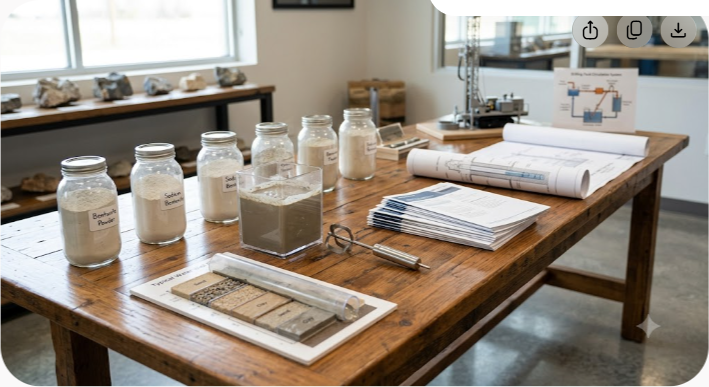
Look at the following factors when evaluating a drilling-grade bentonite:
"High-yield" describes bentonite that can produce a relatively large volume of usable drilling mud from a given quantity of dry clay while meeting specified performance criteria.
The term should be used carefully because yield isn't simply a measure of how much the clay swells in a bucket of water. Standardised test methods define how yield and related properties are evaluated, and different specifications may use different testing conditions.
For this reason, buyers should compare products using the supplier's test method, technical data, and relevant drilling-fluid specifications rather than relying on a high-yield claim alone.
API specifications are widely referenced in drilling-fluid applications, but the precise requirement depends on the grade and intended use. A product marketed for a particular API specification should be supported by appropriate documentation rather than a generic claim of compliance.
For contractors working on multiple wells, consistency can be more valuable than a small difference in the purchase price. Changes in clay quality can alter mud viscosity, hydration time, fluid-loss control, solids handling, and the amount of product required per unit of water.
A reliable supplier should provide clear product specifications and maintain consistent processing and quality-control procedures. Before placing a large order, it is sensible to review a representative technical data sheet and, where the application is critical, evaluate a sample using the actual makeup water and field mixing equipment.
Axewelledge supplies bentonite for industrial applications and can be considered when sourcing drilling-grade material. Claims about mine reserves, production capacity, certifications, and international standards should be verified against current supplier documentation for the specific product and project before procurement.
For water well drilling, the useful performance question is straightforward: does the material consistently produce the required mud properties under the conditions in which it will actually be used?
Deep wells place greater demands on the drilling-fluid system because the circulating path is longer, the fluid column is taller, and the opportunity for solids accumulation and fluid-property changes increases.
The basic principles remain the same, but monitoring becomes more important.
Don't wait until circulation is visibly poor before checking the mud. Record key properties at sensible intervals and whenever the formation changes.
Useful measurements may include funnel viscosity, mud density, sand content, fluid level, and other rheological or filtration properties required by the drilling programme.
Some formations contain clay that hydrates, disperses, or sticks to the bit and drill string. Excessive clay dispersion can increase solids loading and change the mud's behaviour.
Bit balling is a particular concern when sticky formation clay accumulates around the cutting structure. The response may involve adjusting drilling parameters, improving solids control, changing fluid chemistry, or using a compatible polymer or other additive.
As drilling depth increases, the mud can accumulate more fine formation solids. Those solids can change viscosity and density even when no additional bentonite has been added.
Efficient settling and solids-control equipment becomes increasingly valuable on deeper projects. Don't try to correct a solids-loading problem by continually adding fresh bentonite. First remove the unwanted solids.
A good drilling fluid still needs adequate annular velocity to transport cuttings. If flow is too low, even a well-formulated mud may allow solids to settle.
The correct pump rate depends on the hole diameter, drill-pipe size, annular area, cuttings characteristics, fluid properties, and rig limitations. Increasing flow without considering formation pressure can also create problems, so the system needs to be balanced rather than pushed to an arbitrary maximum.
Before starting a project, confirm the following:
There isn't one universal mix ratio because bentonite grades differ in yield and hydration behaviour, and formations require different mud properties. A starting range of about 25 to 35 pounds per 100 gallons may suit some conventional applications, but the final concentration should be based on the product data sheet, water chemistry, and field measurements rather than a fixed recipe.
Hydration time varies with bentonite grade, particle size, water chemistry, temperature, mixing energy, and circulation. Some products develop useful properties quickly, while others need longer conditioning. Instead of relying on a fixed 15- or 20-minute period, maintain adequate agitation and confirm performance with field tests and the supplier's recommended hydration procedure.
Calcium-dominant bentonite generally has lower swelling and hydration characteristics than sodium-dominant bentonite, so it isn't normally the first choice for conventional water well drilling mud. The correct choice depends on the product specification and application. Use a drilling-grade bentonite whose hydration, viscosity, filtration, and gel-strength properties match the planned drilling conditions.
The filter cake is removed or disrupted during well development rather than simply left in the production zone. Depending on the well design, development may use surging, pumping, airlifting, jetting, brushing, or other methods. Where chemical treatment is needed, the product should be selected for the specific drilling-fluid residue and used according to its technical instructions.
Drilling-grade bentonite is widely used in water well construction, but suitability should not be assumed for every bentonite product. For potable-water projects, select material appropriate for the application and review current supplier documentation and applicable requirements. Groundwater protection also depends on proper casing, grouting, sanitary sealing, disinfection, drilling practices, and well development.
Fish eyes form when dry bentonite hydrates on the outside of a clump while the material inside remains dry. This commonly happens when powder is added too quickly or without adequate shear. Use suitable mixing equipment, introduce the bentonite gradually, and maintain strong circulation or agitation so the clay disperses before individual particles become trapped inside partially hydrated lumps.
A Marsh Funnel provides a quick field measurement of drilling-fluid funnel viscosity. A known volume of mud is poured through the funnel and the discharge time is recorded. The result is useful for tracking changes, but it doesn't describe every rheological property of the mud. For demanding projects, density, sand content, gel strength, filtration, or other tests may also be required.
Bentonite for drilling water wells is valuable because it does several jobs at the same time. Properly hydrated drilling-grade sodium bentonite can improve borehole stability, form a filter cake, carry drilled cuttings, develop gel strength during static periods, and help control fluid loss.
The best results come from treating the mud as an engineered part of the drilling system rather than as a product that can simply be added until the water looks thick. Water chemistry, clay concentration, hydration, shear, annular velocity, solids control, formation conditions, and well development all affect performance.
For straightforward formations, a well-controlled bentonite system can make drilling cleaner and more predictable. In difficult formations, bentonite may be combined with other fluid treatments or replaced with a polymer-based system where the application calls for it.
The practical goal is always the same: maintain the fluid properties needed to keep the borehole stable, transport cuttings efficiently, control fluid loss, and complete the well without unnecessarily restricting groundwater flow. Choosing a consistent drilling-grade bentonite and monitoring the mud throughout the job is a much better strategy than relying on a generic mix ratio or simply adding more clay when problems appear.













Have questions about our products? We're here to help!