Axewelledge, a leading exporter from India, specializes in high-quality Bentonite. With a commitment to excellence, we supply premium Bentonite to the Middle East and Southeast Asia markets.


North Angle Complex, 304,
150 Feet Ring Rd, Opposite Ambedkar Nagar BRTS Stop,
Madhav Park, Punit Nagar,
Mavdi, Rajkot, Gujarat 360004
© Axewelledge 2026, All Rights Reserved.
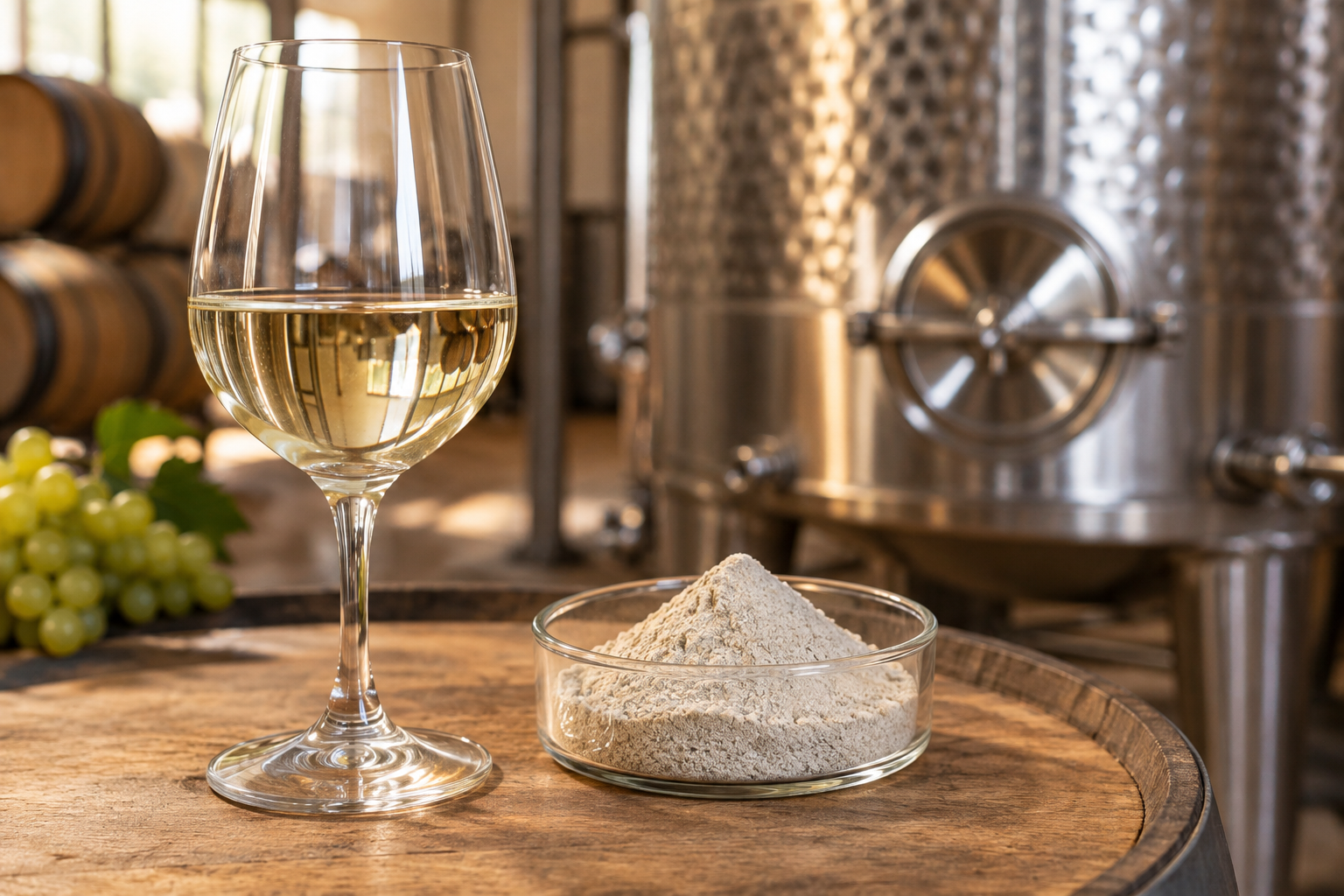
Bentonite for wine clarification is used primarily to reduce protein instability, particularly in white and rosé wines that are prone to developing haze after exposure to heat. It is not simply a general-purpose cleaner for cloudy wine. Used correctly, hydrated bentonite binds unstable proteins, helps them flocculate, and allows the resulting material to settle so the wine can be separated from the sediment.
The important part is dosage. Too little bentonite may leave the wine protein-unstable, while too much can increase wine loss and affect aroma or mouthfeel. The right treatment depends on the wine, the bentonite product, and the result of a bench trial. There is no single dosage that works for every batch.
This guide explains how bentonite works, how sodium and calcium bentonite differ, how to prepare a slurry, how to conduct a practical bench trial, how long the treatment may need to settle, and which mistakes can compromise the result.
Bentonite is a naturally occurring clay dominated by smectite minerals, especially montmorillonite. In winemaking, specially prepared food-grade bentonite is hydrated in water and then dispersed through wine. Its charged clay surfaces interact strongly with proteins that can contribute to protein haze.
The treatment is most closely associated with protein stabilization rather than simple removal of visible particles. A wine can look perfectly clear in the cellar and still contain enough unstable protein to develop haze later. A suitable bentonite treatment can reduce that risk before bottling.
Bentonite can also contribute to clarification because the material it binds can form flocs that settle. However, it shouldn't be treated as a universal substitute for every clarification or filtration step. Yeast, grape solids, tartrates, phenolic compounds, and other forms of turbidity may require different approaches.
For that reason, the first question should be: What is causing the wine to be cloudy or unstable? If the problem is protein instability, bentonite may be an appropriate treatment. If it is something else, adding more bentonite may not solve it.
Wine contains proteins and other macromolecules originating from grapes and, depending on the production method, yeast and other winemaking materials. Some proteins remain soluble during normal cellar conditions but become less stable when the wine is exposed to heat.
During a heat-stability test, unstable proteins can denature and aggregate. The resulting particles scatter light, creating a visible haze. This is why a wine that appears brilliant when cold or at cellar temperature can become noticeably cloudy after warming.
Protein haze is especially relevant to white and rosé wines because visual clarity is an important part of their presentation. The problem can become apparent after bottling, during warm transport, or while wine is stored in a hot environment. By then, correcting the problem can be considerably less convenient than addressing instability before packaging.
A cloudy wine does not automatically need bentonite. Different forms of haze and sediment have different causes.
| Appearance or problem | Possible cause | Is bentonite the first choice? |
|---|---|---|
| Haze that increases after warming | Protein instability | Often, yes |
| Fine yeast sediment after fermentation | Residual yeast | Usually not the primary treatment |
| Crystalline deposits | Tartrate instability | No; cold stabilization or another suitable process may be used |
| Brown or oxidative discoloration | Oxidation or phenolic reactions | Not primarily a bentonite issue |
| Persistent microbial turbidity | Microbial activity | No; identify and address the microbiological cause |
| Coarse grape solids | Suspended lees or solids | Settling, racking, clarification, or filtration may be more appropriate |
The distinction matters because fining is most effective when it is matched to the actual instability.
Hydrated bentonite has a layered mineral structure and a large reactive surface. When dispersed in water, the clay particles become highly hydrated and separate from one another. Their surface charge and ion-exchange properties allow them to interact with charged compounds in the wine.
For protein fining, the key interaction is between negatively charged hydrated bentonite surfaces and wine proteins under suitable wine conditions. The proteins become associated with the clay particles, and the resulting aggregates can form flocs that settle out of suspension.
It is useful to think of the process as adsorption followed by flocculation and settling, rather than as the clay simply absorbing every impurity in the wine.
Bentonite surfaces can carry a net negative charge in the conditions relevant to wine treatment. This makes the clay effective at interacting with positively charged regions of unstable proteins.
The exact behavior is influenced by wine composition, pH, ionic strength, protein type, and the characteristics of the bentonite itself. The chemistry is therefore more nuanced than the common description of bentonite acting like a microscopic magnet.
Dry bentonite does not perform at its best when it is simply scattered into wine. Hydration allows water to penetrate between clay layers and disperse the particles. The resulting slurry provides much greater accessible surface area than poorly hydrated material.
Swelling capacity varies considerably among bentonite products. Sodium bentonite generally hydrates and swells more than calcium bentonite, although product specifications and processing methods matter. A higher swelling index does not automatically mean a product is the best choice for every wine.
After bentonite interacts with proteins and other material, the particles can aggregate into larger flocs. Gravity then separates those flocs from the clearer wine.
The speed and quality of settling depend on several factors, including bentonite type, dose, wine temperature, mixing, tank geometry, wine composition, and the amount of suspended material. Some treatments settle quickly; others need considerably longer before the wine is ready to rack.
Sodium and calcium bentonites differ primarily in their exchangeable cations and hydration behavior. Sodium bentonite generally has a higher swelling capacity, while calcium bentonite tends to swell less and can produce a more compact sediment.
For winemaking, the correct choice should be based on the specifications of the food-grade product and the results it produces in the actual wine. It is not enough to choose a clay solely because it has a high swelling index.
| Feature | Sodium Bentonite | Calcium Bentonite |
|---|---|---|
| Hydration | Generally high | Generally lower than sodium bentonite |
| Swelling capacity | Usually higher | Usually lower |
| Typical slurry behavior | More expansive and highly hydrated | More compact hydration behavior |
| Sediment | Can be relatively bulky | May form a denser sediment |
| Typical consideration | Strong hydration and protein fining performance | Compact sediment and specific formulation requirements |
| Selection basis | Product specification and bench performance | Product specification and bench performance |
A winemaker should also consider whether the material is specifically manufactured and tested for beverage use. Bentonite sold for drilling, foundry, construction, or other industrial applications should not be assumed to be suitable for wine.
Start with the wine, not the marketing description of the clay. A suitable product should have clear specifications for beverage or food use and provide consistent performance from batch to batch.
Important characteristics can include:
A supplier should be able to provide technical information and, where applicable, quality documentation for the product. This is particularly important for commercial wine production, where raw-material consistency affects both processing and finished-product quality.
The exact procedure should follow the bentonite manufacturer's technical instructions and the winery's approved process. The following workflow provides a practical framework, but the bench trial remains the deciding step for dosage.
Before adding bentonite, establish why the wine needs treatment. If protein instability is suspected, perform an appropriate laboratory stability test. A wine that is simply hazy from yeast or another suspended material may need a different treatment.
For finished wines intended for bottling, stability should be assessed before final packaging rather than relying only on visual appearance.
A bench trial is one of the most useful tools for determining bentonite dosage. Take representative samples of the wine and treat separate portions with a range of bentonite concentrations.
The exact range should be appropriate for the wine and the product being tested. The original draft's suggestion of treating every wine at a fixed range is too rigid; actual requirements vary widely. Follow the product's recommended trial range and the winery's laboratory protocol.
After treatment, compare the samples for stability, clarity, aroma, flavor, and other relevant sensory characteristics. The goal is not to use the largest dose that produces a clear sample. It is to find the lowest effective treatment that provides the required stability without unnecessary sensory or yield costs.
Measure the required amount of dry bentonite accurately. Use clean water and follow the supplier's recommended water temperature, concentration, mixing method, and hydration time.
Many bentonite products are hydrated in warm water because warmth can help the clay disperse and hydrate. The exact temperature is product-dependent, so a fixed temperature such as 50 to 60 degrees Celsius should not be treated as a universal requirement.
Add the powder gradually while mixing. Sprinkling it into moving water helps prevent dry pockets from becoming encapsulated by hydrated clay. Once the material is properly dispersed, allow the slurry to hydrate for the period specified by the manufacturer.
A properly prepared slurry should be reasonably uniform rather than containing obvious dry balls or hard lumps. Stir it again before transferring it to the wine because hydrated bentonite can settle or change consistency during holding.
Do not assume that a slurry prepared yesterday is automatically ready simply because 24 hours have passed. Hydration requirements differ among products. The manufacturer's preparation instructions should take priority.
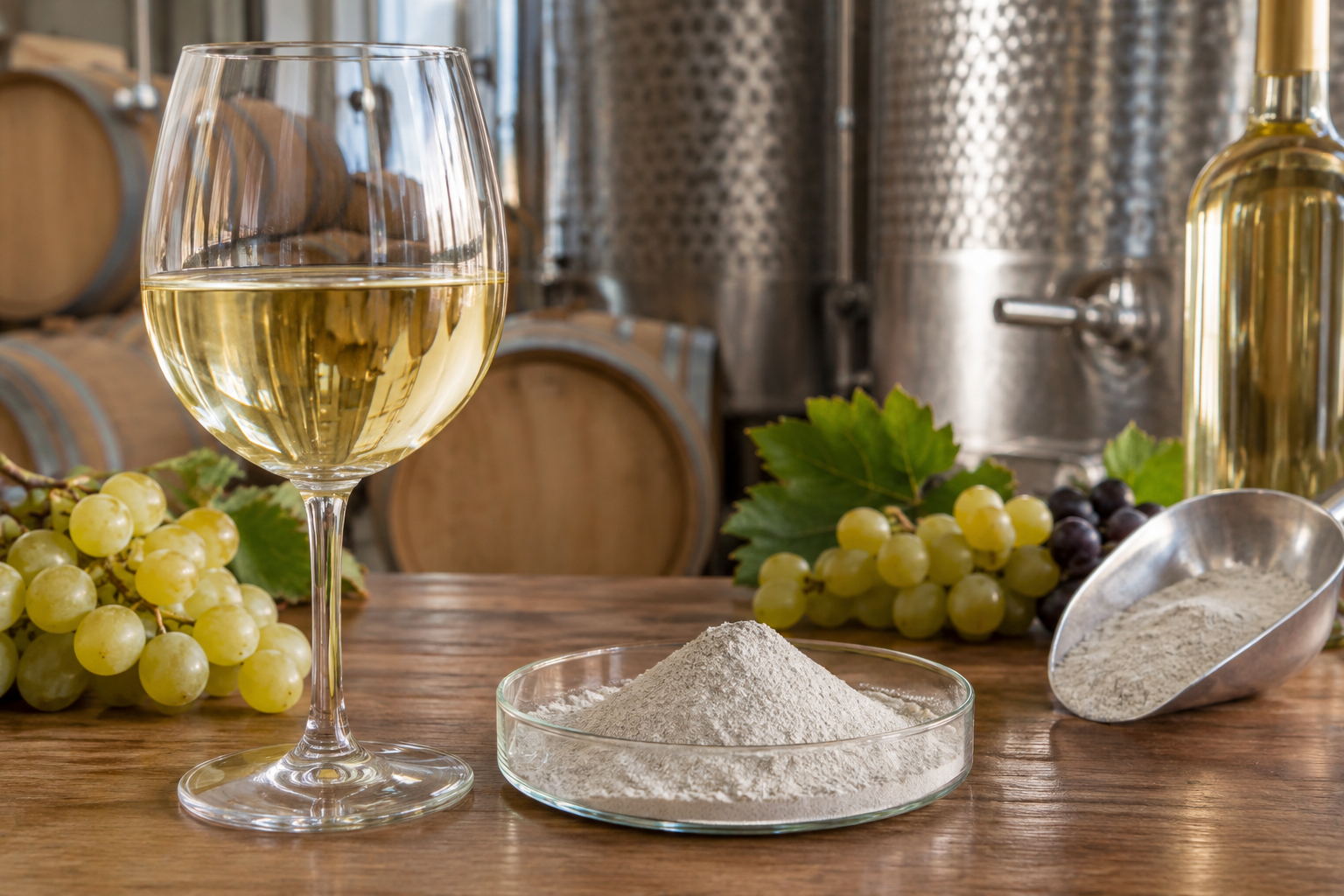
Add the hydrated bentonite while mixing the wine sufficiently to distribute the treatment throughout the tank. The objective is even dispersion, not aggressive agitation.
Mixing should be appropriate for the tank and wine style. Excessive splashing can increase oxygen pickup, which is particularly undesirable for wines where oxidation is a concern. A controlled addition through a suitable recirculation or mixing system can provide better distribution than simply pouring the slurry onto a stationary tank surface.
Once the bentonite has been thoroughly distributed, allow the wine to rest. The required settling time depends on the product and process conditions.
Five to seven days can be a useful practical planning window in some cellar conditions, but it should not be treated as a universal settling time. A treatment may settle sooner, while a colder or more difficult batch may need longer.
The wine should be evaluated before racking rather than moved simply because a predetermined number of days has passed.
When the sediment has settled adequately, rack the clearer wine away from the bentonite lees. Minimize disturbance of the sediment so that the settled material is not resuspended.
Commercial operations may use appropriate transfer, clarification, or filtration equipment depending on the production process. Small producers can often rely on careful racking after sufficient settling, followed by filtration when required by their process.
After treatment, confirm that the wine meets the desired stability and clarity specifications. A visual inspection alone is not enough to prove protein stability.
If the wine is destined for commercial bottling, the winery's laboratory should use its established stability testing protocol before release. The final process should be documented so that successful treatments can be reproduced on later lots.
One of the most common questions about wine fining is how much bentonite to use. The honest answer is that the correct dosage cannot be determined reliably from wine volume alone.
Two wines made from the same grape variety can require different treatments. Protein concentration, pH, alcohol, processing history, previous fining, and other characteristics can change the response. Different bentonite products can also perform differently at the same nominal dose.
That is why a bench trial is more useful than a generic dosage chart.
| Approach | Advantage | Limitation |
|---|---|---|
| Fixed dose for every batch | Simple to administer | Can under-treat or over-treat wine |
| Manufacturer's starting range | Provides a practical trial framework | Still requires testing in the actual wine |
| Bench trial followed by scale-up | Matches treatment to the batch | Requires laboratory work and careful measurement |
For production decisions, the third approach is generally the most defensible.
Suppose a laboratory trial identifies an effective treatment of 0.8 grams of dry bentonite per liter of wine. For a 1,000-liter batch, the corresponding dry-bentonite quantity would be 800 grams, assuming the same product and treatment conditions are used.
The calculation is straightforward:
The calculation itself is simple. The difficult part is establishing that 0.8 grams per liter is actually appropriate. That is what the bench trial determines.
Poor slurry preparation is one of the easiest ways to reduce bentonite performance. The clay needs sufficient contact with water before it is added to wine.
Water quality matters because the water becomes part of the fining preparation. Avoid water with strong chlorine odors or other characteristics that could affect wine quality. Use the winery's approved water source and follow the bentonite manufacturer's specifications.
Dumping a large quantity of dry bentonite into water at once encourages clumping. The outside of a particle can hydrate rapidly while dry material remains trapped inside. Those lumps then disperse slowly and may never perform as efficiently as a properly hydrated slurry.
Gradual addition with effective agitation gives the powder better contact with water from the start.
Hydration time depends on the product. Some commercial bentonites may be prepared relatively quickly, while others benefit from a longer swelling period. Always use the supplier's technical instructions as the starting point.
A longer holding time isn't automatically better if the slurry is exposed to contamination or handled poorly. Clean preparation and controlled storage matter just as much as elapsed time.
This can produce lumps and uneven distribution. It also makes it difficult to control the effective surface area of the clay. Proper slurry preparation is a small extra step that can make a substantial difference in treatment consistency.
A standard dose may be convenient, but convenience isn't a substitute for testing. Over-fining can increase sediment volume and wine loss and may affect sensory characteristics. Under-fining can leave the wine unstable.
Bentonite is strongly associated with protein stability, but not every haze is caused by proteins. If the underlying problem is tartrate precipitation, microbial activity, yeast, or another instability, bentonite may have little useful effect.
More clay does not automatically produce a better result. Once the relevant unstable material has been removed to the required level, additional fining may provide little benefit while increasing solids and potential wine loss.
Temperature affects both the behavior of the wine and the rate at which solids settle. Very cold conditions can slow clarification. At the same time, heat exposure is useful in certain laboratory stability tests because it can reveal protein instability that is not visible under normal cellar conditions.
The bentonite needs to be distributed, but violent agitation is unnecessary. Excessive splashing can increase oxygen exposure and complicate quality control, especially with delicate white and rosé wines.
Not all bentonite is intended for beverage production. A material sold for drilling fluids, construction, foundry applications, or industrial sealing should not be used in wine simply because its mineral name is bentonite. Food or beverage suitability must be established separately.
There is no single settling time that applies to every wine. In many cellar operations, several days of undisturbed settling may be enough for a well-prepared treatment to form a useful sediment layer. Five to seven days is sometimes used as a practical planning period, but the wine should be evaluated before racking.
Several variables affect settling:
If the wine remains visibly turbid, disturbing the tank and racking early can simply put the material back into suspension. When clarity and yield matter, patience is often cheaper than repeating the treatment.
Bentonite can affect wine sensory characteristics when it is used at excessive levels or under unsuitable conditions. Fining is not completely selective in a sensory sense; the treatment can interact with compounds other than the target proteins.
This is another reason to compare bench-trial samples rather than selecting a dose based only on a published starting point. Look at aroma intensity, fruit character, palate weight, and overall balance alongside the stability result.
A good treatment is not simply the sample that looks clearest. It is the sample that achieves the required stability while preserving the character the winemaker wants to keep.
Bentonite treatment and filtration are often discussed together, but they serve different purposes.
Bentonite can reduce protein instability and help remove flocculated material before the wine reaches final filtration. Filtration physically separates suspended particles through a filter medium with a defined retention behavior.
In a commercial process, bentonite may therefore be one part of a broader clarification strategy rather than the final step. Depending on the wine and production goals, a winery may combine settling, racking, fining, stabilization, and filtration in a controlled sequence.
The best sequence depends on the wine and the equipment available. There is no universal clarification recipe that should be applied to every vintage.
Bentonite is not the only fining material available to winemakers. Different agents are selected for different instability or sensory objectives.
| Fining approach | Common purpose | Main consideration |
|---|---|---|
| Bentonite | Protein stabilization, particularly in white and rosé wines | Dose and hydration need to be controlled |
| Gelatin-based fining | Reduction of certain phenolic compounds and clarification | Can have a strong sensory and compositional effect |
| Isinglass | Clarification, particularly in some beer and wine applications | Product-specific use and handling requirements |
| Plant-protein fining agents | Clarification and selected phenolic adjustments | Performance varies with product and wine |
| Activated carbon | Removal of selected color or odor compounds | Can remove desirable compounds if overused |
These materials are not interchangeable. The right fining agent depends on what needs to be removed and what the winemaker wants to preserve.
Before treating a batch with bentonite, confirm the following:
This checklist is simple, but it prevents most avoidable process errors.
For commercial production, the quality of the raw material matters as much as the treatment procedure. A winery should look for a supplier that can provide consistent product specifications, appropriate quality documentation, and clear application guidance.
Bentonite intended for wine should be selected on beverage suitability rather than general industrial grade. Important considerations may include purity, hydration behavior, consistency between lots, contaminant controls, packaging, storage conditions, and technical support.
Suppliers such as Axewelledge may be relevant when evaluating bentonite supply for international industrial and commercial applications, but the specific product should always be confirmed as suitable for the intended beverage use before procurement.
For larger operations, supply consistency is especially important. A change in clay characteristics can alter slurry behavior, dosage response, sediment volume, and treatment performance. Keeping product specifications and lot information as part of the winery's quality records makes future troubleshooting much easier.
Bentonite is a dry mineral powder, so it should be protected from moisture during storage. Damp storage can cause the powder to form hard lumps before it is ever prepared for use.
Keep unopened material in its original packaging or a suitable sealed container in a clean, dry area. Protect it from rain, condensation, and direct contact with wet floors. Follow the supplier's storage instructions, particularly after a package has been opened.
Good storage is not just housekeeping. Consistent dry material is easier to weigh, disperse, and hydrate predictably.
Bentonite is most useful in wine clarification when the goal is to reduce protein instability and prevent protein haze. Its performance depends on the clay's properties, proper hydration, effective dispersion, appropriate dosage, and adequate settling.
The most reliable process is straightforward: identify the instability, run a bench trial, prepare the bentonite correctly, add it under controlled mixing, allow the treatment to settle, rack carefully, and verify the final result.
Don't rely on a universal dose or a fixed settling time. Wine composition and bentonite products vary. A small laboratory trial can prevent a much larger cellar mistake.
For commercial winemakers, the same principle applies to raw-material sourcing. Use a bentonite product intended for the application, keep its specifications on record, and work with a supplier capable of maintaining consistent quality from one lot to the next.













Have questions about our products? We're here to help!