Axewelledge, a leading exporter from India, specializes in high-quality Bentonite. With a commitment to excellence, we supply premium Bentonite to the Middle East and Southeast Asia markets.


North Angle Complex, 304,
150 Feet Ring Rd, Opposite Ambedkar Nagar BRTS Stop,
Madhav Park, Punit Nagar,
Mavdi, Rajkot, Gujarat 360004
© Axewelledge 2026, All Rights Reserved.
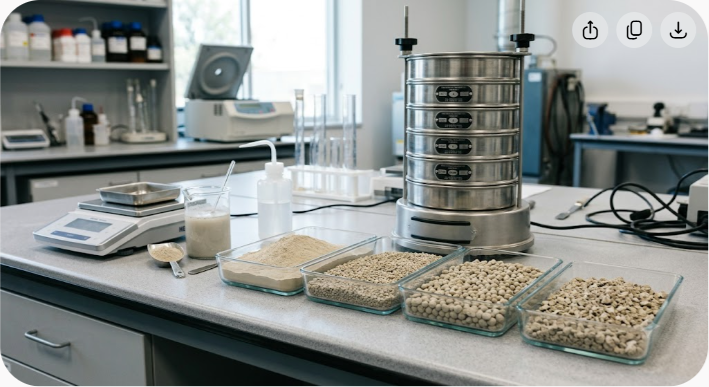
Bentonite granule size affects how quickly the material wets, hydrates and disperses, but it doesn't determine performance on its own. The right size depends on what the bentonite needs to do and how it will be handled.
A coarse granular product, a screened grade and a finely milled powder can come from similar bentonite deposits yet behave quite differently when they meet water or enter an industrial process. Particle size changes surface area, wetting behaviour, handling characteristics and the time required for hydration. Mineralogy, moisture, water chemistry and processing quality matter just as much when the final result is critical.
For drilling fluids, water wells, sealing systems, construction, foundry applications and other industrial uses, the useful question isn't simply, "What is the smallest bentonite particle size available?" It is, "What particle-size distribution gives this process reliable handling and the required performance?"
Bentonite granule size describes the physical size range of the particles supplied in a particular grade. Depending on the product and industry, size may be stated in millimetres, micrometres or by a sieve or mesh designation.
Granular bentonite contains larger particles than a conventional powdered grade. Those granules may be created or separated through crushing, screening, granulation, drying and other processing steps. A commercial product normally contains a range of particle sizes rather than particles that are all exactly identical.
For example, a specification of 1 to 3 mm describes an acceptable size range. It doesn't mean every granule measures exactly 1, 2 or 3 mm. Some variation within the specified range is expected, and a good specification also considers how much material falls outside the target range.
Three terms are especially useful when discussing bentonite sizing:
These terms shouldn't be treated as interchangeable. Two bentonite grades can have the same nominal size but different particle-size distributions and therefore behave differently during handling, mixing and hydration.
Particle size changes the way bentonite interacts with water and with the equipment used to process or install it.
Fine particles generally have more surface area relative to their mass. Water can contact that surface quickly, so fine bentonite often wets and disperses faster than larger granules. Larger particles have a greater distance for water to penetrate and may take longer to hydrate completely.
That difference can be useful or inconvenient depending on the application.
A sealing material, for example, may need to travel through a placement system and reach a specific location before significant hydration occurs. A drilling-fluid additive, on the other hand, may need to disperse efficiently during mixing so that the clay can contribute to the desired fluid properties.
The important point is that faster hydration isn't automatically better. The process determines what "better" means.
Particle size can influence:
These effects are connected, but particle size is only one part of the specification. Bentonite mineralogy, swelling capacity, exchangeable cations, moisture and water chemistry can have a major influence on the final result.
Hydration is one of the clearest ways to understand why bentonite particle size matters.
Bentonite commonly contains smectite clay minerals, particularly montmorillonite. When suitable bentonite contacts water, water enters the clay structure and causes the material to hydrate and expand. Sodium bentonite is widely used where high swelling and sealing performance are required, although the exact behaviour depends on the grade and surrounding conditions.
Particle size affects the rate at which water can interact with the material. A smaller particle presents a shorter distance for water to penetrate. A larger granule can require more time before water reaches and hydrates material throughout the granule.
That distinction is important because hydration rate and ultimate swelling aren't the same measurement.
A fine bentonite may begin hydrating quickly without necessarily producing greater final swelling than a coarser product made from the same material. Conversely, a granular product may hydrate more slowly but be much easier to place accurately in an application where premature swelling would be undesirable.
Other factors also influence hydration and swelling, including:
For this reason, particle size should never be used as a substitute for a performance specification.
Fine bentonite generally offers a large surface area for contact with water. When it is added correctly, this can help the material wet and disperse quickly.
The trade-off is handling. Fine powders can generate more dust and may be more difficult to feed consistently. Poor addition technique can also cause lumping. If a large quantity of dry bentonite is dumped into water at once, the outer layer of the powder can hydrate rapidly and form a partially hydrated mass around dry material.
Good mixing practice matters just as much as particle size. Controlled addition, sufficient agitation and appropriate water conditions can make a significant difference.
Larger granules generally hydrate more slowly because water has to penetrate farther into the material. In sealing and placement applications, this can be an advantage.
The granules can be transported and positioned before developing their full swelling behaviour. Once sufficient water reaches the material, hydration can progress within the confined space.
The surrounding environment still matters. A dry granule exposed to humid storage conditions behaves differently from one kept in moisture-resistant packaging. A granule placed directly in water behaves differently from one installed in a confined formation where water reaches it gradually.
A common purchasing mistake is to ask only for the nominal or average particle size.
Average size can hide a great deal. Consider two bentonite products with a similar average size. Product A may have a relatively narrow distribution, while Product B contains a mixture of very fine particles and much larger granules. The two products may respond differently during feeding, mixing, packing and hydration even though their average values look similar.
For many applications, the distribution is more informative than a single number.
A useful specification might identify the percentage passing or retained on selected sieves, along with limits for fines and oversized material. The exact reporting format should reflect the sensitivity of the application.
For example, a sealing grade may need tight control over undersize material because excessive fines could affect placement. A powder intended for rapid mixing may have different requirements because dispersion is the primary concern.
When buying bentonite, ask for the actual particle-size specification and test method. Don't assume that the word "granular" refers to one standard size used across all suppliers and industries.
Bentonite manufacturers and buyers use several systems to describe particle size. The most appropriate method depends on the physical form of the product and the required level of control.
Millimetres are commonly used for coarse granular products. A range such as 1 to 3 mm gives buyers a straightforward description of the intended physical form.
For commercial purchasing, the range should ideally be accompanied by limits for material outside the target fraction where those limits matter to the application.

Micrometres, or microns, are useful for finer materials. One millimetre equals 1,000 micrometres.
Fine powders can contain particles across a broad range, so instrumental analysis may be useful when a detailed particle-size distribution is required.
Mesh terminology is widely used for screened powders and mineral products. It refers to the screening separation associated with a particular sieve system.
Mesh numbers shouldn't be treated as a universal direct conversion to a single particle diameter in every situation. Sieve standards, particle shape and the test procedure can affect the result.
For international purchasing, it is safer to specify the sieve range and applicable test method rather than relying on a mesh number without context.
The appropriate size depends on the job the bentonite has to perform. A sealing product doesn't necessarily need the same particle characteristics as a drilling-fluid grade, and a foundry application may have different requirements again.
| Application | Why particle size matters | General preference | Main consideration |
|---|---|---|---|
| Water well sealing | Placement, packing and hydration | Controlled granular or pelletised grade | Placement control versus hydration rate |
| Drilling fluids | Wetting, dispersion and fluid-property development | Fine or controlled distribution | Fast dispersion versus handling and dust |
| Construction sealing | Placement, packing and confined swelling | Granular or pelletised material | Installation method and hydration conditions |
| Foundry applications | Distribution and mixing within the moulding system | Application-specific grade | Dispersion, binding and process consistency |
| Agriculture | Spreading, incorporation and moisture interaction | Granular or powder depending on use | Handling and application method |
| Industrial absorbent use | Contact area, handling and absorption rate | Grade matched to the process | Absorption speed versus dust and flowability |
These are selection principles, not universal product specifications. The correct grade should be established from the actual process, equipment and performance requirement.
Water well sealing shows particularly clearly why particle size has to be considered together with installation conditions.
Granular or pelletised bentonite may be placed in selected sections of a borehole where it must reach the intended depth and then hydrate to create a low-permeability seal. The material has to be manageable during placement while still developing the required swelling behaviour after water becomes available.
If a product contains too much fine material for the placement method, it may create dust, bridge or begin dispersing before reaching the target location. If the granules are excessively coarse, hydration may take longer than expected, especially where water movement is limited.
The practical objective is controlled placement followed by predictable hydration.
When specifying bentonite for a water well, consider:
A good specification therefore describes both the physical form and the performance requirements rather than simply stating a particle size.
Drilling fluids place different demands on bentonite. The clay must disperse into the fluid system and contribute to properties such as viscosity, suspension and filtration control.
Particle size affects how quickly the material becomes available to the water phase, but it isn't the only factor that determines drilling performance. Bentonite mineralogy, swelling behaviour and rheological properties are equally important.
Grinding a low-performing bentonite into a finer powder doesn't automatically produce a high-performing drilling-grade material. Finer particles can change the hydration rate, but they can't compensate for unsuitable mineral characteristics.
For technically controlled drilling applications, particle-size information should therefore be reviewed alongside the relevant performance tests and product standards.
Coarse material can take longer to wet and hydrate, which may increase the time required to develop the desired fluid properties. If the mixing stage is too short, the bentonite may not have fully dispersed before the fluid is used.
Addition practice can make the problem more noticeable. Introducing a large amount of dry material at once can reduce dispersion efficiency and promote lumps.
The practical response is to consider particle size together with mixing time, addition rate, water conditions and the required fluid properties.
Very fine material can disperse rapidly under suitable conditions, but it may create more airborne dust during handling. Fine powders can also form hydrated lumps when they contact water too quickly without adequate agitation.
A controlled particle-size distribution can provide a useful balance between rapid dispersion and manageable handling.
Bentonite is used in sealing systems because hydrated clay can form a dense, low-permeability barrier under suitable conditions.
For these applications, particle size affects both placement and packing.
A mixture containing different particle sizes may pack differently from a narrow coarse fraction. Smaller particles can occupy spaces between larger particles, potentially reducing void space. However, the result depends on the material's shape, moisture content, compaction, confinement and hydration behaviour.
The installation method matters just as much. A grade that works well when placed into a confined space may not be suitable for a mechanical spreading or blending operation.
For construction projects, specify the physical form according to how the material will actually be delivered and installed. Then confirm that its swelling and sealing properties meet the project requirements.
No. Smaller doesn't automatically mean better.
This is an easy assumption to make because reducing particle size generally increases the surface area available for contact with water. That can speed up wetting and dispersion. But many applications need more than fast hydration.
A sealing system may require the material to reach a particular location before it swells significantly. A bulk-handling operation may place greater value on low dust and consistent feeding. A drilling-fluid system may prioritise rapid dispersion and predictable rheology.
There is also a limit to what particle size alone can accomplish. Two bentonite products with the same nominal size can perform differently because their mineral composition, clay content, moisture and processing history differ.
Particle size is best treated as one control variable within the overall specification, not as a simple measure of product quality.
Start with the process, not the catalogue.
Identify the main function. Is the material needed for swelling, sealing, suspension, binding, absorption, filtration control, rheology modification or another purpose?
The answer will narrow the appropriate physical forms and performance requirements.
Will the bentonite be poured, pumped, blended, metered, mechanically spread or mixed into water?
The equipment often determines whether a fine powder, granular grade or pelletised product is practical. A product that performs well in a laboratory beaker may behave differently in a high-throughput feeding system.
Specify the desired minimum and maximum size where possible. If the process is sensitive to fines or oversized material, define acceptable limits for those fractions as well.
A range is usually more useful than a single nominal value because it describes what the buyer can expect from the delivered material.
Particle size should be reviewed alongside properties appropriate to the application. Depending on the end use, these may include swelling capacity, moisture, viscosity, filtration behaviour, gel strength, yield characteristics or absorption capacity.
Don't assume that two products with identical screening results will perform identically.
Water chemistry can substantially affect bentonite behaviour. Salinity and dissolved ions may reduce or alter swelling and dispersion compared with fresh water.
If the material will be used in a challenging environment, a small-scale trial using representative water and operating conditions can reveal problems that a dry specification cannot.
Once a suitable grade has been identified, consistency becomes part of performance. Ask for a clear product specification and appropriate quality documentation so future shipments can be compared against the agreed requirements.
The testing method should match the physical form of the material and the level of accuracy required.
For granular bentonite, sieve analysis is often a practical quality-control method. A representative dry sample is passed through a series of sieves with defined openings. Material retained on each sieve is weighed and reported as a percentage of the total sample.
A typical sieve-analysis workflow is:

For finer bentonite powders, wet sieving or instrumental techniques such as laser diffraction may be appropriate when a more detailed particle-size distribution is required.
The method itself isn't enough. Sampling is critical. A poorly collected sample can produce a precise measurement of the wrong material. Consistent sampling, preparation and test conditions are essential when particle size is used for purchasing or quality control.
Fine material may hydrate quickly, but rapid hydration isn't always the objective. In sealing applications, controlled placement can matter more than immediate dispersion.
Choose a size that suits the process rather than assuming finer always means higher performance.
A single nominal size doesn't show the width of the particle-size distribution. Ask about the percentage within the target range and the amount of undersize and oversize material.
Moisture can affect flow, storage stability and the physical condition of granular bentonite. Exposure to humid conditions may contribute to caking, particularly where fine material is present.
For consistent handling, moisture should be controlled and reported according to the product specification.
Bentonite can behave differently in fresh water, saline water and water containing significant concentrations of dissolved minerals. If the end use involves challenging water conditions, test the selected grade with representative process water.
A 1 to 3 mm product from one source isn't automatically equivalent to another 1 to 3 mm product. Mineralogy, swelling behaviour, clay content, moisture and processing all influence performance.
Particle size is one comparison point, not the complete specification.
Two bags can look almost identical while containing different particle-size distributions. Screening data and documented quality-control results provide a much more useful basis for comparison.
It helps to think about particle size through surface area.
For a given mass of a material, breaking a large particle into many smaller particles increases the total external surface area available for contact with water. This generally makes wetting faster.
Bentonite, however, isn't made of perfect spheres. It contains clay particles and aggregates with complex structures, and hydration involves more than simple surface contact. Clay mineralogy, aggregation, pore structure and water chemistry all affect how the material hydrates.
That is why the statement "smaller particles mean more swelling" is too broad.
A more useful description is that smaller particles can increase the rate at which bentonite interacts with water, while final swelling and functional performance depend on the material's mineralogical and chemical characteristics as well.
This distinction is especially important when developing an industrial specification. A faster hydration rate may be desirable in one process and undesirable in another.
| Characteristic | Coarser bentonite | Finer bentonite |
|---|---|---|
| Initial wetting | Generally slower | Generally faster |
| Hydration rate | Often more controlled | Often faster under suitable conditions |
| Dust potential | Usually lower | Usually higher |
| Placement | Often suitable for granular placement | Often suited to powder-mixing systems |
| Feeding | Can be manageable in suitable granular systems | May require greater dust and flow control |
| Mixing into water | May require more mixing time | Can disperse quickly when added correctly |
| Sealing applications | Useful where controlled placement matters | Useful where rapid dispersion is required |
| Overall suitability | Depends on installation conditions | Depends on mixing and process conditions |
Neither form has a universal advantage. The appropriate choice depends on the equipment, water conditions, installation method and performance target.
Particle-size variation that seems insignificant during a laboratory trial can become important at commercial scale.
Changes in the distribution can affect feeding rates, mixing time, dust generation, hydration behaviour and the amount of material needed to reach the desired process result. Operators may compensate by changing water addition, mixing time or dosage, which can introduce another source of variation.
For manufacturers, contractors and industrial processors, consistency therefore has a direct operational value.
A useful procurement specification may include:
This provides much more useful purchasing information than simply writing "granular bentonite" on an order.
Bentonite occurs naturally as clay with varying mineral composition, moisture and physical characteristics. Commercial processing can include drying, crushing, grinding, screening, blending and granulation, depending on the desired grade.
Each stage can change the physical form of the finished material.
Grinding creates finer material. Screening separates particles into defined fractions. Granulation can produce larger, more manageable particles from processed bentonite. Drying reduces moisture and can affect the material's handling characteristics during later processing.
The objective isn't simply to make bentonite finer or coarser. It is to produce a grade whose physical and performance properties suit its intended application.
That is why a reliable technical specification should describe particle size alongside the properties that actually matter to the end use.
A few technical questions can prevent unnecessary trial and error when sourcing bentonite for a commercial process.
Ask the supplier:
For specialised applications, give the supplier as much useful process information as possible. Water conditions, mixing equipment, placement method and required performance can help identify a suitable grade much more effectively than a generic request for "granular bentonite."
Imagine a facility receives two bentonite products with broadly similar mineral characteristics. Product A is relatively coarse. Product B contains a substantially larger fine fraction.
During dry handling, Product A may move cleanly through suitable granular feeding equipment with relatively little dust. Product B may require more attention to dust control and feeding conditions.
During water mixing, the difference may reverse in practical terms. Product B can begin wetting and dispersing sooner, while Product A may require additional mixing time before reaching the desired state.
Now change the application. If the bentonite is being placed into a confined sealing zone, the handling and placement characteristics of Product A may be more useful. If it is being rapidly dispersed into a prepared fluid, Product B may be easier to process.
The material hasn't suddenly become better or worse. The process has changed, so the useful particle characteristics have changed with it.
That is the central idea behind bentonite sizing: the correct particle size is application-specific.
It can affect storage and handling, although particle size isn't the only factor involved.
Fine materials generally present more surface area and can create greater dust exposure during handling. They may also be more prone to caking if moisture enters the package. Granular products can be easier to manage in some bulk-handling systems, but their storage stability still depends on moisture, packaging, humidity, temperature and granule strength.
Bentonite should generally be protected from moisture before use. Packaging should be appropriate for the intended storage conditions, and damaged bags or containers should be addressed promptly.
Storage control supports particle-size consistency because moisture can change the physical condition of the material even when the original screened size was within specification.
Instead of asking, "What is the best bentonite granule size?", ask three more useful questions.
Consider feeding, dosing, dust control, transportation, storage and installation. The physical form needs to work with the equipment and working environment.
Consider wetting, hydration, dispersion and swelling. Water chemistry and availability can be as important as particle size, particularly in sealing and drilling applications.
Define the actual performance requirement. That might be sealing, filtration control, suspension, binding, absorption, rheology modification or another function.
Once those questions are answered, the particle-size requirement becomes much easier to define.
A strong bentonite specification combines physical and performance requirements. Particle size tells you how the material is presented, but it doesn't tell the complete performance story.
For a commercial purchase, consider the full specification: bentonite type, mineral characteristics, swelling behaviour, moisture, particle-size distribution, purity, intended application and quality-control documentation.
Axewelledge supplies processed bentonite for industrial and commercial applications and can help buyers identify a grade based on the requirements of their process rather than a generic granular specification. When granule size is critical, discussing the installation or processing conditions before ordering can help narrow the appropriate product range and testing requirements.
Bentonite granule size matters because it influences how quickly the material wets, hydrates and disperses, as well as how it behaves during handling and placement.
The main points are straightforward:
In practical terms, there is no universal best bentonite granule size. The right specification is the one that provides reliable handling, predictable hydration and the performance your application requires.













Have questions about our products? We're here to help!