Axewelledge, a leading exporter from India, specializes in high-quality Bentonite. With a commitment to excellence, we supply premium Bentonite to the Middle East and Southeast Asia markets.


North Angle Complex, 304,
150 Feet Ring Rd, Opposite Ambedkar Nagar BRTS Stop,
Madhav Park, Punit Nagar,
Mavdi, Rajkot, Gujarat 360004
© Axewelledge 2026, All Rights Reserved.
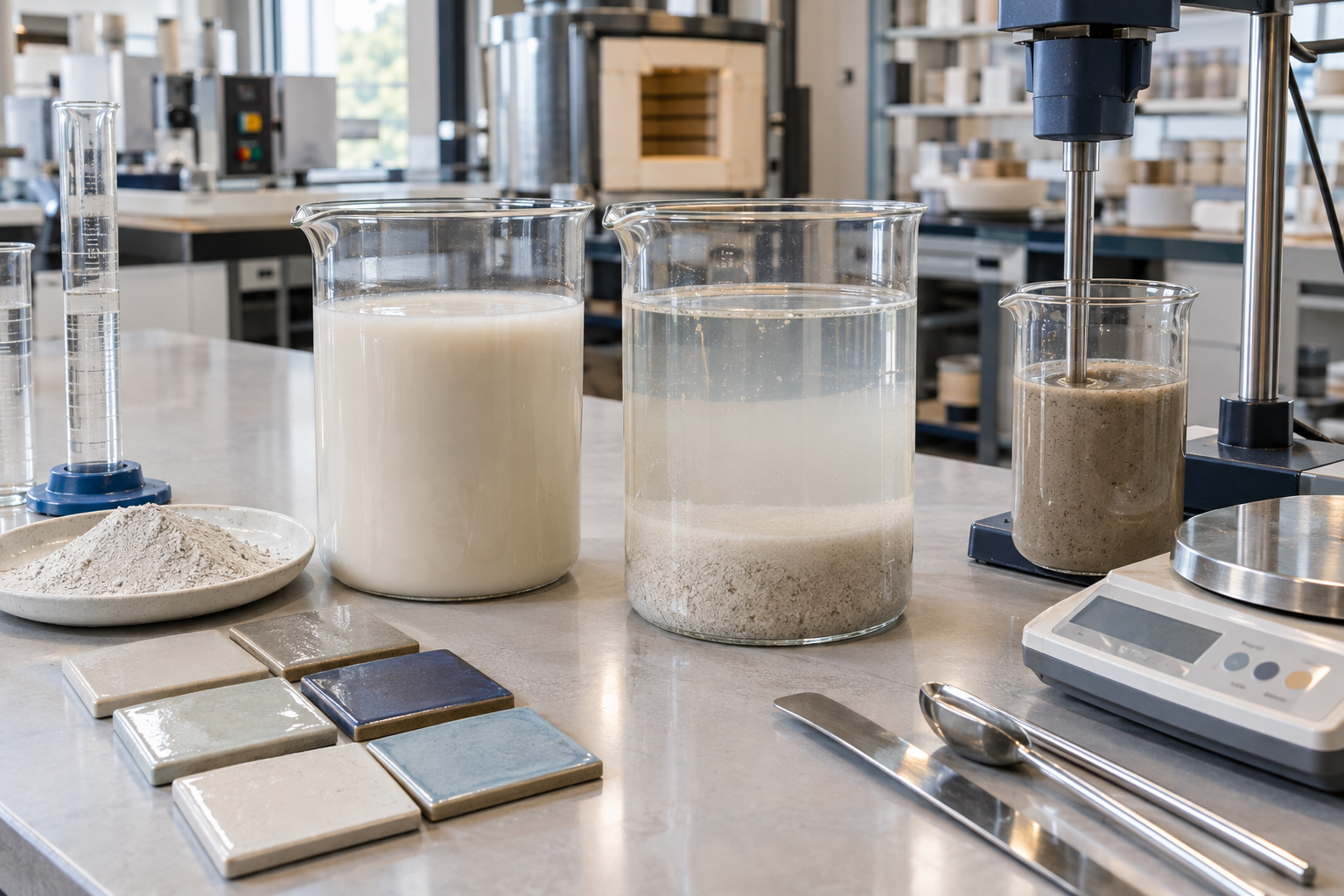
A ceramic frit can be chemically well formulated and still be difficult to process if its particles settle rapidly in the slurry. Bentonite can improve ceramic frit suspension and stability by swelling in water, increasing low-shear structure, and helping keep fine and relatively dense particles dispersed between mixing and application. The important part is dosage: too little may leave the frit slurry unstable, while too much can make the glaze slow to dry, harder to apply, or more prone to drying defects.
That balance matters in tile glazes, ceramic coatings, enamels, and other frit-based formulations where consistent solids distribution is essential. Research on glaze slurries has also shown that adding bentonite can substantially improve suspension stability; one 2023 study reported a marked improvement in glaze-slurry stability at 1 wt% bentonite under its tested formulation. ScienceDirect
The practical lesson is simple: use bentonite as a targeted rheology and suspension aid, not as a substitute for proper glaze formulation.
Ceramic frit is produced by melting a carefully selected mixture of raw materials and rapidly cooling the melt to create a glassy material. The resulting frit is then milled to the particle size needed for the intended ceramic process.
Once that frit is mixed with water and other glaze ingredients, the system becomes a suspension rather than a simple solution. Solid particles are dispersed through a liquid, and gravity is constantly trying to pull those particles toward the bottom of the tank or bucket.
That creates several familiar production problems:
Hard settling is particularly troublesome. A slurry that separates into a soft sediment may be easy to remix, but a compact layer at the bottom can require extended high-shear mixing or manual intervention.
Bentonite addresses part of this problem by changing the physical structure of the liquid phase. Its extremely fine particles hydrate and swell in water, creating a more structured suspension that can slow sedimentation. Ceramic Arts Network describes bentonite as a fine-particle clay with colloidal properties that is commonly used to prevent glaze ingredients from settling and forming hard pan. Default
Bentonite is primarily useful as a suspending and rheology-modifying clay in this application. It is not there to make the frit melt better, and it should not be treated as a universal solution for every glaze stability problem.
When hydrated, bentonite absorbs water and develops a network of very fine clay particles. That network increases resistance to particle movement at rest. In practical terms, the slurry can become better able to hold frit and other solid ingredients in place between mixing cycles.
This behavior is related to the charged surfaces and very high specific surface area of smectite minerals. Bentonite suspensions can display strong time-dependent and shear-dependent flow behavior, which is why the material has long been studied as a rheology modifier. ACerS
For a frit slurry, that can provide several useful effects:
The final result depends heavily on the complete formulation. Frit composition, particle-size distribution, clay content, water quality, pH, dissolved salts, deflocculants, organic additives, and mixing history can all change the behavior of the same bentonite addition.
The easiest way to understand the mechanism is to separate what happens at rest from what happens during mixing and application.
A useful glaze slurry cannot behave like plain water. If it did, dense frit particles would settle quickly.
Hydrated bentonite introduces a fine-particle network into the liquid. At low shear, that structure provides resistance to sedimentation. The goal isn't to stop all particle movement permanently. Instead, it is to make settling slow enough that the slurry remains practically usable between agitation cycles.
This is one reason bentonite can be effective at relatively low additions compared with ordinary clay additions. Ceramic Arts Network notes that bentonite is commonly used in small quantities because its fine particles and swelling behavior provide strong suspension effects. Default +1
A ceramic slurry also needs to move. It has to pass through pumps, hoses, spray equipment, screens, or other application systems depending on the manufacturing process.
A well-designed bentonite-containing suspension can show shear-thinning or thixotropic behavior. In simple terms, it can be relatively structured while standing still and become easier to move when shear is applied.
That distinction is important. The best suspension is not necessarily the thickest suspension. A bucket of extremely viscous material may settle slowly but still be unsuitable for industrial application.
Ceramic suspension rheology is influenced by variables such as deflocculant concentration, pH, and organic additives, so viscosity should always be evaluated under the actual processing conditions rather than by relying on one number alone. ACerS
One of the less obvious issues with ceramic frit is that frit particles aren't always completely inert once placed in water.
Research into glaze suspensions has shown that frits can release cations into the aqueous phase because of their solubility. Those released ions can change the rheology of the suspension as it ages. SciSpace
That matters because a slurry that looks correct immediately after milling may not behave exactly the same several hours later.
You may notice:
Bentonite can improve the structural stability of the system, but it does not eliminate these chemical interactions. If a formulation changes significantly with age, investigate the whole slurry rather than simply increasing bentonite.
There is no single dosage that works for every ceramic frit slurry. The correct level depends on the frit chemistry, solids loading, existing clay content, particle size, application method, water chemistry, and desired rheology.
For small glaze formulations, published ceramic guidance commonly places bentonite additions in the approximate 0.25% to 2% range based on dry glaze ingredients, with testing at the lower end first. Default +1
A 2023 study on glaze-slurry suspension stability reported significant improvement with 1 wt% bentonite in the formulation investigated, but that result should not be treated as a universal industrial recipe. Different frit systems can respond very differently. ScienceDirect
A sensible development approach is to test a small series such as:
| Trial | Bentonite addition | Purpose |
|---|---|---|
| A | 0.25% | Check minimum useful suspension effect |
| B | 0.50% | Compare settling and flow |
| C | 0.75% | Evaluate intermediate structure |
| D | 1.00% | Check stronger suspension and rheology |
| E | 1.50% | Establish whether additional benefit remains |
| F | 2.00% | Define the upper practical range for the formulation |
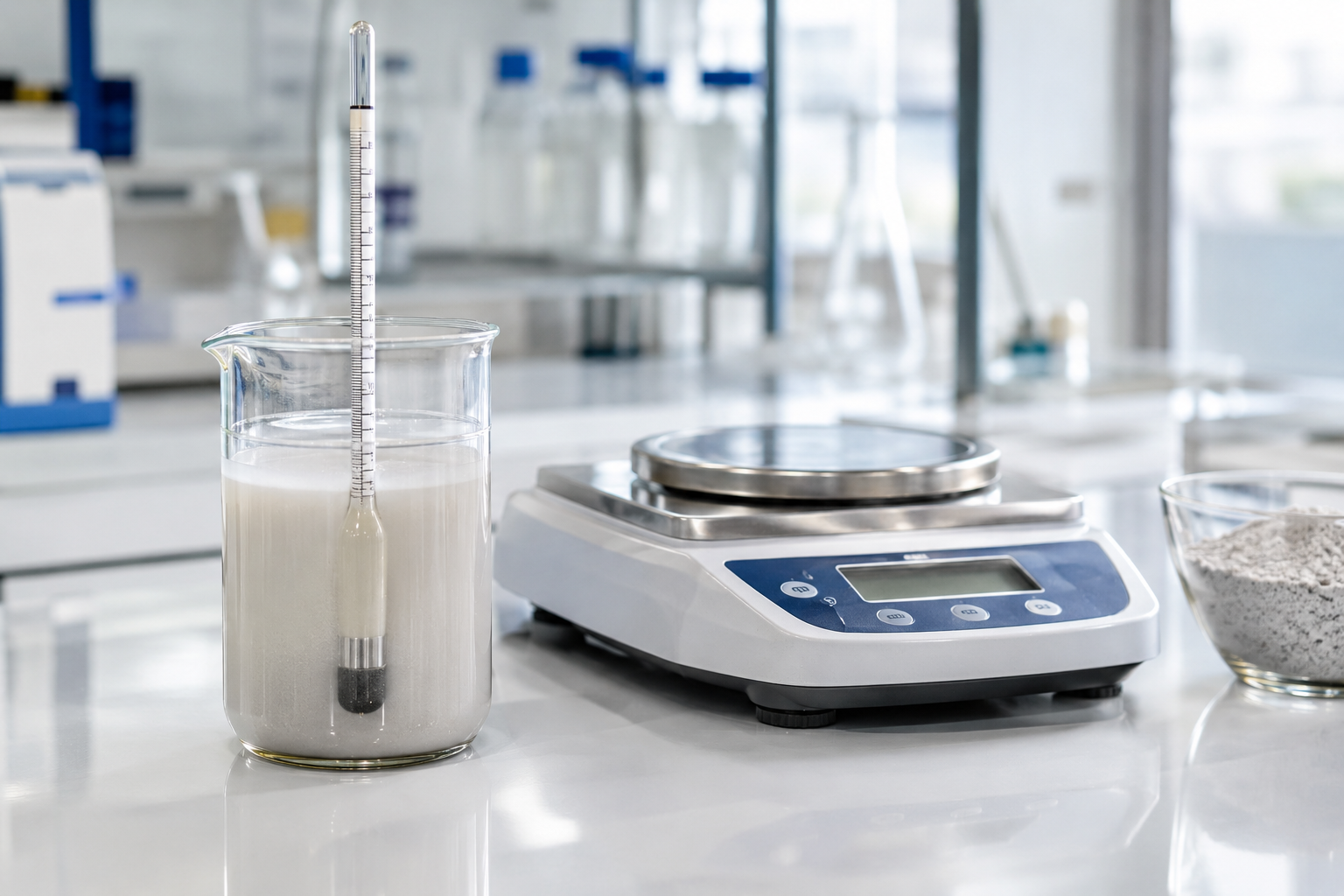
These are screening levels, not guaranteed specifications. If your existing glaze already contains enough clay or another suspension aid, the required bentonite level may be much lower.
The goal is to find the lowest addition that gives adequate stability without creating unwanted application or firing effects.
This is one of the most common mistakes in suspension troubleshooting.
Bentonite absorbs a great deal of water because of its fine particle size and swelling behavior. As the addition rises, slurry viscosity and water demand can increase substantially.
At excessive levels, you may see:
Ceramic Arts Network recommends using bentonite sparingly because excessive amounts can slow drying and contribute to cracking; its guidance also notes that bentonite can introduce iron that may matter in light-colored fired surfaces. Default +1
This is particularly important for white, transparent, translucent, and other appearance-sensitive ceramic products. A bentonite that works well for a conventional colored glaze may not be appropriate for a high-whiteness formulation.
Bentonite and kaolin can both contribute to suspension, but they behave differently.
Kaolin is already a common component of many ceramic glaze formulations and contributes alumina and silica to the fired glaze. Bentonite is much more powerful as a suspension aid per unit addition, but it also brings its own chemistry and drying behavior.
A useful distinction is this: kaolin can be part of the glaze chemistry as well as the suspension system, while bentonite is often added specifically to correct or strengthen suspension.
| Factor | Bentonite | Kaolin |
|---|---|---|
| Main suspension role | Strong suspending aid | Suspension plus glaze chemistry |
| Water swelling | High | Relatively low |
| Typical addition as targeted suspension aid | Low | Higher |
| Effect on viscosity | Can be strong | Usually more moderate per unit addition |
| Contribution to fired chemistry | Yes | Yes, often intentionally |
| Drying shrinkage | Relatively high | Lower than bentonite |
| Risk from excessive addition | Slow drying, cracking, rheology changes | Can alter glaze chemistry and surface behavior |
The best choice depends on what the glaze already contains. If additional alumina is undesirable, a small bentonite addition may be more appropriate than adding several percentage points of another clay.
Sodium bentonite is valued for its strong hydration and swelling behavior. Those properties make it useful where suspension and water interaction are important.
However, the phrase sodium bentonite alone doesn't tell you everything you need to know about a ceramic-grade material. Mineral purity, montmorillonite content, particle size, exchangeable ions, moisture, and processing history can all affect performance.
For appearance-sensitive ceramic applications, the chemical composition also matters. Iron-bearing bentonite may affect fired color, particularly in white or transparent systems.
That is why a supplier specification should be considered alongside an application trial rather than used as a substitute for testing.
Poor dispersion can make a good bentonite look ineffective. The material needs enough opportunity to hydrate and develop its suspension properties.
A practical laboratory workflow is:
Prehydration can be especially useful when you need predictable bentonite performance. It also makes it easier to compare the actual dry bentonite dosage between laboratory batches.
Don't rely on one viscosity reading.
A useful suspension test should combine settling behavior, viscosity, remixability, application behavior, and fired performance.
Record slurry density after mixing. A change in density can indicate differences in solids loading or water content.
Use the same instrument, spindle or measurement method, temperature, and sample preparation for every comparison. If the plant uses a particular application viscosity range, test around that actual operating window.
Place equal volumes of different formulations in transparent graduated containers. Record the height of the clear layer and sediment over time.
The exact numbers will depend on the formulation, so the useful comparison is between your controlled trials rather than an arbitrary universal target.
A slurry that settles slightly but becomes uniform with a short mixing cycle may be more practical than one that remains visually stable but forms a hard compact sediment when eventually disturbed.
Look for spray pattern, film thickness, leveling, edge build-up, dripping, and drying time. A suspension aid should support the process rather than create a new processing problem.
Always compare the fired result. Bentonite changes the unfired suspension, but its mineral content becomes part of the glaze chemistry.
Check color, gloss, opacity, surface defects, adhesion, and any crawling or pinholing relevant to your product.
A slurry can have a high measured viscosity and still show undesirable settling under particular conditions.
Why? Because viscosity measured at one shear rate doesn't completely describe the low-shear structure responsible for holding particles at rest.
This is why rheology matters more than a single viscosity number. Yield behavior, thixotropy, particle interactions, ionic strength, and the presence of organic additives can all influence how a ceramic suspension behaves.
A 1963 study of bentonite suspensions documented concentration-, medium-, pH-, temperature-, and shear-history-dependent rheological behavior. ACerS
For industrial development, that means your QC method should imitate the real process as closely as practical.
This issue can surprise even experienced formulators.
Ceramic glazes often contain soluble materials, and frits themselves can release ions into water. Those ions can change particle interactions and alter the rheology of the slurry over time. SciSpace
Deflocculants create another layer of complexity. A deflocculated suspension may flow at a much lower viscosity than a flocculated one, even though both contain the same amount of solids.
If a glaze settles despite apparently adequate clay content, don't immediately add more bentonite. Check:
Research on ceramic glaze rheology has shown that ionic additives can affect viscosity and stability through changes in particle interactions, with both underdosing and overdosing producing undesirable rheological behavior in some systems. DOI
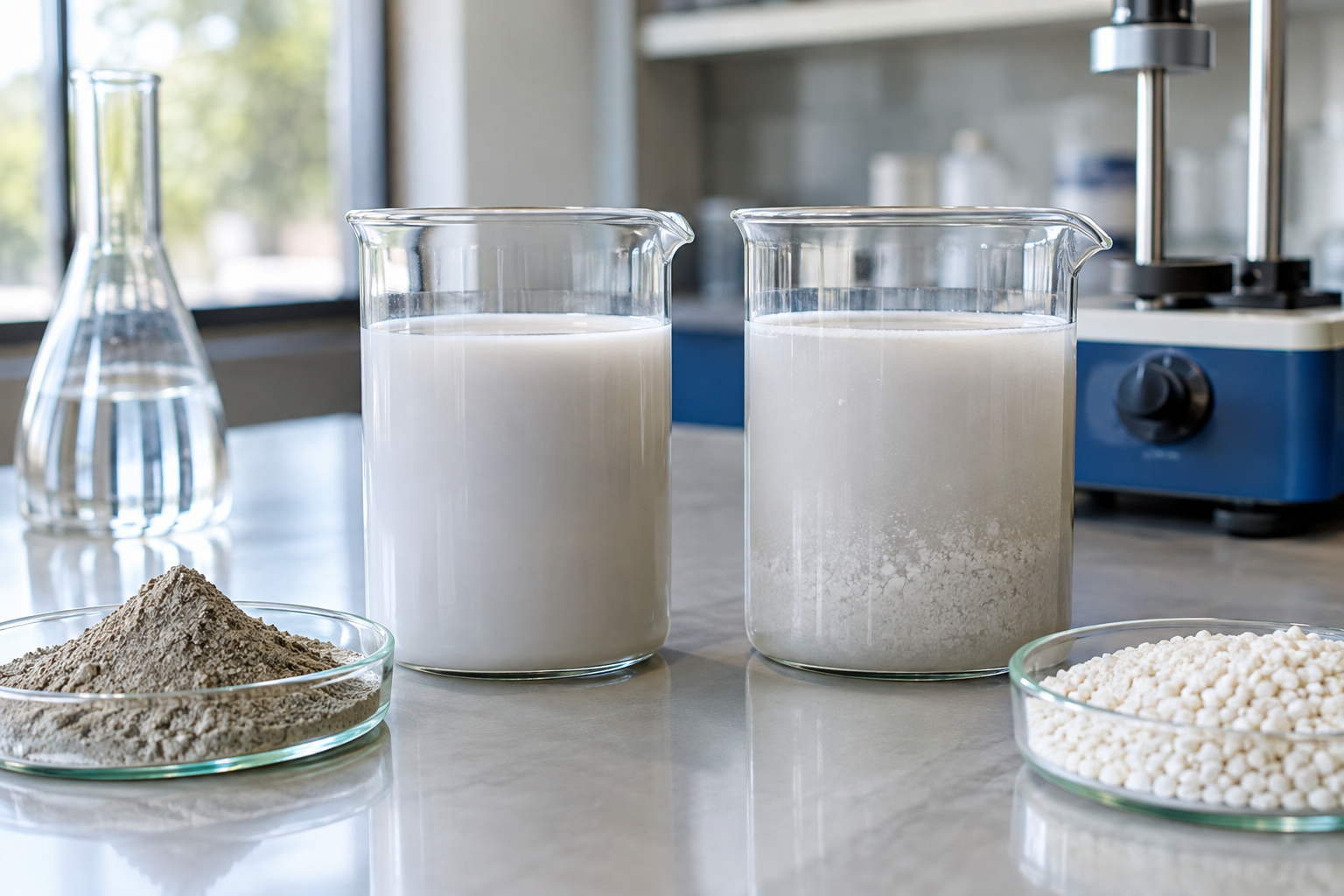
Suppose a glaze becomes thick after bentonite is added. The easiest response may seem to be adding water.
That can backfire.
Adding water reduces solids concentration and changes the application thickness. It can also change drying behavior, coverage, settling rate, and firing response.
Instead, first ask whether the bentonite level is actually necessary and whether it has been fully hydrated and dispersed.
If the process requires a specific solids content, maintain that solids target during development. Adjust rheology through controlled formulation changes rather than continuously diluting the slurry.
The frit particle-size distribution affects both settling and application behavior.
Coarser particles generally have a greater tendency to settle than very fine particles. At the same time, excessive milling can change surface area, water demand, and rheology.
Bentonite doesn't eliminate the need to control frit milling. It is part of the suspension system, not a replacement for particle-size control.
If a plant experiences sudden settling after a change in milling conditions, investigate the particle-size distribution before changing the bentonite dosage.
A bentonite that works well in one glaze may be unsuitable in another.
Consider a transparent tile glaze, a white opaque glaze, and a darker decorative coating. All three may need suspension control, but their tolerance for iron, water demand, viscosity, and fired chemistry can be very different.
A ceramic-grade bentonite should therefore be selected according to the complete formulation and final firing requirements.
For white-firing products in particular, low impurity levels and predictable fired behavior may matter as much as suspension efficiency.
Yes, potentially, and this is one of its most useful advantages when used at a low dosage.
If the formulation already contains the clay needed for its fired chemistry but still settles too quickly, adding a small amount of bentonite can strengthen suspension without requiring a large increase in kaolin or ball clay.
But the phrase without changing chemistry should not be interpreted literally. Bentonite is a mineral raw material, so every addition contributes oxides and impurities to the final fired composition.
The smaller the addition, the easier it is generally to control that effect. For a tightly specified industrial glaze, calculate the bentonite contribution rather than treating it as chemically neutral.
Bentonite is only one tool available to a ceramic formulator.
| Suspension approach | Main benefit | Main trade-off |
|---|---|---|
| Bentonite | Strong suspension at low addition | Can increase viscosity and drying shrinkage |
| Kaolin | Suspension plus alumina and silica contribution | Higher addition may alter glaze chemistry |
| Ball clay | Suspension and binding | Can affect color and fired chemistry |
| CMC or cellulose gum | Suspension and green strength | Organic additive affects application and burnout behavior |
| Synthetic smectite | High suspension efficiency and controlled chemistry | Usually higher material cost |
| Deflocculant adjustment | Can improve flow at high solids loading | Excess or incorrect dosage can destabilize suspension |
Commercial ceramic suspension products may also combine smectite clay with cellulose derivatives. Such blends are designed to provide suspension, viscosity control, and improved unfired glaze handling. Vanderbilt Minerals
The choice should follow the manufacturing problem. If the issue is primarily hard settling, a suspension aid may be appropriate. If the issue is excessive viscosity, simply adding more suspending clay is unlikely to be the right answer.
A stable bucket is only half the job. The glaze still has to behave properly on the ceramic surface.
After application, water begins leaving the glaze layer. Bentonite's high water-holding capacity can slow this process, especially at higher additions.
That may affect:
Ceramic Arts Network notes that excessive bentonite can make a glaze dry too slowly and that small additions are generally preferred. Default +1
For automated production, drying time deserves special attention. A formulation that works on a laboratory tile may not behave the same way on a high-speed production line where the time between glazing and subsequent handling is tightly controlled.
A well-controlled ceramic frit slurry should not simply look thick.
You want a system that:
That is why a formulation should be judged as a complete process rather than by one laboratory measurement.
If your ceramic frit slurry is unstable, start with the symptom rather than the additive.
| Problem | What to investigate first | Possible bentonite role |
|---|---|---|
| Rapid settling | Solids loading, particle size, clay level | Increase suspension structure cautiously |
| Hard pan at tank bottom | Clay balance, soluble salts, deflocculation | Test a small bentonite addition |
| Slurry too thick | Bentonite level, clay level, water, deflocculant | Reduce or rebalance bentonite |
| Poor sprayability | Viscosity profile and shear response | Optimize rheology rather than simply diluting |
| Slow drying | Bentonite and organic binder level | Reduce excessive water-holding structure |
| Drying cracks | Total clay and bentonite content | Reduce bentonite and reassess formulation |
| Fired color change | Bentonite impurities and total addition | Use a cleaner grade or lower dosage |
| Stability changes with age | Frit dissolution and soluble ions | Investigate chemistry before adding more clay |
This approach prevents the common cycle of adding more bentonite, adding more water, changing viscosity, and then adding another chemical to correct the resulting problem.
For industrial ceramic use, material consistency is critical. Ask for technical information that helps you connect the mineral to the actual process.
Useful parameters may include:
The most important specification depends on the glaze. A transparent or white glaze may place more emphasis on iron and other impurities, while a high-solids industrial slurry may place more emphasis on suspension efficiency and rheology.
For procurement, it is also worth requesting a representative sample and running it against the material currently used in production. A direct side-by-side test is more informative than choosing solely from a generic grade description.
Axewelledge supplies bentonite for industrial applications and can be relevant when ceramic manufacturers need a consistent mineral supply for formulation trials and production. The appropriate grade should be selected against the customer's glaze chemistry, appearance requirements, and processing conditions rather than by application name alone.
If you're troubleshooting an unstable frit slurry, a small controlled trial can answer more than a large production adjustment.
Prepare several equal dry batches using the same frit, existing clay, additives, and water content. Change only the bentonite concentration. Keep the mixing procedure and temperature as consistent as possible.
Then record:
This creates a response curve rather than a guess.
You may find that 0.5% gives nearly the same practical stability as 1%, or that increasing from 1% to 1.5% creates much more viscosity without a useful improvement in settling resistance. That is the kind of information a plant can actually use.
It can be tempting to think of settling as a storage problem. It isn't.
Uneven suspension can affect the entire coating process because the composition reaching the ceramic surface may change over time. If the slurry becomes richer or poorer in particular solids during a production run, coating weight and fired properties can drift.
For high-volume ceramic manufacturing, consistency is often more valuable than simply achieving a low initial viscosity.
A stable slurry supports repeatable application. Repeatable application supports more consistent firing results. That connection is why suspension control deserves attention during formulation development, raw-material qualification, and routine process control.
Bentonite can be an effective way to improve ceramic frit suspension and stability because its hydrated fine particles create structure in the water phase, slow settling, and influence the rheology of the slurry. Research and practical ceramic guidance support its use as a suspension aid, but they also show why dosage and formulation context matter. ScienceDirect +1
The strongest formulation is rarely the one with the most bentonite. It's the one that uses enough bentonite to maintain suspension while preserving flow, drying behavior, fired chemistry, and application consistency.
Start with controlled small-scale trials. Keep the bentonite addition as the variable. Measure settling, viscosity, remixability, drying, and fired performance together. If the slurry still changes with age, investigate frit chemistry, soluble ions, deflocculation, water quality, and particle size before increasing the clay level.
For manufacturers sourcing bentonite for ceramic frits and related industrial formulations, Axewelledge can help identify a suitable material based on the required performance and specification. The useful starting point is not simply asking for bentonite; it's defining the slurry problem the bentonite needs to solve.













Have questions about our products? We're here to help!