Axewelledge, a leading exporter from India, specializes in high-quality Bentonite. With a commitment to excellence, we supply premium Bentonite to the Middle East and Southeast Asia markets.


North Angle Complex, 304,
150 Feet Ring Rd, Opposite Ambedkar Nagar BRTS Stop,
Madhav Park, Punit Nagar,
Mavdi, Rajkot, Gujarat 360004
© Axewelledge 2026, All Rights Reserved.
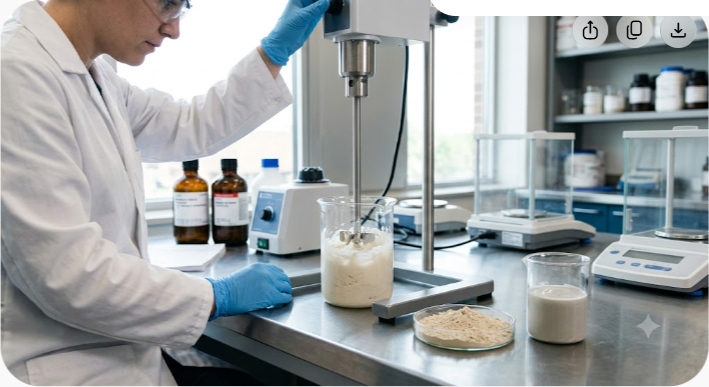
Yes. Bentonite can be used in adhesive formulations, but the right grade and dispersion method depend heavily on the adhesive chemistry. In water-based systems, sodium bentonite can provide viscosity, yield stress, thixotropy, and suspension. Calcium bentonite can be useful where a lower swelling response and mineral body are preferred. Solvent-borne and some reactive systems generally require an organophilically modified bentonite, commonly called an organoclay.
The important point is that bentonite isn't simply a cheap filler. In the right formulation, its plate-like particles create a structured network that changes how an adhesive flows, spreads, holds fillers in suspension, and resists sag after application. That can be valuable in construction adhesives, mastics, paper and packaging adhesives, woodworking products, sealant-like formulations, and selected industrial bonding systems.
There is no universal loading level or single bentonite grade that works across every adhesive. Polymer type, water quality, pH, ionic strength, solids content, filler package, mixing equipment, and the required bond properties all affect the result. A grade that performs well in a water-based adhesive may be unsuitable for a solvent-borne system.
This guide explains how bentonite works in adhesives, how sodium, calcium, and organoclay grades differ, where they fit into common adhesive chemistries, how to incorporate them correctly, and which formulation problems deserve attention during development.
Bentonite is a naturally occurring clay dominated by montmorillonite, a layered 2:1 phyllosilicate. Its fine plate-like particles have a large effective surface area and interact strongly with water or, after suitable chemical modification, with selected organic media.
In an adhesive, those characteristics can produce several useful effects:
These effects are closely connected. For example, the same structure that improves anti-settling behaviour can also make an adhesive harder to pump if the yield stress becomes excessive. Good formulation work therefore focuses on the balance between structure at rest and flow under application shear.
Bentonite is primarily a formulation aid rather than a universal bond-strength enhancer. Adding more clay does not automatically produce a stronger adhesive.
The final bond depends on the adhesive polymer, substrate, surface preparation, curing or drying conditions, moisture, formulation compatibility, and the amount and type of mineral present. Bentonite may improve practical performance by reducing sag, controlling shrinkage, improving application consistency, or keeping components uniformly distributed. At excessive levels, however, mineral loading can dilute the binder and may reduce flexibility or cohesive strength.
For that reason, bentonite should be evaluated against the complete adhesive specification rather than against viscosity alone.
The exchangeable cation associated with montmorillonite has a major influence on how bentonite behaves in water. Sodium bentonite generally has greater swelling and viscosity-building capacity than calcium bentonite, although actual performance varies considerably with mineral composition, montmorillonite content, particle size, processing, and cation exchange capacity.
Sodium bentonite is usually the first material to investigate when a water-based adhesive needs substantial structure from a relatively small clay addition.
When dispersed in water, sodium bentonite hydrates and its layers separate to a greater extent than many calcium-dominated clays. Properly dispersed particles can interact to form a three-dimensional structure that contributes yield stress and thixotropy.
Typical advantages include:
The actual swelling response should always be confirmed using the supplier's technical data and a formulation trial. Statements such as a fixed number of times the clay will swell are too broad to use as a design rule because water chemistry and clay quality can change the result substantially.
Calcium bentonite generally has a lower swelling response in water than sodium bentonite. It can still contribute body, suspension, and mineral content, but it usually isn't the first choice when maximum aqueous viscosity and yield stress are the primary objectives.
Calcium bentonite can be considered when the formulation calls for:
Because natural deposits vary, calcium bentonite should not be selected solely by its name. Montmorillonite content, exchange capacity, moisture, particle size, soluble salts, and other mineral constituents can materially affect adhesive performance.
Raw sodium and calcium bentonites are naturally hydrophilic. That makes them well suited to water-based systems but limits their direct use in many non-polar organic media.
Organoclay is produced by modifying the clay surface, commonly through ion exchange with organic cations such as quaternary ammonium compounds. The treatment changes the clay's affinity for organic media and allows suitable grades to develop a thixotropic structure in selected solvent-borne, oil-borne, and reactive resin systems.
Not every organoclay works in every solvent or resin. Solvent polarity, resin chemistry, activator requirements, temperature, shear history, and the particular surface treatment all matter. The supplier's recommended activation procedure should therefore be treated as part of the grade specification.
| Property | Sodium Bentonite | Calcium Bentonite | Organically Modified Bentonite |
|---|---|---|---|
| General affinity | Hydrophilic | Hydrophilic | Organophilic |
| Main application medium | Water and aqueous systems | Water and aqueous systems | Selected organic media and resins |
| Water swelling | Generally high | Generally lower | Not intended for conventional aqueous swelling |
| Rheology potential | High in suitable aqueous systems | Moderate, grade dependent | High in compatible organic systems |
| Common role | Thickening, yield stress, suspension | Body, mineral loading, moderate rheology | Thixotropy, anti-sag, suspension |
| Dispersion requirement | Thorough hydration and shear | Thorough wetting and dispersion | Wetting, shear, and sometimes activation |
Thixotropy is one of the most useful reasons to consider bentonite in an adhesive. A thixotropic material becomes less resistant to flow when shear is applied and gradually rebuilds structure after the shear is removed.
The behaviour is particularly useful when an adhesive must satisfy two apparently conflicting requirements: it should flow easily during application, but it shouldn't run after it has been applied.
In a suitable water-based formulation, dispersed bentonite platelets interact to form a temporary three-dimensional network. Under mixing, pumping, brushing, spraying, or trowelling, that structure is disrupted and the apparent viscosity falls. Once the shear is reduced, the structure begins to rebuild.
The exact recovery rate matters. An adhesive that rebuilds too quickly may feel difficult to spread. One that rebuilds too slowly may sag before the substrates are joined. This is why viscosity measured at a single shear rate doesn't tell the whole story.
Formulators sometimes use the words viscosity and yield stress interchangeably, but they describe different aspects of flow behaviour.
Viscosity describes resistance to flow under a given shear condition. Yield stress describes the stress required to initiate significant flow in a structured material.
For suspension and anti-sag applications, yield stress can be particularly important. A material with sufficient yield stress can hold mineral particles or an adhesive bead in place until an applied force exceeds that structural threshold.
The target isn't necessarily the highest possible yield stress. Excessive structure can hurt pumpability, extrusion, wetting, and application feel. The useful formulation window is the point where the adhesive stays stable at rest but still flows predictably during use.
Bentonite can raise low-shear viscosity and build structure in aqueous adhesive systems. This is useful when a thin liquid needs to become a more controlled paste, gel, or mastic without relying entirely on synthetic polymeric thickeners.
The effect depends on clay concentration and grade, but also on the surrounding formulation. Electrolytes, surfactants, polymers, pigments, fillers, and pH can all influence clay dispersion and network formation.
Many industrial adhesives contain mineral fillers or pigments that are denser than the continuous phase. Without sufficient structure, these particles can migrate downward during storage.
A bentonite-based network can increase the low-shear structure of the adhesive and reduce the rate at which particles settle. The improvement is often most useful when the goal is soft, easily reversible settling rather than simply achieving a high viscosity number.
A practical storage test should still be performed. No rheology modifier can guarantee indefinite suspension under every temperature, container geometry, and storage condition.
Vertical application is one of the clearest use cases for thixotropic clay. Construction mastics, sealant-like adhesives, wall adhesives, and other products may need to remain in a bead or film after application.
Bentonite can increase resistance to flow under low shear, helping reduce sag. The formulation still needs enough workability to spread or extrude properly. If the clay level is pushed too high, the product can become stringy, difficult to trowel, or hard to dispense.
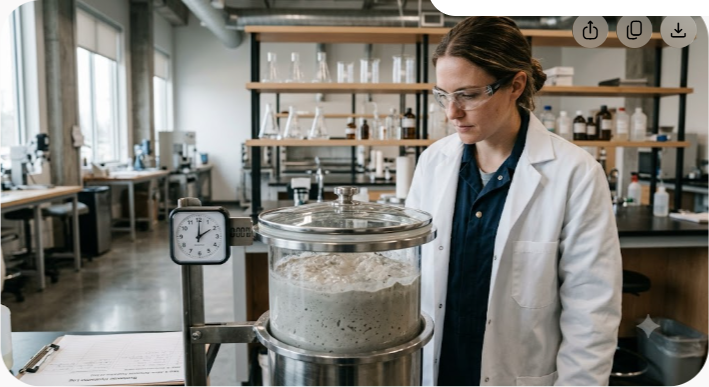
In practical adhesive development, the way a product feels during application can be almost as important as its laboratory viscosity.
A properly structured adhesive can have a smoother transition between high and low shear. This can improve brushing, trowelling, bead formation, or spreading depending on the product. The result should be judged with the actual application equipment rather than with a laboratory spindle test alone.
Bentonite can interact strongly with water, which can affect drying behaviour and water distribution in a formulation. In cementitious and some water-based systems, this may help control workability and water mobility.
However, it is too broad to claim that bentonite always extends open time. Open time depends on evaporation rate, humidity, temperature, substrate absorption, adhesive formulation, film thickness, and surface skin formation. Bentonite may contribute to the desired behaviour in some systems, but it should be demonstrated experimentally rather than assumed.
Bentonite can also provide mineral solids where the adhesive can tolerate them. This can modify density, solids content, body, shrinkage behaviour, and cost.
The trade-off is important. Increasing mineral loading reduces the relative proportion of polymer binder unless the formulation is redesigned. That can affect flexibility, wet adhesion, peel strength, impact resistance, and cohesive strength.
Different adhesive chemistries require different approaches. Grade selection should begin with the continuous phase and the required rheological profile, not with the mineral alone.
Water-based adhesives are the most straightforward environment for natural bentonite because the clay is naturally compatible with water.
Sodium bentonite can be used as a rheology modifier or suspension aid in selected PVAc, EVA, starch, dextrin, and acrylic systems. It may complement cellulose ethers, associative thickeners, or other rheology modifiers when a particular balance of low-shear structure and application flow is required.
A practical starting range might be around 0.5% to 3% of total formulation weight for some systems, but this should be treated only as a development range, not a universal specification. Highly purified or high-efficiency grades may require less, while other clays may need more.
The formulator should evaluate:
Bentonite can be considered as part of the mineral and rheology package in selected cementitious adhesives. These products already contain large quantities of mineral solids, so clay selection must account for the interaction between bentonite, cement, sand, cellulose ethers, redispersible polymer powders, and mixing water.
A suitable clay may contribute water management, body, workability, and resistance to slip. However, excessive swelling or water demand can make the mortar sticky and can interfere with the intended consistency.
Tile adhesive development should therefore assess wet density, open time, slip, pot life, workability, water retention, tensile adhesion, and other requirements relevant to the applicable product standard.
Natural sodium bentonite isn't generally suitable as a direct thixotrope for non-polar solvent-borne adhesives. Organoclay is normally the relevant material when clay-based rheology control is required in systems based on compatible organic solvents and polymers.
Organoclay may be used in contact adhesives containing elastomers such as neoprene or SBS, but performance depends strongly on the solvent blend and surface treatment of the clay.
Activation is also grade specific. Some organoclays require a polar activator to develop their full rheological effect, while self-activating grades are designed to reduce or eliminate that requirement. The supplier's technical instructions should determine the addition sequence and activator level.
Organoclay can provide thixotropy in selected epoxy formulations. This is useful when the product must be applied as a paste or maintained in a vertical gap without excessive slump.
Compatibility with the resin, hardener, reactive diluents, pigments, fillers, and other additives needs to be checked. Moisture control is also important because water can interfere with some adhesive chemistries and can affect clay dispersion.
A common development mistake is to optimise Part A viscosity without evaluating the mixed adhesive. A two-component system must be tested after mixing because the hardener can substantially change rheology, cure kinetics, and final mechanical properties.
Some reactive polyurethane and silane-terminated systems use organophilic rheology modifiers, including appropriately selected organoclays. The chemistry is sensitive, though, so the clay must be compatible with the resin and curing mechanism.
Moisture, surface treatment, residual salts, and other impurities should be considered carefully. The right material may provide useful anti-sag structure without compromising cure or adhesion, but that outcome needs formulation-specific validation.
The use of bentonite or surface-treated clay in hot melt adhesives is more specialised than its use in water-based systems. The clay must disperse adequately in the molten polymer, and its presence can alter melt viscosity, softening behaviour, thermal stability, and mechanical properties.
In EVA, polyamide, or polyolefin hot melts, a clay addition should therefore be assessed with melt-flow behaviour, application temperature, open time, set time, peel strength, shear strength, and heat resistance. A formulation that becomes more viscous isn't automatically a better hot melt adhesive.
Bentonite competes with several established rheology modifiers. The best choice depends on the formulation rather than on a simple ranking of materials.
| Attribute | Sodium Bentonite | Organoclay | Fumed Silica | Cellulose Ethers | Synthetic Acrylic Thickeners |
|---|---|---|---|---|---|
| Typical medium | Aqueous | Selected organic systems | Waterborne and solvent/reactive systems, grade dependent | Mainly aqueous | Mainly aqueous |
| Main rheology effect | Yield stress and thixotropy | Strong thixotropy | Strong structure and thixotropy | Thickening and pseudoplasticity | Thickening, often pseudoplastic or associative |
| Suspension support | High in suitable systems | High in suitable systems | High | Moderate, formulation dependent | Moderate to high, formulation dependent |
| Material form | Mineral powder | Modified mineral powder | Synthetic silica powder | Polymer powder or solution | Polymer dispersion or solution |
| Dispersion considerations | Hydration and shear | Wetting, shear, possible activation | High-shear dispersion | Hydration or dissolution | pH and polymer compatibility can matter |
| Main strength | Efficient mineral-based structure in aqueous systems | Organic-phase thixotropy | Strong rheology at low additions | Flexible water-based viscosity control | Tailored rheology and formulation flexibility |
| Main limitation | Sensitive to water chemistry and formulation interactions | Requires compatible organic chemistry | Higher material cost and dust handling concerns | Can be sensitive to formulation and biological conditions | Cost and chemistry-specific compatibility |
Fumed silica, cellulose ethers, acrylic polymers, and bentonite shouldn't be treated as interchangeable ingredients. In some formulations, a combination of two modifiers provides a better balance than increasing one material alone.
Dispersion is one of the most important practical factors in bentonite adhesive development. Adding dry clay directly to a finished adhesive often creates lumps or partially hydrated particles. Those agglomerates can produce inconsistent viscosity and a gritty or uneven product.
Water quality matters. Dissolved salts and hardness ions can influence clay hydration and swelling. If the formulation uses process water with significant hardness or conductivity, compare it with softened or demineralised water during development.
For many aqueous systems, preparing a separate clay slurry or pre-gel provides better control than adding the powder directly to the finished adhesive.
A development concentration around 5% to 10% clay in water can be investigated, depending on the grade and equipment. Add the powder gradually to well-agitated water so that individual particles become wetted rather than forming dry centres inside larger lumps.
Use equipment capable of dispersing the selected grade. A high-speed dissolver or suitable rotor-stator system may be appropriate depending on batch size and formulation viscosity.
The exact mixing time and tip speed should come from process trials rather than being treated as universal numbers. Different impeller designs and vessel geometries deliver different levels of shear.
Some bentonite grades continue to hydrate after initial mixing. Allowing the clay slurry to mature before final blending can improve consistency, particularly when the product's viscosity depends strongly on complete hydration.
The required time may range from minutes to several hours depending on the grade, water chemistry, temperature, solids concentration, and process. Measure viscosity rather than relying solely on elapsed time.
Once the clay dispersion is uniform, incorporate the polymer emulsion, resin, tackifier, fillers, pigments, defoamer, preservative, and other additives according to the formulation sequence.
Some polymers and surfactants can interfere with clay structure. For that reason, adding bentonite before or after certain components can produce very different results.
Direct addition can work when the formulation and equipment allow it, but the clay should normally enter under conditions that provide rapid wetting and sufficient dispersion.
A practical sequence is:
Organoclay processing differs from natural bentonite processing because the objective is to develop an organophilic clay structure in a compatible organic phase.
A general development sequence is:
There is no universal activator ratio for organoclay. A fixed solvent-to-activator or activator-to-clay ratio copied from another product can produce poor results. Follow the technical data for the exact grade being used.
A bentonite grade doesn't behave in isolation. The surrounding formulation can change its performance significantly.
Hardness, dissolved salts, and conductivity can affect swelling and clay network formation. If a production plant uses water from different sources, viscosity drift can sometimes be traced back to changes in water chemistry.
pH can influence both clay behaviour and the polymers or surfactants surrounding it. The useful pH range should therefore be established experimentally for each formulation.
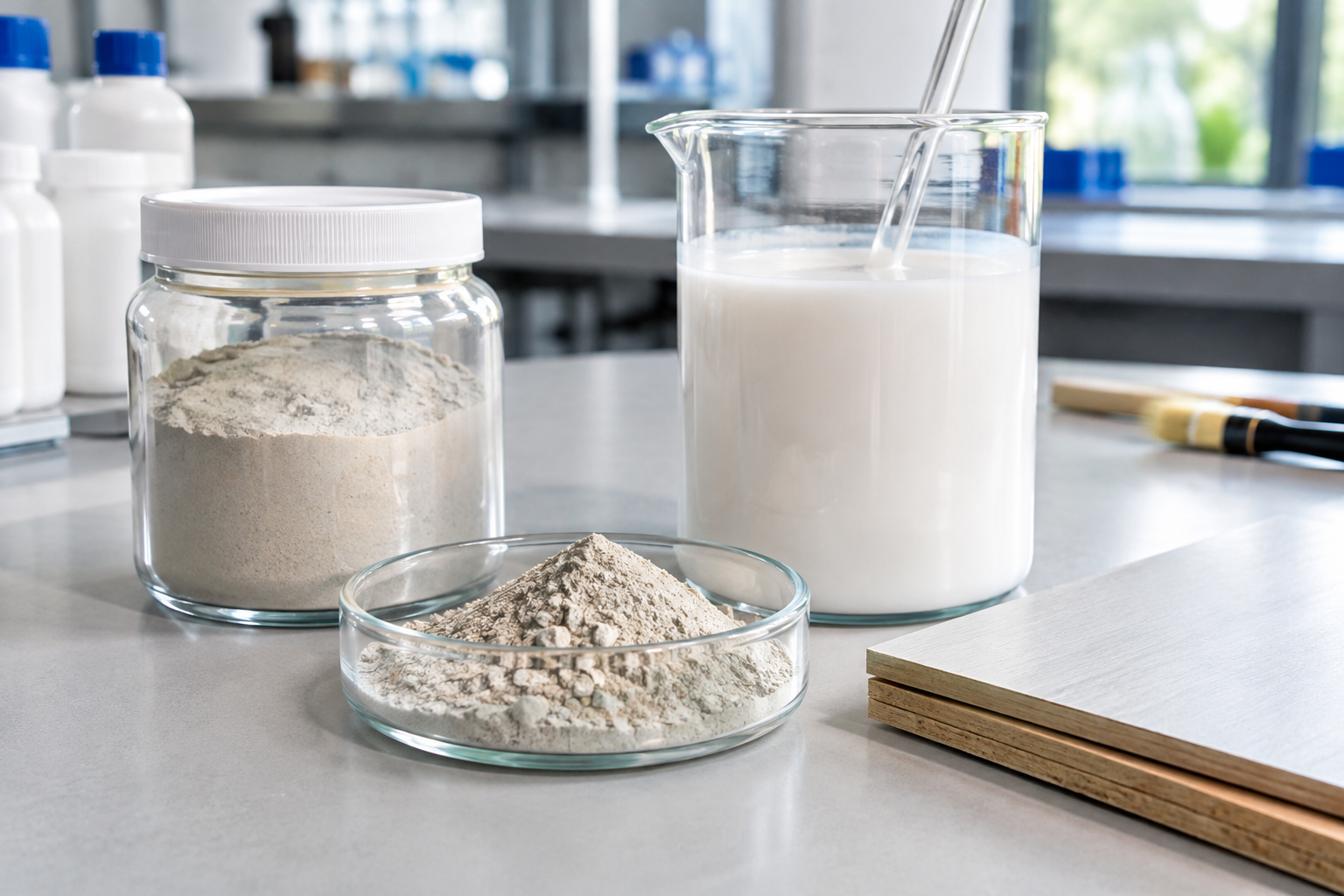
High ionic strength can compress electrostatic interactions between clay particles and change the structure of the dispersion. Salts may therefore reduce or alter the expected viscosity response.
Surfactants can compete for particle surfaces and change the interaction between clay platelets. A dispersant that improves pigment dispersion isn't automatically beneficial for bentonite rheology.
PVAc, EVA, acrylic, polyurethane, and other polymer dispersions can interact differently with clay. Particle size, surface chemistry, solids content, and surfactant package all matter.
Temperature affects both the clay dispersion and the viscosity of the adhesive's continuous phase. Rheology should be measured at temperatures relevant to manufacturing, storage, transport, and application.
Possible causes include incomplete hydration, insufficient dispersion, poor clay quality, incompatible salts, or a formulation component that suppresses clay networking.
Start by checking the clay slurry before changing the final formulation. Compare hydration time, water quality, mixing energy, and solids concentration. If organoclay is involved, verify that the selected grade is compatible with the solvent and that any required activation step has been completed correctly.
Post-thickening can occur when the clay hasn't fully hydrated before packaging. It can also result from slow interactions between clay and other formulation components.
Measure viscosity at defined intervals during development. If the product thickens after filling, compare a fully matured clay dispersion with the original process sequence. Extending hydration before final blending may help, but the correct solution depends on the cause.
Fillers change both the solids content and the interaction between particles. Calcium carbonate, talc, pigments, and other minerals can increase structure or alter the clay network.
Don't simply reduce bentonite based on final viscosity. First determine whether the filler is changing yield stress, high-shear viscosity, or both. A rheology profile is more informative than a single viscosity measurement.
A high Brookfield viscosity reading doesn't guarantee good suspension. If most of the measured viscosity comes from high-shear behaviour while the adhesive has insufficient low-shear structure, dense particles may still settle.
Measure low-shear behaviour and, where possible, yield stress. Then run an actual accelerated and real-time storage test with the complete filler package.
The formulation may not have enough low-shear structure or may recover too slowly after application.
Evaluate the clay grade, loading, dispersion quality, and shear-recovery profile. Also check whether the substrate or application temperature is reducing viscosity. Increasing bentonite is only one possible solution and can make application more difficult if taken too far.
This usually indicates that the mineral addition has changed the binder-to-filler balance or altered the adhesive film's flexibility and wetting.
Compare the clay-containing adhesive with the original formulation at equal total solids where possible. Test tensile shear, peel, tack, flexibility, and failure mode rather than relying on one strength measurement. Reducing the clay level or changing the grade may solve the problem without abandoning mineral modification altogether.
Suppose a water-based adhesive has good dry bond strength but is too fluid during application. It also contains mineral filler that settles slowly during storage.
A sensible development programme would not begin by adding a large amount of bentonite. Instead, the formulator could prepare several small batches using a suitable sodium bentonite at progressively higher levels.
For example, a screening study might compare 0.5%, 1.0%, 1.5%, and 2.0% bentonite by total formulation weight. Those numbers are development points, not universal recommendations.
Each batch should be evaluated for:
The best batch is rarely the one with the highest viscosity. It is the one that meets the complete performance specification with acceptable processing and cost.
Two products sold as sodium bentonite can behave very differently. Mineralogy, montmorillonite content, cation exchange capacity, particle size, moisture, purification, and processing history all matter.
Request a technical data sheet and, where necessary, a representative sample before approving a production grade.
More bentonite can mean more structure, but it can also mean poor flow, difficult pumping, weak wetting, poor film formation, and reduced flexibility.
Build a loading curve instead of assuming that more additive will deliver better performance.
A good bentonite grade can perform badly if it isn't properly dispersed. Powder addition rate, vortex control, impeller design, shear, hydration time, and temperature all affect the result.
Process conditions should be recorded alongside formulation percentages so that a successful laboratory batch can actually be reproduced at production scale.
PVAc, starch, acrylic latex, EVA, and cementitious systems have different chemistry and rheology requirements. A bentonite level that works in one system may be unsuitable in another.
Initial viscosity is just one measurement. Adhesives need to perform during mixing, pumping, application, storage, substrate contact, drying or curing, and service.
A useful test programme should include both rheology and end-use performance.
Hydrophilic natural bentonite is not a drop-in replacement for organoclay in solvent-borne adhesives. The surface chemistry must match the continuous phase.
Bentonite is a naturally occurring mineral, but that fact alone doesn't establish the environmental profile of a finished adhesive. Mining, drying, grinding, purification, transportation, processing, formulation, packaging, and end-of-life all contribute to environmental impact.
If sustainability is an important product claim, compare the complete formulation and substantiate the claim with appropriate lifecycle or supplier data rather than relying on the word natural.
A structured selection process reduces trial-and-error during adhesive development.
Start with water, solvent, resin, or molten polymer. This immediately narrows the range of suitable bentonite products.
Decide whether the primary requirement is low-shear viscosity, yield stress, thixotropy, anti-settling, extrusion behaviour, or a combination of these properties.
Review montmorillonite content, cation exchange capacity, moisture, particle size, pH, soluble salts, and other parameters relevant to the adhesive.
Ask how the grade should be dispersed, whether pre-hydration is recommended, whether an activator is required, and what mixing equipment is appropriate.
Do not approve a grade based on a clay-in-water screening test alone. The final adhesive may contain surfactants, polymers, fillers, pigments, salts, and other ingredients that change performance.
Check viscosity drift, settling, freeze-thaw stability where applicable, packaging stability, sag, application feel, bond strength, and any product-specific requirements.
Bentonite can be attractive from a formulation-cost perspective because processed mineral additives are often less expensive per kilogram than specialised synthetic rheology modifiers. However, the relevant calculation is not simply the price per kilogram of additive.
A lower-cost mineral may require higher loading, more mixing energy, longer hydration, or additional stabilisers. It can also affect packaging density and transport cost because mineral solids increase product weight.
The better comparison is cost per unit of required performance. A formulator should consider additive cost, processing time, energy, equipment, rejected batches, storage stability, and the effect on the rest of the formulation.
In some products, bentonite works best as part of a rheology package. A small amount of clay combined with a polymeric thickener may provide better processing and application behaviour than a high level of either ingredient alone.
Consistency between lots is essential when bentonite is part of a production adhesive. Important quality parameters can include:
The most useful incoming-quality test is often one that correlates directly with adhesive performance. A simple standardised viscosity or swelling test can be more valuable for production control than a long list of unrelated mineral measurements.
For critical applications, suppliers should provide a consistent technical specification and certificate of analysis, while the adhesive manufacturer should maintain its own incoming-material verification programme.
Bentonite can be a useful multifunctional ingredient in adhesive formulations, particularly when the product needs controlled low-shear structure, thixotropy, suspension, or sag resistance.
The main lessons are straightforward:
The strongest results come from matching clay chemistry to adhesive chemistry. For manufacturers developing industrial adhesives, a reliable bentonite supplier should be able to provide consistent mineral specifications, application guidance, technical documentation, and samples for formulation trials. Axewelledge can support this process by helping manufacturers evaluate bentonite grades against their intended adhesive application rather than treating every formulation as the same.













Have questions about our products? We're here to help!