Axewelledge, a leading exporter from India, specializes in high-quality Bentonite. With a commitment to excellence, we supply premium Bentonite to the Middle East and Southeast Asia markets.


North Angle Complex, 304,
150 Feet Ring Rd, Opposite Ambedkar Nagar BRTS Stop,
Madhav Park, Punit Nagar,
Mavdi, Rajkot, Gujarat 360004
© Axewelledge 2026, All Rights Reserved.
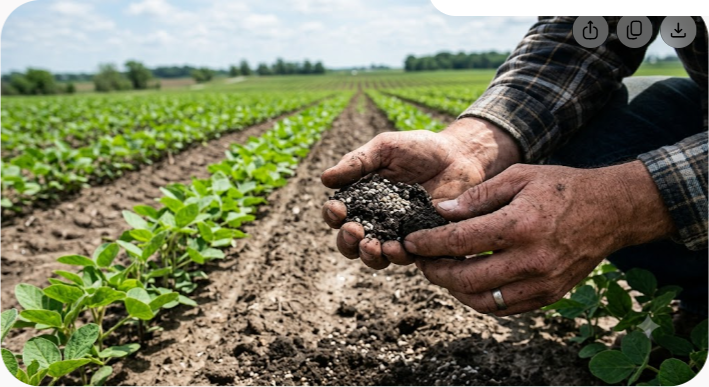
Bentonite can improve the physical and chemical behaviour of some agricultural soils, but it isn't a universal soil amendment. Its strongest case is usually a coarse, sandy soil that drains quickly and has limited capacity to retain water and exchange nutrients. The type of bentonite, application rate, soil texture, salinity, sodium status, and method of incorporation all matter.
Bentonite is a naturally occurring clay dominated by smectite minerals, particularly montmorillonite. Its very fine particles and large reactive surface area allow it to interact strongly with water and exchangeable ions. Sodium-dominant bentonite generally swells more than calcium-dominant bentonite, so it can be useful when the objective is to increase water-holding capacity in very coarse soil. Calcium bentonite behaves differently and may be more appropriate where excessive swelling or sodium loading would be undesirable.
The important point is simple: bentonite should be selected and applied according to the soil problem, not simply added because it is a clay mineral. A soil test and a small field or pot trial are often more useful than relying on a generic rate.
This guide explains seven practical uses of bentonite in agricultural soil management, how the material works, how to apply it, where it can cause problems, and what to check before buying an agricultural-grade product.
Bentonite is not one chemically identical material. Commercial bentonites differ in mineral composition, dominant exchangeable cations, swelling behaviour, particle size, moisture content, purity, and processing method. These differences can change how the material performs in soil.
The two terms growers encounter most often are sodium bentonite and calcium bentonite. The distinction describes the dominant exchangeable cation associated with the clay and is useful when thinking about swelling behaviour, although commercial deposits can contain mixed characteristics.
| Property | Sodium-dominant Bentonite | Calcium-dominant Bentonite |
|---|---|---|
| Wetting behaviour | Typically high swelling and water uptake | Generally lower swelling than sodium-dominant clay |
| Main consideration | Useful where strong swelling and water retention are required | Useful where lower swelling and calcium-dominant exchange chemistry are preferred |
| Potential soil concern | Excess sodium can contribute to dispersion and poor infiltration in susceptible soils | Lower sodium contribution, but performance still depends on the product and soil |
| Typical soil interest | Very coarse, sandy soils | Soil conditioning, blending and applications where excessive swelling is undesirable |
| Selection basis | Swelling capacity, exchangeable sodium, purity and particle size | Mineral quality, exchangeable cations, CEC and particle size |
Smectite clay minerals have a layered structure with a high surface area and a permanent negative charge. Water can enter between clay layers, while positively charged ions can be held on exchange sites at the mineral surface.
Sodium-dominant smectite generally hydrates and expands strongly. That behaviour is valuable in applications where sealing or water retention is required, but the same characteristic can create problems if large quantities are placed in poorly drained or sodium-sensitive soils.
Calcium-dominant smectite usually has lower swelling because calcium helps hold clay layers together more strongly than exchangeable sodium. That doesn't make one type universally better than the other. It makes them suited to different conditions.
The clearest agricultural use of bentonite is improving the water-holding behaviour of coarse, sandy soil. Sand contains relatively large pores, so water can move through the profile quickly after irrigation or rainfall. The result is a narrow window between adequate moisture and water stress.
Adding fine clay particles changes the pore-size distribution. Bentonite occupies some of the larger pore spaces and creates additional surfaces capable of holding water. When a swelling bentonite hydrates, the clay can form a gel-like structure that slows water movement and increases the amount of moisture retained within the amended zone.
That doesn't mean bentonite turns sand into a permanently wet soil. The outcome depends on the original texture, clay quality, application rate, incorporation depth, irrigation regime, organic matter, and climate.
A practical approach is to start with a soil test and then conduct a controlled trial rather than applying a large quantity across an entire farm immediately.
Application rates should not be treated as a universal recipe. A coarse sand may require considerably more clay than a sandy loam, while a heavy soil may not need bentonite at all. Local soil testing and agronomic advice should determine the final rate.
A modest amount of bentonite distributed through the root zone can behave very differently from the same amount concentrated in a few patches. Concentrated sodium bentonite can swell into dense masses that restrict infiltration, while untreated parts of the field receive little benefit.
For that reason, spreading accuracy and incorporation are just as important as the nominal application rate.
Cation Exchange Capacity, or CEC, describes the soil's ability to retain positively charged ions on exchange sites. Potassium, calcium, magnesium, and ammonium are among the important nutrient cations affected by this mechanism.
Sandy soils commonly have lower CEC than soils containing more clay and organic matter. This doesn't mean every nutrient applied to sand immediately disappears, but it does mean the soil has fewer exchange sites available to retain cations between rainfall or irrigation events.
Smectite-rich bentonite has a comparatively high CEC. Mixing it with low-CEC soil can therefore increase the soil's overall exchange capacity.
Higher CEC can improve the soil's ability to retain certain positively charged nutrients. It doesn't automatically increase crop yield, and it doesn't prevent every type of nutrient loss.
Nitrate, for example, is an anion and is not retained by conventional cation exchange in the same way as potassium or ammonium. Phosphorus behaviour is also more complicated and depends on mineralogy, pH, organic matter, and other soil reactions.
A useful way to think about bentonite is as one component of a nutrient-management system. It can provide additional exchange sites, while good fertilizer timing, appropriate application rates, organic matter management, irrigation control, and plant uptake determine how effectively nutrients are ultimately used.
Suppose a sandy field has a low measured CEC and receives repeated applications of potassium fertilizer. Adding a high-CEC clay amendment may increase the number of exchange sites in the amended soil. The potassium can then be retained on those sites and exchanged with other cations in the soil solution.
The actual change in measured CEC should be verified through soil testing. It shouldn't be assumed from the amount of bentonite alone because the final result depends on the mineral quality and the proportion of bentonite in the amended soil.
Fast drainage is not always a benefit. In a very coarse soil, water can move below the main root zone before plants have enough opportunity to use it. That can increase the risk of losing mobile nutrients and can make irrigation less efficient.
Bentonite can reduce hydraulic conductivity when it swells and fills pore spaces. In a suitable sandy soil, this can slow the movement of water through the amended layer and increase the time available for plant uptake.
The effect is physical as well as chemical. Its exchange sites can retain some positively charged nutrients, while the altered pore structure changes how water moves through the soil.
Bentonite won't stop all nutrient losses. Nitrate remains highly mobile in many agricultural soils, and its movement is strongly influenced by rainfall, irrigation volume, soil drainage, crop uptake, and nitrogen application timing.
The best results come when clay amendment is combined with sound nutrient management. Split nitrogen applications, avoid applying fertilizer immediately before heavy rainfall, maintain crop cover where practical, and manage irrigation according to crop demand.
Bentonite can support these practices by changing soil water movement and increasing the retention of some cationic nutrients. It shouldn't be presented as a substitute for them.
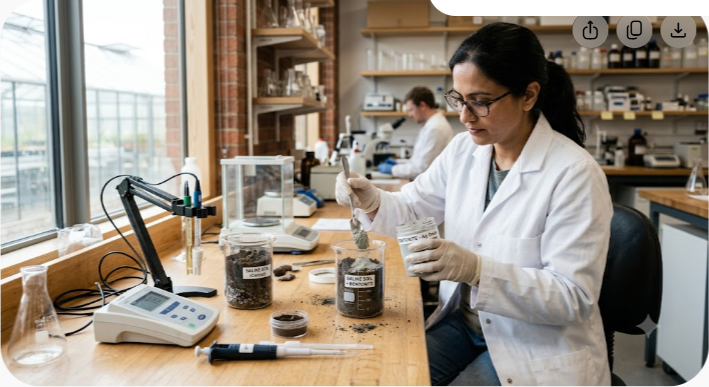
Soil structure describes how individual mineral particles and organic matter form aggregates and pores. Good structure supports infiltration, aeration, root growth, and resistance to erosion.
Bentonite can contribute fine mineral material to soils with very low clay content. When used alongside organic matter, it can participate in organo-mineral associations that influence aggregate stability and water behaviour.
This is especially relevant when trying to improve a coarse, degraded soil rather than a naturally heavy clay soil. Organic amendments such as compost or well-managed manure provide carbon and biological activity, while clay contributes mineral surfaces.
Bentonite alone isn't a replacement for organic matter. A sustainable soil-building programme may combine:
The objective is not simply to make the soil finer. It is to create a pore structure that provides adequate water storage while still allowing air exchange and drainage.
If a field already has poor drainage, adding a strongly swelling bentonite can make the problem worse. Before application, determine whether the existing issue is excessive drainage, compaction, a shallow restrictive layer, salinity, sodicity, or another physical limitation.
The right amendment depends on the cause.
Bentonite is sometimes marketed as a broad pH and salinity stabiliser. That description needs qualification.
Smectite clays have substantial surface area and exchange capacity, so they can influence the movement and exchange of ions in soil. However, bentonite should not be treated as a substitute for agricultural lime in acidic soils or gypsum and other established amendments where sodicity is diagnosed.
Bentonite may influence soil chemical behaviour, but its direct liming value is generally not comparable with a properly selected liming material. If soil acidity is the problem, test the soil and calculate lime requirements using an appropriate laboratory method.
Calcium bentonite contains exchangeable calcium, but the presence of calcium in a clay mineral doesn't mean the product should automatically be used as a liming agent.
Salinity and sodicity are different problems. Electrical conductivity helps assess the soluble salt environment, while measures such as exchangeable sodium percentage and sodium adsorption ratio help evaluate sodium-related soil conditions.
In sodium-affected soils, adding more sodium through a sodium-dominant bentonite may be counterproductive. Infiltration and aggregate stability can deteriorate when exchangeable sodium becomes excessive.
The correct response to salinity or sodicity should therefore begin with a laboratory diagnosis rather than a blanket bentonite recommendation.
Bentonite and other clay minerals are used in environmental applications because their surfaces can interact with contaminants. Their high surface area, charge characteristics, and low permeability when compacted make them useful in selected remediation and containment systems.
In agricultural land affected by heavy metals, however, the objective is usually to reduce contaminant mobility or bioavailability rather than to make the contaminant disappear.
Smectite-rich clay can interact with metals such as lead, cadmium, copper, and zinc through adsorption and ion-exchange processes. Under appropriate conditions, this can reduce the fraction of a contaminant that is readily mobile.
The effectiveness of bentonite depends on the contaminant, soil pH, organic matter, competing ions, clay mineralogy, application rate, and moisture conditions. A result observed in a laboratory experiment can't automatically be transferred to an agricultural field.
If contaminated farmland is involved, begin with a professional soil and contaminant assessment. Depending on the risk, testing may include total metal concentration, bioavailable fractions, soil pH, CEC, organic matter, and other site-specific parameters.
Bentonite can be part of a remediation strategy, but it should not be described as a guaranteed method for making contaminated soil safe for food production.
Bentonite is also used in the manufacture of agricultural granules and as a carrier or binder in selected formulations. Its fine particle size, absorbency, binding characteristics, and mineral composition can make it useful during granulation and formulation.
For fertilizer products, bentonite may help bind ingredients into granules with improved physical handling characteristics. It can also affect how a granule breaks down and releases its soluble components after wetting.
The performance depends heavily on formulation. Bentonite isn't automatically a slow-release fertilizer simply because it absorbs water.
A fertilizer manufacturer may combine bentonite with nutrient-bearing materials to improve granule formation, strength, or handling. The clay can act as a binder or conditioning component, but the final dissolution profile depends on the entire formulation.
For example, a granulated fertilizer containing bentonite may behave differently from a soluble fertilizer applied directly to soil. Laboratory dissolution and agronomic tests are needed to establish the actual release behaviour.
Bentonite has also been investigated and used in some carrier formulations for biological agricultural inputs. However, claims about protecting or extending the viability of bacteria, fungi, or other microorganisms need to be supported by formulation-specific stability data.
A carrier that works for one microbial strain may not work for another. Moisture, storage temperature, pH, particle size, water activity, and compatibility with other ingredients all matter.
Bentonite can also appear in seed-treatment or coating formulations where its binding and water-interaction properties are useful. The coating must be designed carefully so that it doesn't interfere with germination, gas exchange, seed handling, or planting equipment.
For commercial seed treatments, performance should be established through germination and emergence testing rather than assumed from the properties of the raw clay.
The right application method depends on the soil and product, but a structured process reduces the risk of uneven treatment.
Start with a representative soil sample. At minimum, consider texture, pH, electrical conductivity, CEC, and exchangeable sodium where relevant. Organic matter and bulk density can also be useful when the objective is to change water storage or soil physical behaviour.
Don't base the decision only on the fact that the soil looks sandy. Two soils with similar field appearance can have very different clay contents, drainage characteristics, salinity, and CEC.
Be specific. Is the problem rapid drainage, low water-holding capacity, low CEC, erosion, poor aggregation, or a remediation issue?
Different problems require different treatments. If the objective is to correct acidic soil, for example, lime may be the appropriate amendment. If the problem is sodicity, a sodium-dominant bentonite may be unsuitable.
Ask the supplier for a technical specification rather than buying solely by the product name. Useful information can include:
For food or feed-related agricultural applications, additional regulatory and contaminant requirements may apply depending on the intended use and jurisdiction.
Application rates should be expressed in relation to the area, incorporation depth, and bulk density rather than treated as a universal number.
For example, if an agronomist recommends a specific percentage of bentonite by dry soil mass, the required mass can be estimated from the volume and bulk density of the soil being amended.
The basic relationship is:

For an area-based calculation, the target soil mass depends on the field area, incorporation depth, and soil bulk density.
A 1-hectare field incorporates a very different mass of soil at 10 cm depth than it does at 20 cm. The same is true when comparing loose sandy soil with denser soil. That's why a simple statement such as "apply X tonnes per acre" should be treated as a starting recommendation, not a universal agronomic rule.
Granular or appropriately sized bentonite is generally easier to distribute with conventional agricultural spreading equipment than a very fine powder. Fine particles can create dust during handling, particularly in dry and windy conditions.
Use equipment capable of achieving a consistent application across the target area. Calibrate the spreader before large-scale application and check the distribution pattern.
For annual crops, incorporation depth should reflect the intended root zone and the capabilities of the soil-management system. The often-cited 15 to 20 cm range is not automatically correct for every crop or field.
The important objective is uniform mixing. A thin surface layer of highly concentrated bentonite can behave very differently from clay distributed through the soil profile.
Compare the amended area with an untreated reference area. Useful measurements may include soil moisture, infiltration, electrical conductivity, plant establishment, crop growth, and soil test results.
If the amendment is intended to improve water retention, monitor soil moisture before and after irrigation rather than judging performance from one rainfall event.
There is no single bentonite application rate that works for every agricultural soil. The required amount depends on the percentage of sand, the existing clay content, the bentonite's mineral properties, incorporation depth, crop requirements, irrigation regime, and the specific objective.
Published recommendations and field studies can provide useful starting points, but they should be interpreted in the context of local soil conditions.
For small-scale testing, a trial using several rates can be more informative than choosing one large field rate immediately. For example, a grower could compare an untreated plot with two or three increasing bentonite rates while keeping irrigation and fertilizer management consistent.
That trial can answer practical questions such as:
The answer depends on the soil and the job.
| Agricultural objective | More relevant consideration |
|---|---|
| Increase water retention in very coarse sand | Strongly swelling bentonite may be considered, subject to sodium and salinity testing |
| Add clay to a low-clay soil | Compare swelling, CEC, mineralogy and soil chemistry before selection |
| Work with a sodium-sensitive soil | Avoid introducing unnecessary sodium and assess calcium-dominant options where appropriate |
| Address an acidic soil | Use a properly selected liming amendment rather than relying on bentonite as the primary pH correction |
| Address sodicity | Diagnose the problem first; sodium bentonite may be inappropriate |
| Formulate fertilizer granules | Select bentonite based on binding, granulation and release requirements |
| Environmental remediation | Select the clay based on contaminant-specific laboratory and field evidence |
A supplier should be able to provide technical data for the actual product being sold. The label "sodium bentonite" or "calcium bentonite" is useful, but it isn't enough information for a serious agricultural specification.
Different deposits and grades can have very different swelling capacity, CEC, mineral purity, particle size, and exchangeable cations.
Better approach: request a technical specification and match the material to the soil objective.
Adding a sodium-dominant clay to a soil that already has a serious sodicity problem can increase the sodium burden and potentially worsen dispersion and infiltration.
Better approach: test electrical conductivity, exchangeable sodium and related indicators before selecting the amendment.
Too much swelling clay can reduce infiltration and aeration, especially when it is concentrated rather than uniformly distributed.
Better approach: establish an appropriate rate through soil testing, agronomic guidance, and preferably a controlled trial.
Highly swelling clay can form a dense layer when concentrated and repeatedly wetted. That can interfere with infiltration and seedling establishment.
Better approach: distribute and incorporate the amendment uniformly through the intended soil layer.
Bentonite contributes mineral surfaces, but it doesn't provide the same carbon and biological functions as compost, crop residues, or other organic amendments.
Better approach: consider clay and organic matter as complementary tools where both are needed.
The primary effects of a clay amendment are changes in soil physical and chemical properties. Crop response depends on weather, irrigation, fertility, crop variety, rooting depth, and many other variables.
Better approach: measure the soil property the amendment was intended to change before judging the investment.
A low-cost product may have a different mineral composition, moisture content, particle size, or swelling performance from a higher-specification agricultural bentonite.
Better approach: compare products using technical specifications and delivered cost per effective tonne, not simply the quoted price per tonne.
A proper evaluation should connect the amendment to a measurable objective.
If water retention is the goal, measure soil moisture at consistent depths and times. If nutrient retention is the goal, compare CEC and relevant soil nutrient measurements. If the aim is remediation, use contaminant-specific laboratory tests.
A useful field comparison includes an untreated control and one or more treated areas. Keep other management variables as consistent as possible. This makes it easier to separate the effect of bentonite from changes caused by irrigation, fertilizer, rainfall, or crop management.
| Objective | Useful measurements |
|---|---|
| Water retention | Volumetric soil moisture, soil water retention, irrigation frequency |
| Drainage control | Infiltration rate, hydraulic conductivity, drainage observations |
| Nutrient retention | CEC, exchangeable potassium, calcium, magnesium and ammonium where appropriate |
| Salinity management | Electrical conductivity and soluble ion analysis |
| Sodicity assessment | Exchangeable sodium, exchangeable sodium percentage and sodium adsorption ratio where appropriate |
| Soil structure | Aggregate stability, bulk density, infiltration and visual structure assessment |
| Remediation | Total and bioavailable contaminant concentrations using an appropriate laboratory method |
Bentonite should be evaluated as a soil-management investment rather than as a guaranteed yield enhancer. The economics depend on the delivered price of the clay, application and incorporation costs, the size of the treated area, irrigation costs, crop value, and the measurable improvement in soil performance.
For a sandy field, the key economic question might be whether improved water retention reduces irrigation demand or protects crop growth during periods of limited rainfall. For a low-CEC soil, the question may instead be whether better nutrient retention improves fertilizer-use efficiency.
Don't assume a percentage saving before measuring it. Claims that bentonite automatically reduces irrigation or fertilizer use by a fixed amount aren't reliable across different farms because soil, climate, crop, irrigation systems, and management practices vary substantially.
A simple farm trial can provide better evidence. Calculate the cost per hectare of the amendment, spreading, incorporation, and any additional irrigation or labour. Then compare those costs with measured changes in water use, fertilizer management, crop establishment, yield, or another clearly defined outcome.
Product consistency matters when bentonite is being used as a soil amendment or as an ingredient in an agricultural formulation. Buyers should request a current technical data sheet and, where appropriate, a certificate of analysis for the supplied material.
Important purchasing criteria include mineral composition, CEC, swelling characteristics, particle size, moisture, exchangeable cations, contaminant limits, packaging, and batch consistency. The correct specification depends on the application.
For agricultural buyers sourcing from an exporter, it is also worth confirming whether the supplier can provide consistent grades across shipments, suitable packaging for storage and transport, documentation for import requirements, and technical support for the intended application.
Axewelledge supplies processed sodium and calcium bentonite for industrial and agricultural applications, with product selection based on required physical and chemical characteristics rather than a one-size-fits-all grade. Buyers should still match the supplied specification to their own soil tests and application requirements.
Bentonite can be a useful tool for agricultural soil improvement, particularly in coarse soils where water and nutrient retention are limited. Its value comes from the properties of smectite clay: high surface area, cation exchange capacity, and, for suitable grades, strong swelling and water interaction.
The seven main agricultural uses covered here are:
The best application starts with a diagnosis. Test the soil, define the problem, select the bentonite grade using technical data, calculate the rate for the actual soil volume, spread it evenly, incorporate it properly, and monitor the result.
Bentonite isn't a substitute for good irrigation, fertilizer, drainage, organic matter, or soil-conservation practices. Used alongside those practices and matched carefully to the soil, however, it can become a practical part of a long-term soil-management programme.













Have questions about our products? We're here to help!