Axewelledge, a leading exporter from India, specializes in high-quality Bentonite. With a commitment to excellence, we supply premium Bentonite to the Middle East and Southeast Asia markets.


North Angle Complex, 304,
150 Feet Ring Rd, Opposite Ambedkar Nagar BRTS Stop,
Madhav Park, Punit Nagar,
Mavdi, Rajkot, Gujarat 360004
© Axewelledge 2026, All Rights Reserved.
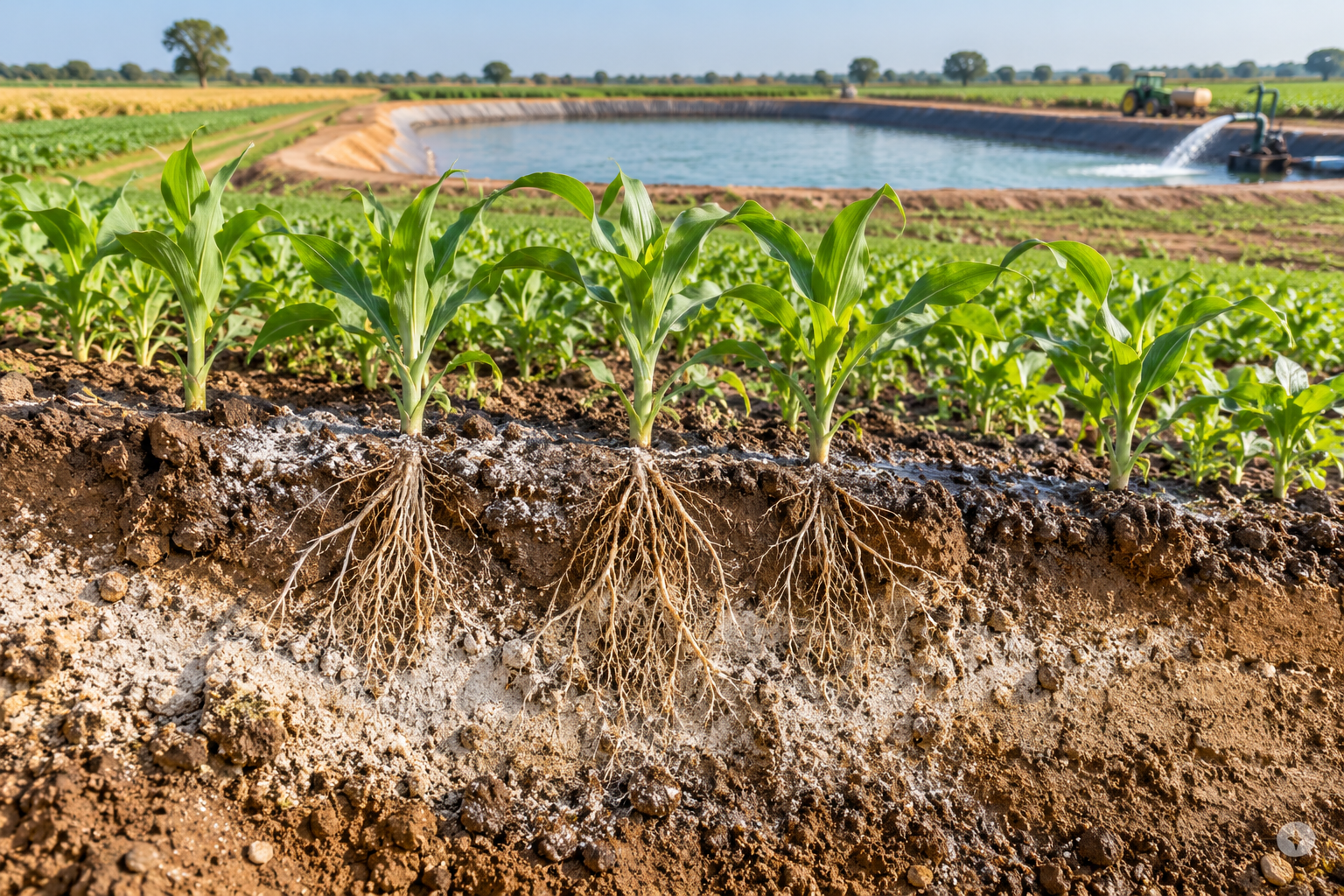
Bentonite is not a fertilizer, and it is not a universal fix for poor soil. Its agricultural value comes from its mineral structure and the way that structure interacts with water, soil particles, nutrients, and other materials.
The main uses of bentonite in agriculture include improving water retention in sandy soils, modifying soil physical properties, supporting water and nutrient retention, helping manufacture fertilizer granules, forming seed-coating formulations, adjusting growing substrates, and sealing agricultural ponds and other earthen water-storage structures. Suitable bentonite grades are also used in certain animal-feed applications, but feed use requires separate quality and regulatory considerations.
The right product depends on the job. Sodium bentonite generally has stronger swelling and sealing behavior than calcium bentonite, but that does not make sodium bentonite the automatic choice for crop production. Mineralogy, particle size, purity, application rate, soil texture, climate, irrigation practices, and crop requirements all influence performance.
For farmers, fertilizer manufacturers, nurseries, and agricultural water-management projects, the practical lesson is simple: start with the problem you need to solve, then select a bentonite grade that fits that application. Applying a mineral simply because it is described as a natural soil amendment can add cost without producing a useful agronomic result.
Bentonite is a naturally occurring clay material dominated by smectite minerals, particularly montmorillonite. Its layered mineral structure gives it a strong affinity for water and allows it to interact with certain dissolved ions.
Those properties explain why bentonite has several different agricultural uses. A grower dealing with coarse, rapidly draining soil may be interested in its ability to increase water storage. A fertilizer manufacturer may want its binding properties during granulation. A pond contractor may select a swelling grade because it can help create a low-permeability soil liner. A feed manufacturer may require a specific, documented grade for an approved application.
Bentonite is therefore better understood as a functional mineral than as a single-purpose agricultural input.
The distinction between grades is important. Sodium bentonite generally swells more strongly when hydrated and is widely used where swelling and sealing are important. Calcium bentonite normally has lower swelling capacity, although the behavior of commercial products depends on the deposit, processing, mineral composition, and other characteristics. Two products sold simply as "bentonite" can therefore perform differently.
Research also shows why application-specific testing matters. A five-year field study in sandy-loam soil under semi-arid conditions evaluated bentonite rates from 6 to 30 Mg/ha and reported improvements in soil moisture, soil water storage, millet biomass, grain yield, and water-use efficiency under the tested conditions. Those findings demonstrate potential, but they do not establish one application rate for every crop or soil.
The practical rule is to choose bentonite for a defined soil, crop, processing, or water-management problem rather than treating it as a general-purpose input.
Improving water retention is one of the most widely discussed agricultural uses of bentonite, particularly in coarse-textured soils.
Sandy soils contain relatively large pores, so water can move through them quickly. Rapid drainage is useful when excess water needs to leave the root zone, but it becomes a limitation when rainfall is unreliable or irrigation water moves below the depth where roots can use it.
Bentonite adds fine clay particles to the soil. Because of its mineral structure and surface properties, those particles can change how water is stored and how quickly it moves through the soil. The objective is not to stop drainage completely. It is to shift the soil toward a more useful balance between water storage, infiltration, and drainage.
Field research on millet grown in sandy-loam soil reported higher soil moisture and soil water storage after bentonite amendment. The same study reported changes in crop biomass, grain yield, and water-use efficiency over five years. The response varied with application rate and growing conditions, which is a useful reminder that soil amendments need to be evaluated in context.
Bentonite may be worth investigating when a field has:
Before applying bentonite, identify the actual cause of poor crop performance. A field that looks dry may instead have problems related to irrigation uniformity, compaction, salinity, low organic matter, shallow rooting, or poor soil structure. Bentonite addresses some physical properties of soil, but it cannot correct every underlying problem.
The fine particles introduced by bentonite can occupy spaces between larger soil particles and increase the amount of water retained after irrigation or rainfall. The size of the effect depends on the bentonite mineralogy, soil texture, application rate, mixing depth, and local climate.
The goal should be a root zone that stores enough water while still allowing oxygen and excess water to move through the soil. Maximum water retention is not necessarily the desired outcome. Roots need both water and air.
Bentonite can also change the physical behavior of soil. This is particularly relevant when sandy soil has limited aggregation and little capacity to hold water between irrigation events.
Fine clay particles can fill some of the spaces between larger particles and contribute to changes in aggregation, pore distribution, and water movement. These changes can affect the environment around plant roots.
Studies of bentonite-amended sandy soils have reported changes in soil aggregation and water storage, and some field research has associated these changes with improved crop performance. Results depend heavily on the starting soil and the amendment rate.
That qualification matters. Adding clay to an already fine-textured soil is not automatically beneficial. If infiltration and drainage are already limited, adding more fine material can make the physical problem worse.
Before applying bentonite across an entire field, work through the following steps:
The purpose is not to turn sandy soil into clay. It is to adjust a specific soil property enough to improve the root-zone environment.
Water and nutrient management are closely connected. Nutrients dissolved in soil water can move downward with drainage, while nutrients held on soil particles or organic matter may remain in the root zone for longer.
Bentonite has a reactive mineral surface and cation-exchange capacity that can influence the behavior of certain ions in soil. That makes it relevant to soil systems where water and nutrient losses are concerns.
Research on bentonite-amended soil has reported changes in soil moisture as well as changes in soil biological and chemical properties. In the five-year millet study discussed earlier, researchers reported increases in microbial biomass carbon, nitrogen, and phosphorus, together with changes in soil organic carbon and total nitrogen and phosphorus. These observations occurred alongside changes in soil moisture and crop growth under the tested conditions.
This should not be interpreted as evidence that bentonite supplies the nutrients a crop requires. Bentonite is not a replacement for nitrogen, phosphorus, potassium, or micronutrient fertilizers.
A better way to view it is as one component of the soil system. Fertilizers provide nutrients, while soil minerals, organic matter, water, and pore structure influence how those nutrients move and remain available.
Sandy soil often has lower nutrient-retention capacity than soils with greater clay and organic-matter content. Heavy irrigation or rainfall can move soluble nutrients below the active root zone.
A suitable clay amendment may change the physical and chemical environment around the roots. The size and direction of that effect depend on the mineralogy of the bentonite, soil chemistry, application rate, nutrient involved, and crop.
Commercial nutrient management should still begin with soil testing and crop requirements. Bentonite should support a fertilizer program, not replace one.
Bentonite is also used in agriculture before a fertilizer reaches the field. Fertilizer manufacturers may use it as a binder or processing aid during granulation.
Granular fertilizers need consistent particle size, sufficient mechanical strength, suitable flow characteristics, and reasonable storage stability. Fine powders can be difficult to handle, and a suitable binder can help form them into more manageable granules.
Bentonite is useful in some formulations because its binding and swelling characteristics can help fine particles come together during granulation. The result depends on the fertilizer chemistry, moisture level, granulation equipment, drying conditions, and target product specifications.
This is a different application from spreading bentonite directly on agricultural soil. In fertilizer manufacturing, bentonite is selected for a particular processing function.
Depending on the formulation and process, bentonite can help with:
The correct dosage is formulation-specific. Too little may provide insufficient binding, while too much can affect granule hardness, dissolution behavior, nutrient concentration, production cost, or equipment performance.
For that reason, manufacturers should evaluate the finished fertilizer rather than selecting a bentonite percentage from a generic recommendation. Pilot trials are often more informative than relying on a specification designed for a different fertilizer formulation.
Seed coatings have to balance several requirements. A coating should adhere well, interact appropriately with water, remain compatible with the seed and other coating ingredients, and allow normal germination and emergence.
Bentonite can contribute binding and water-interaction properties to some seed-coating and encapsulation formulations. Research on bentonite-polymer seed encapsulants has reported potential for agricultural seed applications, while also showing that performance depends on plant species, formulation, and soil-moisture conditions.
That is an important distinction. A material that retains water effectively can still be unsuitable if the coating becomes too restrictive around the seed.
Depending on the formulation, bentonite may be used to:
Seed coatings should be tested for the actual crop and formulation. Seed size, seed surface, coating thickness, storage conditions, soil moisture, and planting equipment can all affect performance.
For commercial development, useful measurements include germination percentage, emergence speed, coating uniformity, storage stability, mechanical durability, and compatibility with other seed-treatment materials.
Bentonite can also be incorporated into selected growing substrates when additional water-holding capacity is needed. This can be relevant to nurseries, greenhouse production, horticulture, and other controlled growing systems.
The objective is usually to modify the physical properties of the growing medium rather than provide plant nutrition.
Research comparing bentonite with other water-retaining materials in compost-based substrates found that bentonite could increase water-holding capacity. However, increased water retention did not necessarily translate into greater plant growth in the tested ryegrass system.
That result illustrates an important principle: more retained water is not automatically better for plants.
A growing medium must balance water availability with air-filled pore space, drainage, bulk density, root penetration, and nutrient availability. If a substrate already holds sufficient water, adding another water-retaining material may offer little practical benefit.
When testing a nursery or greenhouse formulation, compare the following properties:
| Property | Why it matters | What to watch for |
|---|---|---|
| Water-holding capacity | Determines how much water the medium retains | Excess retention can reduce aeration |
| Drainage | Prevents prolonged saturation | Fine particles may slow drainage |
| Air-filled porosity | Supplies oxygen to roots | Excess fine material can reduce pore space |
| Bulk density | Influences handling and root development | Excess density can restrict roots |
| pH and EC | Affect nutrient availability and root conditions | The full formulation determines the final values |
| Plant growth | Shows whether physical changes help the crop | Test the actual crop rather than relying only on laboratory data |
A small greenhouse trial can reveal whether a change in water-holding capacity actually improves crop performance. Test the complete substrate formulation before scaling up.
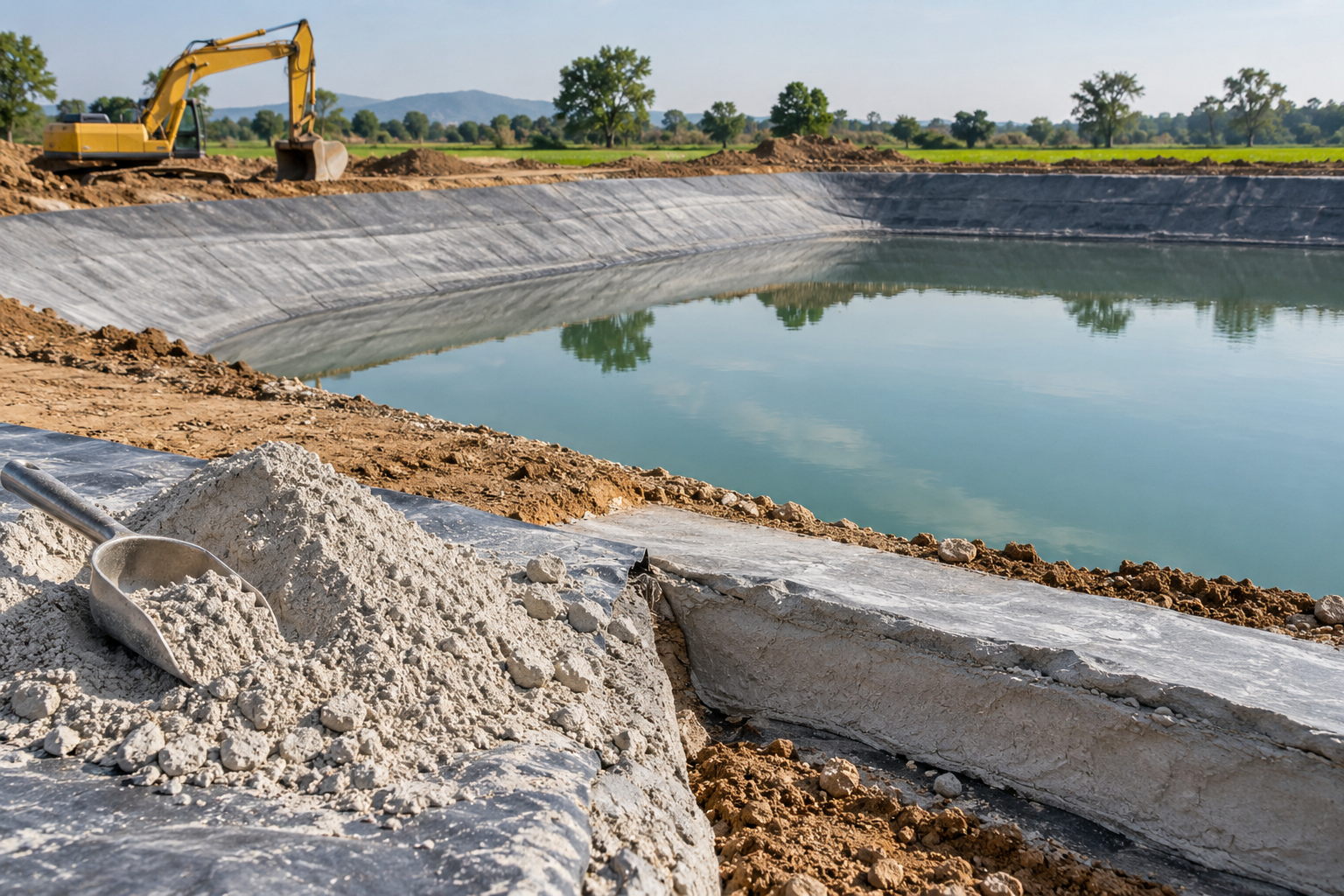
Bentonite has an important agricultural use outside crop production: reducing seepage from suitable earthen ponds and water-storage structures.
Farm ponds and irrigation reservoirs can lose water through seepage when the underlying soil is too permeable. Where site conditions are appropriate, bentonite can be incorporated into soil and compacted to create a lower-permeability sealing layer.
USDA Natural Resources Conservation Service guidance identifies bentonite as one option for pond sealing and emphasizes that application requirements should be determined from site conditions and appropriate testing. Guidance also describes incorporating bentonite into surface soil and compacting the treated layer. A commonly cited application range is about 1 to 3 pounds per square foot, but the appropriate rate depends on the soil, design, and site conditions rather than the number alone.
A pond liner is not created simply by spreading bentonite over the ground. Soil preparation, moisture, mixing, layer thickness, compaction, drainage conditions, and protection from erosion all affect the finished seal.
Before installation, evaluate:
For a large agricultural reservoir or a structure where water loss has significant economic consequences, involve a qualified soil, agricultural engineering, or water-resources professional. An unsuitable soil, poorly compacted layer, incorrect moisture content, or inadequate thickness can compromise the seal.
Agriculture also includes livestock production, and suitable clay minerals have been used in certain animal-feed applications for functions such as binding or adsorption. This should be treated as a separate application from using bentonite as a crop-soil amendment.
Animal-feed applications have specific regulatory and quality requirements. In the United States, substances intentionally added to animal food are subject to applicable Food and Drug Administration requirements unless an appropriate regulatory basis or exemption applies.
Bentonite and montmorillonite clays have also been studied for their ability to adsorb certain mycotoxins, including aflatoxin. Research and regulatory materials concerning these uses do not mean that any industrial or agricultural bentonite can be placed in animal feed.
Feed-grade mineral selection requires attention to purity, contaminants, intended use, regulatory status, and supplier documentation. Quality concerns are particularly important for clay-based materials because mineral deposits can contain unwanted elements or other contaminants.
For that reason, never assume that bentonite sold for drilling, construction, pond sealing, or industrial processing is suitable for animal feed. The product must be specifically appropriate for the intended feed application and meet the applicable requirements.
The question of whether sodium or calcium bentonite is better has no universal answer. The appropriate type depends on what the material needs to do.
| Factor | Sodium bentonite | Calcium bentonite |
|---|---|---|
| Typical swelling behavior | Generally higher | Generally lower |
| Water interaction | Strong swelling and water retention | Lower swelling, depending on mineralogy |
| Sealing applications | Often considered where strong swelling is required | May suit applications where lower swelling is acceptable |
| Soil amendment potential | Depends on soil and objective | Depends on soil and objective |
| Selection basis | Application testing and product specifications | Application testing and product specifications |
These are general differences rather than universal rules. Natural deposits vary considerably, and commercial products may be processed or modified. A technical data sheet, certificate of analysis, and application-specific test are more useful than choosing a product based only on the words "sodium" or "calcium bentonite."
There is no single bentonite application rate that works for every agricultural soil.
The correct amount depends on soil texture, mineralogy, crop, climate, bentonite grade, incorporation depth, irrigation regime, and the property being targeted. A rate designed for pond sealing should not be transferred to crop soil, and a rate studied in one field should not automatically be applied to another.
For example, the five-year millet field study discussed earlier evaluated 6, 12, 18, 24, and 30 Mg/ha in a particular semi-arid sandy-loam environment. The study found positive responses under those experimental conditions, but that does not make any of those rates a universal recommendation for commercial farms.
Use a measured process:
This approach reduces the risk of spending heavily on an amendment without confirming that the field will benefit.
Bentonite does not replace nitrogen, phosphorus, potassium, or a balanced micronutrient program. Its role is primarily related to physical and mineral properties, depending on the application.
A coarse sandy soil and a heavy clay soil do not have the same physical limitations. The same bentonite rate can produce very different results in each.
Increasing water retention can help where water is scarce. It can be counterproductive where the root zone already stays wet or drains poorly.
Products can differ in mineralogy, swelling behavior, particle size, moisture, processing, and impurities. Request a technical specification and certificate of analysis when the application requires controlled performance.
Strong swelling is useful for some sealing applications, but crop production requires a balance between water retention, drainage, aeration, nutrient availability, and root development.
A product suitable for pond sealing, drilling, or industrial processing is not automatically suitable for animal feed. Feed applications require the appropriate grade, documentation, quality controls, and regulatory basis.
Yield is important, but it does not always explain why a treatment worked. Soil moisture, infiltration, irrigation frequency, root development, soil structure, and total production cost can provide valuable additional information.
A good purchasing decision starts with the application, not the product name.
Ask the supplier for relevant information such as:
The information you provide to the supplier matters just as much. For a soil amendment, describe the soil type, crop, climate, and intended purpose. For fertilizer manufacturing, explain the fertilizer formulation and granulation process. For pond sealing, provide information about the existing soil and water-storage structure. For animal-feed applications, identify the intended feed use and applicable regulatory requirements.
A knowledgeable supplier should be able to discuss performance requirements rather than simply recommend the product with the highest swelling value. The most suitable bentonite is the one whose properties match the application.
Bentonite is one option among many soil amendments. Compost, biochar, gypsum, lime, organic matter, and synthetic water-retaining polymers can all have useful roles, but they address different problems.
| Amendment | Main purpose | Particularly relevant when | Main consideration |
|---|---|---|---|
| Bentonite | Water retention and mineral soil conditioning | Sandy or low-retention soils | Rate and soil compatibility matter |
| Compost | Adds organic matter and supports biological activity | Low-organic-matter soils | Quality and nutrient content vary |
| Biochar | Modifies carbon content and selected physical or chemical properties | Certain degraded or low-carbon soils | Properties vary with feedstock and production method |
| Gypsum | Supplies calcium and sulfur and can help address specific sodic-soil problems | Certain sodic or calcium-related conditions | It is not a universal soil conditioner |
| Lime | Raises soil pH and supplies calcium | Acidic soils | Rate should be based on soil testing |
| Water-retaining polymers | Increase water-holding capacity | Specific horticultural and soil applications | Performance varies by polymer and environment |
The useful question is not which amendment is universally best. It is which soil property is limiting the crop, and which amendment can address that limitation without creating another problem or adding an uneconomic cost.
Bentonite is a naturally occurring mineral, and it can have a useful place in resource-efficient agricultural systems when it addresses a genuine soil or water-management problem.
Its potential value is clearest when better water storage, reduced seepage, or improved material handling provides a measurable benefit. Under certain semi-arid field conditions, research has linked bentonite amendment with improved soil water storage and water-use efficiency.
However, natural does not automatically mean sustainable in every application. Mining, processing, transportation, spreading, and incorporation all consume resources. A heavy application that produces little agronomic benefit may not make economic or environmental sense.
A better way to assess sustainability is to measure the benefit achieved per unit of material used. If a well-designed trial shows that bentonite reduces irrigation demand, improves a limiting soil property, reduces water loss from a farm pond, or provides a useful manufacturing function, its role can be evaluated on measurable results rather than broad environmental claims.
The seven main agricultural uses of bentonite are:
Animal-feed applications are another agricultural use, but they should be evaluated separately because grade selection, contaminant control, intended function, and regulatory requirements are critical.
Bentonite works best when its mineral properties match a clearly defined problem. It is not a universal agricultural solution, and more material does not automatically produce better results.
If you're evaluating bentonite for crop production, fertilizer manufacturing, agricultural water storage, or another agricultural application, begin with the technical requirements of the soil or process. Then compare grades, request appropriate documentation, and test the material before committing to large-scale use. Axewelledge can help buyers evaluate bentonite specifications and supply requirements according to the intended application.













Have questions about our products? We're here to help!