Axewelledge, a leading exporter from India, specializes in high-quality Bentonite. With a commitment to excellence, we supply premium Bentonite to the Middle East and Southeast Asia markets.


North Angle Complex, 304,
150 Feet Ring Rd, Opposite Ambedkar Nagar BRTS Stop,
Madhav Park, Punit Nagar,
Mavdi, Rajkot, Gujarat 360004
© Axewelledge 2026, All Rights Reserved.

Yes. Bentonite can substantially increase the plasticity and green strength of a ceramic body when it is used in a controlled amount. The main reason is its high content of montmorillonite, a very fine-grained smectite mineral with a large specific surface area and strong interaction with water.
That makes bentonite a powerful additive rather than a bulk replacement for ordinary plastic clays. In many formulations, a small addition can improve cohesion, forming behavior, green handling strength, and suspension stability. The exact effect depends on the bentonite grade, the rest of the body formulation, moisture content, particle-size distribution, and processing method.
The important qualification is dosage. Bentonite absorbs and retains considerably more water than most ceramic raw materials. Too much can make a body sticky, increase drying shrinkage, slow moisture removal, raise drying stress, and create problems in forming or casting. For that reason, ceramic formulators normally treat bentonite as a fine adjustment to an existing body rather than as a substitute for the main plastic clay fraction.
For many bodies, laboratory trials in the range of about 0.5% to 2% by dry weight are a sensible starting point. Some formulations may require less, while difficult, highly non-plastic bodies may tolerate more. There is no universal optimum percentage, so the final addition should be established through controlled testing rather than a fixed recipe.
Plasticity is a clay body's ability to deform under applied force without cracking and to retain its new shape after the force is removed. It is one of the properties that determines whether a body feels workable during throwing, extrusion, pressing, jiggering, or other forming operations.
A plastic body can be shaped without immediately tearing or developing visible cracks. A body with poor plasticity often feels short: it may crumble, crack at thin edges, tear during extrusion, or fail to hold a complex shape.
Plasticity isn't controlled by one property alone. It develops from the interaction of mineralogy, particle size, particle shape, water content, soluble salts, organic matter, and the proportions of plastic and non-plastic ingredients.
Three factors are particularly important:
A ceramic body therefore needs enough water to become workable, but not so much that it loses shape or becomes difficult to dry. The useful working range depends on the formulation and forming process.
Plasticity has a direct effect on production efficiency. A body that forms consistently is easier to process and less likely to generate defects during handling.
Key benefits include:
Plasticity should not be considered in isolation, though. A body can be very plastic and still perform poorly if it has excessive drying shrinkage, inadequate permeability, poor fired strength, or unsuitable firing characteristics.
Bentonite is a clay material dominated by smectite minerals, particularly montmorillonite. Montmorillonite has a 2:1 layered structure and a strong capacity to interact with water and exchangeable cations.
Its particles are generally much finer than those of many other ceramic raw materials. That fine particle size gives bentonite a high specific surface area. When water is introduced, the mineral hydrates and develops a large hydrated surface. The resulting system can increase cohesion and resistance to deformation while also changing the rheology of the body.
This is why a small quantity of bentonite can have a noticeable effect on a formulation that contains a large proportion of quartz, feldspar, grog, calcined material, or other relatively non-plastic ingredients.
The effect is not simply that bentonite acts as a conventional binder. Its particles interact with water, other clay minerals, dissolved ions, and non-plastic particles throughout the body. The resulting particle network can improve green cohesion and influence the way the body flows or yields under stress.
Montmorillonite and kaolinite behave differently because their crystal structures and surface properties are different.
| Property | Kaolinite | Montmorillonite |
|---|---|---|
| Layer structure | 1:1 | 2:1 |
| Swelling behavior | Low | High, depending on exchangeable cations and grade |
| Typical particle size | Fine | Very fine |
| Specific surface area | Relatively low | High |
| Water interaction | Moderate | Strong |
| Cation exchange capacity | Relatively low | Relatively high |
| Effect on rheology | Usually moderate | Often substantial |
These differences explain why bentonite can have a strong effect at a relatively low addition rate. They also explain why adding it indiscriminately can create problems with water demand and drying.
Bentonite can do more than simply make a clay body feel softer or easier to shape. Depending on the formulation, it can influence green strength, suspension behavior, and the handling of unfired ware.
Bentonite is highly plastic compared with many common ceramic minerals. Small additions can improve cohesion in bodies that otherwise feel short or brittle during forming.
This is particularly useful when a formulation contains a substantial amount of non-plastic material. Instead of substantially increasing the total amount of plastic clay, a formulator can trial a small bentonite addition and measure whether it provides the required improvement.
The actual response varies by bentonite grade and body composition. A highly swelling sodium bentonite may produce a much stronger rheological effect than a calcium bentonite at the same addition rate.
Green strength describes the strength of an unfired ceramic body after forming. It matters during trimming, demoulding, transportation, stacking, machining, and kiln loading.
Bentonite can increase green cohesion because its fine particles form a strong hydrated network around other body constituents. As the body dries, particle contacts become stronger as water is removed.
This can be useful for thin-walled products, extruded shapes, pressed components, and other products where handling damage is costly.
The effect should still be verified experimentally. A stronger green body isn't automatically a better body if the same formulation becomes harder to dry or develops excessive shrinkage.
Bentonite is also used in ceramic slips because hydrated bentonite can increase viscosity and suspension stability. This can help keep dense particles such as feldspar, quartz, and other minerals from settling rapidly during storage or processing.
The same property can become a disadvantage when too much bentonite is used. Excessive addition may make a slip too viscous or thixotropic, increasing the amount of deflocculant needed to achieve acceptable casting behavior.
For casting applications, bentonite dosage should therefore be evaluated together with solids content, particle-size distribution, water quality, pH, and deflocculant chemistry.
White-burning porcelain and other light-colored ceramic bodies require careful control of iron-bearing impurities. Some natural plastic clays contain enough iron or other coloring minerals to affect fired color.
A low-iron, ceramic-grade bentonite can provide additional plasticity without requiring a large increase in a darker plastic clay. However, bentonite itself isn't automatically white or low in iron. Grade selection matters.
Before using bentonite in a white-burning body, check its chemical analysis, iron content, fired color, loss on ignition, moisture content, and other relevant specifications. A small addition can still affect the fired result when the body has very tight color requirements.
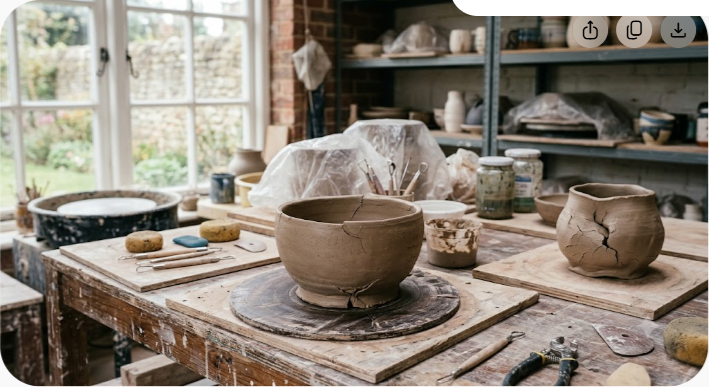
Ball clay and bentonite can both improve workability, but they shouldn't normally be treated as interchangeable materials.
Ball clay is a broader ceramic raw material containing kaolinite along with varying amounts of other clay minerals, quartz, organic matter, and accessory minerals. Its plasticity and firing behavior depend heavily on the deposit and grade. Bentonite, by contrast, is dominated by smectite and is generally used at much lower addition levels because of its high water demand and rheological activity.
| Feature | Ball Clay | Bentonite |
|---|---|---|
| Main clay mineral | Usually kaolinite-rich, with other clay minerals possible | Smectite, mainly montmorillonite |
| Typical role | Major plastic component in many bodies | Low-level plasticity and rheology modifier |
| Water demand | Moderate to high, grade dependent | High to very high, grade dependent |
| Swelling | Limited | Often substantial, especially for sodium bentonite |
| Typical body addition | Often several percent to tens of percent | Often below a few percent |
| Effect on rheology | Moderate to strong, depending on grade | Often strong at low addition levels |
| Fired color | Highly grade dependent | Highly grade dependent; low-iron grades are available |
| Main formulation concern | Impurities, shrinkage, firing behavior | Water demand, shrinkage, rheology, dispersion |
In practical formulation work, ball clay often supplies a substantial part of the body's plastic fraction, while bentonite is used to fine-tune performance. Replacing a large quantity of ball clay with bentonite isn't necessarily a like-for-like substitution because the two materials affect water demand, drying, rheology, and firing behavior differently.
Bentonite grades differ significantly. Mineralogy, exchangeable cations, purity, particle size, moisture content, and processing history can all change performance.
Sodium bentonite generally has a greater swelling capacity than calcium bentonite. Its high water uptake and strong hydrated structure make it useful when a formulation needs a substantial increase in plasticity, green strength, or suspension stability from a small addition.
The trade-off is higher water demand. If the addition is too high, drying can become slower and shrinkage-related defects can become more difficult to control.
Calcium bentonite generally swells less than sodium bentonite. It can still contribute to plasticity, cohesion, and rheology, but its behavior in water is different.
A calcium bentonite may be appropriate when the formulation doesn't require the high swelling response of sodium bentonite. The choice should be based on actual body performance rather than the assumption that one type is universally better.
For technical ceramics, porcelain, sanitaryware, electrical ceramics, and other demanding applications, a processed or beneficiated grade may be preferable to an untreated mineral.
Important specifications can include:
The right specification depends on the application. A bentonite selected for drilling fluids, for example, shouldn't automatically be assumed to be suitable for a white ceramic body.
There is no single dosage that works for every ceramic formulation. The sensible approach is to establish a starting range and then compare small laboratory batches under identical processing conditions.
For many bodies, a trial range of approximately 0.5% to 2% bentonite by dry batch weight is useful. Some formulations may perform well below 0.5%, while others may require a higher level. Additions above about 3% should be treated cautiously because water demand, drying shrinkage, and rheology can increase significantly.
| Application or body condition | Initial trial range by dry weight | Main objective |
|---|---|---|
| Minor workability adjustment | 0.25% to 0.75% | Fine-tune cohesion and forming behavior |
| Short stoneware or similar body | 0.5% to 1.5% | Improve plasticity and green strength |
| Highly non-plastic or refractory-rich body | 1% to 2% | Increase cohesion and forming tolerance |
| Porcelain or translucent body | 0.5% to 2% | Improve plasticity while controlling color and shrinkage |
| Casting slip | Often 0.1% to 0.5% or application-specific | Improve suspension and rheology |
These are formulation trial ranges, not universal production specifications. The bentonite grade and the rest of the recipe can shift the optimum considerably.
Suppose a dry ceramic body weighs 10 kg and the target trial addition is 1% bentonite. The calculation is straightforward:
For a 10 kg dry batch at 1%, the bentonite addition is 100 g. A second batch at 1.5% would contain 150 g, while a 0.5% trial would contain 50 g.
The point of this stepped approach is to find the lowest addition that produces the required improvement. More bentonite isn't automatically better.
The main formulation mistake is treating bentonite as a universal fix for poor plasticity. If a body is badly balanced, increasing bentonite may improve one property while creating several new defects.
Montmorillonite has a strong affinity for water. Increasing its proportion can increase the amount of water required to reach a workable consistency. As the body dries, the resulting moisture loss can contribute to greater shrinkage.
The actual shrinkage depends on the complete formulation, forming moisture, particle packing, drying conditions, and firing schedule. It isn't accurate to assign one fixed shrinkage value to all bentonite-containing bodies.
A bentonite-rich body can hold water strongly. Thick sections may therefore dry more slowly than thin sections, increasing the risk of differential shrinkage.
The solution isn't always to reduce bentonite immediately. Drying conditions, wall thickness, particle packing, moisture content, and the rest of the body formulation should also be reviewed.
Excessive bentonite can make a wet body feel tacky or overly cohesive. Depending on the forming process, that can increase sticking to tools, dies, molds, or forming equipment.
A body that is technically more plastic can therefore become less pleasant and less efficient to process.
In casting slips, excess bentonite can raise viscosity and yield stress. The slip may become difficult to pour, may require more deflocculant, or may cast more slowly than intended.
This is why casting formulations need to be evaluated as complete systems rather than by adjusting bentonite alone.
Adding bentonite changes the chemical and mineral balance of the body. Even a small addition can introduce additional fluxing components, silica, alumina, iron, alkalis, or other minor constituents depending on the grade.
For technical or white-burning ceramics, fired shrinkage, water absorption, porosity, fired strength, color, and dimensional change should be checked after formulation changes.
Dispersion is just as important as dosage. Poor dispersion can produce local concentrations of bentonite that behave differently from the rest of the body.
Dry blending is often practical when all body ingredients are being prepared from dry powders.
The appropriate sieve size and mixing time depend on the raw materials and equipment. An 80- or 100-mesh screen may be useful in some laboratory preparations, but it shouldn't be treated as a universal processing requirement.
A pre-hydrated slurry can be useful when adjusting an existing wet slip or clay system.
Room-temperature water is generally sufficient. Warm water may alter hydration and processing behavior, so the water temperature should be controlled if it is used.
The exact hydration time depends on the bentonite grade. Overnight aging is commonly used in laboratory work, but the supplier's technical guidance and actual dispersion quality should determine the final procedure.
Likely causes: Too much bentonite, excessive forming moisture, or inadequate control of the body formulation.
What to check: Measure the actual moisture content and compare the bentonite addition with the dry batch calculation. If the bentonite level is high, reduce it in a controlled trial rather than making a large change immediately.
Likely causes: High drying shrinkage, uneven moisture distribution, rapid drying, excessive water content, or a body with poor particle packing.
What to check: Compare drying shrinkage at different bentonite levels. Slow the drying rate, reduce unnecessary water, and review the proportion of fine and coarse particles. Fine grog or calcined material may help adjust packing in some bodies.
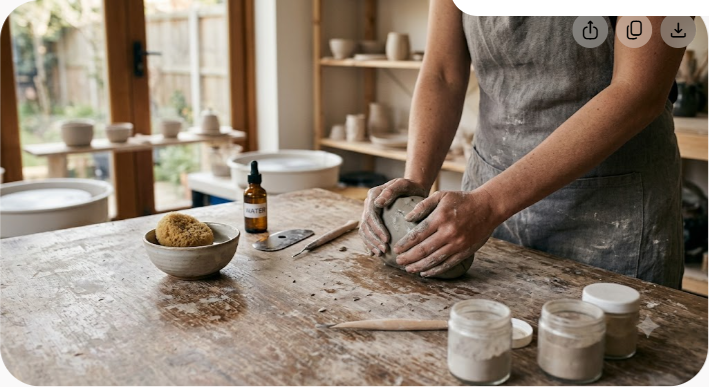
Likely causes: Poor dispersion or adding dry bentonite directly to a wet system.
What to check: Improve dry mixing or prepare a separately hydrated bentonite slurry. High-shear mixing can be useful for slip preparation, but the exact equipment and mixing time should be matched to the batch size.
Likely causes: Iron-bearing impurities in the bentonite or other changes to the raw material balance.
What to check: Review the bentonite chemical analysis and run a fired-color comparison using the actual production firing schedule. A low-iron ceramic grade may be more suitable.
Likely causes: Excess bentonite, excessive solids, inadequate deflocculation, unsuitable water chemistry, or poor dispersion.
What to check: Measure viscosity, density, and flow behavior while changing only one variable at a time. Don't automatically add more deflocculant; excessive chemical addition can also destabilize a casting system.
A good formulation program combines simple shop-floor observations with repeatable laboratory measurements. No single test describes every aspect of ceramic plasticity.
A simple coil test provides a quick qualitative comparison between formulations.
Roll clay at a consistent moisture content into a uniform coil. Bend the coil around a rod or other repeatable radius and inspect the outer surface.
The test becomes much more useful when the same coil diameter, moisture content, bend radius, and sample preparation are used for every batch.
The Pfefferkorn method is widely used to characterize the forming consistency of ceramic clays. It relates deformation under a standardized test procedure to the moisture content of the sample.
The method can help compare different bodies and determine a workable moisture range. Because the result depends on standardized preparation and equipment, it is more useful as a comparative laboratory measurement than as a number considered in isolation.
Atterberg limits are widely used in soil science and can also provide useful information about fine-grained clay systems. They include the liquid limit and plastic limit, from which the plasticity index is calculated:
These measurements can help characterize how moisture affects a clay-rich material. However, ceramic formulation decisions should not rely on Atterberg values alone because ceramic bodies contain non-clay minerals and are processed under conditions that differ from conventional geotechnical applications.
Plasticity gains are only useful if the finished body still meets its dimensional and firing requirements. Record linear drying shrinkage for each trial batch and, where relevant, also measure fired shrinkage, water absorption, bulk density, fired strength, and fired color.
This gives the formulator a much clearer picture of whether a bentonite addition genuinely improves the body or simply moves the problem from forming to drying.
Consider a porcelain body that contains a high proportion of kaolin, feldspathic material, and quartz but feels too short during forming.
A practical trial would keep the base recipe unchanged and prepare several small batches containing different bentonite levels, such as 0%, 0.5%, 1%, 1.5%, and 2% by dry weight.
For each batch, record:
The best formulation isn't necessarily the one with the highest plasticity. It is the formulation that reaches the required forming performance without creating unacceptable drying or firing problems.
The right bentonite level depends strongly on how the ceramic body is formed.
Extrusion bodies need enough plasticity and cohesion to pass through the die without tearing or laminating. A small bentonite addition can improve green strength and reduce the tendency of a short body to crack at edges.
However, excessive stickiness can increase die friction and complicate release. Extrusion pressure and moisture content should therefore be monitored alongside bentonite dosage.
Pressed ceramic bodies often rely heavily on controlled particle-size distribution, granulation, moisture content, and binder systems. Bentonite can influence green strength and particle cohesion, but excessive addition may interfere with powder flow or increase the water needed for granulation.
Trials should be performed using the same powder preparation and pressing conditions used in production.
Slip casting requires a careful balance between solids loading, viscosity, yield stress, particle settling, deflocculation, and mold absorption. Bentonite can improve suspension but can also make a slip too viscous.
For this reason, bentonite additions in casting systems are generally much lower than those used to modify a plastic forming body.
In throwing bodies, bentonite can improve cohesion and reduce tearing, particularly in bodies containing significant amounts of grog or coarse mineral material. The benefit is most noticeable when the body is short at its normal working moisture content.
Again, too much can make the clay tacky and difficult to trim or release from tools.
A bentonite's performance depends on mineral composition, exchangeable cations, purity, particle size, and processing. Two products sold under the same general mineral name can behave differently in a ceramic body.
A 1% addition of one bentonite isn't necessarily equivalent to a 1% addition of another. Swelling capacity, moisture content, smectite content, and rheological activity can all affect the result.
Ceramic formulations should be calculated on a consistent dry-weight basis. If one raw material contains substantially more moisture than another, weighing materials without correcting for moisture can change the effective formulation.
Poor plasticity can result from particle-size distribution, insufficient plastic clay, excessive grog, incorrect moisture, poor mixing, or unsuitable raw materials. Bentonite may help, but it isn't a substitute for sound body design.
If bentonite percentage, water content, ball clay percentage, and deflocculant dosage are all changed together, it becomes difficult to determine which change produced the result.
Controlled trials are slower than guesswork at first, but they save considerable time when a production formulation needs to be stabilized.
For commercial production, consistency matters as much as peak performance. A bentonite that performs exceptionally well in one laboratory batch isn't useful if its properties vary significantly from shipment to shipment.
When evaluating a supplier or grade, ask for relevant technical specifications and, where appropriate, a certificate of analysis. Depending on the application, useful information may include:
For white-burning or technical ceramics, low iron and consistent chemistry may be particularly important. For plastic forming bodies, hydration and rheological behavior may be more important. For casting slips, suspension and deflocculation response deserve close attention.
A supplier's recommended addition rate should be treated as a starting point. The final dosage still needs to be validated in the actual ceramic body and production process.
Before introducing bentonite into a production body, check the following:
Bentonite can be an effective way to improve ceramic body plasticity, green strength, and suspension behavior, particularly when used as a low-level modifier. Its high montmorillonite content gives it strong interaction with water and a much greater rheological effect than many conventional ceramic minerals.
The same properties that make bentonite useful also create its main limitations. Excessive additions can increase water demand, drying shrinkage, stickiness, and slip viscosity. Raw-material quality also matters, especially in porcelain, sanitaryware, electrical ceramics, and other applications where fired color and dimensional stability are tightly controlled.
A practical approach is to begin with small additions, prepare controlled comparison batches, and measure both forming and drying performance. For many ceramic bodies, a starting trial around 0.5% to 2% by dry weight is reasonable, but the correct level must be established for the specific bentonite and body formulation.
The goal isn't to add as much bentonite as possible. It is to use enough to solve the formulation problem while preserving predictable drying, firing, and production behavior.













Have questions about our products? We're here to help!