Axewelledge, a leading exporter from India, specializes in high-quality Bentonite. With a commitment to excellence, we supply premium Bentonite to the Middle East and Southeast Asia markets.


North Angle Complex, 304,
150 Feet Ring Rd, Opposite Ambedkar Nagar BRTS Stop,
Madhav Park, Punit Nagar,
Mavdi, Rajkot, Gujarat 360004
© Axewelledge 2026, All Rights Reserved.
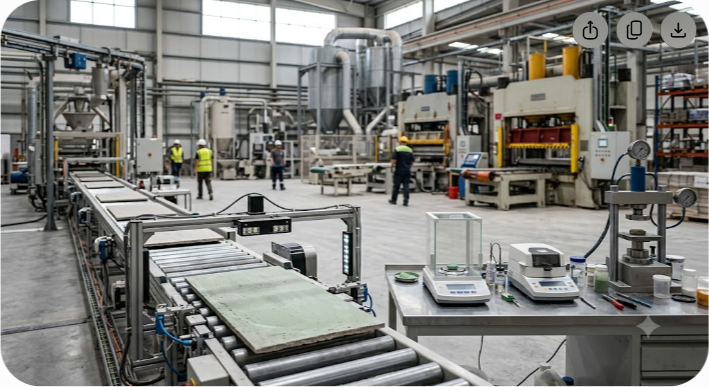
Bentonite is used in ceramic tile bodies mainly to increase plasticity, improve green and dry strength, and help control the behavior of water-based slips. Because bentonite is rich in montmorillonite and has a very high specific surface area, a relatively small addition can have a noticeable effect on processing. The right dosage, however, depends on the complete body formulation, the bentonite grade, milling conditions, deflocculation system, and the firing schedule.
For many tile bodies, a starting trial range of about 0.25% to 1.5% by dry batch weight is practical, but there is no universal dosage that works for every factory. Too little may provide limited benefit. Too much can raise slip viscosity, change drying behavior, increase shrinkage, affect firing color, or make deflocculation more difficult.
That balance is what makes bentonite useful. It isn't simply a stronger version of ball clay. It is a highly active clay mineral that can be used in small quantities to adjust several properties at once.
This guide explains how bentonite works in ceramic tile bodies, where it provides the most value, how sodium and calcium bentonite differ, how to select a suitable grade, how to incorporate it during milling, and which production problems it can and cannot solve.
Bentonite is a clay-rich material containing a high proportion of smectite minerals, most commonly montmorillonite. It forms through the alteration of volcanic ash and other volcanic materials, although its geological origin varies by deposit. The mineral's layered structure gives it an unusual ability to interact with water.
In a ceramic tile body, bentonite can serve three related functions:
These effects come from montmorillonite rather than from bentonite being a conventional binder in the same sense as an organic polymer. The distinction matters because the processing behavior of bentonite is strongly influenced by water chemistry, exchangeable cations, particle size, and the presence of deflocculants.
Montmorillonite is a 2:1 phyllosilicate. Each structural layer contains an alumina- or magnesia-rich octahedral sheet between two silica-rich tetrahedral sheets. Isomorphic substitution within the layers creates a net negative charge, which is balanced by exchangeable cations such as sodium, calcium, and magnesium between the layers.
Those exchangeable ions affect how the clay interacts with water. Sodium-dominant montmorillonite generally hydrates and disperses more strongly than calcium-dominant material. The resulting hydrated particles have a large effective surface area and can form a network throughout a suspension.
In a ceramic body, this fine fraction fills spaces between coarser quartz, feldspar, kaolin, and other raw materials. During drying, the particles become closely packed and contribute to cohesion. During wet milling, they influence the slip's viscosity and yield stress.
The practical point is simple: montmorillonite content and mineral quality matter more than the word bentonite on a product label. Two bentonites can behave very differently at the same addition rate.
Bentonite does not have one fixed chemical formula. Its composition depends on the deposit, degree of purification, exchangeable cations, associated minerals, and processing method. A supplier's certificate of analysis should therefore be used instead of relying on generic composition figures.
Common oxides found in ceramic-grade bentonite include:
For white and super-white ceramic bodies, iron content deserves particular attention because even a small addition of a high-iron bentonite can influence fired color. The acceptable limit depends on the base body, glaze system, firing atmosphere, target whiteness, and the amount of bentonite being added.
The difference between sodium and calcium bentonite is especially important in ceramic processing because the dominant exchangeable cation affects hydration, swelling, dispersion, and rheology.
Sodium-dominant bentonite generally has high water absorption and swelling capacity. When properly hydrated, its montmorillonite particles can form a strong colloidal network. This makes sodium bentonite useful when the objective is to increase plasticity, green strength, or suspension stability at a relatively low dosage.
The actual swelling value varies significantly with mineralogy and test method, so published swelling figures should be treated as product-specific rather than universal.
Calcium-dominant bentonite generally has lower swelling and different hydration behavior. It can still contribute plasticity and binding, but its performance in a ceramic body or slip may differ substantially from a sodium bentonite at the same addition rate.
Calcium bentonite can be chemically activated with sodium carbonate to exchange calcium for sodium. The resulting material is commonly called activated sodium bentonite. Its performance depends on the quality of the original clay and the effectiveness of the activation process.
For applications where high plasticity, green strength, and slip suspension are important, a well-selected sodium bentonite is often the more effective starting point. But the best material is the one that performs consistently in the factory's actual body recipe.
A controlled laboratory trial is more useful than choosing a grade solely because it has a higher swelling number. Excessive swelling or viscosity can create new processing problems if the plant's deflocculation system isn't adjusted accordingly.
The main benefits of bentonite appear before the tile enters the kiln. It changes the behavior of the raw body during milling, spray drying, pressing, handling, and drying. Some effects can also influence firing, but those effects should be evaluated through laboratory testing rather than assumed from the bentonite type alone.
Green strength is the ability of a pressed, unfired tile to withstand handling without cracking or breaking. Dry strength refers to the strength after most of the free moisture has been removed.
This matters on automated production lines. A tile may pass through conveyors, brushing equipment, glaze application, digital decoration, transfer systems, dryers, and stacking equipment before it reaches the kiln. Weak edges and corners can fail during any of these operations.
Fine montmorillonite particles increase cohesion between body particles. Once the water is removed, the closely packed clay fraction contributes to the strength of the dry compact.
The actual increase in modulus of rupture depends on the starting formulation and test conditions. It isn't accurate to promise a fixed percentage improvement for every ceramic body. Instead, manufacturers should establish a baseline MOR and compare several bentonite dosages under identical pressing and drying conditions.
A useful trial might compare 0%, 0.25%, 0.5%, 0.75%, 1.0%, and 1.5% bentonite. The results should include green MOR, dry MOR, bulk density, moisture, shrinkage, water absorption, and fired color where relevant.
Plasticity becomes particularly valuable when a body contains a high proportion of non-plastic minerals such as quartz and feldspar. These materials contribute important fired properties, but they don't provide the same workability as plastic clays.
Bentonite has very high plasticity because of its fine particle size and interaction with water. A small addition can therefore change the forming behavior of a body that otherwise feels short or brittle.
That doesn't mean bentonite should replace ball clay on a one-to-one basis. Ball clay contributes more than plasticity alone. It can also influence casting behavior, green strength, firing color, shrinkage, and the overall balance of the body.
The better approach is to treat bentonite as a formulation tool. If a body needs more plasticity or green strength, a small bentonite addition can sometimes reduce the amount of conventional plastic clay required. The replacement ratio must be established experimentally.
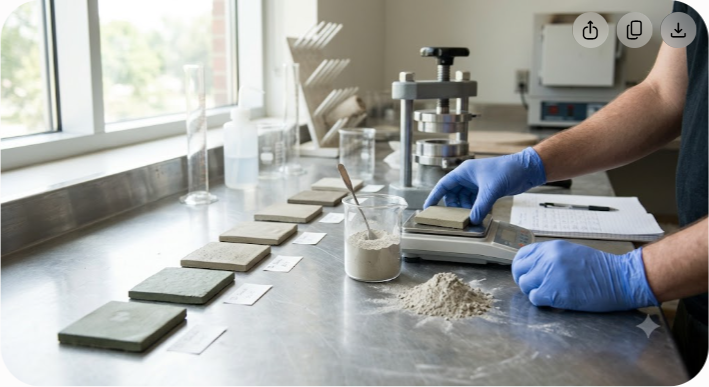
Pressing performance depends on the complete spray-dried granule structure, moisture distribution, particle size, granule strength, and compaction behavior. Bentonite can influence these properties because its fine particles occupy spaces within and between larger particles.
However, it is misleading to assume that adding bentonite automatically increases green density or reduces press pressure. At higher levels, the extra clay fraction can increase water demand and change the compressibility of the powder.
The useful question is not simply whether bentonite increases density. It is whether the selected dosage produces a compact with the required density and strength without creating excessive springback, lamination, sticking, or drying problems.
During trials, measure:
These measurements reveal whether bentonite is actually improving the pressing window.
Ceramic tile slips contain a mixture of finely ground minerals suspended in water. Without adequate control, heavier particles can settle during storage or transport, creating changes in slip composition and density.
Hydrated bentonite can increase yield stress and create a weak three-dimensional particle network. This can slow sedimentation and improve suspension stability.
There is a trade-off. Too much bentonite can raise apparent viscosity and make the slip harder to pump, atomize, or deflocculate. The objective is therefore not maximum viscosity. It is stable suspension at a workable viscosity and solids content.
Slip testing should include density, viscosity, thixotropy, residue, temperature, pH where relevant, and settling behavior. These measurements are more useful than applying a fixed bentonite dosage to every body.
Bentonite is a mineral component, so it participates in the reactions that occur as the ceramic body is heated. Its silica, alumina, alkali, alkaline-earth, and iron-bearing components become part of the overall body chemistry.
At normal tile-firing temperatures, the effect of a small bentonite addition is usually assessed as part of the complete formulation rather than as an isolated fluxing mechanism. Depending on its composition, bentonite can affect vitrification, shrinkage, porosity, fired color, and phase development.
For this reason, manufacturers should not assume that adding bentonite will automatically lower the firing temperature or increase vitrification. The result depends on the existing feldspar, quartz, clay, flux, carbonate, and other mineral proportions.
Fired testing should include water absorption, linear shrinkage, fired MOR, color, warpage, and visible defects. A small laboratory firing matrix can reveal the effect much more reliably than a generic rule.
Bentonite works differently from the other materials commonly used to adjust ceramic body behavior. Choosing among them requires looking at the job each material needs to perform.
| Property / Performance | Sodium Bentonite | Ball Clay | Kaolin | Organic Binders such as CMC |
|---|---|---|---|---|
| Typical role | Plasticizer, binder, rheology modifier | Plasticity and green strength | Aluminosilicate clay, plasticity and fired properties | Green binder and rheology modifier |
| Typical addition | Often below 2% in tile bodies | Often much higher | Formulation dependent | Usually low dosage |
| Plasticity | Very high | High | Moderate to low, depending on grade | Not directly comparable |
| Effect on slip | Can strongly increase yield stress | Moderate | Usually lower | Can strongly affect viscosity |
| Organic content | Inorganic mineral | Can contain organic matter | Inorganic mineral | Organic polymer |
| Effect on fired color | Depends strongly on Fe content | Depends on grade | Generally important to body color | Burns out during firing |
| Main formulation risk | Excess viscosity, shrinkage, or color impact at high dosage | Higher clay loading and shrinkage | Lower plasticity in some bodies | Burnout and gas-related process effects if poorly controlled |
Ball clay and bentonite can both improve plasticity and green strength, but they aren't interchangeable raw materials.
Ball clay normally contributes a broader balance of plasticity, particle size, organic content, mineral composition, fired color, and firing behavior. Bentonite is much more concentrated in its effect because of its high smectite content.
A formulation engineer may therefore replace part of a plastic clay fraction with bentonite, but the replacement should be based on laboratory results. A fixed claim such as one kilogram of bentonite always replacing a specific quantity of ball clay is too broad to apply across different deposits and body recipes.
Organic binders such as carboxymethyl cellulose can provide strong green bonding at very low concentrations. They are useful in many ceramic processes, but they decompose and oxidize during firing.
Bentonite is inorganic and therefore doesn't introduce the same organic burnout load. That can be useful when a manufacturer is trying to simplify the organic additive package.
Still, bentonite isn't automatically a substitute for every organic additive. The two materials behave differently in water, during drying, and during firing. If an organic binder is removed, the complete process should be requalified rather than changed on a one-for-one basis.
A sensible starting range for many tile body trials is 0.25% to 1.5% by dry batch weight. Some bodies may perform well outside this range, while others may require less.
The correct dosage depends on montmorillonite content, exchangeable cations, particle size, iron content, body composition, moisture, milling conditions, deflocculant chemistry, pressing pressure, and firing schedule.
| Tile Body | Practical Trial Range | Main Objective |
|---|---|---|
| Super-white porcelain | 0.25% to 0.75% | Green strength with minimal color impact |
| Glazed porcelain | 0.5% to 1.25% | Strength, plasticity, and process stability |
| Floor tile / monocottura | 0.5% to 1.5% | Green and dry strength |
| Porous wall tile | 0.75% to 1.5% | Plasticity and handling strength |
| Large-format body | 0.25% to 1.0% | Uniformity and green handling strength |
These are trial ranges, not production specifications. The final dosage should be established from the actual body and plant process.
A simple test matrix can prevent costly full-scale production trials. Prepare the same base body with several bentonite concentrations while keeping all other variables constant.
The best dosage is usually the point where the required strength improvement is achieved without creating an unacceptable change in rheology, drying, firing, or cost.
Bentonite must be dispersed properly to deliver consistent performance. Localized agglomerates can behave very differently from uniformly dispersed montmorillonite.
For conventional wet-milled ceramic bodies, bentonite can be introduced into the ball mill with the other raw materials. This approach gives the material time to hydrate and disperse during milling.
The exact sequence depends on the plant's mill loading procedure. Some manufacturers may benefit from pre-dispersing bentonite, while others can add it directly with the dry raw materials. The key is to prevent dry lumps from surviving the milling process.
After milling, check residue and slip rheology rather than assuming that longer milling is always better. Excessive milling can alter particle size distribution and increase energy consumption without improving the final body.
Where dry grinding or dry granulation is used, bentonite should be distributed uniformly through the raw material stream before forming. A fine, consistent powder is easier to distribute than coarse agglomerates.
A dry sieve result such as 95% passing 200 mesh can be a useful supplier specification, but the appropriate particle size depends on the product and process. More important is consistent dispersion in the actual production system.
Sodium bentonite doesn't behave like an inert mineral powder. It interacts with water quickly, but complete dispersion can require time and adequate mixing.
If bentonite is added immediately before a slip is pumped to the spray dryer, the measured rheology may continue changing during storage. This is one reason plant trials should record both the time after mixing and the time after deflocculant addition.
One of the most common mistakes is to judge bentonite only by its strength benefit while ignoring its effect on slip rheology.
Bentonite can increase viscosity and yield stress. If the dosage is too high, the plant may respond by adding more water. That can reduce slip solids, increase spray-drying load, and change granule formation.
A better response is to optimize the entire deflocculation system.
Deflocculants such as sodium silicate, sodium tripolyphosphate, or suitable polyacrylate-based products may be used depending on the body chemistry and plant practice. The correct combination must be determined experimentally because clay minerals respond differently to dispersants.
Iron content can be one of the most important purchasing criteria when bentonite is used in a white ceramic body.
A bentonite with several percent Fe2O3 may be acceptable in a colored or conventional body but unsuitable for a super-white porcelain formulation. Because the addition rate is small, the contribution to the overall batch is also small, but highly white bodies can still be sensitive to the change.
For example, if a bentonite contains 1.0% Fe2O3 and is added at 1.0% of the dry batch, its direct Fe2O3 contribution is approximately 0.01 percentage points, assuming the stated analysis is accurate. That doesn't mean fired color will change by exactly a predictable amount, because iron behavior also depends on the rest of the body and firing atmosphere.
Ask the supplier for a recent certificate of analysis and, for critical white bodies, confirm the material with your own laboratory testing.
A ceramic buyer should consider more than swelling capacity. Useful specifications include:
The test method matters. Two suppliers can report similar numbers while using different procedures, making direct comparison unreliable.
Bentonite can be useful across several ceramic product categories, but the reason for adding it changes with the body.
Porcelain bodies typically contain substantial amounts of feldspathic and siliceous raw materials and are designed to vitrify at relatively high temperatures. The body needs enough plasticity and green strength to survive pressing, drying, glazing, decoration, and handling.
A small amount of low-iron sodium bentonite can improve green strength without requiring a large increase in the total plastic-clay fraction. The resulting body must still meet its targets for water absorption, shrinkage, color, warpage, and mechanical strength.
For porcelain, bentonite should therefore be viewed as a formulation adjustment rather than a standalone performance additive.
Wall tile bodies often contain carbonate-rich raw materials and have different firing and absorption targets from porcelain. Their plasticity and green handling strength can become limiting when the body contains a large proportion of non-plastic minerals.
A controlled bentonite addition can improve cohesion and reduce handling losses. The dosage should be kept within the range established by laboratory trials because excess clay can affect drying and firing shrinkage.
Large-format products are less forgiving of local differences in moisture and density. A small variation that causes no visible problem in a small tile can create significant internal stress in a large slab.
Bentonite may contribute to green cohesion and plasticity, which can help during transfer and drying. It doesn't, however, eliminate density gradients or drying stresses by itself. Granule quality, pressing uniformity, moisture distribution, dryer design, and handling remain critical.
Bentonite can help with some defects, but it shouldn't be treated as a universal defect correction. Before changing the formulation, identify whether the problem originates in raw material quality, milling, granulation, pressing, drying, glazing, or firing.
Possible causes: Low green strength, insufficient plasticity, excessive press stress, poor granule structure, uneven moisture, or mechanical impact during handling.
Bentonite approach: Run a controlled dosage trial and compare green and dry MOR. If strength increases without excessive rheology or shrinkage changes, a small bentonite addition may reduce handling losses.
Also inspect conveyor transfers, press settings, powder moisture, and granule strength. Adding more bentonite won't fix a mechanical impact problem.
Possible causes: Uneven green density, moisture gradients, inconsistent granule moisture, non-uniform pressing, or uneven drying.
Bentonite approach: Check whether the bentonite improves green cohesion and powder behavior. Then verify density distribution and drying conditions. Warpage is usually a process problem involving several variables rather than a simple lack of binder.
Bentonite itself isn't an organic carbon source like CMC or other organic additives, but replacing an organic binder with bentonite doesn't automatically eliminate pinholes or black cores.
Black core can be associated with the oxidation of carbonaceous matter, incomplete burnout, gas release, body permeability, firing conditions, and other formulation factors. Pinholes and blisters can have additional causes involving glaze and firing behavior.
If these defects occur, examine the complete organic additive package, raw material chemistry, body permeability, firing curve, and kiln atmosphere before changing bentonite dosage.
If coarse particles settle rapidly in a storage tank, a small amount of bentonite may increase yield stress and improve suspension. But first check particle size, milling residue, slip density, deflocculation, and storage conditions.
The goal is controlled rheology, not maximum viscosity. A slip that stays suspended but becomes difficult to pump is not a successful formulation.
Mineralogy varies from deposit to deposit. Sodium-dominant, calcium-dominant, activated, beneficiated, and differently processed bentonites can have very different behavior.
Better approach: Approve bentonite by performance specification and lot consistency, not simply by product name.
A higher dosage can increase strength, but it can also increase water demand, viscosity, drying shrinkage, and firing shrinkage. At some point, the disadvantages outweigh the strength gain.
Better approach: Identify the lowest dosage that meets the required green and dry strength targets.
A grade that works perfectly in a conventional floor tile may cause an unacceptable color shift in a super-white porcelain body.
Better approach: Review Fe2O3 and TiO2 specifications and confirm fired color in the actual body.
If both variables change together, it becomes difficult to determine which change caused an improvement or a problem.
Better approach: Use a structured trial matrix and change one major variable at a time where practical.
Poor granulation, uneven moisture, excessive fines, worn dies, or incorrect press settings can cause defects even when the body has adequate plasticity.
Better approach: Diagnose the complete process before changing the mineral recipe.
For ceramic production, consistency is often more important than a single impressive laboratory number. A bentonite that performs well one month and differently the next can create larger problems than a slightly less active material with stable properties.
Ask potential suppliers for:
A supplier should also be able to discuss how its product behaves in the presence of common ceramic deflocculants and high-solid-content slips.
Axewelledge supplies bentonite from India for industrial applications and focuses on export markets including the Middle East and Southeast Asia. For ceramic manufacturers evaluating a new bentonite source, the most useful starting point is a representative sample accompanied by a current technical specification and certificate of analysis.
Rather than selecting a product solely from a general specification sheet, ceramic manufacturers should test the material in their own body recipe. Green MOR, dry MOR, slip rheology, moisture, fired shrinkage, water absorption, and color provide a much stronger basis for approval.
Where low-iron performance is required, the supplier should provide clear Fe2O3 and TiO2 specifications and support lot-to-lot consistency testing.
When deciding whether to add bentonite to a ceramic tile body, start with the process problem rather than the product.
If the problem is low green strength: Test a small amount of suitable sodium bentonite and compare green and dry MOR with the existing body.
If the problem is poor plasticity: Compare bentonite with the current plastic clay system rather than assuming it can replace ball clay completely.
If the problem is slip sedimentation: Measure settling behavior and rheology before and after the addition. Confirm that pumpability and spray-dryer performance remain acceptable.
If the problem is fired color: Prioritize low-iron material and confirm the result through fired laboratory testing.
If the problem is warpage: Investigate density and drying uniformity first. Bentonite may support green strength, but it cannot compensate for major process gradients.
If the problem is pinholes or black core: Review organic additives, body chemistry, permeability, glaze behavior, and kiln conditions before changing bentonite.
This approach keeps the formulation change focused and makes the results easier to interpret.
Bentonite can be a highly effective minor component in ceramic tile body formulations when its mineralogy and dosage are matched to the process.
The best bentonite formulation is not necessarily the one with the highest swelling or the highest montmorillonite content. It is the grade and dosage that solve the production problem while keeping the rest of the ceramic process inside its operating window.
For manufacturers evaluating bentonite for porcelain, wall tile, floor tile, or large-format ceramic bodies, a controlled plant-specific trial is the most reliable next step. A qualified mineral supplier can then use the test results to recommend a grade, dosage, and supply specification that fits the actual body formulation.













Have questions about our products? We're here to help!