Axewelledge, a leading exporter from India, specializes in high-quality Bentonite. With a commitment to excellence, we supply premium Bentonite to the Middle East and Southeast Asia markets.


North Angle Complex, 304,
150 Feet Ring Rd, Opposite Ambedkar Nagar BRTS Stop,
Madhav Park, Punit Nagar,
Mavdi, Rajkot, Gujarat 360004
© Axewelledge 2026, All Rights Reserved.
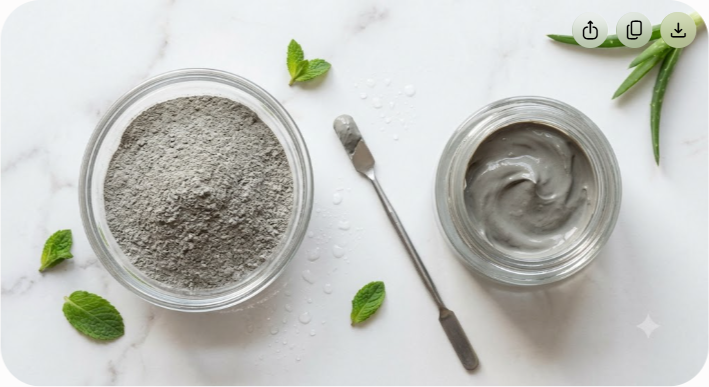
Yes, bentonite can be used in cosmetics and personal care products when the material is appropriately selected, processed, tested, and formulated for its intended application. It is valued mainly for its ability to modify viscosity, suspend particles, absorb oils, improve texture, and build stable clay-based systems.
The important distinction is between cosmetic-grade bentonite and untreated industrial clay. Bentonite is a naturally mined material, so its composition can vary with the deposit, processing method, and mineral impurities present. A formulator should not assume that every bentonite sold for drilling, construction, foundry work, or industrial absorbents is suitable for skin or personal care products.
In cosmetics, the clay's mineral composition, swelling behavior, particle size, surface chemistry, microbiological quality, and trace-element profile all affect performance. A good raw material is only the starting point. The finished formula still needs appropriate stability, preservation, compatibility, and safety testing.
This guide explains what bentonite is, how sodium and calcium grades differ, where the clay is used, how it behaves in a formula, what to check when sourcing it, and which common formulation assumptions deserve a second look.
Bentonite is a clay material composed largely of minerals from the smectite group, with montmorillonite commonly being the dominant mineral. Many deposits form from the alteration of volcanic ash in geological environments where water and other conditions allow clay minerals to develop over long periods.
Montmorillonite has a layered crystal structure. Each particle consists of very thin mineral sheets with an internal arrangement that allows water and exchangeable ions to interact with the layers. That structure is responsible for much of bentonite's swelling, dispersion, adsorption, and rheological behavior.
The exact performance of bentonite depends on more than the word "bentonite" on a specification sheet. Mineral composition, exchangeable cations, particle-size distribution, moisture content, processing history, and activation can all change how the powder behaves in water and in a finished cosmetic product.
During mineral formation, some ions within the crystal lattice can be replaced by ions with a different charge. This process, called isomorphous substitution, gives montmorillonite a permanent negative layer charge.
Exchangeable cations such as sodium, calcium, magnesium, and potassium balance that charge around the clay layers. When the clay contacts water, those ions influence how far the layers separate and how readily the particles disperse.
That chemistry explains why two bentonite grades can behave very differently even when both are sold under the same broad mineral name. One may form a strong gel at a relatively low concentration, while another may disperse more readily as an absorbent powder but provide less swelling.
For formulators, the practical lesson is simple: choose bentonite by specification and intended function, not by name alone.
Particle size affects both formulation behavior and the sensory experience of the finished product. Coarser material can feel gritty, settle more readily, or require more processing to produce a uniform dispersion. Finer grades can provide a smoother skin feel and faster hydration, although very fine powders also require appropriate dust-control measures during manufacturing.
Particle-size data should therefore be reviewed alongside swelling, moisture, microbiological, and chemical specifications. A supplier's stated mesh size or D50 value is useful, but it does not replace testing of the actual grade in the intended formula.
The difference between sodium and calcium bentonite is particularly important when choosing a clay for personal care formulations. The dominant exchangeable ion affects hydration, swelling, dispersion, and the strength of the clay's rheological network.
Sodium bentonite generally has a stronger swelling response in water than calcium-dominant bentonite. Once properly dispersed and hydrated, it can produce a useful yield stress and help keep suspended particles from settling.
Common formulation applications include:
Its strong swelling behavior can also create processing challenges. Too much clay, poor dispersion, or a high electrolyte load can produce a system that becomes difficult to mix or loses viscosity after other ingredients are added.
Calcium-dominant bentonite generally swells less than sodium bentonite. It can still provide useful absorbency and body, but its behavior is often better suited to dry blends, masks, powders, and formulas where very high water-phase swelling is not required.
Potential applications include:
The choice isn't always either-or. Some commercial cosmetic grades are blended or specially processed to achieve a particular balance of swelling, viscosity, suspension, and sensory properties.
Start with the product's job. If the formula needs a strong aqueous gel network, a highly swelling sodium bentonite may be useful. If the goal is primarily oil absorption in a dry mask, a less-swelling grade may be easier to work with.
The supplier's technical data should provide the information needed to make that decision. Look for swelling or viscosity data generated by a defined test method rather than relying on broad descriptions such as "high swelling" or "high absorption."
Bentonite is often described as both an adsorbent and an absorbent. Those terms aren't interchangeable.
Adsorption is the attachment of substances to a material's surface. Bentonite has a large reactive surface area and a charged mineral structure, so it can interact with ions and other substances at its particle surfaces.
Absorption describes a substance entering the bulk of another material. In a cosmetic context, bentonite can also hold oils or liquids within spaces between and around its particles, but that doesn't mean every ingredient or impurity is being pulled deep into the clay in the same way.
This distinction matters because marketing language sometimes turns a useful physical property into an unsupported claim about "detoxification."
In a clay mask, bentonite can bind some oils and other substances at its particle surfaces while also holding water within the hydrated clay network. As the mask dries, the water gradually leaves the system and the clay layer becomes firmer.
The tightening sensation people notice during drying is not proof that pores are being physically pulled closed or that toxins are being removed from the body. It is mainly a consequence of water loss, film formation, and the mechanical behavior of the drying clay layer.
Bentonite can be useful for products intended for oily or combination skin because it can reduce surface oil and leave a temporarily more matte finish. It should not, however, be presented as a medical treatment for acne or as a substitute for evidence-based acne therapy.
A clay can adsorb certain compounds under particular laboratory conditions without proving that a cosmetic product removes environmental toxins from human tissue. Cosmetic formulators should keep claims tied to what the finished product has actually been tested to do.
That is especially important for products marketed around terms such as "detox," "toxin removal," or "heavy metal cleansing." The mineral's surface chemistry is real; the marketing claim still needs evidence.
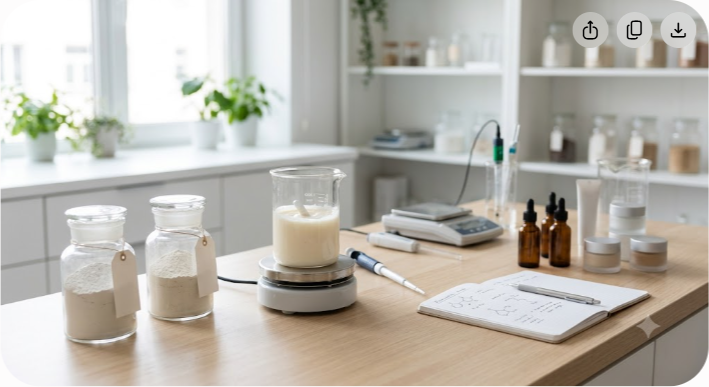
Bentonite is a versatile functional ingredient, but its role changes from one product category to another. It may act as an absorbent, rheology modifier, suspending aid, texturizer, or part of a clay-based product system.
Facial masks are among the most familiar applications. Bentonite can provide body, absorb surface oil, and create the characteristic clay texture consumers expect from a mineral mask.
A clay mask may contain a substantial proportion of clay, but there is no universal percentage that works for every product. The right level depends on the bentonite grade, particle size, water content, co-thickeners, humectants, oils, and desired sensory profile.
A high-clay mask can feel dry or tight if the rest of the formula does not compensate for the water loss and absorbency of the mineral. Humectants and emollients can be used to improve the skin feel, while appropriate processing helps prevent a gritty texture.
Bentonite can also appear in shampoos, scalp masks, cleansing pastes, and other hair-care products. Its absorbent and rheological properties can help create a product aimed at oily scalp conditions or heavy product buildup.
However, "detox shampoo" is primarily a marketing term. Bentonite does not cleanse the body of systemic toxins through the scalp. In a well-designed hair-care formula, its practical role is closer to helping manage oil, particulate matter, and product residues at the hair and scalp surface.
The clay can also affect slip, rinsability, viscosity, and foam. Because it may interact with surfactants and polymers, compatibility testing is essential before scaling a formula.
Bentonite is sometimes included in cream, balm, or stick deodorant formulas because it can absorb moisture and contribute to a dry skin feel.
Its performance is different from that of an antiperspirant active. Bentonite does not function as an aluminum antiperspirant salt and should not be presented as preventing sweat through the same mechanism.
In deodorants, it may be combined with other odor-control ingredients. The complete formula should be assessed for skin compatibility, residue, color, spreadability, and odor performance rather than assuming that more clay will produce better protection.
Bentonite has been used in some mineral and natural oral-care products, including toothpastes and powdered products. Its suitability depends on the specific grade, particle characteristics, purity, and abrasivity of the finished formula.
Claims about enamel safety should not be based solely on particle size or a general description of the clay. Dental abrasivity is evaluated using established test methods, and the finished toothpaste should be assessed accordingly.
For oral products, raw-material documentation needs to be particularly robust because the intended exposure differs from a rinse-off skin product. A clay that is appropriate for a facial mask isn't automatically appropriate for toothpaste.
Bentonite can help suspend pigments and mineral particles in selected liquid color-cosmetic systems. Its hydrated particles can form a network that slows sedimentation and improves the consistency of the product.
The concentration should be optimized through stability testing. Too little may provide insufficient suspension, while too much can produce excessive viscosity, drag during application, or an undesirable clay-like sensory profile.
The same principle applies to mineral sunscreen formulations. Bentonite may contribute to suspension, but it is not itself a sunscreen active unless the finished product contains an approved UV-filter system that provides the claimed protection.
Bentonite isn't automatically the best clay for every cosmetic. Kaolin, hectorite, illite, and other clay minerals each bring different properties to a formula.
| Clay Type | Main Mineral Group | Water Swelling | Typical Functional Role | Common Cosmetic Uses |
|---|---|---|---|---|
| Bentonite | Montmorillonite-rich smectite | Moderate to high, depending on grade | Absorption, suspension, rheology | Masks, cleansers, gels, selected emulsions |
| Kaolin | Kaolinite | Low | Gentle absorbency, texture | Masks, powders, cleansers |
| Hectorite | Smectite | High for suitable grades | Rheology and suspension | Gels, emulsions, color cosmetics |
| Illite-rich clay | Illite | Low to moderate | Absorbency and texture | Masks and mineral blends |
| Attapulgite or sepiolite | Magnesium aluminum silicate minerals | Variable | Absorbency and rheology | Powders, masks, suspensions |
These descriptions are broad. Commercial grades can differ substantially even within the same mineral family.
For a formula designed around strong oil absorption and a pronounced clay texture, bentonite may be a useful choice. Kaolin is often selected when a milder, less-swelling clay system is preferred.
Skin type alone shouldn't determine the choice. The formulator also needs to consider the product's intended contact time, total clay concentration, particle size, humectant content, fragrance, preservatives, and final pH.
Hectorite is often favored when a formulator needs a highly effective smectite rheology modifier at a relatively low concentration, particularly in systems where a clear or elegant gel structure matters. Bentonite can still be useful when its stronger mineral character, absorbency, or cost profile fits the formulation.
The best choice comes from comparative bench testing rather than mineral labels alone.
Bentonite can be suitable for cosmetic use when the specific raw material is appropriately processed and the finished product is safe for its intended use. "Natural" does not automatically mean safe, and "mineral" does not automatically mean unsafe.
The main considerations include the quality of the clay, trace contaminants, microbiological quality, particle characteristics, formulation concentration, exposure time, and the sensitivity of the user.
A clay mask, for example, may be perfectly acceptable as a short-contact rinse-off product but overly drying when applied too frequently or left on the skin until completely cracked and uncomfortable.
Bentonite can remove surface oil, which is useful in some products but may also contribute to dryness or tightness in people with already dry or sensitive skin. A formula intended for sensitive skin should therefore be evaluated for irritation rather than assuming that the mineral itself determines tolerability.
Fragrance, preservatives, surfactants, essential oils, and other ingredients may also contribute to irritation. When assessing a finished product, the complete formula matters.
For leave-on products, appropriate safety assessment and stability testing are especially important. For rinse-off products, exposure time and rinsability should be considered.
Because bentonite is mined from geological deposits, trace elements can occur naturally in the raw material. The actual profile depends on the source and processing route, so a supplier should provide analytical documentation for the specific grade being purchased.
Lead, arsenic, mercury, cadmium, and other potentially concerning elements should be assessed according to the requirements applicable to the target market and product category.
Avoid relying on a generic statement such as "heavy-metal free." A better approach is to request a current Certificate of Analysis showing the analytical results, test methods, specification limits, and batch information.
There is no single global specification that makes every material labeled "cosmetic grade" interchangeable. Regulatory requirements and accepted limits can vary by jurisdiction, product type, exposure route, and intended use.
For products sold in the United States, the responsible company must ensure that the cosmetic is safe and complies with applicable federal requirements, including those introduced or expanded under the Modernization of Cosmetics Regulation Act. In the European Union, cosmetic products must comply with Regulation (EC) No 1223/2009 and related requirements.
The appropriate documentation may include:
USP or NF status should not be claimed unless the exact material and specification genuinely meet the applicable monograph requirements. Cosmetic-grade, pharmaceutical-grade, food-grade, and technical-grade materials are not interchangeable labels.
Natural clays can carry microorganisms from the environment. Processing and storage conditions therefore matter, especially for water-containing cosmetics where microbial growth can become a finished-product problem.
The clay supplier should provide appropriate microbiological specifications, while the finished product still requires its own preservation and microbiological evaluation. Adding a tested raw material does not automatically make the final formula microbiologically safe.
Preservative efficacy should be assessed using an appropriate challenge-test method for the product and market. The exact acceptance criteria depend on the applicable standard and product category.
Bentonite is easy to misuse during batching. The most common problems are clumping, incomplete hydration, excessive viscosity, poor suspension, and loss of structure after electrolytes are added.
Start with the specification rather than trying to rescue a poor grade during production. Confirm the mineral identity, particle size, moisture, swelling or viscosity performance, microbiological limits, and trace-element profile.
If the supplier offers several grades, request small samples and compare them in the actual base formula. A clay that performs well in water may behave differently once surfactants, salts, oils, polymers, or active ingredients are introduced.
Bentonite generally performs best when it has enough opportunity to hydrate before the formula becomes crowded with electrolytes and other ingredients.

A practical laboratory sequence is:
High-shear mixing can help, but more shear is not always better. Excessive shear may heat the batch, introduce air, or alter other sensitive ingredients. Equipment type, batch size, powder addition rate, and mixing geometry all matter.
Bentonite dispersions can be sensitive to ionic strength. Salts and charged ingredients may compress the electrical double layer around the clay particles, changing the strength and structure of the dispersion.
For this reason, sodium chloride, mineral salts, some active ingredients, and electrolyte-rich botanical extracts should be introduced only after the clay has hydrated and the formula has been tested for compatibility.
There is no universal "ideal pH" for every bentonite cosmetic. The correct range depends on the clay grade and the complete formula. Instead of forcing every product into one generic pH window, test the actual system across the intended range.
Bentonite can work alongside selected non-ionic or anionic polymers, but compatibility depends on polymer chemistry, concentration, ionic strength, and processing conditions.
Cationic ingredients require particular attention because they can interact strongly with negatively charged clay surfaces. This may cause flocculation, viscosity loss, sedimentation, or other changes in the formula.
Don't assume that a polymer or conditioning agent is compatible because it works in another clay system. Run a small-scale compatibility study first.
Likely causes: coarse particles, poor wetting, inadequate dispersion, or an unsuitable raw material.
What to check: review the particle-size distribution, inspect the dry powder for coarse material, and evaluate the dispersion process. Switching to a finer cosmetic grade may help, but only after confirming that the new grade provides the required rheology.
Likely causes: insufficient yield stress, poor hydration, an incompatible electrolyte level, or a particle load that exceeds the system's suspension capacity.
What to check: measure viscosity and yield behavior, review the order of addition, and compare the bentonite level with a suitable co-thickener. A small amount of a compatible polymer may improve suspension, but adding more clay isn't always the best solution.
Likely causes: excessive bentonite, over-hydration, an especially high-swelling grade, or interaction with other rheology modifiers.
What to check: reduce the clay level in the next bench batch, review the grade's technical data, and test the formula after all electrolytes and active ingredients have been added.
Likely causes: poor emulsification, insufficient interfacial stabilization, electrolyte effects, or an inappropriate clay level.
Bentonite can contribute to physical stability, but it should not be treated as a universal replacement for a suitable emulsifier system. Confirm that the primary emulsion is stable before relying on clay to provide additional structure.
Clay can interact with ingredients in ways that affect their availability or distribution. A preservative system should therefore be evaluated in the finished product, not simply approved because every individual raw material has previously been used elsewhere.
Use an appropriate preservative efficacy test and monitor the finished product throughout stability testing.
The following example is best treated as a laboratory starting point, not a production-ready commercial formula. Every finished cosmetic needs compatibility, stability, microbiological, preservative efficacy, packaging, and safety evaluation before commercial use.
| Ingredient | Starting Level | Purpose |
|---|---|---|
| Deionized water | 69.0% | Continuous phase |
| Glycerin | 4.0% | Humectant and processing aid |
| Cosmetic-grade bentonite | 18.0% | Clay structure and oil absorption |
| Xanthan gum | 0.5% | Co-thickener and suspension support |
| Caprylic/capric triglyceride | 5.0% | Emollient |
| Cetearyl alcohol | 2.0% | Structure and texture |
| Glyceryl stearate | 1.0% | Emulsifying support |
| Phenoxyethanol and ethylhexylglycerin | 1.0% | Preservative system |
| Aloe vera ingredient | 0.5% | Skin-conditioning ingredient |
| Tocopherol | 0.5% | Antioxidant for the oil phase |
| Total | 101.5% | Formula requires adjustment |
This example intentionally illustrates an important formulation check: the percentages add up to more than 100%. A formula should never be copied into production without reconciling the batch to a true 100% total and verifying the supplier's recommended use levels.
For a practical development batch, the formulator could reduce the water phase to bring the formula to 100%, then confirm that the resulting clay concentration, viscosity, preservation system, and sensory profile still meet the product brief.
The exact process conditions should be established experimentally. A fixed temperature or mixer speed copied from another formula may not transfer to a different batch size or equipment setup.
Raw-material sourcing can have as much impact on formulation success as the recipe itself. A supplier should be able to explain where the material comes from, how it is processed, and which tests are performed on each production batch.
When evaluating a supplier, ask for the following information.
Confirm the dominant mineral, deposit source, and whether the material is sodium-dominant, calcium-dominant, blended, activated, or otherwise modified. The source can influence both performance and trace-element composition.
Ask for a defined particle-size specification rather than a vague statement such as "micronized." If the product is intended for a facial mask, cream, toothpaste, or liquid suspension, test the actual material in the finished formula.
Request current batch-specific analytical results for relevant trace elements. The exact testing panel should reflect the target market and product category.
Natural mineral ingredients should have appropriate microbiological specifications. Confirm that the supplier's testing program fits the intended cosmetic application.
A large mineral reserve does not automatically guarantee consistent cosmetic performance. Ask how the producer controls mineral variability, processing conditions, moisture, particle size, and key performance parameters between batches.
A useful supplier should be able to provide more than a specification sheet. Technical data on swelling, viscosity, dispersion, recommended processing, and compatibility can save substantial time during formulation development.
Axewelledge can be evaluated as one potential source of bentonite, but the final purchasing decision should be based on the specific cosmetic grade, documentation, samples, testing results, supply requirements, and regulatory needs of the product being developed.
Different grades can have very different swelling, viscosity, particle-size, and impurity profiles. Always test the actual grade intended for production.
Construction and drilling grades are developed for completely different applications. They should not be substituted for appropriately specified cosmetic raw materials.
This can create lumps and incomplete hydration. Whenever practical, establish a controlled dispersion and hydration step before the formula becomes highly viscous or electrolyte-rich.
Increasing clay can also increase drag, dryness, viscosity, settling risk, and processing difficulty. The best concentration is the one that meets the product's performance target without compromising usability.
Bentonite can provide useful cosmetic functions, but claims about treating disease, removing systemic toxins, or curing acne require a much higher level of evidence and may place the product outside ordinary cosmetic positioning.
A raw material can meet its specification while the final product still fails stability, preservation, packaging, or skin-compatibility testing. Ingredient quality and finished-product quality are related, but they aren't the same thing.
Bentonite is a useful mineral ingredient with a strong track record in clay masks, cleansing products, scalp treatments, powders, suspensions, and selected color-cosmetic and personal-care systems. Its value comes from its mineral structure and surface chemistry, particularly its ability to interact with water, ions, oils, and other formulation components.
The most important decision is choosing the right grade for the job. Sodium-dominant bentonite generally provides stronger swelling and rheological structure, while calcium-dominant grades tend to offer lower swelling and useful absorbency. Commercial grades can vary, so supplier specifications and bench testing should guide the final choice.
Safety also starts with the raw material. Check trace-element results, microbiological quality, particle size, identity, and batch consistency. Don't rely on the term "natural" or "cosmetic grade" without supporting documentation.
From a formulation perspective, good dispersion is critical. Give the clay enough time to hydrate, control electrolytes, evaluate polymer compatibility, and test the complete formula rather than assuming that a standard concentration or processing temperature will work everywhere.
For brands and manufacturers, the strongest approach is straightforward: source a well-characterized cosmetic-grade material, define the function you need it to perform, test it in the real formula, and substantiate the finished product's safety and claims. That's how bentonite becomes a dependable formulation ingredient rather than simply another natural-clay marketing story.













Have questions about our products? We're here to help!