Axewelledge, a leading exporter from India, specializes in high-quality Bentonite. With a commitment to excellence, we supply premium Bentonite to the Middle East and Southeast Asia markets.


North Angle Complex, 304,
150 Feet Ring Rd, Opposite Ambedkar Nagar BRTS Stop,
Madhav Park, Punit Nagar,
Mavdi, Rajkot, Gujarat 360004
© Axewelledge 2026, All Rights Reserved.
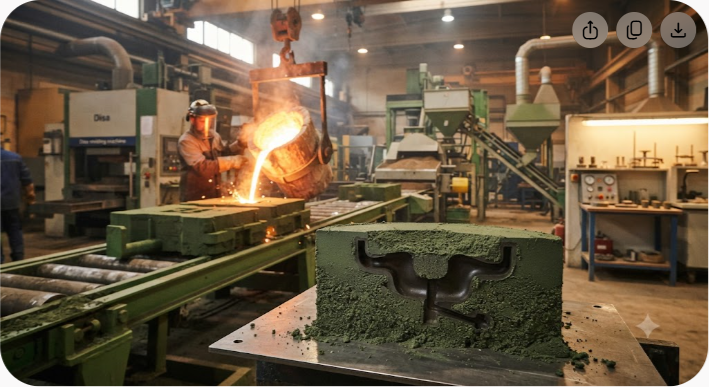
Bentonite is one of the key active binders in green sand molding, but simply adding more clay does not automatically produce better castings. The result depends on the bentonite grade, its active clay content, moisture level, mulling quality, sand condition, and the other additives used in the system.
In a properly controlled green sand system, bentonite coats the sand grains and develops the cohesion needed to make a mold that can be compacted, stripped from the pattern, handled, and filled with molten metal without losing its shape. At the same time, the mold must retain enough permeability to let gases escape. That balance is what makes bentonite so important to foundry casting quality.
For foundries, the practical question is not simply whether bentonite is present. It is whether the clay is active, uniformly distributed, properly hydrated, and matched to the molding process. Poor control can contribute to weak molds, poor surface finish, gas-related defects, erosion, sand inclusion, and inconsistent casting dimensions.
Bentonite is a naturally occurring clay dominated by smectite minerals, particularly montmorillonite. Its layered structure gives it a high surface area and an ability to interact strongly with water. Those characteristics make bentonite useful as a binder in clay-bonded molding sands.
A typical green sand system contains foundry sand, bentonite, water, and selected additives. The exact formulation varies with the alloy, molding equipment, casting geometry, sand system, and quality requirements.
When water is added, the bentonite hydrates and develops a cohesive clay matrix around the sand grains. During mulling, mechanical energy distributes that hydrated clay across the available grain surfaces. The resulting coating helps the sand hold together when compacted around a pattern.
The finished mold needs several properties at the same time. It must have sufficient green strength to survive pattern withdrawal and handling, adequate compactability for accurate mold formation, appropriate permeability for gas release, and enough resistance to thermal and mechanical stresses during pouring and solidification.
That is why foundry bentonite should be treated as a process material rather than a simple filler.
Green sand is called green because the mold is used in its moist, chemically bonded condition rather than being dried or fired before pouring. The sand itself provides the bulk of the mold structure, while bentonite and water create the bonding system that holds those grains together.
The quality of that bond affects several stages of the casting process:
A problem at any of these stages can show up later as a casting defect.
Sodium and calcium bentonites are commonly discussed in foundry applications because their exchangeable cations influence their hydration and swelling behavior. The choice between them should be based on the actual molding system rather than on the name of the clay alone.
Sodium bentonite generally has higher swelling capacity and can develop strong bonds when adequately hydrated and dispersed. These characteristics make suitable sodium bentonite grades useful in demanding green sand systems, including applications involving ferrous castings.
Its performance still depends on the mineral source and processing quality. A product described simply as sodium bentonite may perform differently from another product with the same general classification. Active clay content, swelling behavior, particle size, moisture demand, thermal behavior, and compatibility with the existing sand system all matter.
Calcium bentonite generally swells less than sodium bentonite in water and has different hydration and bonding characteristics. Some foundries use calcium-based bentonites where their processing behavior and casting requirements make them suitable, including selected non-ferrous applications.
Calcium bentonite should not automatically be treated as an inferior version of sodium bentonite. The useful question is whether the grade delivers the required molding properties at the required addition rate and moisture level.
| Characteristic | Sodium Bentonite | Calcium Bentonite | Foundry Consideration |
|---|---|---|---|
| Swelling behavior | Generally higher | Generally lower | Affects hydration and bonding behavior |
| Water interaction | Strong hydration and swelling | Different, generally lower swelling | Influences moisture demand and mixing |
| Green bonding | Can provide high bond strength when properly activated | Can provide effective bonding in suitable systems | Evaluate actual test results |
| Typical use considerations | Often selected for demanding green sand systems | Used in selected molding systems and applications | Match grade to alloy and process |
| Selection basis | Swelling, active clay, strength, thermal behavior | Strength, moisture response, system compatibility | Product data and foundry trials matter |
The important point is that bentonite type alone does not determine casting quality. A well-controlled molding system can outperform a poorly controlled one regardless of the nominal clay type.
Bentonite affects several measurable green sand properties. The most important are not independent. Increasing clay or water, for example, can improve one property while creating problems somewhere else. Foundry process control is therefore about finding the operating window rather than maximizing a single number.
Green compression strength describes the ability of moist molding sand to withstand compressive loading before the metal is poured. Adequate strength helps the mold retain its shape during pattern withdrawal, mold handling, closing, and pouring.
If green strength is too low, mold edges can crumble and cavity dimensions may change. Weak molds can also be damaged by handling or by the movement of metal during pouring.
Bentonite contributes to strength by forming bonds between sand grains. Those bonds become effective when the clay has been adequately hydrated and mechanically worked into the sand. Simply increasing bentonite addition is not a substitute for proper mulling.

Compactability describes how the molding sand responds to compaction under a given moisture condition. It has a direct relationship with how easily the molding machine can reproduce the pattern and achieve a consistent mold density.
Bentonite, moisture, sand grain distribution, and fines all influence compactability. A system with too little moisture may resist compaction and produce weak or friable areas. Excessive moisture can make the sand overly plastic and can alter permeability and gas behavior.
For automated molding lines, stable compactability is particularly important because even small changes in the sand system can affect mold density and therefore casting dimensions.
A green sand mold needs enough permeability to allow air, steam, and decomposition gases to move away from the mold cavity. If the mold is too dense or contains excessive fines and moisture, gas evacuation can become more difficult.
Bentonite itself is not a gas-generating material in the same way as many organic additives, but the amount and condition of clay influence the pore structure of the sand system. More clay and tighter compaction can reduce the open pathways available for gas movement.
This is why strength and permeability must be controlled together. A mold that is extremely strong but poorly permeable is not necessarily a better mold.
The mold surface is exposed to intense heat when molten metal enters the cavity. The behavior of the clay binder at elevated temperature affects mold integrity, surface stability, and the risk of defects such as scabbing, erosion, or sand-related inclusions.
Foundry bentonite grades differ in their response to thermal exposure. Some systems also use carbonaceous additives or other materials to influence the mold-metal interface, particularly when producing iron castings.
It is useful to separate two issues here. Bentonite provides the clay bond, while the complete molding sand formulation determines how the mold behaves during pouring and solidification. Casting quality therefore cannot be attributed to bentonite alone.
The condition of the mold surface has a direct effect on the surface of the finished casting. A well-prepared green sand mold can reproduce fine pattern details and provide a consistent surface for the metal to solidify against.
Poor sand control can contribute to metal penetration, burn-on, erosion, and rough surfaces. Bentonite helps maintain cohesion at the mold surface, but the result also depends on grain fineness, compactability, permeability, additives, pouring temperature, metal fluidity, and mold density.
Good foundry performance comes from controlling the entire sand system, not from selecting a clay grade in isolation. The following process provides a practical starting point for evaluation.
Before changing the bentonite addition rate, establish what is already happening in the molding sand. Review moisture, compactability, active clay, permeability, green compression strength, sand temperature, grain distribution, and relevant casting defects.
This baseline prevents a common mistake: changing several variables at once and then having no clear way to identify which change produced the result.
Total clay in a reclaimed sand system can include active clay as well as thermally degraded or otherwise inactive material. The two should not be treated as equivalent.
Active clay is the portion contributing to the bonding system under the test conditions. Monitoring it helps the foundry decide when fresh bentonite is required and whether accumulated fines or dead clay are affecting the sand.
The exact testing method and control limits should be selected according to the foundry's process and laboratory practice.
Water activates bentonite, but more water is not automatically better. Moisture affects compactability, green strength, permeability, mold hardness, and gas generation during pouring.
A practical foundry should establish its own moisture operating range through controlled testing rather than relying on one universal percentage. Alloy type, sand temperature, bentonite grade, additives, molding equipment, and reclaimed sand condition all influence the appropriate range.
Measure moisture consistently and adjust additions based on the condition of the sand actually entering the molding line.
Mulling is one of the most important steps in activating a bentonite-bonded sand system. The objective is not simply to mix ingredients together. Mechanical action helps distribute moisture and bentonite across the sand grains and develops the clay bond needed for molding.
The sequence of sand, water, bentonite, and additives can affect the final result. Mixing time also matters, but longer is not automatically better. Excessive mechanical action can alter the sand grain population and increase fines, which may affect permeability and other properties.
Foundries should establish mulling conditions through their own equipment trials and routine sand testing.
Green sand is commonly reclaimed and reused, which makes sand balance an ongoing process. Every pouring cycle changes the condition of the molding material. Some clay becomes inactive after thermal exposure, while fines and other materials accumulate.
Fresh sand and bentonite additions should therefore be based on measured system conditions rather than a fixed routine alone. If the reclaimed sand is becoming overloaded with fines or degraded material, adding more bentonite may mask the underlying problem instead of solving it.
Many green sand systems use carbonaceous additives and other materials to influence casting surface quality and metal-mold interaction. These additives can affect gas evolution, permeability, mold behavior, and surface finish.
Changing the bentonite grade without considering these materials can make troubleshooting difficult. When a defect appears, examine the complete sand formulation and recent process changes rather than assuming that bentonite is the only variable.
Most molding problems have more than one possible cause. A useful troubleshooting approach starts with the observed defect and then works backward through sand properties and process conditions.
Weak green molds may result from insufficient active clay, inadequate moisture, poor mulling, unsuitable sand distribution, or excessive degraded material.
Adding more bentonite can help if active clay is genuinely low, but it will not correct poor activation or a badly balanced sand system. Check moisture, mulling effectiveness, active clay, and compactability before increasing the binder rate.
Blowholes and pinholes can have several causes, including excessive moisture, insufficient permeability, high gas generation from additives, inadequate venting, or unfavorable pouring conditions.
Bentonite management matters because clay and moisture influence the mold structure, but a gas defect should not automatically be blamed on bentonite. Examine the entire gas-generation and gas-escape system.
Sand inclusions may develop when the mold surface loses particles during filling. Weak bonding, poor mold compaction, turbulent metal flow, inadequate mold strength, or erosion at vulnerable locations can all contribute.
If the problem appears after a change in bentonite, compare green strength and mold surface condition before and after the change. Also inspect pouring practice and gating design.
A rough surface can originate from the mold, metal, pattern, pouring conditions, or several factors together. Bentonite contributes to mold cohesion and surface stability, but it is only one part of the system.
Check sand grain size distribution, compactability, mold density, active clay, moisture, carbonaceous additives, and pouring temperature before making a large formulation change.
A product labeled simply as bentonite does not provide enough information to predict how it will perform in a specific foundry. Mineral composition, processing, particle size, moisture, swelling behavior, active clay contribution, and thermal response can vary between deposits and grades.
Ask for technical specifications and, where appropriate, evaluate a sample in the actual sand system.
Swelling capacity is useful, but it does not tell the entire story. Foundry performance also depends on active clay behavior, bonding strength, moisture response, thermal characteristics, compatibility with the sand, and the effectiveness of the mixing process.
A bentonite with a strong swelling result in a laboratory test may not automatically produce the best casting performance if it requires a moisture level or processing condition that does not suit the molding line.
This is a common troubleshooting trap. More clay may increase bonding, but excessive fines can affect permeability, compactability, and gas behavior. If the actual problem is inadequate mulling, moisture imbalance, or excessive dead clay, additional bentonite may only increase material consumption.
Correct the cause before increasing the dose.
Bentonite is a moisture-sensitive mineral product. Storage should protect it from contamination and uncontrolled moisture exposure. Bags or bulk systems should be kept in conditions that preserve the material's specified properties and prevent foreign material from entering the product.
Consistent storage is particularly important when a foundry relies on repeatable automatic dosing.
A supplier's certificate of analysis can provide useful information, but foundries should also understand which properties matter for their own process.
Depending on the application, evaluation may include:
| Test or Control | What It Helps Assess | Why It Matters |
|---|---|---|
| Active clay | Effective clay contribution | Helps control bonding in reclaimed sand |
| Swelling behavior | Water interaction and expansion | Useful for comparing bentonite grades |
| Moisture | Water content of molding sand | Affects strength and compactability |
| Compactability | Response of sand to compaction | Supports consistent mold density |
| Green compression strength | Mold strength before pouring | Helps prevent handling and molding failures |
| Permeability | Gas passage through the mold | Important for controlling gas-related defects |
| Grain distribution | Sand particle population | Influences surface finish and permeability |
| Sand temperature | Thermal condition before molding | Affects moisture response and consistency |
The exact test methods and acceptance limits should be established according to the foundry's equipment, alloy, molding process, internal quality system, and applicable customer requirements.
Suppose a foundry begins seeing weaker mold edges and a rise in sand-related defects after several weeks of stable operation. The first reaction might be to increase the bentonite addition.
That may not be the right first step.
A better investigation would compare current and historical measurements. Check active clay, moisture, compactability, permeability, green compression strength, sand temperature, grain distribution, and the rate of fresh sand addition. Review whether the reclaimed sand has accumulated excessive inactive clay or fines. Then check whether the mulling cycle and water addition sequence have changed.
If active clay is low while the other conditions remain appropriate, increasing fresh bentonite may be justified. If active clay is already high but permeability has fallen, adding more clay could make the problem worse.
This example illustrates an important principle: foundry process optimization works best when decisions are based on measured sand properties rather than on a single defect or a single raw-material specification.
For a foundry buyer, supplier evaluation should extend beyond price per tonne. Consistency is often more valuable than a nominally low purchase price because changes in clay behavior can force adjustments elsewhere in the molding system.
Consider the following points when comparing suppliers:
A supplier such as Axewelledge can be considered as part of this procurement process where its available bentonite grades, technical specifications, quality controls, and supply capabilities match the foundry's requirements. The final grade should still be selected from documented product data and application testing.
Bentonite performs best when the rest of the green sand process is stable. The most useful optimization work usually comes from tracking several related measurements over time rather than reacting to individual casting defects.
A foundry can build a practical control routine around five questions:
Trend these measurements alongside defect data and major process changes. Over time, the relationship between sand condition and casting performance becomes much easier to see.
This approach also helps distinguish raw-material problems from process problems. If a new bentonite lot arrives but the sand properties remain stable, the supplier is less likely to be the source of a later defect. If several properties shift at the same time, the investigation can focus on the changes that occurred immediately beforehand.
Bentonite plays a central role in green sand molding because it provides the clay bond that holds sand grains together during molding and pouring. Its contribution, however, depends on the condition of the entire molding system.
The main points to remember are:
The best results come from treating bentonite as one component of a controlled molding system. When the clay grade, moisture, mulling, sand condition, additives, and molding parameters are managed together, the foundry has a much stronger basis for producing consistent molds and repeatable castings.













Have questions about our products? We're here to help!