Axewelledge, a leading exporter from India, specializes in high-quality Bentonite. With a commitment to excellence, we supply premium Bentonite to the Middle East and Southeast Asia markets.


North Angle Complex, 304,
150 Feet Ring Rd, Opposite Ambedkar Nagar BRTS Stop,
Madhav Park, Punit Nagar,
Mavdi, Rajkot, Gujarat 360004
© Axewelledge 2026, All Rights Reserved.
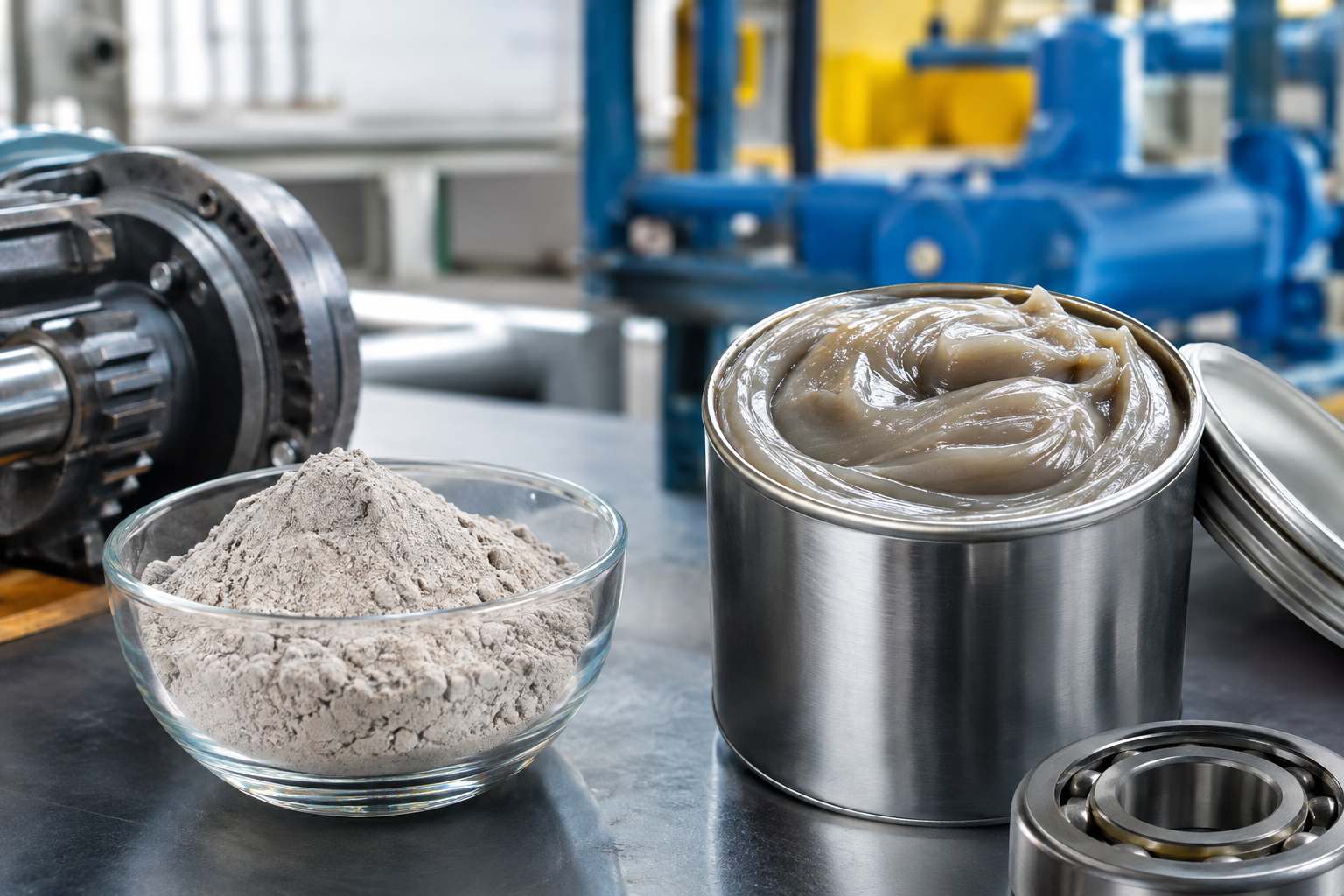
Bentonite in high-temperature grease is valued for a simple reason: an organoclay thickener does not rely on a conventional metal-soap structure that melts at a defined dropping point. Instead, it forms a physical mineral network that holds base oil in place. That makes clay-thickened grease useful in industrial applications where heat, heavy loads, water spray, dust, or long relubrication intervals place severe demands on a conventional soap grease.
There is an important qualification, though. A bentonite thickener does not make the entire lubricant immune to heat. The useful operating temperature of the finished grease is still controlled by the base oil, additives, organoclay treatment, bearing design, speed, load, oxygen exposure, and relubrication practice. The fact that the clay itself does not melt should never be interpreted as a blanket claim that a finished grease can operate indefinitely at 250 or 300 degrees C.
This distinction is central to selecting and formulating high-temperature bentonite grease. The sections below explain what bentonite grease is, how sodium bentonite is converted into organoclay, how the clay network thickens oil, how it compares with other grease thickeners, and what formulators and maintenance teams should check before using it in demanding equipment.
Bentonite grease is a non-soap grease in which specially treated clay, usually organophilic bentonite or another organoclay, acts as the thickener. The finished lubricant normally contains a base oil, organoclay thickener, a polar activator or activation system, and additives selected for the intended service.
The key difference from lithium, calcium, aluminum, or other soap-thickened greases is the way the structure is created. A soap grease depends on a network of soap fibers or related thickener structures. Organoclay grease depends on the physical association of very fine, high-aspect-ratio clay platelets dispersed throughout the oil.
Raw sodium bentonite is not normally suitable for direct use as a thickener in a non-polar hydrocarbon oil. Bentonite is a smectite clay dominated by montmorillonite, and its natural surface chemistry is strongly influenced by exchangeable inorganic cations. To work effectively in an oil-based grease, the clay is generally modified with organic cations so that its surface becomes more compatible with organic liquids.
The resulting material is commonly called organophilic clay, organoclay, or bentone-type thickener. Depending on the grade and treatment, it can disperse in mineral oils and selected synthetic fluids and develop a stable gel structure after appropriate activation and high-shear processing.
The main attraction of organoclay grease is its non-soap thickener structure. A conventional grease may show a measurable dropping point because its thickener structure softens or collapses under the conditions of the test. Organoclay systems are different: the mineral clay itself does not have a conventional melting transition that produces the same kind of dropping behavior.
That does not mean the grease has no temperature limit. At elevated temperature, the base oil can oxidize, volatilize, or crack, while organic surface treatments and additives can also degrade. A clay thickener can remain physically present after the oil has become unsuitable for lubrication. For this reason, high-temperature grease selection must always consider the complete formulation rather than the thickener alone.
Organoclay greases are particularly useful when several conditions occur together:
Typical applications include selected steel-mill equipment, hot-process conveyors, kiln and furnace machinery, glass-processing equipment, and other industrial components where a suitable clay-thickened formulation has been validated for the service conditions.
Grease is not simply a thick liquid. It is a structured lubricant made from base oil and a thickener, with additives supplying functions such as oxidation control, corrosion protection, extreme-pressure performance, and anti-wear protection.
The base oil normally provides most of the actual fluid lubrication. The thickener forms a three-dimensional structure that holds the oil within the grease and controls how readily it is released under mechanical stress.
Metal-soap greases use soaps based on fatty acids and metallic cations. Lithium soap is a familiar example, while lithium complex, calcium sulfonate complex, aluminum complex, and other systems use different chemistries to improve temperature performance, water resistance, load carrying, or other properties.
A dropping point test is useful for characterizing many grease types, but it should not be confused with the maximum service temperature. A grease can have a high dropping point and still have a substantially lower recommended continuous operating temperature because the base oil and additive system may deteriorate before the thickener loses its structure.
For example, lithium complex grease can have a high measured dropping point while still requiring careful temperature management in continuous service. The same principle applies to organoclay grease: the absence of a conventional dropping point does not remove the need to control base-oil oxidation and evaporation.
Bentonite is a naturally occurring clay dominated by minerals from the smectite group. Montmorillonite is usually the principal component responsible for its swelling, cation exchange, surface area, and rheological behavior.
Montmorillonite has a layered 2:1 structure. An octahedral sheet is located between two tetrahedral sheets, creating very thin plate-like particles. Isomorphic substitutions within the crystal structure generate a net negative layer charge, which is balanced by exchangeable cations located between the layers.
In sodium bentonite, sodium is a major exchangeable cation. Calcium and other cations may also occur depending on the deposit and its geological history.
This mineral structure matters because organoclay production depends on cation exchange. The exchange capacity provides sites where selected organic cations can replace the original inorganic exchangeable ions. The exact chemistry depends on the organoclay grade and intended end use.
Raw bentonite also contains varying amounts of non-clay minerals. Quartz, feldspar, mica, carbonates, and other minerals may occur depending on the deposit. For lubricant applications, excessive coarse or abrasive impurities are undesirable because they can reduce processing efficiency and potentially contribute to equipment wear.
The conversion from natural clay to an organophilic thickener is not simply a drying or grinding operation. It involves mineral purification, chemical modification, washing or other processing, drying, milling, and quality control.
The starting clay is selected for mineralogy, cation exchange capacity, particle characteristics, and impurity profile. Depending on the ore, the material may be dispersed in water and processed to separate coarse non-clay particles from the finer clay fraction.
The objective is not to produce a universally "pure" bentonite. It is to provide a consistent mineral feedstock with the characteristics required by the organoclay process and the final lubricant application.
The refined bentonite can be treated with a suitable quaternary ammonium compound. During the reaction, organic cations exchange with some of the naturally occurring inorganic cations associated with the montmorillonite layers.
The organic substituent changes the surface chemistry of the clay. Instead of behaving primarily as a water-compatible swelling clay, the modified material becomes substantially more compatible with selected organic liquids.
The precise quaternary ammonium chemistry matters. Different alkyl chain lengths and substitution patterns produce different organoclay characteristics, including compatibility with particular oils, activation requirements, rheology, and thermal behavior.
After chemical treatment, the organoclay is processed into a controlled powder or other suitable form. Particle size and moisture control are important because the material must disperse consistently during grease manufacture.
A high-quality organoclay grade is therefore more than a bag of finely ground bentonite. It is an engineered mineral product whose surface chemistry has been modified for a defined application.
Once dispersed and properly activated, organoclay creates a three-dimensional physical network throughout the base oil. The platelets interact with one another and restrict the movement of the oil, producing the consistency and yield stress required from a grease.
The structure is often described using the phrase "house of cards." That expression is useful as a conceptual model, but the actual network depends on particle geometry, surface chemistry, activator selection, oil polarity, concentration, shear history, temperature, and processing conditions.
The organoclay must first be thoroughly wetted by the base oil. Poor wetting can leave dry agglomerates that never become part of the intended gel structure.
The choice of mixing equipment and addition rate matters here. Adding powder too quickly can create compacted lumps on the surface or around the mixing zone. Slow, controlled addition generally gives the oil more opportunity to wet each particle.
Many organoclay systems require a polar activator to develop their full thickening efficiency. Propylene carbonate is one commonly used activator, although other systems may use different polar materials or combinations depending on the organoclay grade and formulation.
The activator interacts with the organoclay surfaces and helps separate or rearrange the platelet stacks. The exact mechanism varies with the organoclay chemistry, so the activator ratio should come from the thickener supplier's technical guidance rather than from a universal formulation rule.
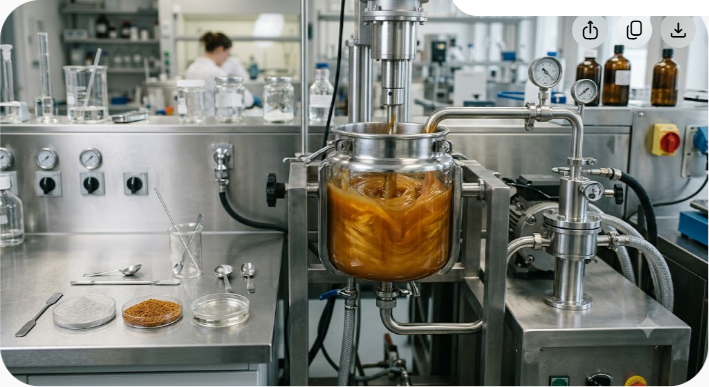
High shear helps break down agglomerates and distribute the activated organoclay throughout the oil. Equipment may include a high-shear mixer, colloid mill, homogenizer, or other suitable dispersion equipment.
The target is a uniform grease structure rather than simply a smaller clay particle size. Excessive shear, poor temperature control, or an unsuitable processing sequence can damage the desired rheology or introduce excessive air.
As the organoclay becomes properly dispersed and activated, the platelets form a physical network that restricts oil movement. At rest, this network gives the grease its body and helps prevent rapid oil separation.
Under shear, some of the weak physical associations within the network are disrupted. The grease becomes easier to move through a bearing or lubrication line. After the shear is removed, the structure can rebuild to a significant degree.
This shear-dependent behavior is one reason organoclay greases can combine a firm consistency at rest with useful flow during application.
The useful properties of a clay-thickened grease come from the complete formulation. The organoclay contributes structure, but the base oil and additive package determine much of the lubricant's oxidation resistance, load performance, corrosion protection, and compatibility.
Organoclay thickeners do not behave like conventional soap systems that soften and release oil at a defined dropping point. Consequently, many clay-thickened greases are reported as having no dropping point in standard dropping-point testing rather than being assigned a conventional numerical value.
This is an important advantage in applications where soap-thickened grease could soften excessively as temperature rises. It is not, however, evidence that the complete lubricant can operate at any temperature.
The practical temperature ceiling is often set by base-oil oxidation and evaporation, additive stability, bearing materials, seals, and the actual thermal environment around the lubricated contact.
The organoclay network is particulate rather than a conventional soap-fiber structure. Properly formulated systems can therefore offer good resistance to mechanical working and can rebuild their structure after shear.
Actual shear stability varies with clay grade, concentration, base oil, additive package, manufacturing method, and test conditions. It should be verified through the relevant grease testing rather than assumed from the word "bentonite" alone.
Organophilic clay is designed to be more compatible with oil and less water-sensitive than untreated sodium bentonite. That can contribute to useful water resistance in the finished grease.
Still, organoclay does not automatically make every grease waterproof. Base-oil chemistry, additives, manufacturing quality, seals, temperature, and the formulation's ability to resist mechanical displacement all affect water performance.
For equipment exposed to cooling water, steam, or washdown, the finished grease should be evaluated using appropriate water-resistance and corrosion tests rather than selected solely because it contains bentonite.
Clay particles can contribute to boundary-film behavior, but bentonite should not be treated as a replacement for a complete extreme-pressure additive system.
Where shock loading or high contact pressure is expected, formulators may use EP and anti-wear additives appropriate to the base oil, bearing materials, temperature, and regulatory requirements. Molybdenum disulfide, graphite, sulfur-containing additives, phosphorus chemistry, and other technologies may be considered depending on the application.
The finished grease should be evaluated through relevant load and wear tests. A high four-ball weld-load result, for example, does not by itself establish suitability for a particular industrial bearing.
This is the most important limitation to understand.
The clay thickener can remain physically present after the base oil has started to oxidize or evaporate. Once the oil has degraded, however, the grease is no longer performing its intended lubrication function simply because the clay structure remains.
A high-temperature grease specification should therefore identify the base oil type, viscosity, oxidation resistance, additive package, operating temperature, bearing speed, load, and relubrication interval rather than relying on thickener type alone.
No grease thickener is ideal for every application. The right choice depends on temperature, speed, load, water exposure, compatibility, service life, cost, and the chemistry of the equipment.
| Performance attribute | Bentonite or organoclay | Lithium complex | Calcium sulfonate complex | Polyurea | PFPE or PTFE-based systems |
|---|---|---|---|---|---|
| Thickener type | Organically modified mineral clay | Complex soap | Calcium sulfonate complex | Organic non-soap thickener | Fluorinated fluid and thickener system |
| Conventional dropping point | Typically none | High, formulation dependent | High, formulation dependent | High, formulation dependent | Typically none for PFPE-based systems |
| High-temperature capability | Strong, formulation dependent | Strong for a soap grease, but limited by full formulation | Strong | Strong | Very high for suitable PFPE systems |
| Water resistance | Good to excellent, formulation dependent | Good to very good | Often excellent | Good to excellent | Excellent in suitable systems |
| Mechanical stability | Generally good | Generally good | Generally good to excellent | Application dependent | Application dependent |
| Compatibility | Requires careful evaluation with other greases | Requires compatibility testing | Requires compatibility testing | Requires compatibility testing | Requires strict compatibility control |
| Relative cost | Moderate, depending on organoclay and oil | Often moderate | Often higher | Moderate to high | Very high |
The values above are general formulation-level comparisons, not universal specifications. Two greases using the same thickener family can perform very differently because base oil, additive chemistry, manufacturing process, and concentration all matter.
Lithium complex grease is widely used because it provides a practical combination of mechanical stability, temperature capability, load performance, and general-purpose versatility. It can be a suitable choice for many industrial bearings.
Organoclay becomes more interesting when the application specifically benefits from a non-soap thickener and the temperature or process environment makes conventional soap systems less attractive. The choice should be based on the actual bearing temperature and lubricant test data, not simply on the nominal dropping point of either grease.
Calcium sulfonate complex greases are known for strong load-carrying, corrosion protection, and water-resistance characteristics. They are used in demanding industrial environments, including applications exposed to water and heavy loads.
Organoclay grease may be preferred where its non-soap structure, cost profile, or specific rheology fits the application. Calcium sulfonate complex grease may be preferable where inherent corrosion and load performance are central requirements.
Polyurea is a non-soap thickener commonly selected for electric motor bearings and other applications where long service life and oxidation resistance are important. Some polyurea systems also provide excellent high-temperature performance.
Organoclay offers a different thickener chemistry and may be selected where non-melting mineral structure and particular high-temperature behavior are useful. Compatibility must be checked carefully because different non-soap grease families are not automatically interchangeable.
PFPE lubricants are designed for environments where exceptional chemical inertness, low volatility, and very high temperature capability justify their high cost. They can be appropriate for specialized equipment in chemical processing, semiconductor manufacturing, vacuum service, and other demanding applications.
Organoclay grease is generally considered for less chemically extreme industrial environments where a conventional hydrocarbon or synthetic base oil can meet the lubrication requirement at a substantially lower material cost.
There is no single universal recipe for bentonite grease. Commercial formulations vary according to organoclay grade, base oil, target NLGI grade, operating temperature, speed factor, load, water exposure, and additive requirements.
For that reason, percentages should be treated as development ranges rather than production instructions. The organoclay supplier's recommended loading and activation procedure should take precedence over a generic formulation.
A development formulation may contain:
Base-oil selection is often more important than the thickener when continuous high-temperature service is involved.
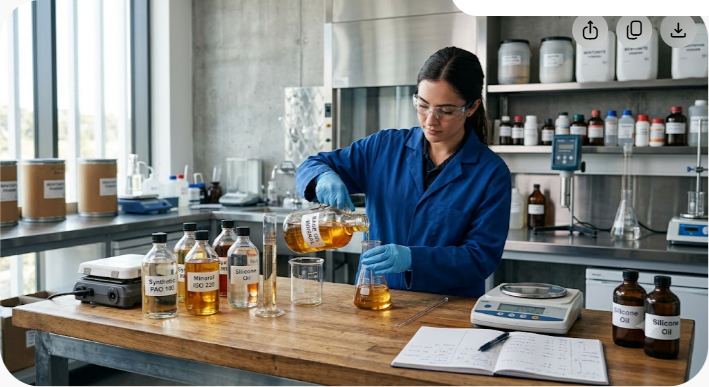
Mineral oils can be economical and may work well in moderate high-temperature applications when the viscosity and oxidation resistance are appropriate. High-viscosity mineral oils are commonly considered for slow, heavily loaded industrial components.
PAO base oils offer good low-temperature behavior, high viscosity index, and useful oxidation resistance. They are often considered when a synthetic hydrocarbon base stock can extend service life or improve temperature performance.
Synthetic esters can provide good lubricity and high-temperature performance, although their polarity and additive interactions need to be considered during organoclay selection and formulation.
Silicone fluids may be suitable for specialized temperature ranges and light-to-moderate load applications, but organoclay compatibility is not universal. A clay thickener designed for hydrocarbon oils should not automatically be transferred to a silicone formulation.
The finished consistency determines how easily the grease can be pumped, how well it stays in place, and how it behaves in the bearing.
A softer grease may be useful for centralized systems or applications requiring easier flow. NLGI 2 is common for many bearing applications. A firmer grease may be selected where the lubricant must resist displacement, but excessive thickener loading can reduce oil release and affect low-temperature pumpability.
The target should be confirmed using worked penetration testing rather than inferred from thickener percentage alone.
Organoclay concentration should be established experimentally for the selected grade. Increasing clay loading generally increases structure, but it can also affect pumpability, oil release, mechanical behavior, and cost.
A common development approach is to prepare several small batches around the supplier's recommended loading range and compare penetration, oil separation, mechanical stability, water resistance, and high-temperature behavior.
This is more reliable than assuming that a fixed percentage will produce the same NLGI grade with every organoclay and every base oil.
Activator concentration is particularly important because insufficient activation can leave the organoclay poorly developed, while excessive activation can alter consistency and other properties.
For example, if a supplier recommends an activator-to-clay ratio of 0.30 by mass, a formulation containing 90 kg of organoclay would start with approximately 27 kg of activator before process adjustments.
The calculation is straightforward:
The ratio should not be copied between organoclay grades without confirmation because surface treatment and activation requirements differ.
The additive package should address the actual failure modes expected in service.
Antioxidants help slow base-oil oxidation. Rust inhibitors protect ferrous components in the presence of moisture. Anti-wear and EP additives can be used where contact pressures and load conditions justify them.
Additive compatibility with the organoclay, base oil, seals, and other components must be confirmed. Some additives can change grease structure or interact with the clay surface, so the additive package should be validated in the finished formulation rather than evaluated independently.
Commercial organoclay grease production typically relies on controlled mixing, activation, dispersion, and finishing. The exact sequence depends on the equipment and organoclay supplier's process recommendations.
A representative development sequence is:
High-shear processing should be controlled rather than treated as a simple matter of increasing pressure. Excessive mechanical energy can generate heat, alter the structure, or create processing problems. The optimum shear history is formulation and equipment dependent.
Clay-thickened grease is most useful where the lubricant must remain in place under heat and mechanical stress and where a non-soap thickener offers a practical advantage.
Steel processing equipment combines high temperatures with water spray, scale, heavy loads, vibration, and difficult access for maintenance. Bearings and mechanisms around continuous casters can therefore require specialized grease formulations.
The steel itself may be at extremely high temperature, but that does not mean the bearing or grease reaches the same temperature. The actual lubricant temperature should be measured or estimated from the bearing arrangement, heat transfer, cooling system, speed, and operating conditions.
Where the bearing temperature falls within the validated range of the selected organoclay grease, the non-soap thickener can help the lubricant resist softening and run-out. Water resistance, corrosion protection, EP performance, and base-oil oxidation resistance still need to be addressed by the complete formulation.
Cement and lime plants contain bearings, conveyors, drive components, and other machinery exposed to heat, dust, vibration, and heavy loads.
Some kiln-support and related components operate under demanding thermal conditions, but the appropriate grease depends on the actual bearing temperature and lubrication arrangement. High-viscosity base oils can be useful for slow, heavily loaded components, while the additive package must address oxidation, wear, and contamination.
Bentonite grease can be considered where a stable non-soap structure helps the lubricant remain in the intended location despite high process temperatures.
Glass and ceramic processing can expose conveyor bearings, chains, and mechanisms to elevated ambient temperatures and radiant heat. Annealing equipment, for example, can create a sustained hot environment around moving components.
The lubricant specification should be based on the temperature at the bearing rather than the temperature of the glass or furnace itself. A suitable organoclay formulation can help where conventional soap grease softens excessively, but the base oil must still survive the actual bearing temperature.
Asphalt plants combine heat with abrasive dust, heavy loads, and contamination. Bearings and rollers near hot material handling equipment may benefit from a grease that stays in place and maintains suitable consistency under elevated temperatures.
Bentonite grease can be considered for these applications when its temperature, load, water, and contamination performance has been validated. The lubricant should not be selected solely because the process material itself is hot.
One of the most important practical considerations is grease compatibility.
A maintenance team should never assume that two greases are compatible simply because both are labeled as high-temperature or industrial products. Different thickeners, base oils, and additives can interact in ways that change consistency, oil separation, corrosion protection, or pumpability.
When an organoclay grease is mixed with a soap grease, the resulting mixture may not retain the properties of either original product. The interaction can weaken the thickener structure, alter oil release, or produce an unexpectedly soft or hard material.
The result may be especially serious in a bearing because the mixture can move away from the contact zone, block a lubrication passage, separate oil excessively, or change the effective operating temperature of the grease.
The correct approach is to consult compatibility data from the lubricant manufacturers and perform a controlled compatibility test when necessary.
Color coding can help prevent accidental mixing, but color alone should never be used as proof of grease identity or compatibility.
The clay thickener may not have a conventional dropping point, but the base oil can still oxidize and evaporate. The finished grease must be rated for the actual continuous and peak bearing temperatures.
A kiln, furnace, or steel product may be extremely hot while the bearing housing remains much cooler. Conversely, a poorly cooled bearing can become hotter than expected.
Measure or estimate the temperature at the lubricated component rather than selecting grease solely from the surrounding process temperature.
Different organoclays can have different activation requirements, oil compatibility, consistency, water behavior, and temperature performance. A grease made with one organoclay grade cannot be treated as a direct substitute for every other clay-thickened grease.
A high-temperature label does not make two products compatible. Confirm the thickener and base-oil chemistry before making a conversion.
If the base oil is oxidizing or evaporating rapidly, the remaining clay structure cannot restore lubrication by itself. High-temperature service often requires shorter relubrication intervals, improved seals, better cooling, or a more thermally stable base oil.
A grease suitable for a slow, heavily loaded roller may not be appropriate for a high-speed bearing exposed to the same ambient temperature. The speed factor affects heat generation, oil release, churning, and bearing temperature.
For manufacturers of organoclay, the mineral feedstock has a direct influence on process consistency and finished-product performance. However, there is no single universal specification for every grease-grade bentonite.
Important characteristics to evaluate include:
A higher proportion of the active smectite mineral can provide more usable exchange capacity and reduce the proportion of inert material entering the organoclay process. The acceptable level depends on the organoclay manufacturing method and commercial specification.
A supplier should provide actual test data rather than relying on a generic claim such as "high purity."
CEC is an important mineralogical property because it indicates the clay's capacity to exchange cations. For organoclay production, it helps the processor understand how much organic cation treatment may be required.
CEC should not be treated as a standalone predictor of grease performance. Mineral purity, exchangeable ion composition, surface chemistry, particle characteristics, and the final organoclay treatment all matter.
Coarse quartz and other hard particles are undesirable in a lubricant raw material because they can increase wear risk and complicate processing. Wet refining, classification, screening, or hydrocyclone treatment may be used where appropriate to reduce coarse mineral impurities.
The required impurity specification should be defined by the organoclay process and final lubricant application rather than by an arbitrary universal number.
Sodium-rich bentonite is often attractive as a starting material because its swelling and exchange behavior can support efficient processing. However, not every organoclay process requires exactly the same starting mineral, and the final specification should be based on the chemistry of the modification process.
For a mineral supplier, consistent CEC, mineralogy, moisture, particle characteristics, and impurity control can be just as important as a single headline purity value.
Laboratory testing should connect the grease's properties to the actual failure modes expected in service.
Useful tests may include:
No single test predicts field performance. A grease can perform well in one laboratory test and still fail because the bearing speed, seal design, contamination level, or temperature is outside its intended operating range.
Before specifying a bentonite high-temperature grease, confirm the following:
These questions prevent a common mistake in lubricant selection: choosing a thickener for its headline temperature characteristic while overlooking the rest of the lubricant system.
Bentonite in high-temperature grease is useful because organophilic clay provides a non-soap thickener structure that does not behave like a conventional metal soap at its dropping point. The clay can maintain a physical network and hold base oil in place under conditions where some soap-thickened greases become excessively soft.
The practical temperature limit of the finished grease is still controlled by the complete formulation. Base-oil oxidation, evaporation, additive stability, bearing speed, load, seals, and heat transfer all influence service life.
Raw sodium bentonite is generally not used directly as an oil-compatible grease thickener. It is commonly refined and chemically modified to produce an organophilic clay with surface chemistry suited to the selected base oil.
Successful organoclay grease manufacture depends on proper wetting, activation, dispersion, and high-shear processing. The correct activator and dosage depend on the specific organoclay grade, so supplier technical guidance should be followed rather than treating a generic ratio as a universal formula.
Bentonite grease should also be treated as a specialized lubricant rather than a universal replacement for lithium complex, calcium sulfonate complex, polyurea, or fluorinated grease. Each thickener family has different strengths and limitations.
For industrial users, the safest specification process starts with the actual bearing conditions: temperature, speed, load, water exposure, contamination, existing grease, relubrication method, and expected service life. For organoclay manufacturers and formulators, consistent mineralogy, CEC, low grit, controlled moisture, and repeatable processing are important foundations for a reliable product.
When sourcing bentonite for organoclay or lubricant manufacturing, ask for a defined technical specification, mineralogical information, CEC data, impurity controls, moisture limits, and batch-to-batch consistency data. A dependable mineral feedstock gives the formulator a much better starting point for developing a grease that performs consistently in real equipment.













Have questions about our products? We're here to help!