Axewelledge, a leading exporter from India, specializes in high-quality Bentonite. With a commitment to excellence, we supply premium Bentonite to the Middle East and Southeast Asia markets.


North Angle Complex, 304,
150 Feet Ring Rd, Opposite Ambedkar Nagar BRTS Stop,
Madhav Park, Punit Nagar,
Mavdi, Rajkot, Gujarat 360004
© Axewelledge 2026, All Rights Reserved.
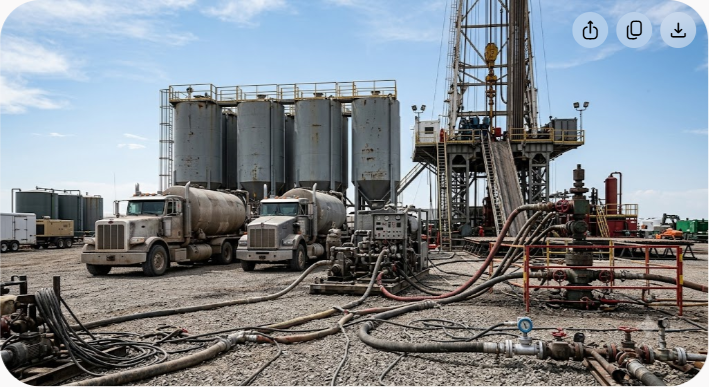
Bentonite is widely used as a cement extender in oil and gas well construction, particularly when engineers need a lower-density slurry for weak or pressure-sensitive formations. Sodium bentonite absorbs and retains additional mixing water, increasing slurry yield while helping keep cement solids suspended. The result is a lighter, more stable cement system that can reduce hydrostatic pressure during placement.
The important qualification is that bentonite isn't simply mixed into cement whenever a lighter slurry is needed. Its use changes the water requirement, rheology, thickening behaviour, free-fluid characteristics, compressive strength, and sometimes fluid-loss performance of the cement system. The concentration and mixing method therefore have to be established through laboratory testing at the expected downhole temperature and pressure.
In practical terms, bentonite is most useful when the cement design needs more volume from each unit of dry cement and a lower slurry density than conventional neat cement can provide. It can be particularly valuable for surface and intermediate casing jobs where the formation has a narrow margin between pore pressure and fracture pressure.
This guide explains how bentonite works in oil well cementing, when engineers use it, how dry blending differs from pre-hydration, what happens to cement strength, how salt water affects performance, which standards and tests matter, and what to check when sourcing an oilfield-grade material.
A conventional oilfield cement slurry is relatively dense. A typical neat Class G or Class H cement system can be designed around the mid-15 pounds-per-gallon range, although the actual density depends on cement type, water content, additives, temperature, and the required performance.
That density isn't automatically a problem. In many wells, it is exactly what the cement design requires. The difficulty appears when the hydrostatic pressure generated by the cement column approaches or exceeds the fracture pressure of the formation.
Once a formation fractures, cement can be lost into the rock instead of returning through the annulus as planned. The consequences can include poor zonal isolation, inadequate cement coverage, additional cementing work, and delays to the drilling programme.
Bentonite provides one way to address that problem. As a swelling clay, sodium bentonite can hold substantially more water than untreated cement. The extra water increases slurry yield and lowers the density of the cement system when the formulation is properly designed.
The basic purpose is therefore straightforward: use bentonite to create a higher-yield, lower-density cement slurry without simply adding uncontrolled water to neat cement.
That distinction matters. Adding water alone can cause free fluid, sedimentation, poor cement structure, and inadequate bonding. Bentonite helps bind much of that additional water into a stable colloidal system.
Before looking at the role of bentonite, it helps to understand what a primary cementing job is supposed to accomplish.
After a casing string is run into the well, cement slurry is pumped down through the casing and then displaced upward through the annulus between the casing and the formation. Once the cement sets, it forms a sheath around the casing.
A properly designed cement sheath can provide several functions:
The cement has to be pumpable long enough to reach its intended location, but it must also develop sufficient strength after placement. That creates a design problem: the slurry has to behave correctly during pumping and produce an appropriate solid barrier after setting.
Bentonite changes both parts of that equation.
Every fluid column in a well produces hydrostatic pressure. As depth increases, the pressure at the bottom of the column increases according to fluid density and vertical depth.
The surrounding formation also has limits. A formation can tolerate pressure up to a certain point before it begins to fracture. Cementing engineers therefore work within a pressure window bounded by formation pore pressure on one side and fracture pressure on the other.
A dense cement slurry can create too much pressure during placement, particularly in shallow weak formations, depleted zones, naturally fractured formations, or wells with a narrow pressure window.
For example, imagine a formation that can tolerate only a relatively modest increase in equivalent circulating density above the formation pressure. Pumping a conventional heavy slurry may push the equivalent hydrostatic pressure beyond the fracture limit. The resulting losses can prevent the cement from reaching the planned top of cement.
Reducing slurry density is one way to lower that risk.
This is where cement extenders become useful.
A cement extender is an additive or material used to increase cement slurry yield and, in many formulations, reduce slurry density. Different extenders work through different mechanisms.
Common approaches include:
Sodium bentonite belongs to the first category. It absorbs and retains water, allowing the cement system to contain more water than a comparable neat cement slurry while maintaining a degree of suspension stability.
The key word is designed. A bentonite-extended cement isn't simply a conventional cement slurry with extra clay and water thrown into the mixing system. The complete formulation must be tested because every change in water demand affects density, yield, rheology, strength, thickening time, and fluid-loss behaviour.
Bentonite is a clay whose principal swelling component is usually montmorillonite. Sodium bentonite is valued for its relatively high swelling and water-retention capacity.
Montmorillonite has a layered structure. Water and exchangeable ions interact with the spaces between these layers. In fresh water, sodium-dominated montmorillonite can hydrate and disperse extensively, producing a colloidal suspension with significant viscosity and gel strength.
That behaviour is useful in a cement slurry because the hydrated clay helps immobilise part of the added water and supports suspended cement particles.
The effect can be thought of in three stages.
Dry bentonite comes into contact with mixing water and begins to hydrate. Water enters the clay structure and separates the individual platelets.
The hydrated platelets disperse through the water and produce a viscous colloidal system. The amount of swelling depends on the bentonite's mineralogy, exchangeable ions, water chemistry, particle size, mixing energy, concentration, and hydration conditions.
When the hydrated bentonite is incorporated into the cement system, its colloidal structure helps retain water and suspend solids. Engineers can therefore design a cement slurry with higher water content and greater yield than a comparable neat cement system.

This is also why not every bentonite performs equally well. A material with a high proportion of non-swelling minerals or unsuitable exchangeable ions may not provide the same performance as a high-quality sodium bentonite selected for the application.
One of the most important points for anyone researching a bentonite-to-cement ratio in oilfield applications is that there is no single percentage that works for every cement job.
Bentonite concentration is commonly expressed as BWOC, meaning by weight of cement. Formulations can use several percentage points of bentonite, and the appropriate concentration depends heavily on whether the clay is dry blended with the cement or pre-hydrated before cement is introduced.
Higher bentonite concentrations generally increase water demand and slurry yield, but they also influence rheology and reduce the amount of Portland cementitious material present per unit volume of finished slurry.
For that reason, a formulation should start with a target rather than a fixed recipe:
A field crew should never compensate for an incorrectly designed slurry by adding water at the mixing unit. The water-to-cement relationship is part of the engineered formulation.
There are two broad ways to incorporate bentonite into a cement system: dry blending and pre-hydration.
The choice affects the amount of bentonite required and the way the clay behaves during mixing.
With dry blending, bentonite is incorporated into the dry cement blend before the material reaches the rig or cementing unit. The blended powder is then mixed with water during slurry preparation.
This method has an obvious logistical advantage. The cementing crew doesn't have to prepare a separate bentonite hydration stage at the wellsite.
The limitation is that bentonite and cement encounter the mixing water together. Cement hydration releases calcium ions and changes the chemical environment around the clay. Those conditions can restrict the swelling and dispersion that would occur in fresh water alone.
As a result, dry-blended formulations generally require more bentonite than a comparable pre-hydrated system.
With pre-hydration, bentonite is dispersed in suitable fresh water before the cement and other components are introduced.
This gives the clay more opportunity to hydrate and develop its colloidal structure before it encounters the cement's highly alkaline and calcium-rich environment.
Pre-hydration can provide more efficient use of bentonite, but it introduces additional operational requirements. The crew needs suitable mixing and batch capacity, sufficient time, and a controlled procedure for achieving consistent hydration.
The choice should therefore be based on the complete cementing programme rather than on bentonite concentration alone.
The main trade-off with bentonite-extended cement is lower compressive strength compared with a conventional neat cement system of otherwise similar design.
The reason is fundamental. Bentonite allows more water to be incorporated into the slurry. After placement, that higher water content contributes to a more porous cement matrix. The resulting solid generally has lower density and lower compressive strength than a dense neat cement system.
That isn't necessarily a failure.
Oil and gas cementing doesn't require every cement sheath to have the highest possible compressive strength. The required strength depends on the casing programme, pressure conditions, temperature, mechanical loads, waiting-on-cement schedule, and the barrier requirements of the well.
Engineers therefore balance density against strength rather than maximising one property in isolation.
A commonly repeated figure in oilfield discussions is 500 psi of compressive strength before drilling or other subsequent operations. That number is useful as historical context, but it shouldn't be treated as a universal design requirement for every well.
Actual acceptance criteria depend on the well design, operator requirements, applicable regulations, cementing programme, test method, temperature, pressure, and the operation planned after cement placement.
Laboratory compressive-strength testing under representative conditions is the appropriate way to establish whether a bentonite-extended cement system is fit for its intended purpose.
Bentonite changes the rheology of the cement slurry, often increasing viscosity and gel strength. That can be useful for suspension and fluid stability, but excessive rheology can make the slurry harder to mix and pump.
Thickening time also has to be tested rather than assumed.
The cement must remain pumpable for the full job duration, including mixing, surface lines, displacement, planned contingencies, and the time needed to place the cement at depth. At the same time, the system should transition to a solid barrier within the required schedule.
Temperature has a major effect on cement hydration and thickening behaviour. A slurry that performs well in a room-temperature test may behave very differently at elevated downhole temperatures.
For that reason, cement laboratories test formulations under simulated well conditions using appropriate consistometer procedures and other standardised tests.
Bentonite can influence fluid retention because its hydrated clay structure holds water and affects permeability and rheology. However, it should not automatically be treated as a dedicated fluid-loss additive.
Where strict fluid-loss control is required, cement formulations commonly use purpose-designed fluid-loss additives in combination with the extender. The final performance depends on the complete chemical system.
This distinction matters because cementing engineers may need to satisfy several requirements at the same time: low density, controlled fluid loss, acceptable rheology, sufficient thickening time, low free fluid, predictable compressive strength, and compatibility with other additives.
A bentonite extender can contribute to the overall design, but it doesn't replace every other cement additive.
Fresh water is important to sodium bentonite performance. Dissolved salts and multivalent ions can significantly reduce the clay's ability to hydrate and swell.
Seawater contains substantial concentrations of dissolved salts, while formation water and other available water sources can contain calcium and magnesium. These ions change the electrical environment around the clay platelets and can reduce dispersion.
That creates a practical issue for offshore and other locations where freshwater availability is limited.
Engineers cannot assume that a bentonite formulation designed with fresh water will perform identically with seawater. The actual water source should be tested and incorporated into the laboratory cement design.
Depending on the job, alternatives may include pre-hydration in suitable water, a different extender, or a completely different low-density cement technology. The correct choice depends on the required density, water chemistry, temperature, strength, and placement conditions.
Bentonite is only one option for reducing cement density or increasing slurry yield. Other materials may be more suitable when the well presents unusual temperature, pressure, water-chemistry, or strength requirements.
| Extender Type | Main Mechanism | Typical Advantage | Main Limitation | Common Application Consideration |
|---|---|---|---|---|
| Sodium bentonite | Hydrates and retains additional water | Economical, high yield, familiar technology | Higher water demand and lower set-cement strength | Lower-density systems where suitable water is available |
| Pozzolanic materials | React with calcium hydroxide and contribute to cementitious reactions | Can provide useful long-term properties in designed systems | Requires formulation and temperature-specific testing | Large-volume or specialised cement systems |
| Lightweight solid additives | Reduce bulk density of the dry or mixed system | Can lower slurry density without relying entirely on extra water | Cost, rheology, and particle compatibility vary | Low-density cement designs |
| Gilsonite and similar lightweight materials | Incorporate low-density solid particles | Can help address certain lost-circulation and lightweight-cement requirements | Not suitable for every temperature or cement chemistry | Specialised well conditions |
| Foamed cement | Uses gas to lower effective density | Can achieve very low effective densities | Complex placement and pressure control requirements | Extremely weak formations and specialised low-density jobs |
The point isn't to identify one extender as universally superior. The cementing engineer has to select the technology that fits the pressure window and the required set-cement properties.
API standards are an important part of oilfield cementing, but it is worth being precise about what they cover.
API Specification 10A addresses well cements and cement classes used in well construction. API Recommended Practice 10B-2 provides procedures for testing well cement systems, including properties such as thickening time, compressive strength, fluid loss, free fluid, rheology, and other performance characteristics.
Bentonite itself should not simply be described as an API 10A cement. It is an additive used within a cement system, and the suitability of the complete formulation needs to be established through the appropriate cementing tests and project specifications.
When purchasing bentonite for oilfield cementing, buyers should evaluate the material's actual technical data rather than relying on the phrase API grade alone.
Important quality parameters can include:
The exact acceptance limits should come from the cementing programme, customer specification, and applicable test method rather than from a generic supplier specification.

A reliable procurement process starts with the cement design and works backwards to the raw material.
Start with the actual problem. Is the goal to reduce slurry density, increase yield, improve suspension, manage a narrow pressure window, or reduce material cost? A clear objective makes it easier to determine whether bentonite is appropriate.
Determine whether the job uses fresh water, treated water, seawater, or another source. Water chemistry can substantially affect sodium bentonite hydration.
The target density should be established from the formation pressure and fracture-pressure limits, with appropriate safety margins. The objective is not simply to make the slurry as light as possible.
Bentonite should be evaluated together with the actual cement, water, dispersant, retarder, fluid-loss additive, defoamer, and any other components planned for the job.
Two materials can both be sold as sodium bentonite while behaving differently in a cement system. Consistent mineralogy and processing are therefore important for repeatable field results.
Bentonite is a dry mineral powder. Moisture pickup can cause lumping and handling problems. Bulk storage, bagged packaging, transportation, and silo conditions should protect the product from moisture and contamination.
Even a technically suitable bentonite can produce poor results if the cementing procedure is not controlled.
Sodium bentonite is a broad material category, not a guarantee of identical performance. Mineralogy, processing, particle size, moisture, and exchangeable cations all matter.
A supplier's generic swelling number isn't enough to predict performance in a high-temperature cement system. Test the actual product in the intended formulation.
If the slurry appears too thick, the answer isn't automatically more water. Extra water changes density, yield, free fluid, compressive strength, and other properties.
Any significant adjustment should be based on an approved cementing design and appropriate laboratory verification.
Poor dispersion can leave partially hydrated bentonite in the slurry. The material may form lumps or hydrate unevenly, producing inconsistent rheology and poor density control.
The mixing procedure should provide sufficient dispersion without damaging the overall cement system or creating excessive air entrainment.
Cement properties are temperature-dependent. Thickening time, compressive strength development, rheology, and additive performance can all change substantially downhole.
The laboratory programme should reproduce the expected circulating and static temperature conditions as closely as practical.
A low-density slurry isn't automatically a good cement slurry. Engineers also need to consider free fluid, sedimentation, rheology, thickening time, fluid loss, compressive strength, bonding, compatibility, and placement efficiency.
The cement has to work as a complete system.
Bentonite can also appear in cementing programmes associated with well abandonment, although the exact barrier design depends on the regulatory requirements and well conditions.
Plug and abandonment work requires durable barriers that isolate formations and prevent unwanted fluid movement. Cement systems may be selected for their density, strength, placement characteristics, chemical resistance, and long-term integrity.
A bentonite-extended system can be useful where a lower-density, higher-yield formulation is appropriate. It should not, however, be selected simply because it reduces the amount of cement required. The final barrier has to satisfy the applicable abandonment standard and operator design criteria.
Bentonite is also closely associated with lost-circulation control in drilling fluids, but that application should not be confused with cement extension.
During drilling, bentonite is commonly used in water-based drilling fluids because its swelling and rheological properties help suspend cuttings and control fluid behaviour. Lost-circulation materials may then be added when drilling fluid is escaping into fractures or highly permeable formations.
Cement can also be used as a remedial lost-circulation treatment, but the cement formulation and placement method are different from those used for primary casing cementing.
A bentonite-rich cement system may be considered for certain applications, but the formulation must be designed for the specific fracture, temperature, pressure, setting time, and required sealing performance.
Bentonite can be considered in geothermal cementing, but high temperature makes material selection more demanding.
Geothermal wells can expose cement systems to temperatures far above those encountered in many conventional wells. Cement strength development, long-term stability, permeability, chemical resistance, and thermal cycling all become important.
At elevated temperatures, ordinary cement systems can experience strength retrogression. Silica-containing cement formulations are commonly used where the expected temperature requires protection against this effect.
That means a bentonite-extended geothermal cement should never be designed by simply transferring a conventional oil-well recipe to a hotter well. The complete formulation needs temperature-specific laboratory testing and a long-term integrity assessment appropriate to the application.
Cementing engineers work with tightly controlled formulations. If the bentonite changes from one shipment to another, the slurry may also change.
A difference in swelling behaviour can alter water demand. A difference in particle size can affect hydration and dispersion. A difference in mineral impurities can influence rheology and compatibility with other additives.
For that reason, a supplier should be able to provide consistent material specifications and batch documentation. For large oilfield programmes, buyers may also require retained samples, prequalification testing, production controls, and a certificate of analysis for each lot.
Consistency isn't just a procurement preference. It is part of maintaining a predictable cement design.
When sourcing bentonite for oil and gas cementing, price per tonne is only one part of the purchasing decision.
A useful supplier evaluation should consider:
For critical oilfield applications, the supplier should be treated as part of the quality chain. The final cement job depends on the consistency of every component that enters the formulation.
Axewelledge supplies sodium bentonite for industrial applications and can support buyers evaluating bentonite for oilfield use. For cementing applications, the important consideration is matching the material specification to the customer's laboratory formulation and field requirements rather than selecting a product solely by grade name.
For international buyers, supply reliability also matters. A suitable material still creates problems if shipments arrive with excessive moisture, damaged packaging, inconsistent documentation, or long lead times.
Axewelledge's India-based production and export capabilities can support bulk mineral supply programmes serving international markets. Buyers should request the current technical specification, certificate-of-analysis requirements, packaging options, and application-specific data before approving material for a cementing programme.
Before approving a bentonite-extended cement formulation, the engineering and procurement teams should be able to answer these questions:
If the answer to any of these questions is unclear, the formulation needs more work before it reaches the wellsite.
Bentonite can be used effectively in oil and gas cementing, particularly as an extender for lower-density, higher-yield cement slurries.
The main points to remember are:
Bentonite is therefore not simply a cheap way to make cement go further. Used correctly, it is an engineered component of a lightweight cement system. The best results come from balancing density, yield, pumpability, placement time, strength, and long-term well integrity rather than optimising any one property in isolation.













Have questions about our products? We're here to help!