Axewelledge, a leading exporter from India, specializes in high-quality Bentonite. With a commitment to excellence, we supply premium Bentonite to the Middle East and Southeast Asia markets.


North Angle Complex, 304,
150 Feet Ring Rd, Opposite Ambedkar Nagar BRTS Stop,
Madhav Park, Punit Nagar,
Mavdi, Rajkot, Gujarat 360004
© Axewelledge 2026, All Rights Reserved.
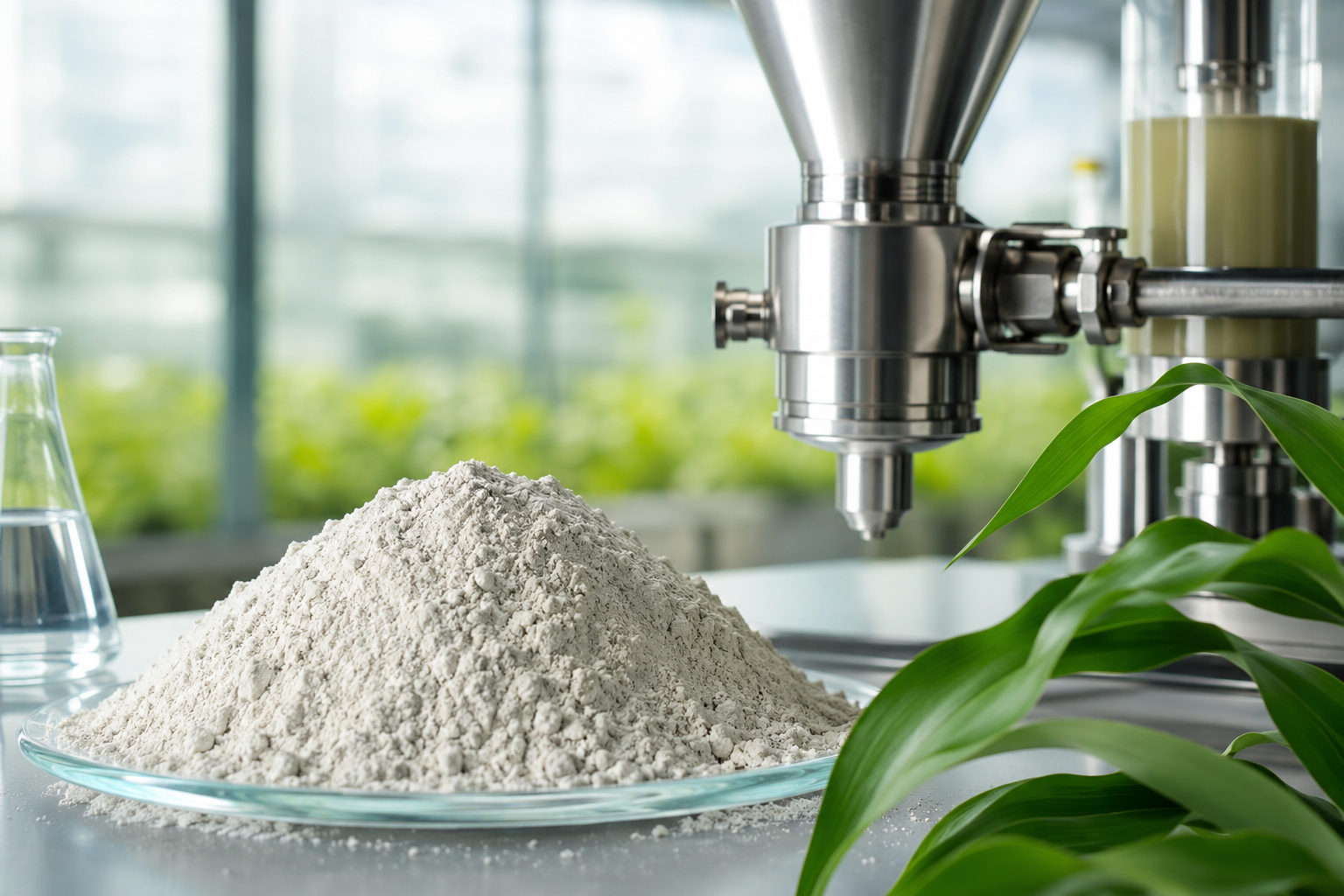
Bentonite can play several useful roles in pesticide formulation, but its value depends on the grade, formulation type, and active ingredient. In the right system, bentonite can help suspend particles, bind granules, modify viscosity, absorb liquid ingredients, and influence how an active ingredient is released after application.
That makes bentonite more than a simple mineral filler. For agrochemical manufacturers, it can be a practical formulation aid when the physical properties of the clay match the technical requirements of the product.
The important point is that bentonite doesn't automatically improve every pesticide formulation. Sodium bentonite, calcium bentonite, particle size, swelling behavior, purity, electrolyte tolerance, and compatibility with the active ingredient all matter. A formulation that works well in the laboratory may also behave differently after storage, temperature cycling, dilution, or field application.
This guide explains where bentonite fits into pesticide formulations, how it works in liquid and solid products, what formulators should test, and how to choose a suitable agricultural-grade material.
Bentonite is a naturally occurring clay material composed predominantly of smectite minerals, especially montmorillonite. Its properties vary according to mineral composition, deposit origin, exchangeable cations, processing, and particle size.
Sodium bentonite is particularly well known for its ability to hydrate and swell in water. When dispersed correctly, its fine clay particles can develop a three-dimensional structure that increases viscosity and helps keep suspended particles from settling quickly. The same material can also provide binding and absorption properties in dry or granular products.
In pesticide manufacturing, these characteristics can be useful in several ways:
These functions are formulation-dependent. A clay that performs well as a binder may not be the best choice for a suspension concentrate, and a grade selected for swelling may create excessive viscosity in another product.
Selecting bentonite by name alone isn't enough. The formulation team should evaluate the measurable properties that control how the mineral behaves during processing and application.
Swelling capacity describes how strongly the clay expands when hydrated. Sodium-dominant bentonites generally swell more strongly than calcium-dominant bentonites, although actual performance varies among deposits and processed grades.
High swelling can be useful when a formulator needs a strong hydrated structure or effective binding. At the same time, excessive swelling can create mixing and pumping problems. The objective isn't to select the clay with the highest swelling value in every case; it is to select a grade whose hydration behavior fits the formulation.
Montmorillonite has a high surface charge and can exchange cations associated with its structure. Cation exchange capacity can affect how the clay interacts with salts, ionic active ingredients, and other formulation components.
This property is important when developing controlled-release or soil-applied products. Adsorption onto clay can change the mobility of a compound, but the strength and reversibility of that interaction depend on the chemistry of the active ingredient and the surrounding formulation or soil environment.
Particle size affects dispersion, surface area, hydration rate, sedimentation behavior, and processing. Fine material can provide a greater surface area for interaction, while excessive coarse particles or grit can create problems in pumps, valves, and spray equipment.
For agricultural formulations, particle-size specifications should therefore be treated as a quality-control parameter rather than an afterthought.
Bentonite can produce a structured suspension that behaves differently at rest and under shear. This is useful when a product needs to remain stable in a container but still pour, pump, or spray after agitation.
The exact rheology depends on clay concentration, water chemistry, mixing energy, temperature, pH, electrolytes, and the presence of other formulation ingredients. Laboratory viscosity measurements under relevant shear conditions are more useful than relying on a single viscosity number.
Mineral purity matters in applications involving pumps, nozzles, milling equipment, and fine spray systems. Unwanted coarse particles can contribute to abrasion or blockage, while inconsistent mineral composition can produce differences between production batches.
For this reason, technical specifications should address purity, moisture, particle-size distribution, swelling or rheological performance, and any other parameters that are critical to the finished formulation.
| Bentonite Property | Why It Matters | What the Formulator Should Check |
|---|---|---|
| Swelling capacity | Influences hydration, structure, and binding | Hydration rate and swelling under actual process conditions |
| Cation exchange capacity | Affects interactions with ionic materials | Compatibility with active ingredients and salts |
| Particle size | Influences dispersion and equipment performance | Particle-size distribution and coarse-particle content |
| Rheological behavior | Helps control settling and flow | Viscosity across relevant shear rates |
| Moisture content | Affects dosing and processing | Consistency between batches |
| Mineral purity | Reduces unwanted formulation and equipment issues | Mineralogical and chemical specifications |
| Bulk density | Affects handling and formulation calculations | Batch-to-batch consistency |
Liquid pesticide products can contain insoluble active ingredients that naturally tend to settle. The formulation must keep those particles reasonably distributed during storage while still allowing the product to be mixed and applied correctly.
Bentonite can contribute to this balance by building structure within the liquid phase. When properly hydrated and dispersed, clay platelets interact to create a network that increases resistance to sedimentation. Agitation then reduces the apparent viscosity and helps the product flow during transfer or application.
This is one reason bentonite is considered a useful viscosity modifier and suspension aid in selected formulations.
Suspension concentrates contain finely milled solid active ingredients dispersed in a liquid, commonly water. Because the active ingredient isn't dissolved, particle settling is an inherent formulation challenge.
A suitable clay can help slow sedimentation by increasing the structure of the continuous phase. However, bentonite should not be treated as a complete substitute for all other suspension-stabilizing components. Particle size, density differences, dispersants, wetting agents, and rheology all influence the final result.
The goal is not necessarily to prevent every particle from moving. A practical formulation should resist hard settling and should redisperse readily after normal agitation.
Some pesticide products combine suspended solid particles with emulsified liquid components. These systems are more complicated because the formulation must remain stable across several interfaces.
Bentonite may affect viscosity and physical stability, but its compatibility with emulsifiers, surfactants, electrolytes, and other additives must be established experimentally. A clay that performs well in a simple water suspension may behave differently once the formulation contains oils or high concentrations of dissolved salts.
The order in which ingredients are added can make a noticeable difference. Bentonite generally needs adequate contact with water and sufficient mixing energy to hydrate and disperse properly.
A common development approach is to prepare a controlled bentonite dispersion before introducing ingredients that could interfere with hydration. The precise sequence should be determined through formulation trials rather than copied from a generic recipe because water quality, clay grade, equipment, and formulation chemistry vary.
Bentonite can also be useful in solid formulations where mechanical strength, absorption, and disintegration need to be balanced.
Granular pesticides are designed to deliver an active ingredient in a form that can be handled, transported, measured, and applied to a target area. The granule needs enough strength to survive manufacturing and transport, but it may also need to break down or release its contents after contacting moisture.
Bentonite can serve as a binder or carrier in this setting. Its swelling behavior can contribute to disintegration after wetting, while its binding properties can help produce a cohesive granule during manufacture.
Granulation involves several variables, including moisture content, binder level, mixing conditions, compression or granulation method, drying conditions, and particle-size targets.
Adding too little binder may produce fragile granules that generate fines during handling. Adding too much can create overly hard particles or change the way the granule breaks down in the field.
Bentonite therefore has to be evaluated as part of the entire granulation system, not as an isolated ingredient.
Certain formulation processes use a mineral carrier to absorb a liquid active ingredient or other liquid component into a free-flowing solid. Bentonite's surface area and absorbency can make it useful for this purpose in suitable systems.
The amount that can be absorbed depends on the clay grade and the chemistry and loading level of the liquid. High loading isn't automatically better. The final product still needs acceptable flow, strength, storage stability, and release characteristics.
Once a bentonite-containing granule encounters water or soil moisture, hydration can cause the clay to swell. Depending on the formulation structure, this may help the granule break apart and distribute its contents.
The actual release profile must be measured. Soil texture, moisture, temperature, active ingredient properties, granule size, and binder concentration can all affect the result.
Bentonite can influence the release and mobility of some active ingredients, but claims of controlled release should be supported by formulation-specific testing.
Clay minerals can adsorb certain molecules on their surfaces or within interlayer regions. The strength of that interaction depends heavily on the chemistry of the active ingredient. Some compounds may interact strongly with the clay, while others may show limited adsorption.
When adsorption is reversible, the clay can act as a temporary reservoir rather than simply trapping the active ingredient permanently. Changes in moisture, ionic strength, pH, concentration, and competing ions can alter the balance between adsorption and release.
This makes bentonite potentially useful in controlled release pesticide formulations, particularly where a slower release profile is technically desirable. It does not, however, guarantee a particular release period.
Several factors can change how quickly an active ingredient becomes available:
A controlled-release claim should therefore come from laboratory and field data rather than from the presence of bentonite alone.
Drift is a broad application issue, and bentonite can address only certain parts of it. In dry formulations, a mineral binder may help reduce the formation of fines during manufacture and handling. Fewer fine particles can mean less dust generation under some operating conditions.
That should not be confused with controlling spray drift from liquid applications. Droplet size, nozzle selection, spray pressure, weather conditions, formulation properties, and application equipment are major factors in spray drift.
For granular products, the relevant tests may include attrition, dustiness, particle-size distribution, and mechanical strength. These measurements provide a more meaningful assessment than simply describing a product as low-drift.
This claim needs particular care. Bentonite may influence deposition and film formation in certain formulations, but it shouldn't automatically be described as a universal rainfastness agent.
Rainfastness depends on the active ingredient, formulation type, leaf surface, drying time, rainfall intensity, adjuvants, and other formulation factors. If bentonite is being considered for this purpose, the finished spray should be tested under defined rainfall conditions and compared with an appropriate control.
The useful question isn't whether bentonite is naturally sticky. It is whether the complete formulation retains an acceptable amount of active ingredient on the target surface after the relevant environmental exposure.
Wettable powders and water-dispersible granules have different processing and application requirements, but both require good control over particle behavior when mixed with water.
In these systems, bentonite can contribute to bulk properties, binding, absorption, or physical structure. Its use must be balanced against dispersibility. A mineral that binds a granule too strongly can make it difficult to disperse in the spray tank.
Wettable powders must be easy to wet, disperse, and suspend when diluted. They also need acceptable flow and storage stability in the dry state.
Bentonite can be considered as one component of the mineral carrier system, but the formulation still needs suitable wetting and dispersing behavior. The finished powder should be evaluated for wetting time, suspension characteristics, particle size, flowability, and storage stability.
Water-dispersible granules are designed to offer better handling than very fine powders while breaking apart in water before application. Here, the formulator has to balance granule strength with dispersibility.
Bentonite can help provide cohesion during granulation, while its hydration behavior may support breakdown after wetting. The correct grade and concentration depend on the rest of the formulation.
The choice between sodium and calcium bentonite should be based on the required performance rather than a blanket assumption that one type is always superior.
Sodium bentonite generally has greater swelling and water-absorption capacity than calcium bentonite. This makes sodium-rich grades attractive for applications that need strong hydration, binding, or rheological structure.
Calcium bentonite generally exhibits lower swelling in water, although its surface chemistry and other properties can still make it useful for specific applications.
| Characteristic | Sodium Bentonite | Calcium Bentonite |
|---|---|---|
| Water swelling | Generally higher | Generally lower |
| Hydration behavior | Strongly swelling in suitable conditions | Typically less swelling |
| Rheological contribution | Often useful for structured suspensions | Depends strongly on grade and processing |
| Binding applications | Commonly used where strong binding is needed | Can be useful in selected systems |
| Pesticide formulation suitability | Often considered for suspension and granular applications | Application-specific |
The actual mineralogical and performance specifications should always be verified with testing. Two products described as sodium bentonite can still behave differently because deposit characteristics and processing methods vary.
Bentonite can solve one formulation problem while creating another if the grade or dosage isn't appropriate. Several failure modes are worth checking during development.
The most obvious problem is a formulation that becomes too thick. High bentonite loading, incomplete dispersion, or unfavorable water chemistry can produce a structure that is difficult to pump or pour.
The solution is usually not simply to reduce the clay. Formulators should examine hydration conditions, addition sequence, shear history, electrolyte concentration, and interactions with other ingredients before changing the dosage.
A suspension that looks stable immediately after manufacture can still develop sediment during storage. The key distinction is between soft sediment that can be readily redispersed and hard cake that remains at the bottom of the container.
Accelerated storage studies, temperature cycling, and redispersion tests can reveal problems that aren't visible in a short bench-top trial.
Dissolved salts can alter the electrical environment around clay particles. Depending on concentration and chemistry, this can change swelling and viscosity or cause undesirable aggregation.
Hard water can also behave differently from deionized or low-ionic-strength laboratory water. Formulation development should therefore use water representative of the intended manufacturing and application conditions.
Coarse mineral particles can create abrasion or blockage risks. This is particularly important for products intended for fine spray equipment.
Particle-size specifications, filtration, milling, and dispersion quality should be considered together. A material can meet an average particle-size target while still containing a small coarse fraction that causes operational problems.
Natural minerals can vary from one source or production batch to another. If critical properties aren't specified and monitored, the same formulation may behave differently after a raw-material change.
A strong supply program uses a defined specification, representative sampling, certificate-of-analysis review, and periodic verification testing for the properties that matter to the formulation.
Choosing a supplier should start with the technical specification, not the product name.
First determine whether the bentonite will be used in a suspension concentrate, granular pesticide, dry powder, water-dispersible granule, or another formulation. Each application places different demands on swelling, viscosity, binding, absorption, and particle size.
Identify the properties that affect your process. Depending on the application, these may include mineralogy, montmorillonite content, swelling capacity, moisture, particle-size distribution, bulk density, pH, cation exchange capacity, and grit content.
Not every property needs the same acceptance limit. Focus on the characteristics that have a measurable effect on your finished product.
A clay can interact with an active ingredient in ways that aren't obvious from its basic specification sheet. Run compatibility tests with the actual active ingredient and the intended formulation components.
Check for changes in dispersion, viscosity, sedimentation, chemical stability, release behavior, and other product-specific parameters.
Bench-scale testing should reproduce the important parts of commercial processing. Mixing energy, water quality, addition sequence, temperature, residence time, and drying conditions can all affect performance.
A bentonite grade that looks excellent in a beaker may behave differently in a high-shear mixer or production-scale granulator.
Long-term formulation performance depends on consistent raw materials. Ask suppliers how they control mining, processing, testing, and lot release. For large-volume production, supply continuity matters just as much as the initial laboratory result.
A structured development process reduces the risk of choosing a clay based on a single attractive specification.
This process helps separate a genuinely useful formulation ingredient from a mineral that simply looks promising on paper.
Mineral-based formulation aids can support sustainability goals, but the environmental profile of a pesticide product depends on the complete formulation and its use.
Bentonite is naturally occurring and widely used in many industrial applications. Using a mineral carrier may reduce reliance on some synthetic formulation components in particular products, but it doesn't automatically make a pesticide environmentally safe.
The more defensible approach is to evaluate the complete product. Consider active ingredient dose, persistence, mobility, toxicity, formulation composition, packaging, application efficiency, worker exposure, and environmental fate.
For example, if a formulation design improves handling or allows more precise placement of an active ingredient, that may provide a practical environmental benefit. Such benefits should be demonstrated through product-specific data rather than assumed from the presence of bentonite.
Bentonite has a separate role in soil management because its swelling and water-retention properties can influence soil physical behavior. This should not be confused with its function as a pesticide carrier.
In some soils, particularly coarse-textured soils, clay amendments can affect water movement and moisture retention. However, the outcome depends on soil texture, clay mineralogy, application rate, irrigation, climate, and local conditions.
When bentonite is incorporated into a pesticide granule, its soil interaction can also affect how the active ingredient moves away from the application site. Again, this is a formulation and soil-chemistry question that requires testing.
More swelling isn't always better. A highly swelling clay can create excessive viscosity, complicate processing, or reduce the flow properties of a formulation. Match swelling behavior to the job the material needs to perform.
Bentonite is a natural mineral, not a single standardized chemical with identical behavior from every deposit. Mineralogy and processing influence performance. Always compare technical specifications and actual test results.
A formulation developed with purified laboratory water may behave differently with production water or field dilution water. Hardness and dissolved salts can affect clay hydration and rheology.
Immediate stability isn't enough. A formulation should be checked after appropriate storage and temperature exposure. For suspensions, ease of redispersion is often just as important as the amount of sediment formed.
Bentonite can support certain formulation objectives, but it isn't a universal solution for runoff, drift, or pesticide persistence. Environmental claims should be tied to measurable product performance.
A cheaper mineral may increase total manufacturing costs if it causes batch inconsistency, poor dispersion, equipment wear, or rejected product. Raw-material cost should be considered alongside performance and supply reliability.
For commercial pesticide manufacturing, technical communication with the mineral supplier is important. Share the intended application and the properties that matter most rather than requesting a generic 'agricultural bentonite.'
Useful supplier questions include:
A supplier that can answer these questions clearly is easier to qualify than one that provides only a generic product description.
For manufacturers evaluating bentonite for export-scale procurement, Axewelledge supplies bentonite from India and can be considered as a source for projects requiring defined mineral specifications and consistent supply. The appropriate grade should still be selected through the customer's own formulation testing and quality requirements.
Bentonite has a useful place in pesticide formulation when its mineral properties are matched carefully to the product's technical requirements. Sodium bentonite can provide strong hydration, swelling, binding, and rheological structure, making selected grades useful in suspension concentrates, granular products, and other mineral-based formulation systems.
The strongest formulation strategy is not to add as much bentonite as possible. It is to identify the property that solves the manufacturing or application problem, select a consistent grade, and verify performance in the complete formulation.
For formulators, that means testing compatibility, viscosity, settling, redispersion, granule strength, dispersibility, storage stability, and application performance. It also means controlling raw-material quality from batch to batch.
When those fundamentals are in place, bentonite can be a practical mineral component in modern pesticide formulations, particularly where suspension stability, binding, absorption, or release behavior needs to be carefully engineered.













Have questions about our products? We're here to help!