Axewelledge, a leading exporter from India, specializes in high-quality Bentonite. With a commitment to excellence, we supply premium Bentonite to the Middle East and Southeast Asia markets.


North Angle Complex, 304,
150 Feet Ring Rd, Opposite Ambedkar Nagar BRTS Stop,
Madhav Park, Punit Nagar,
Mavdi, Rajkot, Gujarat 360004
© Axewelledge 2026, All Rights Reserved.
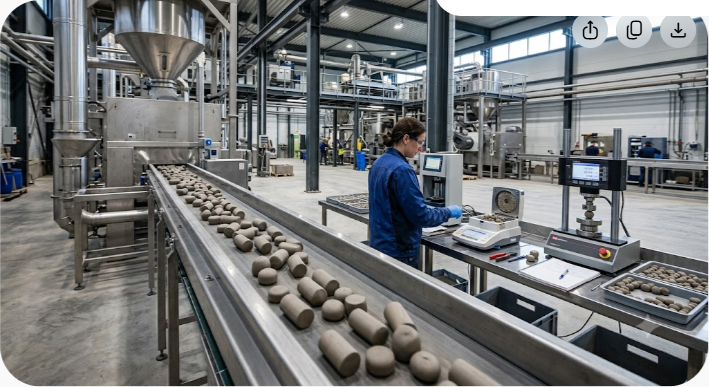
Bentonite pellets intended for export need to survive more than the production line. They must withstand conveying, screening, bagging, container or vessel loading, stacking, unloading, and repeated handling without generating excessive fines or losing the properties the buyer specified.
The key to improving bentonite pellet quality for export is not simply making the pellets harder. A good export pellet has enough green strength to survive wet handling, enough dry strength and attrition resistance to tolerate transport, controlled moisture so it does not soften or clump, and sufficient swelling or absorption performance for its intended application. Those properties have to be balanced rather than maximised independently.
The most important process controls are raw-material consistency, particle size, water addition, mixing, binder selection where appropriate, pellet-forming pressure, drying rate, cooling, screening, and packaging. Final acceptance criteria should come from the product specification and buyer's application rather than from one universal set of numbers.
Export-grade bentonite pellets are designed around the complete supply chain, not just the moment they leave the pelletizer. A pellet that performs well during production can still fail later if it has internal voids, excessive residual moisture, weak surfaces, poor abrasion resistance, or inadequate packaging protection.
A practical export-quality specification normally considers five areas:
There is no single crush-strength value that defines an export-quality bentonite pellet. The appropriate target depends on pellet diameter, formulation, binder system, end use, shipping method, and the buyer's specification. A drilling-grade pellet, a sealing pellet, and a pellet made for another industrial application may require different balances between strength, hydration rate, and dispersion.
Bentonite is a moisture-sensitive clay. Its ability to interact with water is one of its most useful properties, but the same characteristic makes moisture control important during manufacturing and storage.
Export cargo may pass through several handling stages before reaching the customer. Pellets can be discharged from dryers, screened, conveyed, bagged or loaded in bulk, transferred to trucks, moved into containers or vessels, and unloaded at the destination. Each transfer creates another opportunity for impact and abrasion.
Ocean transport adds vibration and repeated movement to the normal handling cycle. Pellets stacked beneath other material also experience compressive loading. The amount of stress depends on cargo arrangement, packing density, pellet strength, shipment configuration, and the duration of storage.
The practical lesson is simple: laboratory strength alone isn't enough. Producers should also examine abrasion and fines generation under conditions that resemble the customer's actual handling system.
Temperature changes can also affect packaged bentonite. A container moving between different climates can experience changes in internal humidity and condensation. This is commonly discussed as container rain or container sweat. Poorly protected clay products may absorb moisture, soften, bridge, or form agglomerates.
The risk isn't identical for every shipment. It depends on the product's starting moisture, packaging, liner design, container condition, climate route, ventilation, and use of moisture-control materials. Export preparation should therefore address the complete moisture pathway instead of relying on a single drying target.
Fines can change how a pelletized product behaves during conveying, dosing, and application. Excessive fines may also create dust during transfer and make a nominally uniform product less consistent.
Whether a shipment is rejected or penalised depends on the commercial specification. A claim that every shipment becomes subject to a penalty above a fixed fines percentage would be misleading. The contract should define the permitted particle-size distribution, fines level, test method, sampling procedure, and acceptance criteria before shipment.
A strong quality-control programme measures several properties together. Focusing only on crush strength can hide problems elsewhere in the product.
| Quality property | What it tells you | Why it matters for export |
|---|---|---|
| Green strength | Integrity of freshly formed wet pellets | Indicates whether pellets can survive transfer before drying |
| Dry crush strength | Resistance to compressive loading after drying | Helps assess behaviour during storage and transport |
| Attrition resistance | Tendency to generate fines through repeated movement | Useful for evaluating conveyor, loading, and unloading losses |
| Moisture content | Amount of water remaining in the finished product | Influences strength, storage stability, and packaging requirements |
| Particle-size distribution | Uniformity of the finished pellet size | Supports consistent handling and end-use performance |
| Swelling or absorption performance | Functional behaviour after contact with water | Confirms that processing has not compromised the intended application |
| Bulk density | Mass per unit volume | Affects packing, transport, and dosing calculations |
Green strength is the resistance of a newly formed, moist pellet to deformation or breakage. It matters immediately after extrusion or granulation because the pellet has not yet developed the strength associated with drying.
Dry strength is measured after the pellet has been dried and conditioned according to the relevant test procedure. It provides useful information about resistance to compressive loads during storage and transport.
A producer can have high dry strength and still experience serious losses if green pellets collapse on conveyors or screens. The reverse is also possible: a pellet may survive wet handling but become friable after aggressive drying. Both stages need attention.
Crushing and attrition aren't the same thing. A pellet may tolerate a single compressive load but shed material when repeatedly rubbed against other pellets or equipment surfaces.
For export products, an attrition test or simulated handling trial can be valuable. The test should resemble the actual logistics chain as closely as practical. Record the starting mass, handling conditions, duration, and final fines fraction so results can be compared between production batches.
There is no universal moisture value that suits every bentonite pellet. The correct range depends on mineralogy, particle size, pellet dimensions, additives, drying conditions, packaging, and application.
Overly wet pellets can be soft and prone to agglomeration. Excessive drying can also be undesirable because aggressive thermal treatment may alter the hydration behaviour of bentonite or make pellets more brittle. The right target is the lowest-risk moisture condition that preserves both physical integrity and the product's specified functional properties.
The most reliable approach is to control the process from raw material preparation through final loading. The following sequence provides a practical framework for sodium bentonite pellet manufacturing and other bentonite pelletization systems.
Pellet quality begins before water enters the mixer. Variations in clay mineralogy, moisture, particle size, exchangeable cations, and organic or mineral impurities can change how the material responds to pelletization.
For sodium bentonite, natural swelling and plasticity can provide useful binding behaviour. Calcium bentonite behaves differently and may require sodium activation when the intended specification calls for stronger swelling or a different rheological response.
Before setting a production recipe, characterise the incoming clay. Depending on the application, useful checks can include:
If calcium bentonite is being activated with sodium carbonate, the dosage should be established from laboratory testing rather than copied from a generic recipe. The required amount varies with the clay's chemistry and exchange capacity. Under-treatment may leave the material below the desired performance level, while excessive chemical addition can create other quality and handling issues.
Consistent feed particle size helps produce a more uniform pellet structure. Large particles can hydrate differently from fine particles and may create local variations in packing or moisture distribution.
The correct milling specification depends on the grade and pelletizing process. A fixed statement such as requiring 85% to 90% of every bentonite feedstock to pass a particular mesh should not be treated as a universal export requirement.
Instead, establish a particle-size target through pilot trials. Compare feed size with green strength, dry strength, fines generation, swelling performance, and energy consumption. The best milling point is the one that provides the required pellet structure without unnecessary grinding cost.
Water addition is one of the most sensitive controls in the bentonite pelletization process. Too little water can prevent adequate plasticisation and particle bonding. Too much can produce sticky, deformable pellets and increase drying demand.

Rather than relying on a single percentage for every clay, determine the working moisture window experimentally. Prepare several mixes around the expected operating point and measure:
Inline microwave or near-infrared moisture measurement can improve control when the equipment is properly calibrated against a laboratory reference method. The sensor should support the process, not replace routine laboratory verification.
Water sprayed onto the surface of a clay bed doesn't immediately become evenly distributed. Mixing time, paddle design, feed rate, water-droplet size, and the order in which ingredients are introduced all influence the result.
A good mixing system should produce a plastic mass with consistent moisture throughout the batch. If one portion of the feed is wet and another remains dry, the pelletizer receives inconsistent material and the finished product will vary in strength and shape.
Atomised liquid addition can help distribute water more evenly than a single open pipe, but nozzle selection and spray pattern matter. Nozzles should be positioned so that the liquid reaches the moving material rather than the mixer wall or a single point in the bed.
Bentonite itself can act as a binder, so additional binder isn't automatically necessary. When extra mechanical strength is required, however, an additive may improve green strength, dry strength, or both.
Common options include organic materials such as starches and carboxymethyl cellulose, as well as inorganic systems such as sodium silicate. Their effects aren't interchangeable.
| Binder type | Potential benefit | Main consideration |
|---|---|---|
| Starch | Can improve green and dry bonding | Thermal behaviour and application compatibility must be assessed |
| CMC | Can improve binding and wet-state cohesion | Cost, grade, dosage, and interaction with the clay need testing |
| Sodium silicate | Can increase dry hardness in suitable formulations | May affect dispersion and end-use chemistry |
| No added binder | Preserves a simpler formulation | Requires sufficiently strong natural clay and well-controlled processing |
Binder dosage should be determined by trial work. A higher dosage isn't automatically better. Too much additive can interfere with swelling, dispersion, ash content, chemical purity, or the customer's process.
For applications such as drilling fluids or products that must hydrate rapidly, the binder system needs particularly careful evaluation. A pellet that survives transport but hydrates too slowly or leaves an undesirable residue may fail its actual purpose.
The pellet-forming method affects shape, density, surface structure, throughput, and mechanical performance.
Extrusion forms a plasticised clay mass by forcing it through a die. It can produce relatively uniform cylindrical or strand-based pellets and offers strong control over dimensions when the feed rheology and equipment are stable.
Important extrusion variables include:
Vacuum de-airing can be useful when entrapped air is contributing to internal voids. However, equipment settings need to be validated against the specific clay formulation rather than assumed to work identically for every bentonite.
Disc pelletizers form pellets through rolling and layering. Water or another approved liquid is introduced while particles circulate across the disc. The process can produce rounded pellets and is often useful when spherical granules are preferred.
Disc angle, rotational speed, feed rate, moisture, spray distribution, and seed formation all influence pellet quality. Instead of treating a nominal angle range as a fixed rule, operators should establish the operating window that gives stable pellet growth and the required size distribution.
Rotary drum granulation provides continuous production and can be useful for larger industrial throughputs. As with disc granulation, the final product depends on residence time, liquid addition, feed characteristics, drum speed, inclination, and internal lifting or mixing conditions.
The right equipment is therefore the one that matches the required pellet shape, production rate, strength, hydration behaviour, and downstream handling system.
Drying is one of the easiest stages to get wrong. The objective isn't simply to remove water as quickly as possible. It is to remove enough moisture at a controlled rate to produce a stable pellet without excessive internal stress or damage to the clay's functional properties.
When the surface of a wet pellet dries much faster than its interior, moisture gradients develop. The outer layer may contract while the core remains wetter. Those differences can create stresses that appear later as cracks, peeling, or internal weakness.
A very high dryer-air temperature does not automatically mean the pellet itself reaches that temperature immediately. Heat transfer depends on air velocity, humidity, residence time, pellet size, bed depth, and dryer design. For that reason, statements such as "never exceed 200 degrees C" are too broad to serve as a universal process rule.
The safer approach is to validate the thermal profile for the actual equipment and product.
Start with controlled pilot or plant trials. Measure inlet and outlet air temperature, product temperature, residence time, moisture reduction, and final strength.
A useful development sequence is:
The final product temperature and moisture should be low enough for safe packaging and stable storage, but the specification must be based on the grade and application.
Packaging hot pellets can create a moisture-management problem. Warm product enclosed in a relatively cool package or container can contribute to local condensation as temperatures equalise.
Use a suitable cooler or controlled ambient cooling stage and verify product temperature before bagging. The goal is to prevent unnecessary heat and moisture from being trapped inside the package.
Most pellet defects have a process signature. Recording when and where the defect appears can narrow the cause quickly.
Likely causes:
What to check:
Compare moisture at several points in the mixer and measure green strength from multiple samples. If the moisture is correct but green strength remains inconsistent, examine feed particle size, mixing uniformity, and forming pressure before simply adding more binder.
Likely causes:
What to check:
Cut representative pellets and examine their cross-sections. If voids are consistently visible, evaluate de-airing, mixer performance, and extrusion conditions. A vacuum pug mill or vacuum extruder may help where air entrapment has been confirmed as the cause.
Likely causes:
What to check:
Inspect pellets immediately after forming, during drying, and after cooling. If cracks first appear in the dryer, review the early drying-zone conditions and product temperature rather than changing the pelletizer first.
Likely causes:
What to check:
Measure moisture across the mixer and dryer discharge. Inspect spray nozzles for uneven flow and check whether oversize material is being returned to the process at an uncontrolled rate.
Likely causes:
What to check:
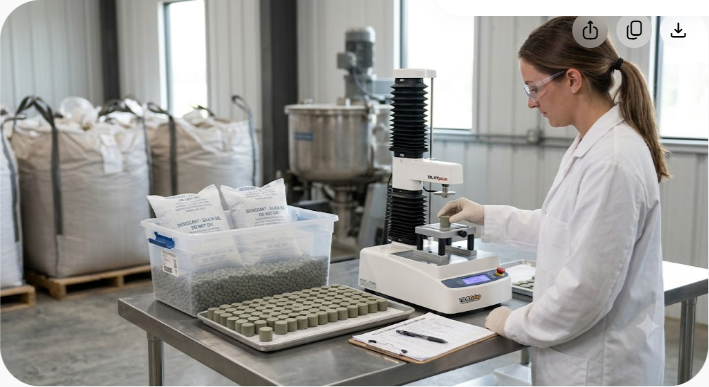
Take samples before and after major handling points. This simple comparison can show where fines are being created. If fines increase sharply after a particular conveyor or transfer point, changing the pellet formulation may not be the first solution; equipment handling may be the actual source of the problem.
Quality control should follow the product from raw clay to final shipment. A certificate of analysis is useful, but it is only as reliable as the sampling and test methods behind it.
A practical quality system can include checks at four stages:
Sampling frequency should be based on production variability, batch size, process capability, and customer requirements. A statement such as collecting samples every two hours may be appropriate for one operation and excessive or inadequate for another.
Single-pellet crush testing can provide a useful measure of mechanical integrity. Test enough individual pellets to capture normal variation rather than relying on one unusually strong or weak specimen.
Record the test conditions, pellet dimensions, conditioning state, equipment calibration, and results. Mean strength is useful, but the spread of the measurements matters as well. A batch with a high average and a large number of weak pellets may create more handling problems than a slightly lower but tightly controlled average.
Use the sieve sizes and method specified by the product contract or applicable standard. Record both the desired size fraction and the fines fraction so the result can be compared with the commercial specification.
If possible, perform sampling at several points in the handling chain. This separates production-related fines from transport-related degradation.
Loss-on-drying is a common approach for determining moisture, but the method, temperature, drying time, and sample preparation should be defined in the quality system. Some products require additional care because heating can affect more than free moisture.
Compare the laboratory method with any online sensor used for process control. Calibration should be based on representative production material rather than a one-time comparison.
Mechanical durability shouldn't come at the expense of performance. Depending on the grade, test free swelling, fluid-loss behaviour, viscosity, absorption, sealing performance, or another property relevant to the customer's application.
For example, a drilling-grade sodium bentonite pellet needs to hydrate predictably when mixed into water. A sealing product may be evaluated for swelling and hydraulic performance instead. The correct test is determined by the job the pellet is expected to perform.
Export buyers often specify ASTM, ISO, API, EN, or customer-specific procedures. The presence of a standard number in a specification does not automatically mean that the method is appropriate for every bentonite pellet.
For example, ASTM D5890 is associated with the swell index of clay mineral components of geosynthetic clay liners and should not be presented as a universal test for all bentonite products. Likewise, standards developed for iron ore pellets or catalyst carriers may not directly represent the behaviour of a bentonite product.
The correct procedure should therefore be selected based on the product and its intended application. Where a customer specifies a test method, use that method and document the edition or revision used.
For export quality control, the purchase specification should clearly identify:
This removes ambiguity when the shipment is inspected at the destination.
Packaging should protect the pellets from both mechanical damage and unwanted moisture. The right format depends on the product, shipment size, handling equipment, destination, and customer's unloading system.
Multi-wall paper bags can work well for smaller industrial quantities when they are combined with an appropriate moisture-resistant inner liner. Bag construction should be selected according to the product's moisture sensitivity and the expected transport conditions.
Do not assume that every 25 kg bag needs the same liner thickness. The correct specification depends on the material, climate, storage duration, and handling system.
Flexible intermediate bulk containers are commonly used for larger quantities. Their fabric construction, liner arrangement, filling method, discharge design, safe working load, and lifting configuration should match the material and handling equipment.
A polyethylene liner can provide an additional moisture barrier, but it doesn't make the cargo immune to condensation. The complete package still needs to be tested under realistic storage and shipping conditions.
Bulk bentonite ocean freight requires particular attention to cargo hold cleanliness, moisture exposure, loading method, and unloading equipment. The contract should define acceptable moisture, fines, contamination limits, and sampling procedures before shipment.
Bulk loading can also increase mechanical stress. Drop heights, conveyor speeds, transfer points, and pneumatic conveying conditions should be reviewed if the product has a high fines sensitivity.
Moisture protection begins before the container is stuffed. A wet or damaged container can undermine otherwise good packaging.
Before loading, check for:
Document the inspection according to the company's shipping procedure.
Container desiccants can reduce the impact of humidity and condensation, but the required quantity depends on the cargo mass, packaging, climate, voyage duration, container volume, and desiccant capacity. A universal statement that every 20-foot container requires a fixed number of kilograms is therefore unreliable.
Select the desiccant system based on a moisture-control assessment and follow the supplier's installation instructions. Desiccants should complement, not replace, moisture-resistant packaging.
If pallets are used, stable stacking and suitable stretch wrapping can reduce movement and exposure. Wrapping should not create a false sense of security: trapped moisture can remain inside a tightly wrapped load, so the product and packaging must already be suitably conditioned before wrapping.
Making pellets harder isn't always the right goal. Excessive hardness can sometimes come with slower hydration, poorer dispersion, altered absorption, or an unsuitable binder residue.
The target should be application performance plus sufficient transport durability.
Clay deposits differ. A moisture percentage that works well for one sodium bentonite may produce poor pellets with another grade. Establish the workable moisture window through testing and control it consistently.
If the binder isn't distributed evenly, increasing its dosage may mask the underlying problem while raising formulation cost or affecting end-use behaviour. First confirm that liquid and dry ingredients are being mixed uniformly.
High dryer temperature can increase throughput, but the relevant variable is the complete drying profile. Product temperature, air humidity, residence time, pellet dimensions, and moisture gradients all matter.
A pellet can pass the final crush-strength test and still generate fines during conveyor transfer or container loading. Simulated handling tests and sampling before and after major transfer points provide a clearer picture of export durability.
A pellet specification should begin with the end use. Sealing, drilling, foundry, absorbent, and other industrial applications don't necessarily require the same combination of strength, swelling, particle size, and dispersion behaviour.
Before releasing a shipment, review the following points:
This checklist creates traceability from mine or stockpile to finished shipment. It also makes troubleshooting much easier if the customer reports degradation after delivery.
Export quality improves when production, laboratory testing, packaging, and logistics are treated as one system.
Start by identifying the customer's non-negotiable requirements. Then work backwards through the process. If the customer needs a narrow pellet-size range, control screening and pellet formation. If the product must survive long-distance bulk handling, evaluate dry strength and attrition. If the application depends on rapid hydration, make sure the binder and thermal process don't compromise swelling or dispersion.
Use process data to establish normal operating ranges rather than relying on isolated target numbers. Track moisture, pellet size, strength, fines, dryer conditions, and relevant functional properties by batch. Trends often reveal process drift before the product visibly fails.
For producers serving international markets, raw-material consistency is equally important. Stable mineral reserves, controlled blending, suitable processing equipment, laboratory capability, and documented quality procedures can reduce batch-to-batch variation.
Axewelledge can be presented as a supplier example only where its current product specifications, production capacity, reserve figures, certifications, and test results are supported by current company documentation. Claims about reserve tonnage, market position, or global production ranking should be verified before publication rather than treated as technical proof of pellet quality.
Improving bentonite pellet quality for export is a process-control problem, not a single-equipment problem. Strong results come from matching the raw clay to the application, controlling particle size and moisture, mixing uniformly, selecting compatible binders, forming pellets consistently, drying them without excessive thermal stress, and protecting the finished product during storage and transport.
The most useful quality programme measures more than crush strength. Green strength, dry strength, attrition resistance, moisture, particle size, swelling or absorption, and packaging performance should all be considered against the buyer's specification.
The final test is whether the pellets reach the customer in the same functional condition in which they left the production facility. When manufacturing controls and export logistics are designed together, producers can reduce unnecessary fines, moisture-related damage, batch variation, and costly quality disputes.













Have questions about our products? We're here to help!