Axewelledge, a leading exporter from India, specializes in high-quality Bentonite. With a commitment to excellence, we supply premium Bentonite to the Middle East and Southeast Asia markets.


North Angle Complex, 304,
150 Feet Ring Rd, Opposite Ambedkar Nagar BRTS Stop,
Madhav Park, Punit Nagar,
Mavdi, Rajkot, Gujarat 360004
© Axewelledge 2026, All Rights Reserved.
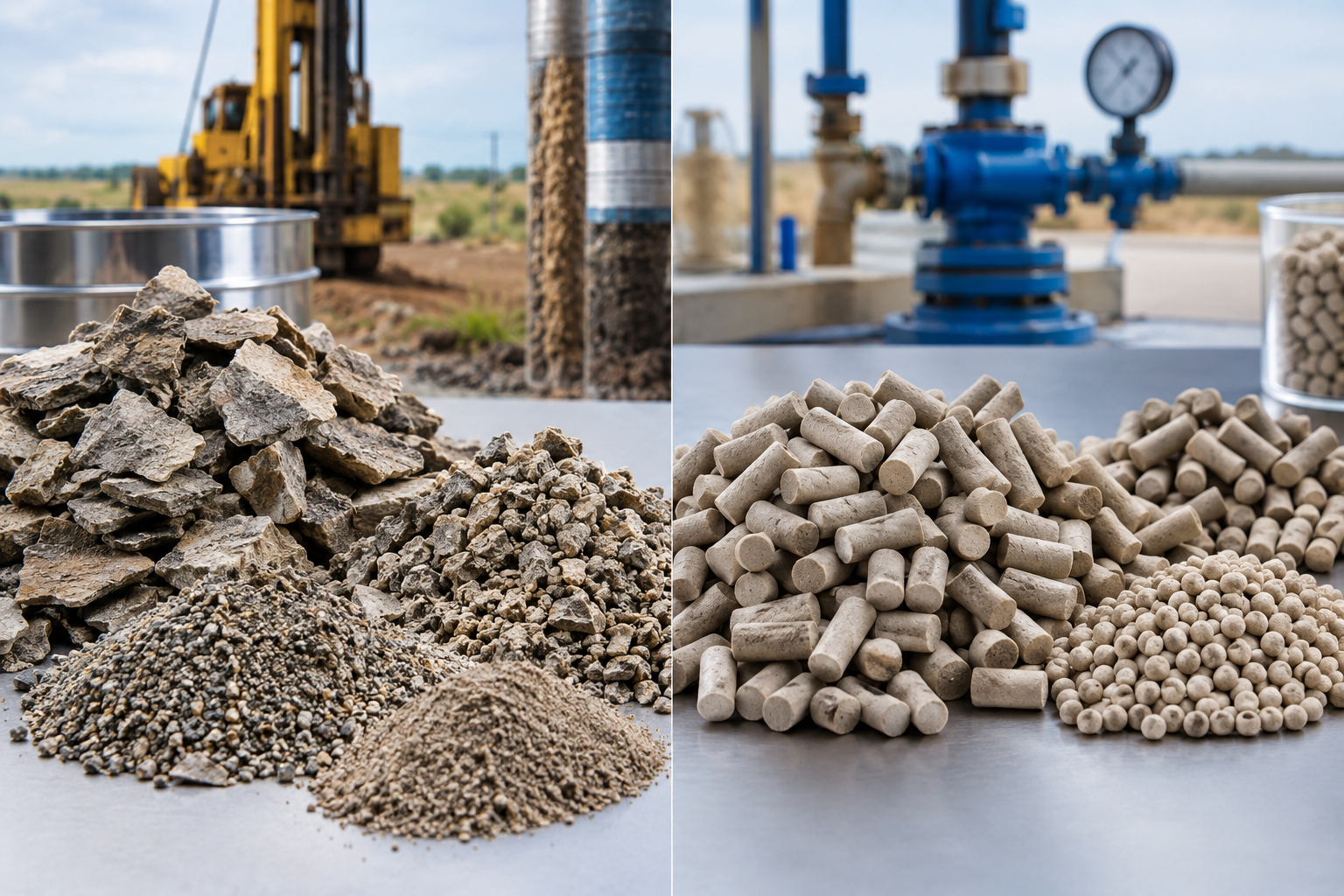
When the question is whether bentonite pellets or chips are better for a well seal, there isn't a single answer. The better material depends on the borehole geometry, annular space, water conditions, placement method, and the requirements of the well or abandonment procedure.
For narrow annular spaces and deep placements through standing water, uniform bentonite pellets are often easier to place reliably because their consistent size reduces the tendency to bridge. Bentonite chips can be an economical choice for larger spaces, dry holes, and many well-abandonment projects, provided the particle size and installation method are appropriate.
That distinction matters because a bentonite seal only works as designed if the material actually reaches the intended interval and hydrates there. A product with excellent swelling characteristics can still produce a poor seal when it bridges above the target depth, becomes contaminated, or is installed without accounting for groundwater chemistry.
This guide compares bentonite pellets and chips from a practical field perspective, including swelling behaviour, bridging, placement, well applications, water chemistry, installation checks, and common mistakes.
Both products are forms of sodium bentonite used to create low-permeability seals. The main difference is physical form and how that form behaves during placement.
Bentonite chips are granular pieces of processed bentonite, generally produced by crushing and screening larger material into controlled size ranges. Their irregular shape and relatively simple processing make them economical, particularly where large quantities are required.
Bentonite pellets are manufactured into more uniform particles, commonly cylindrical or granular in shape. Their controlled dimensions and higher consistency make them useful when accurate placement is important, especially in confined annular spaces.
The choice should therefore begin with the installation conditions rather than the assumption that one product is always superior.
| Factor | Bentonite Chips | Bentonite Pellets |
|---|---|---|
| Physical form | Irregular granular pieces | Uniform manufactured particles |
| Typical cost | Generally lower | Generally higher |
| Particle consistency | More variable | More consistent |
| Placement in narrow annuli | Requires careful sizing | Often easier to control |
| Bridging potential | Can be significant if oversized | Generally lower when correctly sized |
| Dust and fines | Can be higher depending on product | Usually lower |
| Deep placement through water | Requires careful installation | Often preferred, especially with suitable coated products |
| Large-volume abandonment | Often economical | Can be more expensive |
| Dry-hole applications | Suitable | Suitable |
| Coated versions | Less common | Common for delayed hydration |
Sodium bentonite contains a high proportion of the clay mineral montmorillonite. When it contacts water, the clay absorbs water and expands. In a confined borehole or annular space, the hydrated clay can form a dense, low-permeability barrier.
The effectiveness of the seal depends on more than maximum swell. Particle size, dry density, water quality, placement, hydration conditions, and the surrounding formation all influence the final result.
A useful way to think about bentonite is that placement comes before swelling. The material needs to reach the intended sealing interval before significant hydration prevents further movement.
This is particularly important when dry bentonite is introduced into standing water. Fine particles can hydrate quickly near the water surface, while larger particles travel farther. If the material is introduced too quickly or the selected particle size is unsuitable for the annular space, a bridge can form before the required quantity reaches depth.
A product marketed as having very high swelling capacity isn't automatically the best choice for every well. Laboratory swell values are useful for comparing materials, but field performance also depends on how the bentonite is installed and the chemistry of the water available for hydration.
A well seal needs to be continuous and properly located. A highly expansive product that bridges halfway down the hole is less useful than a product that reaches the required depth and hydrates uniformly.
For specification work, review the manufacturer's technical data, product grading, yield information, installation recommendations, and any applicable regulatory requirements rather than relying on a single swelling figure.
Bentonite chips remain a practical sealing material because they're straightforward to manufacture, widely available, and usually economical for high-volume work.
Their irregular shape isn't necessarily a disadvantage. In a sufficiently large borehole or annular space, appropriately graded chips can be placed effectively and then hydrated to form a competent seal.
Lower material cost: Chips generally require less processing than precision-formed pellets, which can make them attractive for projects involving substantial quantities of bentonite.
Useful for larger spaces: Where the annular space is generous and the particle size is properly selected, chips can be installed without the same placement constraints found in very narrow annuli.
Good choice for many abandonment projects: Water-well and borehole abandonment can require considerable volumes of sealing material. Granular bentonite can provide a practical balance between performance and material cost when permitted by the applicable abandonment procedure.
Straightforward handling: Dry chips are easy to transport, measure, and introduce into suitable open or dry sections of a borehole.
The principal concern is particle placement. Irregular particles can interlock or accumulate when the available space is too small, the borehole is irregular, or the installation rate is too high.
Chips can also contain a proportion of fines. Those fines may hydrate quickly when they contact water. If excessive fines accumulate near the top of a standing-water column, they can interfere with the descent of additional material.
The solution isn't to reject chips automatically. It is to match the chip grading to the borehole and follow the manufacturer's placement guidance.
Pellets are manufactured to provide more consistent particle dimensions. That consistency can make a major difference when the available annular space is limited or when the material must travel through a significant depth of standing water.
Pellets can also be supplied in coated forms. The coating is designed to delay hydration so the particles have more time to reach the required depth before they expand.
Consistent particle size: Uniform pellets provide more predictable flow characteristics than irregular chips. This is particularly useful when the annular clearance is limited.
Reduced bridging potential: Properly sized pellets tend to move through a confined space more predictably. They aren't immune to bridging, however. An annulus can still bridge if the particles are too large, the borehole is obstructed, or the material is introduced too quickly.
Suitable for deep placement: Coated pellets can provide additional placement time in standing water. The exact delay depends on the product and installation conditions, so the manufacturer's technical specification should be used rather than assuming a universal hydration time.
Lower fines in many products: Manufactured pellets are generally designed to minimise dust and fines, which can simplify placement through water.
The main drawback is cost. Additional processing, pellet formation, and, where applicable, coating increase the price compared with basic granular products.
Pellets also need to be stored properly. Moisture exposure can affect products that rely on a coating or other controlled-hydration feature. Packaging should remain intact and the manufacturer's storage instructions should be followed.
Pellet size also matters. A pellet isn't automatically suitable simply because it is a pellet. The particle diameter must be compatible with the available space and the installation procedure.
Bridging occurs when bentonite forms a blockage above the intended sealing depth. Material placed afterward accumulates on top of that blockage instead of reaching the bottom of the target interval.
The result can be a seal that looks complete from the surface but contains an unsealed section underneath. For environmental wells and other applications where vertical isolation matters, that can be a serious installation failure.
Several factors can contribute:
Start by measuring the actual borehole and casing dimensions. Calculate the available annular space rather than selecting particle size by habit.
Next, compare the selected particle size with the manufacturer's placement recommendations. There is no single particle-to-annulus ratio that should be treated as a universal rule for every product and installation condition.
Control the rate of placement. If material is being poured from the surface, a steady feed is preferable to dumping a large quantity at once.
For critical or very deep installations, consider a placement method specifically designed to deliver sealing material to depth. Depending on the project, that may involve a tremie pipe or bentonite grout rather than free-falling dry solids.
Most importantly, verify the material's depth as the work progresses. Don't assume that the quantity poured into the hole is the same as the quantity that reached the target interval.
Pellets are often the better practical choice when placement precision matters more than the lowest possible material cost.
A narrow annulus leaves little room for error. The particle diameter has to be compatible with the available clearance, and the material must move without becoming lodged between the casing and borehole wall.
Uniform pellets can provide more predictable placement in these conditions, particularly when the product has been selected specifically for the application.
Deep placements create a simple problem: the material has a long distance to travel before it reaches the sealing interval. If the bentonite hydrates too quickly, it can stop moving before reaching its intended depth.
A coated pellet designed for delayed hydration can provide additional placement time. The actual delay should always be taken from the product specification because coating formulations and field conditions vary.
Monitoring wells often require careful vertical separation between screened intervals and other formations. The seal must be placed accurately so it doesn't interfere with the filter pack or create unintended hydraulic connections.
For these projects, uniform bentonite pellets are commonly selected because they offer controlled particle sizing and, where needed, delayed hydration. The final material choice should still follow the project specifications, local regulations, and the recommendations of the well designer or qualified contractor.
Chips can make sense when the installation provides enough space for the selected grading and the project requires a large amount of material.
Abandonment work often involves sealing a substantial length of casing or borehole. The objective is to prevent the abandoned well from becoming a preferential pathway for movement between groundwater zones or from the surface into the subsurface.
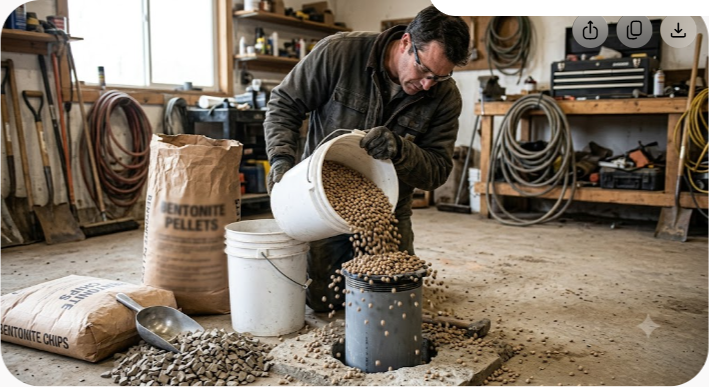
Where regulations and the approved abandonment method allow granular bentonite, chips can provide an economical solution. The material still needs to be placed from the bottom upward where required, and the installer should verify that it reaches the intended depth without bridging.
Local well-construction and abandonment rules should always take priority over a generic installation procedure.
A larger annular space provides more room for granular particles to pass. Appropriately sized chips can therefore be a practical choice for certain large-diameter sealing applications.
The key word is "appropriately." A large borehole doesn't mean any chip size will work. Particle grading should be selected according to the borehole dimensions and manufacturer's instructions.
Dry placement removes one of the main challenges associated with free-falling bentonite through standing water. Chips can be introduced, distributed, and hydrated under controlled conditions where the project design permits it.
Even in a dry hole, though, the material shouldn't simply be dumped without checking the required seal thickness and placement depth.
The term "bentonite pellet" covers more than one product type. One of the most important distinctions is whether the pellet is coated to delay hydration.
Uncoated pellets begin interacting with water as soon as they become wet. They are useful when rapid hydration is acceptable and the material can reach the target location without significant delay.
Coated pellets use a coating intended to slow water penetration and delay swelling. This can be particularly useful when pellets must pass through a deep column of standing water before reaching the sealing interval.
A delayed-hydration product isn't automatically better. If the installation is shallow or dry, the additional cost may provide little practical benefit. The coating should be selected when the placement conditions justify it.
Don't assume that all coated pellets provide the same delay. Hydration time varies by product, coating, temperature, water chemistry, and field conditions. Use the manufacturer's technical documentation for the actual product being installed.
Bentonite does not hydrate in a vacuum. The chemistry of the available water affects its behaviour.
Sodium bentonite generally performs best in relatively fresh water. Elevated concentrations of dissolved salts and certain multivalent ions, particularly calcium and magnesium, can reduce swelling and alter the rheology and permeability of hydrated bentonite.
This matters in coastal areas, saline formations, some industrial sites, and locations with naturally hard groundwater.
If water chemistry is known to be unusual, review available groundwater data before choosing the sealing material. Relevant information can include electrical conductivity, total dissolved solids, chloride concentration, hardness, calcium, magnesium, and pH.
For critical applications, consult the bentonite supplier or technical specialist about compatibility rather than assuming that a standard sodium bentonite product will perform identically in all water types.
Increasing the quantity of bentonite isn't always an adequate solution to poor water compatibility. In strongly saline conditions, a different formulation or grout system may be more appropriate.
The exact procedure should follow the well design, regulatory requirements, and product instructions. For a general dry-solids placement process, the following sequence provides a useful framework.
Record the borehole diameter, casing diameter, casing depth, total depth, and intended seal interval. If the borehole diameter varies substantially, use the best available measurements rather than assuming a constant diameter.
For a uniform annulus, the theoretical annular volume can be estimated from the difference between the borehole and casing cross-sectional areas multiplied by the required seal length.
The basic relationship is:
For cylindrical sections, the cross-sectional area is based on the circle's diameter. Product yield information should then be used to convert the required volume into an appropriate quantity of bentonite.
In practice, account for actual borehole conditions and the manufacturer's yield data. Don't rely solely on a nominal bag weight.
Choose a pellet or chip size that is compatible with the narrowest relevant space. Consider casing centralisation, borehole irregularities, standing water, and any other components occupying the annulus.
Inspect the bags for moisture damage and confirm the product type and particle grading. Coated products deserve particular attention because damaged packaging or prolonged exposure to humidity can affect their performance.
Introduce the material steadily rather than dumping large quantities at once. The installation method should allow the bentonite to reach the intended interval without accumulating prematurely.
For deep applications, a suitable tremie or other controlled placement system may be preferable to free-falling dry solids.
Measure the depth during installation when the project procedure calls for verification. A sudden reduction in available depth can indicate that material has bridged above the target zone.
If bridging is suspected, stop adding material and follow the approved procedure for correcting the obstruction. Continuing to pour usually makes the problem worse.
Dry sections above the water table may require controlled hydration depending on the product and sealing design. Don't add a fixed quantity of water simply because it is a common field rule. Follow the manufacturer's instructions and the project specification.
Bentonite needs sufficient time and water to hydrate. The required period depends on the product, temperature, water chemistry, confinement, and installation conditions. Avoid disturbing a newly placed seal before it has developed the required condition.
Even good bentonite can underperform when installation shortcuts are taken.
The cheapest bag isn't necessarily the lowest-cost option. If inexpensive chips bridge in a narrow annulus, correcting the problem can consume more time and material than the original price difference between chips and pellets.
Uniform pellets still need sufficient clearance. A pellet that works well in one well may be too large for another. Always compare particle size with the actual installation geometry.
High swelling is useful, but it doesn't replace good placement. Review product yield, particle size, hydration characteristics, water compatibility, and installation guidance as a package.
Fast placement can create accumulation and bridging. Controlled feeding gives particles more opportunity to settle through the available space.
Excessive fines can hydrate prematurely in standing water. If fines are a known concern, choose a product designed for the placement conditions and follow the supplier's handling recommendations.
A bag count doesn't prove placement depth. Where verification is required, measure the material level during installation.
Water requirements depend on the material and site. Adding a fixed number of gallons per bag without considering the manufacturer's instructions can produce inconsistent results.
Well construction and abandonment requirements vary by jurisdiction and application. A technically reasonable method can still be unacceptable if it doesn't comply with the governing authority's requirements.
The most useful comparison is not simply which material is "better," but which material fits the installation.
| Application | Typical Preference | Main Reason |
|---|---|---|
| Environmental monitoring well | Pellets | Controlled placement in confined annular spaces |
| Deep placement through standing water | Coated pellets | Delayed hydration can improve placement control |
| Large-volume well abandonment | Chips or pellets | Choice depends on borehole geometry and regulations |
| Large annular space | Chips often practical | Lower cost and adequate room for placement |
| Narrow annulus | Pellets often preferred | More consistent particle dimensions |
| Dry borehole | Either, depending on design | Water-column bridging is less of a concern |
| Geothermal borehole | Application-specific | Grout and thermal requirements often govern the design |
| Grounding applications | Granular bentonite may be suitable | Requirements differ from groundwater isolation |
Geothermal boreholes present a different set of design considerations. The sealing material may need to provide hydraulic isolation while also meeting thermal conductivity requirements around the loop.
For closed-loop geothermal systems, engineered thermally enhanced bentonite grouts are commonly considered because the grout formulation can be selected for both sealing and heat-transfer performance.
Solid pellets or chips may have a role in particular sections or sealing arrangements, but they shouldn't be selected simply because they are inexpensive. The borehole design, loop configuration, grout requirements, and local standards should determine the system.
Bentonite is also used around grounding electrodes and in some cathodic protection installations because hydrated clay can retain moisture and provide a conductive environment around the electrode.
These applications shouldn't be confused with groundwater well sealing. The performance criteria are different, and the installation method should be designed for the electrical system rather than copied from a water-well abandonment procedure.
Granular bentonite may be suitable for some shallow grounding installations, particularly where the material can be placed and hydrated without the challenges associated with a deep standing-water column.
A practical selection process can be reduced to six questions.
If the answers point toward precision placement, pellets are often worth the additional cost. If the installation has generous space and requires large quantities of material, appropriately graded chips can be a sensible option.
Particle shape gets most of the attention when comparing pellets and chips, but the underlying clay quality is just as important.
Bentonite performance depends on mineralogy, processing, particle grading, moisture condition, and consistency from batch to batch. A product with a convenient particle size can still disappoint if its clay quality or yield is poorly controlled.
For industrial and environmental projects, buyers should ask suppliers for technical specifications, product data, quality-control information, applicable certifications, and guidance on the intended application.
Axewelledge supplies sodium bentonite products for industrial and sealing applications, with processing and grading options intended for different end uses. When selecting a supplier, the important questions are practical ones: Can the supplier provide consistent material? Is the particle size controlled? Can the supplier provide technical documentation? Does the product match the water and installation conditions at the site?
Those checks are more useful than choosing a product solely because it has the highest swelling number or the lowest purchase price.
Choose bentonite pellets when placement precision is the priority. They're particularly useful for narrow annular spaces, deep installations through standing water, and applications where controlled particle size and delayed hydration can reduce placement risk.
Choose bentonite chips when the installation provides adequate space and cost efficiency matters. They can be a practical option for large-volume sealing and many abandonment projects when the particle grading, placement method, and regulatory requirements are appropriate.
Neither product is universally better. The strongest selection is the one that reaches the required depth, hydrates under the actual site conditions, and forms the required low-permeability barrier without bridging or leaving voids.
Before ordering material, check the borehole dimensions, target seal interval, standing-water depth, groundwater chemistry, particle size, product yield, and installation method. That short review can prevent a much more expensive problem in the field.
Uncoated bentonite pellets begin hydrating as soon as they contact water, but the time required to reach a fully developed seal varies with pellet size, temperature, water chemistry, confinement, and product formulation. Coated pellets are designed to delay hydration, giving them more time to reach depth. Always use the manufacturer's stated hydration and placement guidance for the specific product.
Yes, bentonite chips can be used in standing water when the product size and installation method are suitable. The main concern is premature hydration and bridging, particularly if fines accumulate near the water surface or material is poured too quickly. For deep water columns or narrow annuli, a suitable pellet or controlled placement method may provide more reliable results.
Bentonite chips can bridge when their particle size is too large for the available annular space, when irregular particles interlock, or when material is introduced faster than it can settle. Excess fines can also hydrate near the water surface and interfere with later placement. Borehole irregularities and obstructions can increase the risk, so depth should be monitored during installation.
Coated pellets can justify their higher cost when bentonite must travel through a deep column of standing water or a narrow annulus before hydration. The coating delays water contact and can reduce premature swelling during placement. They aren't necessary for every application, however. Compare the product's placement characteristics, site conditions, and project requirements before paying for delayed hydration.
The required quantity depends on the borehole diameter, casing diameter, seal length, product yield, and actual borehole conditions. Start by calculating the theoretical annular volume, then use the manufacturer's yield data to determine the material requirement. For abandonment work, also follow the applicable local regulations and approved procedure, which may specify material type, placement method, or seal dimensions.
Yes. Hydrated sodium bentonite can lose volume if it becomes sufficiently dry, and repeated wetting and drying can affect seal performance. The degree of shrinkage depends on the formulation and surrounding conditions. A well-designed seal should account for the site's long-term moisture regime rather than assuming that bentonite will remain permanently hydrated under all conditions.
Sodium bentonite is widely used in water-well construction and sealing, but suitability depends on the specific product and its intended use. For drinking-water applications, select a product that meets the relevant regulatory and project requirements and obtain the manufacturer's technical and quality documentation. Don't assume that every industrial-grade bentonite product is automatically approved for potable-water use.













Have questions about our products? We're here to help!