Axewelledge, a leading exporter from India, specializes in high-quality Bentonite. With a commitment to excellence, we supply premium Bentonite to the Middle East and Southeast Asia markets.


North Angle Complex, 304,
150 Feet Ring Rd, Opposite Ambedkar Nagar BRTS Stop,
Madhav Park, Punit Nagar,
Mavdi, Rajkot, Gujarat 360004
© Axewelledge 2026, All Rights Reserved.
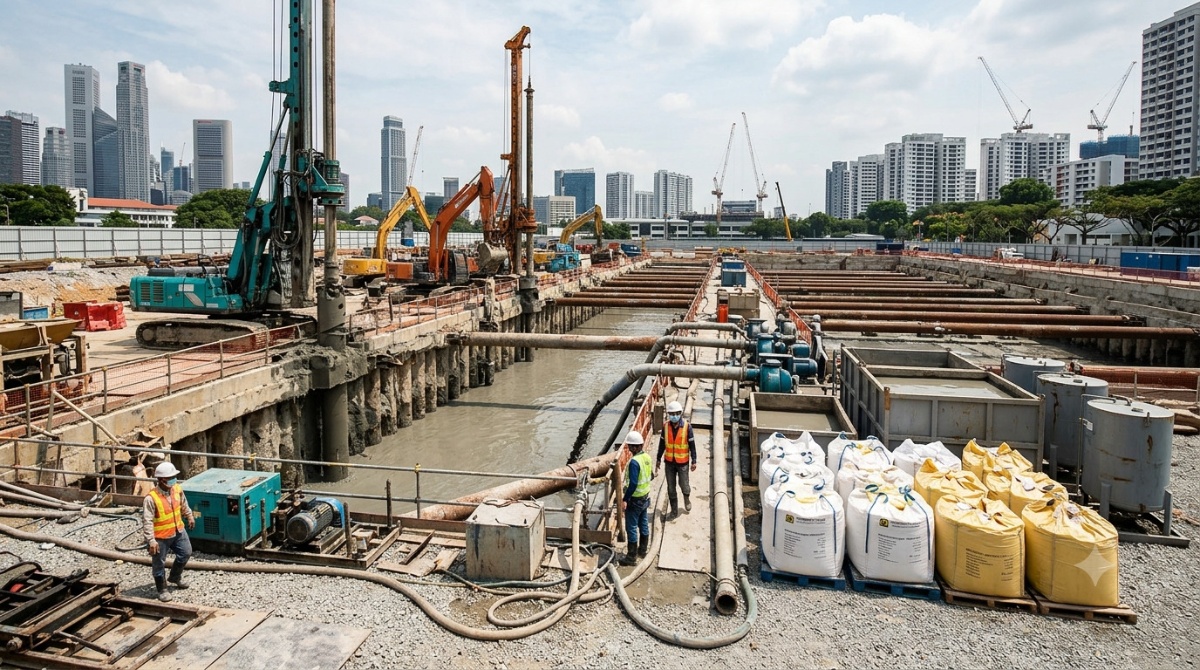
Singapore’s industrial landscape is a powerhouse of precision, innovation, and rapid infrastructure growth. From the deep-underground tunneling of the Land Transport Authority (LTA) MRT expansions to high-tech foundations, chemical manufacturing, and environmental engineering, one humble mineral plays a massive, unseen role: Bentonite Powder.
If you are a procurement officer, civil engineer, or supply chain manager in Singapore, sourcing the right grade of bentonite can make or break your project. Meeting strict local regulatory standards, ensuring the correct technical specifications, and navigating Minimum Order Quantities (MOQs) are critical steps in your procurement journey.
This comprehensive guide breaks down everything you need to know about securing a reliable bentonite powder supply in Singapore, ensuring your operations run smoothly, efficiently, and cost-effectively.
Bentonite is an absorbent aluminum phyllosilicic clay consisting mostly of montmorillonite. It is essentially weathered volcanic ash that possesses unique crystalline structures, giving it incredible hydration, swelling, and sealing properties.
There are two primary types of bentonite used in industrial applications:
Sodium Bentonite: High swelling capacity, excellent gelling properties, and superior thermal stability.
Calcium Bentonite: Low swelling capacity but highly effective for adsorption, bleaching, and refining.
For Singapore’s primary industrial sectors—mainly civil engineering, construction, and piling—Sodium Bentonite is the undisputed king.
When importing or sourcing bentonite powder in Singapore, matching the technical datasheet with your specific application is paramount. Civil engineering projects, for instance, strictly adhere to API (American Petroleum Institute) or DFCP (Drilling Fluid Materials) standards.
Below are the critical technical specifications you must evaluate before signing off on a supply contract:
What it is: The volume of gel formed when a specific amount of bentonite is hydrated in water.
Standard Range: $ge 24 ext{ ml} / 2 ext{g}$ for high-quality sodium bentonite.
Why it matters: High swelling ensures that the bentonite forms an impermeable barrier, which is vital for preventing water ingress in Singapore’s coastal and deep excavation sites.
What it is: A measure of the time it takes for a specific volume of drilling fluid to flow through a standardized funnel.
Standard Range: $32 ext{ to } 40 ext{ seconds}$ (or higher for specialized slurry walls).
Why it matters: It determines the slurry’s ability to suspend cuttings and exert hydrostatic pressure against excavation walls, preventing cave-ins during diaphragm wall construction.
What it is: The percentage of water remaining in the dry powder.
Standard Range: $8\% ext{ to } 12\%$.
Why it matters: Excessive moisture leads to clumping, reduced shelf life, and inaccurate weight calculations during batching.
What it is: The fineness of the powder.
Standard Range: $75 ext{ microns (200 mesh)} ge 90\%$ passing.
Why it matters: Finer powder ensures rapid dispersion and hydration when mixed with water, preventing "fish-eyes" (unhydrated lumps) in the mixing tanks.
| Parameter | Civil Engineering Grade | API 13A Grade | Foundry / Casting Grade |
| Montmorillonite Content | $ge 75\%$ | $ge 85\%$ | $ge 80\%$ |
| Swelling Volume | $20 - 30 ext{ ml}/2 ext{g}$ | $ge 24 ext{ ml}/2 ext{g}$ | $18 - 25 ext{ ml}/2 ext{g}$ |
| Moisture Content | Max $12\%$ | Max $10\%$ | Max $12\%$ |
| pH Value | $8.5 - 10.5$ | $9.0 - 10.0$ | $8.5 - 9.5$ |
| Fineness (200 Mesh) | $ge 90\%$ | $ge 96\%$ | $ge 85\%$ |
Singapore’s unique geography—consisting of reclaimed land, soft marine clay, and dense urban zones—demands specialized materials. Bentonite powder fulfills several crucial roles across multiple sectors.
Singapore’s mega-infrastructure projects, such as the Cross Island Line (CRL) and Changi Airport East developments, rely heavily on diaphragm walls and deep bored piling.
The Role: Bentonite slurry acts as a stabilizing fluid. It exerts hydrostatic pressure on the trench walls, preventing collapse before concrete is poured.
The Benefit: It forms a thin, low-permeability "filter cake" on the excavation walls, minimizing fluid loss into the surrounding soil.
As a compact city-state, Singapore frequently utilizes trenchless technology to lay utilities, sewers, and cables without disrupting surface traffic.
The Role: Bentonite functions as a lubricant to reduce friction between the pipe string and the soil.
The Benefit: It drastically lowers the required jacking force, protecting structural components and extending the reach of microtunneling drives.
Protecting Singapore's limited natural water catchments and managing waste sustainably (such as at Semakau Landfill) requires reliable containment barriers.
The Role: Bentonite is used to construct Geosynthetic Clay Liners (GCLs) and slurry cutoff walls.
The Benefit: Its incredibly low hydraulic conductivity ensures that contaminants and leachate are safely sealed off from the surrounding ecosystem.
Precision manufacturing shops in Singapore utilize bentonite as a binding agent for green sand molding.
The Role: It holds the sand mold together while molten metal is poured.
The Benefit: High thermal stability ensures clean castings with minimal surface defects.
Navigating MOQs is a critical aspect of international supply chain management, especially for a bulk commodity like bentonite powder. Because Singapore relies almost entirely on imported industrial minerals, understanding logistics and volume thresholds is key to managing cost per ton.
For international shipping to the Port of Singapore (PSA), supply structures typically follow these baselines:
Full Container Load (FCL): The industry standard MOQ is 1 FCL, which typically accommodates 20 to 25 Metric Tons (MT) in a 20-foot container. Shipping via FCL is highly recommended as it minimizes freight costs per ton and prevents cross-contamination from other cargo.
Less than Container Load (LCL): For smaller projects, research labs, or specialized manufacturing, some suppliers offer MOQs of 3 to 5 Metric Tons. However, LCL shipments incur higher handling fees at Singapore ports and face higher risks of moisture absorption during transit.
To match local material handling equipment on Singapore construction sites, bentonite is packaged in two primary formats:
Jumbo Bags (Ton Bags): 1.0 MT or 1.25 MT heavy-duty PP bags with lifting loops. Ideal for large-scale batching plants and automated mixers.
Small Bags: 25 kg or 50 kg multi-wall paper or plastic bags stacked on pallets. Perfect for manual mixing, smaller construction footprints, or tight urban job sites with limited crane access.
Procuring bentonite in Singapore presents unique logistical and quality control challenges that supply chain managers must anticipate:
Singapore’s limited spatial footprint means construction sites rarely have extensive storage yards. Silo space is optimized, and material turnover must be rapid.
Solution: Partner with a supplier capable of staggered shipping or one that coordinates seamlessly with local warehousing hubs to deliver just-in-time (JIT) shipments.
Singapore’s Building and Construction Authority (BCA) and National Environment Agency (NEA) mandate strict adherence to safety and performance parameters. Using sub-standard bentonite can lead to structural failures or environmental fines.
Solution: Always insist on third-party test certifications (such as SGS or Intertek) verifying the swelling index, heavy metal limits, and chemical composition before the shipment leaves the loading port.
Bentonite is highly hygroscopic—it eagerly absorbs moisture from the air. Shipping via tropical sea routes exposes the cargo to high humidity, which can cause pre-hydration and clumping inside the containers.
Solution: Ensure your supplier utilizes high-quality container liners, seaworthy shrink-wrapping, and heavy-duty moisture-barrier packaging.
Securing a seamless supply chain requires finding an experienced mineral exporter who understands the specific demands of the Singapore market.
When evaluating potential suppliers, prioritize companies that offer comprehensive technical datasheets, proven logistics networks, and flexible packaging choices. A premier provider in the industrial minerals space can assist you in identifying the exact mineral specifications required for your engineering or manufacturing applications.
To learn more about tailored mineral solutions, grades, and global delivery frameworks, explore the specialized offerings available through the axewelledge.com industrial minerals portfolio. Our team bridges the gap between high-yield mineral extraction and precise industrial deployment.
Depending on the country of origin (e.g., India, China, or Wyoming, USA), transit times to the Port of Singapore generally range from 7 to 21 days. Factor in an additional 7–10 days for production, packaging, and export customs clearance at the origin port.
Given Singapore’s high humidity and frequent rainfall, bentonite must be stored in a dry, covered warehouse or inside weatherproof silos. Pallets should be kept off the ground and remain shrink-wrapped until the moment of use to prevent atmospheric moisture absorption.
Yes. Experienced suppliers can modify raw sodium bentonite with polymer additives (such as CMC or PAC) to enhance viscosity, reduce fluid loss, or improve performance in highly saline or contaminated groundwater environments common to Singapore’s coastal reclamation sectors.
Bentonite powder might be an invisible component of Singapore’s skyline and underground network, but its quality dictates the structural integrity and efficiency of major industrial initiatives. By mastering the required technical specifications—from swelling volume to mesh size—and aligning your procurement schedules with realistic container-load MOQs, you can eliminate operational bottlenecks and protect your project budgets.
When preparing your next material requisition order, remember that value lies not just in the lowest price per ton, but in consistent quality assurance, robust maritime packaging, and reliable delivery timelines.
For deeper insights into raw material procurement, industry supply trends, and advanced mineral logistics strategies, check out the comprehensive guides available on the axewelledge.com industry insights blog. Equipping your procurement team with verified data ensures your projects remain built on solid ground.













Have questions about our products? We're here to help!