Axewelledge, a leading exporter from India, specializes in high-quality Bentonite. With a commitment to excellence, we supply premium Bentonite to the Middle East and Southeast Asia markets.


North Angle Complex, 304,
150 Feet Ring Rd, Opposite Ambedkar Nagar BRTS Stop,
Madhav Park, Punit Nagar,
Mavdi, Rajkot, Gujarat 360004
© Axewelledge 2026, All Rights Reserved.
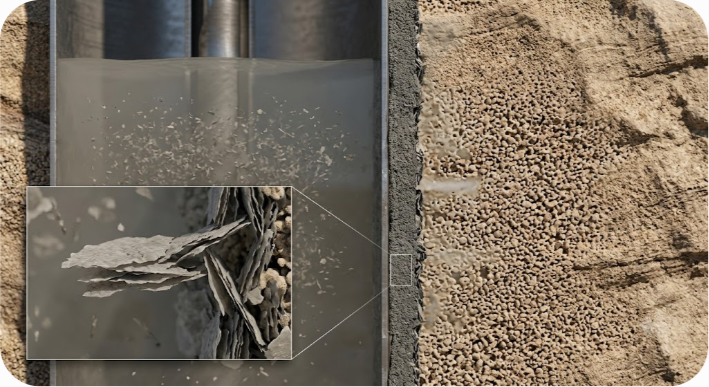
Yes. Sodium bentonite can reduce water loss in water-based drilling mud because its hydrated montmorillonite particles disperse through the fluid and form a thin, low-permeability filter cake against permeable formations. The quality of that filtration control depends on several factors, including clay grade, concentration, water chemistry, hydration, shear, solids control, salinity, temperature, and the use of compatible fluid-loss polymers.
That distinction matters. Adding more bentonite isn't automatically the answer to high filtration loss. A poorly hydrated clay system, contaminated make-up water, excessive drilled solids, or an unsuitable clay grade can produce a thick, weak cake and still give poor fluid-loss results. The goal is a well-dispersed clay system that builds a thin, tough, relatively impermeable cake while maintaining the rheology needed for hole cleaning and suspension.
Water loss, more precisely called fluid loss or filtration loss, is the liquid portion of a drilling fluid that passes from the wellbore into a permeable formation under differential pressure. Some filtrate invasion is normal. The problem starts when the rate becomes high enough to alter formation properties, destabilize the wellbore, or interfere with drilling operations.
Bentonite helps by creating a barrier at the formation face. When sodium bentonite hydrates and disperses, its very fine clay particles are carried toward the permeable surface. They deposit across pore openings and build a filter cake. The cake restricts further movement of the liquid phase without requiring the entire drilling fluid to become excessively viscous.
A good filtration-control system therefore needs to achieve two things at once:
This is why bentonite drilling mud water loss is closely connected to clay quality, dispersion, and mud chemistry rather than to viscosity alone.
Uncontrolled filtrate invasion can create several operational problems, depending on the formation and drilling method.
Fluid-loss control isn't simply a matter of keeping water in the tank. It is part of maintaining a predictable interface between the drilling fluid and the formation.
Bentonite is a clay-rich material dominated by smectite minerals, particularly montmorillonite in drilling-grade products. Montmorillonite has a layered structure with a large surface area and a permanent negative charge on much of the platelet surface. Exchangeable cations, including sodium and calcium, occupy spaces associated with the clay structure and influence how the particles interact with water.
When suitable sodium bentonite is added to fresh water, water enters and hydrates the clay layers. The particles swell and disperse, especially when the system receives adequate mixing energy and the water chemistry is favorable.
As the drilling fluid contacts a permeable formation under pressure, the dispersed clay particles accumulate at the surface. Larger particles can help initiate the deposit, while finer particles fill gaps within the developing cake. The result is a compact layer that offers substantially more resistance to liquid flow than the open formation pores beneath it.
The quality of this cake matters more than simply its thickness. A thick, soft, highly permeable cake can perform worse than a much thinner cake with a dense microstructure.
Montmorillonite gives sodium bentonite much of its usefulness in water-based drilling fluids because it can hydrate, swell, and disperse into very fine particles. Those particles have a high surface area relative to their mass and can form a closely packed deposit.
The exact performance varies between bentonite deposits and commercial grades. Mineral composition, montmorillonite content, particle-size distribution, exchangeable cations, processing, and impurities all affect hydration, yield, rheology, and filtration behavior.
For that reason, a product described simply as "bentonite" isn't enough information when designing a drilling-fluid system. The relevant product specification and laboratory performance should be checked against the drilling application.
Not all bentonite behaves the same way in water. The dominant exchangeable cations influence hydration and dispersion, which in turn affect drilling-fluid performance.
| Property | Sodium-Rich Bentonite | Calcium-Rich Bentonite |
|---|---|---|
| Typical hydration | High in suitable freshwater systems | Lower than sodium-rich clay |
| Dispersion | Greater tendency to disperse | Greater tendency to remain aggregated |
| Swelling | Relatively high | Relatively low |
| Drilling-fluid yield | Generally higher | Generally lower |
| Filter-cake potential | Dense, relatively thin cake when properly formulated | More likely to produce a coarser, more permeable cake |
| Typical drilling use | Water-based drilling fluids, water wells, HDD and related applications | Often used in foundry, civil, pelletizing, and other non-drilling applications |
| Response to hard water | Performance can decline as divalent-ion concentration rises | Less suited to producing a highly dispersed freshwater drilling mud |
Sodium-rich bentonite is generally preferred when the objective is to build a well-dispersed freshwater drilling fluid. Calcium ions tend to compress the electrical double layer around clay particles and promote aggregation. That reduces dispersion and can increase filtration loss.
Calcium bentonite can sometimes be treated with sodium carbonate to improve its behavior in a freshwater system, but treatment isn't a guaranteed substitute for a drilling-grade sodium bentonite. The result depends on the starting clay, water chemistry, treatment level, mixing, and application. For demanding drilling work, selecting an appropriate drilling-fluid-grade product is usually more predictable than trying to convert an unsuitable raw material on site.
API Spec 13A establishes requirements for materials used in oil- and gas-well drilling fluids, including drilling-fluid-grade bentonite. It is important to separate product specification from field mud performance.
An API-compliant bentonite product has to meet the applicable requirements of the specification and test method. That doesn't mean every mud made from that product will automatically achieve a particular fluid-loss value in the field. Water chemistry, concentration, solids loading, temperature, shear history, contamination, and other additives can change the final mud properties substantially.
For purchasing decisions, ask the supplier for the applicable certificate of analysis, product grade, relevant API test results, and recommended application range. A drilling engineer should then evaluate the actual mixed fluid rather than assuming the dry product's specification predicts every field condition.
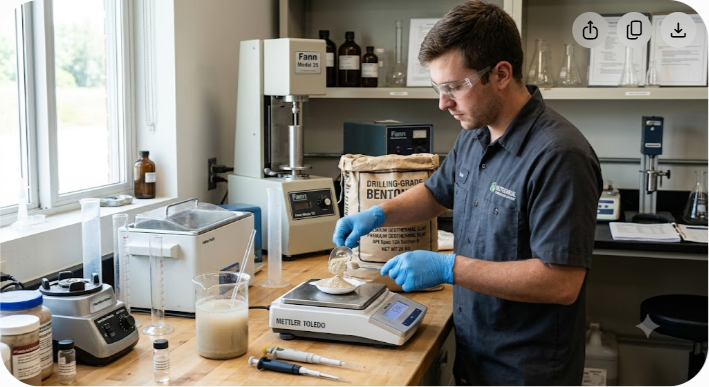
The standard low-pressure, low-temperature filtration test is widely used to evaluate water-based drilling-fluid filtration behavior. API RP 13B-1 provides procedures for testing water-based drilling fluids, including low-pressure filtration measurements.
In a conventional API LPLT test, a mud sample is placed in a filter press and subjected to a controlled pressure differential. Filtrate passing through the filter medium is collected for a specified test period, commonly 30 minutes. The filtrate volume is reported in milliliters, and the resulting filter cake can be examined for thickness and quality.
The reported fluid-loss number should always be interpreted alongside the mud's density, viscosity, gel strengths, solids content, pH, temperature, and other relevant properties. One number rarely tells the whole story.
There is no single API fluid-loss value that is universally "acceptable" for every drilling operation. A freshwater water-well mud, an HDD fluid, and a high-temperature oilfield drilling fluid can have very different performance requirements.
For a simple freshwater bentonite system, an LPLT result in the low-teens milliliters may be workable in some applications, while a demanding formation may require substantially lower filtration loss. Polymer-treated systems can achieve lower values when the formulation, formation, and operating conditions justify the treatment.
Rather than treating 15 mL, 10 mL, or 5 mL as universal pass-fail limits, establish the target from the drilling program and compare laboratory results with actual field performance.
Good fluid-loss control starts before the bentonite enters the mud tank. The following workflow helps avoid common formulation problems.
Water chemistry can determine whether bentonite hydrates properly. Test at least pH and hardness, and check salinity or conductivity when the source water or formation makes contamination possible.
Hard water contains calcium and magnesium ions that can reduce clay dispersion. If treatment is required, soda ash may be used to precipitate calcium as calcium carbonate. The correct dosage should be based on an actual water-hardness measurement rather than a fixed recipe.
A common mistake is to add soda ash by habit. Too much treatment can introduce carbonate problems and alter mud chemistry. Treat the water to the required condition, then verify it with another test.
Choose a product intended for the drilling application and verify its relevant specification and performance data. A high-yield drilling-grade sodium bentonite is generally more efficient than a lower-yield clay when the objective is to build a dispersed drilling-fluid system.
The required concentration depends on the hole size, formation, water chemistry, circulation system, desired rheology, and solids loading. A common freshwater starting range for many bentonite-based drilling fluids is roughly 20 to 35 lb/bbl, but the correct concentration should be established through testing rather than applied as a universal rule.
Feed dry bentonite through suitable mixing equipment at a rate the hopper can disperse. High-shear mixing is useful because it breaks down aggregates and exposes more clay surface to water.
Adding powder too quickly can create partially hydrated lumps. These lumps may look dispersed from a distance but contain dry or poorly hydrated clay inside. That material contributes less to the intended colloidal structure and can make the final mud less predictable.
Bentonite performance develops over time. Mixing energy and hydration time both matter, and the optimum conditioning period depends on the clay, water chemistry, temperature, and equipment.
Don't assume that a mud is fully developed simply because it has passed through the hopper. Condition the slurry, then measure viscosity and filtration rather than relying on elapsed time alone.
A drilling mud can be too thin, too thick, or simply unbalanced. Measure relevant rheological properties alongside API fluid loss and filter-cake characteristics.
High viscosity isn't proof of good filtration control. A fluid overloaded with drilled solids can have high viscosity and still produce an undesirable cake. Conversely, an under-treated bentonite system may have inadequate carrying capacity and filtration control.
The objective is a balanced fluid, not the highest possible viscosity.
When bentonite alone can't meet the filtration target, compatible polymers can improve performance. Common options include PAC and CMC, while other polymers are selected according to temperature, salinity, shale reactivity, and the rest of the fluid program.
PAC is widely used in water-based drilling fluids because it can reduce filtration while contributing to rheology. CMC can also provide fluid-loss control in suitable freshwater systems. PHPA serves different primary functions, particularly shale encapsulation and inhibition, and shouldn't automatically be treated as a direct substitute for a dedicated fluid-loss polymer.
The dosage should be determined by laboratory testing. More polymer isn't necessarily better; excessive treatment can raise viscosity, interfere with solids control, or create other formulation problems.
Even a good sodium bentonite can perform poorly when the surrounding fluid chemistry or solids environment changes.
Increasing salinity compresses the electrical double layer around dispersed clay particles and can reduce their tendency to remain separated. The result can be greater flocculation, altered rheology, and poorer filter-cake structure.
The severity depends on salt concentration, clay concentration, temperature, and the overall fluid formulation. A freshwater bentonite system should not be assumed to retain the same performance after substantial salt contamination.
Gypsum and anhydrite can introduce calcium ions into the drilling fluid. Calcium interacts strongly with clay surfaces and can change the hydration and dispersion behavior of bentonite.
When drilling through calcium-bearing formations, monitor the mud for changes in calcium concentration, pH, rheology, and filtration. Chemical treatment or a different fluid formulation may be needed depending on the severity of contamination.
Temperature affects hydration, rheology, polymer stability, and clay interactions. Bentonite systems that perform well at surface temperature may behave differently at elevated downhole temperatures.
For higher-temperature wells, filtration should be evaluated under representative conditions. HPHT filtration testing and purpose-designed polymers may be necessary when conventional freshwater bentonite systems cannot maintain the required performance.
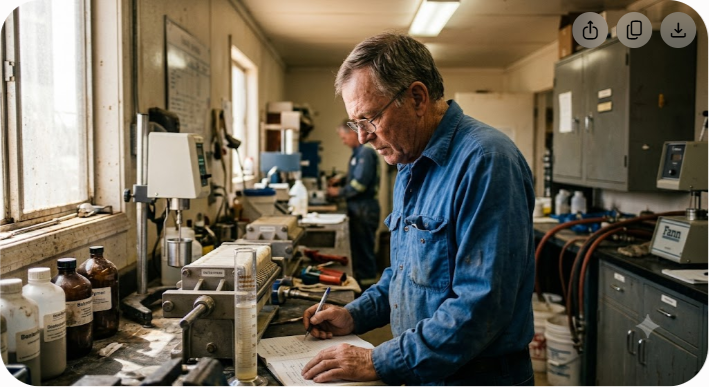
Drilled solids are not the same as bentonite. Fine, inert particles can accumulate during circulation and change both rheology and filter-cake structure.
Effective shale shakers, desanders, desilters, centrifuges, or other solids-control equipment should be selected according to the drilling system. Removing unwanted solids often improves mud performance more effectively than adding another chemical treatment.
The following examples illustrate how formulation decisions affect filtration. They are representative examples, not published field case studies, so the numerical results should not be treated as guaranteed outcomes.
An HDD operation through permeable sand may lose significant fluid because the formation accepts filtrate readily. Suppose the make-up water has high hardness and the initial bentonite slurry produces excessive filtration.
A sensible response would be to test and condition the water, switch to an appropriate drilling-grade sodium bentonite if necessary, improve mixing and hydration, and then retest the mud. If the required filtration target still isn't reached, a compatible PAC or other fluid-loss additive can be evaluated in the laboratory.
The important point is that fluid loss should be attacked at its cause. Simply increasing bentonite concentration can raise viscosity without producing the desired filter-cake improvement.
A water-well contractor may encounter clay or shale that reacts strongly with fresh water. If the mud has inadequate rheology and filtration control, filtrate invasion can contribute to formation softening and hole enlargement.
A properly hydrated sodium bentonite system can improve suspension and help build a filter cake. The driller should then monitor fluid loss, viscosity, sand content, cuttings condition, and hole behavior. If the formation remains unstable, the solution may require more than bentonite; the fluid chemistry and drilling parameters may need to change as well.
These examples show why a drilling-fluid program should be treated as a system. Bentonite is an important component, but it isn't a universal cure for every source of fluid loss.
Hardness and salinity can change clay behavior before the mud reaches the formation. Test the water first and treat it when the chemistry calls for treatment.
Viscosity and fluid loss measure different aspects of mud behavior. A high-viscosity fluid can still produce excessive filtrate, while a well-designed low-viscosity fluid can provide effective filtration control.
Mineralogy, processing, yield, particle-size distribution, and product quality vary. Compare technical data and test the actual product in the water you intend to use.
Drilled solids accumulate during circulation and can change the mud faster than a routine bentonite addition can correct it. Monitor solids content and keep separation equipment properly adjusted.
An extremely low filtration number isn't automatically the best outcome. If achieving it requires excessive polymer, creates unacceptable viscosity, or compromises other properties, the formulation may be worse overall.
These three properties are related, but they aren't interchangeable.
| Mud property | What it tells you | Why it matters |
|---|---|---|
| Viscosity | Resistance to flow | Affects hole cleaning, suspension, pump pressure, and hydraulics |
| Fluid loss | Volume of filtrate passing through the test medium | Indicates filtration behavior under the test conditions |
| Filter-cake thickness | Amount of deposited solids | Helps assess cake buildup and potential sticking risk |
| Filter-cake quality | Texture, firmness, and permeability | Indicates how effectively the cake restricts filtrate movement |
| Solids content | Amount and type of suspended solids | Strongly affects rheology and cake structure |
A good drilling-fluid program monitors all of these properties together. If fluid loss rises while viscosity also climbs, for example, the problem may be an increase in fine drilled solids rather than a shortage of bentonite.
Yield is a practical way to think about how much useful drilling-fluid volume a given quantity of bentonite can produce at a specified apparent viscosity under a defined test method. Higher-yield bentonite can provide the desired colloidal structure with less dry clay than a lower-yield material.
However, drilling fluid yield API should not be confused with a guarantee of low field fluid loss. API test performance describes the product under standardized conditions. The finished mud still has to be evaluated in the actual water and operating environment.
To improve field performance:
This approach is more reliable than following a fixed bentonite dosage for every hole.
Yes. Properly hydrated sodium bentonite can reduce fluid loss by dispersing into fine montmorillonite particles that deposit on permeable formation surfaces and form a low-permeability filter cake. The actual reduction depends on clay quality, concentration, water chemistry, solids content, temperature, and other additives. Bentonite alone may not meet filtration targets in every formation or drilling environment.
Sodium-rich bentonite generally hydrates, swells, and disperses more readily in freshwater than calcium-rich bentonite. That makes it better suited to building the fine, compact particle structure required for many water-based drilling fluids. Calcium contamination can reduce dispersion and change rheology and filtration. Actual performance still depends on mineralogy, water chemistry, concentration, and conditioning.
There is no single fluid-loss value that applies to every bentonite drilling mud. The appropriate target depends on the formation, drilling method, temperature, fluid type, and operational objectives. Many freshwater systems operate satisfactorily in the low-teens milliliter range under LPLT testing, while demanding applications may require lower values through optimized formulation or polymer treatment.
Hard water contains calcium and magnesium ions that can interfere with bentonite hydration and dispersion. Calcium is particularly important because it can promote clay aggregation and alter filtration behavior. Water treatment with soda ash is commonly used when hardness needs to be reduced, but the dosage should be based on measured water chemistry. Always verify the treated water before mixing the full mud system.
PAC and CMC are commonly used fluid-loss-control polymers in suitable water-based drilling fluids. They can improve the structure of the filter cake and reduce filtrate volume. Other polymers may be selected for specific salinity, temperature, shale-inhibition, or rheology requirements. The best additive and dosage depend on the complete mud formulation, so laboratory testing is preferable to applying a fixed treatment rate.
A useful filter cake should generally be thin, firm, and low in permeability rather than simply as thin as possible. The appropriate thickness depends on the fluid and test method, and there is no universal 1.0 to 1.5 mm requirement for every drilling system. Evaluate cake thickness together with filtrate volume, cake texture, permeability, differential pressure, and the operational risk of sticking.
Bentonite can be an effective tool for controlling water loss in water-based drilling mud, but its performance depends on how the entire fluid system is designed and maintained.
The key points are straightforward:
For drilling-fluid manufacturers, contractors, and distributors, product consistency matters just as much as the nominal bentonite grade. A reliable drilling-grade sodium bentonite should be evaluated using recognized specifications and then tested in the actual make-up water and formulation planned for the job.
Axewelledge supplies sodium bentonite for drilling, water-well, HDD, and related industrial applications. Product selection should be based on the required specification, mineral characteristics, test data, and the conditions of the intended drilling program. Technical documentation and representative samples can help drilling teams evaluate whether a particular grade is suitable before committing to a full-scale application.













Have questions about our products? We're here to help!