Axewelledge, a leading exporter from India, specializes in high-quality Bentonite. With a commitment to excellence, we supply premium Bentonite to the Middle East and Southeast Asia markets.


North Angle Complex, 304,
150 Feet Ring Rd, Opposite Ambedkar Nagar BRTS Stop,
Madhav Park, Punit Nagar,
Mavdi, Rajkot, Gujarat 360004
© Axewelledge 2026, All Rights Reserved.
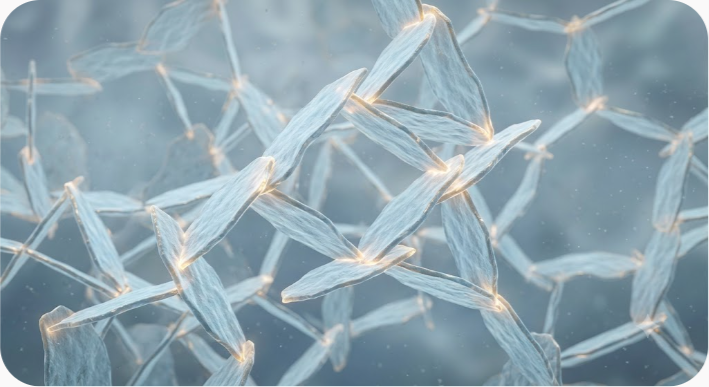
Bentonite can do something that many simple thickeners cannot: it can give a formulation structure at rest while still allowing it to flow when stirred, pumped, brushed, sprayed, or otherwise subjected to shear. That combination makes bentonite useful as a rheology modifier in water-based coatings, drilling fluids, agricultural suspensions, adhesives, sealants, and other industrial systems.
The key is not simply that bentonite absorbs water. Its rheological effect comes from the interaction of hydrated smectite platelets, their surface charges, the chemistry of the surrounding liquid, and the way the clay is dispersed. When conditions are suitable, these platelets form a reversible three-dimensional network that increases low-shear viscosity and yield stress. Under shear, the network partially breaks down, allowing the material to flow more easily. When shear is removed, the structure can rebuild.
That behavior is commonly described as thixotropy, although the exact flow curve and recovery profile depend on the clay grade and the rest of the formulation. The practical benefit is straightforward: a well-selected bentonite can help keep solids suspended during storage, reduce sagging after application, provide useful gel strength, and maintain manageable viscosity during processing.
Rheology is the study of how a material flows and deforms when a force is applied. For industrial formulations, rheology affects far more than how thick a product feels in a container. It influences pumping, mixing, filling, spraying, brushing, extrusion, sedimentation, leveling, sag resistance, and storage stability.
A rheology modifier is an ingredient used to change those flow properties. Depending on the application, the formulator may want to increase viscosity, introduce yield stress, create shear thinning, control thixotropic recovery, or improve suspension stability.
Two properties are particularly important when evaluating bentonite.
Viscosity describes a material's resistance to flow under a specified shear condition. It is not a single fixed number for a non-Newtonian formulation because viscosity can change as the applied shear rate changes.
Yield stress is the stress required to initiate significant flow in a structured material. A useful yield stress can help keep pigments, mineral fillers, active ingredients, or drilling cuttings suspended while the formulation is at rest.
A good rheology system balances storage stability with application performance. Excessive low-shear viscosity can make a product difficult to pour or pump. Too little structure can result in settling, sagging, or separation. Bentonite is valuable because its platelet network can provide strong low-shear structure without requiring the same viscosity at higher shear rates.
The short answer is that hydrated bentonite platelets interact to create a temporary three-dimensional network in a suitable liquid medium. The network increases viscosity and yield stress when the formulation is at rest or under low shear. Applied shear disrupts the network and reduces resistance to flow. Once the shear is removed, the structure can rebuild over time.
This behavior starts with the mineral itself. Most commercial bentonites used for rheology control contain a substantial proportion of montmorillonite, a member of the smectite group of clay minerals. Montmorillonite has a layered structure with a high surface area and the ability to interact strongly with water or, after chemical modification, with selected organic liquids.
The mineral grade matters. Montmorillonite content, exchangeable cations, particle-size distribution, impurities, moisture, pH, ionic strength, and processing history can all affect the final rheology. Two bentonites sold under the same broad mineral name can therefore produce noticeably different results in the same formulation.
Montmorillonite is a 2:1 phyllosilicate. Each basic mineral layer consists of an octahedral sheet positioned between two tetrahedral sheets. Substitution of certain atoms within this crystal lattice creates a net negative charge on the platelet surfaces. Exchangeable cations occupy the interlayer region and help balance that charge.
When the clay is placed in water, those exchangeable ions and the mineral surfaces interact with water molecules. Sodium-dominant bentonite generally hydrates and swells more extensively than calcium-dominant bentonite, although actual performance depends on mineral composition and processing.
The individual platelets are extremely small, and their large surface area relative to their mass gives them considerable influence over the surrounding liquid. Once sufficiently hydrated and dispersed, the platelets can interact with one another throughout the continuous phase.
A useful way to understand bentonite gel formation is to distinguish between the broad faces and the edges of the clay platelets.
The broad platelet faces carry a predominantly negative surface charge. The charge at platelet edges is more dependent on surface chemistry and pH. Under some conditions, edge sites can develop a positive character relative to the faces.
These differences allow attractive and repulsive interactions between nearby particles. In a dispersed system, the result can be a loose network in which platelets associate in configurations often described as a "house-of-cards" structure.
The term is a simplified model rather than a literal description of every bentonite dispersion. Real systems can contain face-to-face associations, edge-to-face interactions, tactoids, and other particle arrangements. Still, the house-of-cards model is useful for explaining why a dispersed smectite clay can create structure without becoming a permanent solid.
The rheological effect of bentonite develops through several overlapping physical and chemical processes rather than a single reaction.
Dry bentonite first needs to become thoroughly wetted. Water enters the spaces associated with the exchangeable cations and interacts with the hydrophilic mineral surfaces. Sodium-dominant bentonite can undergo substantial hydration and swelling as this process progresses.
The amount of swelling varies with mineralogy, exchangeable cations, electrolyte concentration, pH, temperature, particle size, and the amount of available water. It is therefore better to treat published swelling values as grade-specific performance data rather than as a universal property of all bentonite.
Hydration alone does not guarantee an efficient rheological system. Clay particles can remain as partially hydrated aggregates or tactoids if the powder is poorly wetted or insufficiently dispersed.
Mixing supplies the mechanical energy needed to distribute hydrated clay throughout the liquid. Depending on the grade and formulation, the hydrated aggregates can progressively separate into smaller units and platelets.
This is one reason processing order matters. If the clay is introduced after large amounts of salt, pigment, resin, surfactant, or another competing ingredient have already been added, the final structure may be weaker than expected.
When the dispersion reaches a suitable state and shear decreases, the clay platelets interact and form a connected structure throughout the liquid. The network restricts particle movement and increases resistance to flow.
This structure is responsible for much of bentonite's low-shear yield stress. It can also reduce the rate at which dense particles move downward through the formulation.
The network does not necessarily immobilize the entire liquid permanently. It is a dynamic structure. Its strength and recovery rate depend on clay concentration, particle interactions, electrolyte concentration, pH, temperature, and other formulation variables.
When the formulation is stirred, pumped, brushed, rolled, sprayed, or extruded, the applied shear disrupts part of the clay network. The platelets become more oriented with the flow, and the apparent viscosity falls.
This is the practical reason bentonite can provide both structure and processability. A formulation may be relatively firm at rest but easier to move when mechanical energy is applied.
After shear decreases, particle interactions begin to rebuild the network. Recovery can occur over a range of timescales rather than at one fixed rate.
For a coating, fast recovery can help resist sag shortly after application. For a sprayable suspension, slower recovery may provide better atomization and leveling. The correct recovery profile is therefore application-specific. More thixotropy is not automatically better.
The choice between sodium and calcium bentonite is important because exchangeable cations influence hydration, swelling, dispersion, and gel development.
| Property | Sodium-Dominant Bentonite | Calcium-Dominant Bentonite |
|---|---|---|
| Water hydration | Generally high | Generally lower |
| Swelling | Generally greater | Generally lower |
| Colloidal dispersion | Often favorable for aqueous gel formation | Typically less extensive |
| Gel strength | Often higher in suitable water systems | Often lower |
| Common rheology use | Drilling fluids, water-based coatings, suspensions | Selected foundry, construction, absorbent, and other applications |
| Formulation sensitivity | Sensitive to salts, pH, and water chemistry | Also sensitive to water chemistry and mineral composition |
Sodium bentonite is often preferred when the objective is strong hydration and colloidal structure in water. Calcium bentonite can still be useful, but it should not be treated as a direct substitute when the formulation depends on high swelling or gel strength.
In some applications, calcium bentonite can also be chemically modified or blended to change its performance. The correct decision should come from application testing rather than mineral name alone.
Natural hydrophilic bentonite is well suited to water-rich systems because its mineral surfaces readily interact with water. It is not, however, a universal thickener for organic solvents.
For non-polar or low-polarity systems, processors can modify smectite clay with organic cations to produce organophilic clay, commonly called organoclay. The treatment changes the surface chemistry so that the modified clay can interact with organic liquids and selected resin systems.
| Property | Hydrophilic Bentonite | Organoclay |
|---|---|---|
| Surface character | Water-compatible | Organically modified |
| Typical continuous phase | Water and selected polar media | Oils, hydrocarbons, resins, and other organic systems |
| Main activation mechanism | Hydration and dispersion | Organic solvation and, for conventional grades, activation |
| Typical applications | Water-based coatings, drilling fluids, suspensions | Solvent-borne coatings, greases, sealants, adhesives |
| Processing priorities | Wetting, hydration, shear, water chemistry | Dispersion, activation, solvent compatibility |
Conventional organoclays are often activated with a suitable polar additive to develop their full rheological effect. The exact activator and dosage are grade-specific. A formulation should therefore follow the clay supplier's technical data rather than applying one universal activation ratio to every organoclay.
Bentonite can influence several aspects of flow behavior at the same time. The relative contribution of each property depends on the formulation and test method.
At rest, a well-dispersed bentonite system can develop a three-dimensional particle network. That structure increases low-shear viscosity and can create measurable yield stress.
For coatings and suspensions, this can help prevent pigments or mineral particles from settling. In drilling fluids, the structure contributes to the ability of the mud to suspend cuttings when circulation stops.
The target is not simply maximum viscosity. Excessive structure can create poor flow, difficult pumping, poor leveling, or an undesirable application feel. Formulators should specify a rheological profile rather than a single viscosity number whenever possible.
Many bentonite dispersions show shear-thinning behavior: their apparent viscosity decreases as shear rate increases. This can make a structured formulation easier to pump or apply than its low-shear viscosity would suggest.
A useful example is a water-based coating. In the container, the clay network helps maintain suspension. During brushing or rolling, the applied shear lowers the apparent viscosity and allows the coating to spread. After application, the structure begins to recover and contributes to sag resistance.
The actual viscosity at each shear rate depends heavily on clay grade and concentration. Values such as 10,000 or 100,000 centipoise should not be treated as universal benchmarks for bentonite because viscosity measurements are meaningful only when the test conditions, instrument, temperature, shear history, and formulation are specified.
Thixotropy describes time-dependent structural breakdown under sustained shear followed by structural recovery when the shear is reduced or removed. Bentonite dispersions can show pronounced thixotropic behavior because the particle network is reversible.
A thixotropic index is sometimes calculated from viscosity measurements at selected shear rates. However, there is no single universal test that captures every aspect of a bentonite system. Recovery tests, flow curves, oscillatory measurements, and application-specific tests can provide a more complete picture.
Gel strength is especially important in drilling fluids and other systems that must suspend solids while stationary. A stronger gel can provide better suspension, but excessive gel strength may increase the pressure needed to restart circulation or move the fluid.
The objective is therefore a controlled gel structure, not the highest possible value. In drilling applications, gel-strength measurements should be considered alongside plastic viscosity, yield point, fluid loss, density, solids content, and other mud properties.
Poor dispersion is one of the most common reasons a bentonite grade fails to deliver its expected rheological performance. Adding dry powder directly to a complex finished formulation can create partially hydrated lumps that remain difficult to break down.
A more reliable approach is to establish the clay dispersion under controlled conditions before introducing ingredients that interfere with hydration or particle interactions.
Start with the appropriate carrier liquid and ensure that it is compatible with the selected bentonite grade. For aqueous systems, water quality deserves attention. High concentrations of dissolved salts can compress the electrical double layer around clay particles and reduce swelling or alter the resulting network.
Where possible, use a controlled water source during development so that changes in clay performance can be distinguished from changes in water chemistry.
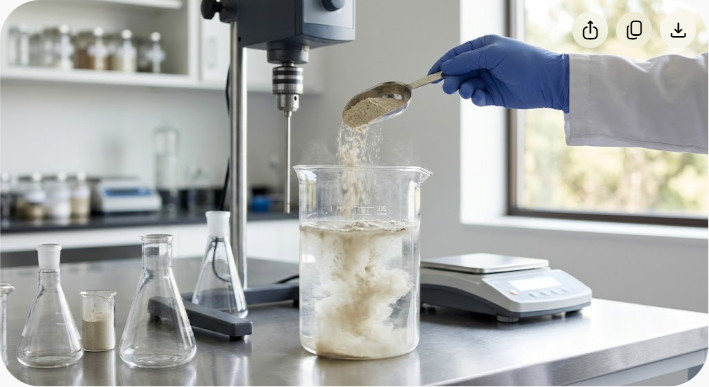
Introduce the bentonite gradually under sufficient agitation to prevent dry powder from forming persistent lumps. The objective is complete wetting rather than simply distributing visible powder throughout the tank.
A pre-gel can be useful when the final formulation contains pigments, polymers, surfactants, or salts that may interfere with hydration. The appropriate clay concentration for a pre-gel depends on the grade and equipment.
Use mixing equipment capable of providing the shear required by the selected grade. High-speed dispersers, rotor-stator mixers, and other equipment can be appropriate depending on batch size and formulation.
There is no universal mixing time or tip speed that guarantees complete dispersion. A fixed number such as 15 or 20 minutes should therefore be treated as a starting point for development, not a specification that applies to every production system.
Evaluate the dispersion by measuring viscosity, observing for undispersed particles, and comparing the result with a controlled laboratory sample. The process should be scaled based on energy input, equipment geometry, temperature, and batch characteristics rather than mixing time alone.
Once the bentonite has developed the intended dispersion, add the remaining formulation components according to their compatibility and processing requirements. Pigments, fillers, polymers, surfactants, electrolytes, and active ingredients can all change the final rheology.
If a formulation requires an organoclay, follow the supplier's recommended dispersion and activation sequence. Some organoclays are designed for particular solvents or require a specific polar activator, while others have been engineered to activate more easily.
Do not judge success from one viscosity reading. Measure the properties that matter for the end use.
A useful evaluation may include:
This approach makes it easier to distinguish a true rheology problem from a dispersion problem, compatibility problem, or process-order problem.
Bentonite and other smectite clays can be useful rheology modifiers in water-based paints, primers, coatings, and pigment dispersions. Their main contribution is often low-shear structure rather than simply increasing viscosity across the entire shear range.
In a paint can, the clay network can help keep dense pigments and fillers suspended. During brushing or rolling, shear reduces the apparent viscosity and makes application easier. After the coating is deposited, structural recovery can contribute to resistance against sagging.
However, bentonite can also affect gloss, transparency, flow, leveling, and application feel. A grade that provides excellent anti-settling may not be the best choice when a high-gloss finish and very smooth leveling are the main priorities.
Formulators should test bentonite alongside the binder, pigment volume concentration, dispersant package, defoamer, surfactant system, and other rheology modifiers. Clay performance cannot be separated completely from the rest of the coating chemistry.
Drilling fluids are one of the clearest examples of why bentonite rheology matters. A drilling mud needs enough structure to transport cuttings and maintain solids suspension, but it must also remain pumpable through the circulation system.
During active circulation, shear reduces the apparent viscosity of the structured fluid and helps it move through the drill string and annulus. When circulation stops, the clay network can rebuild and help keep suspended solids from settling rapidly.
The target properties depend on the drilling environment. Mud density, temperature, salinity, formation chemistry, polymer additives, filtration control, solids loading, and bentonite grade all affect rheology.
This is why bentonite selection for drilling should be based on the applicable specification and laboratory mud testing rather than on free-swell performance alone. API requirements, when applicable, should be checked against the current edition of the relevant standard and the intended drilling-fluid application.
Suspension concentrates and other agricultural formulations may contain insoluble active ingredients that tend to settle during storage. A suitable smectite clay can provide low-shear structure that slows sedimentation while still allowing the formulation to flow through application equipment.
The challenge is to maintain suspension without making the concentrate so structured that it becomes difficult to redisperse, pump, dilute, or spray.
Clay concentration, particle size, electrolyte level, surfactant selection, active ingredient properties, and storage temperature all matter. A formulation that looks stable after one day may behave differently after weeks of storage, so accelerated and real-time stability testing are important during development.
Bentonite and organoclays can provide useful structure in selected adhesive and sealant systems. The desired result is often a material that stays in place after application but can still be dispensed under pressure.
In solvent-borne or oil-rich systems, organoclay can contribute thixotropy and anti-sag behavior. In water-based systems, hydrophilic smectite grades may provide suspension and low-shear structure.
Compatibility with the binder is critical. Clay can interact with dispersants, resins, plasticizers, fillers, and other additives, so the same organoclay grade may perform differently in two resin systems.
Bentonite is not automatically a replacement for synthetic polymers. Each rheology modifier has strengths, and many commercial formulations use more than one modifier to achieve a specific flow profile.
| Modifier | Main Rheological Mechanism | Typical Strength | Common Limitation |
|---|---|---|---|
| Bentonite and smectite clay | Reversible particle network | Low-shear structure, yield stress, suspension | Sensitive to water chemistry and dispersion conditions |
| Cellulosic polymers | Polymer-chain thickening | Water-phase viscosity and flow control | Can affect application feel and may be sensitive to formulation conditions |
| Associative acrylic thickeners | Hydrophobic association | Flow, leveling, and viscosity control | Performance can change with pH, surfactants, and binder chemistry |
| Fumed silica | Particle network and surface interactions | Strong anti-sag and thixotropy | Can create high viscosity and requires careful dispersion |
| Castor-oil derivatives | Crystalline or associative structure | Thixotropy in selected non-polar systems | Application and temperature range depend on grade |
The right comparison is therefore not simply "natural versus synthetic." It is about the rheological profile required by the product.
Bentonite often performs particularly well when low-shear structure and suspension are more important than uniform viscosity throughout the shear range. A polymer may be preferable when the formulation needs precise high-shear flow control or specific leveling characteristics.
Possible causes include incomplete wetting, inadequate dispersion, low montmorillonite content, excessive electrolyte concentration, incompatible additives, or an unsuitable clay grade.
Start by checking the dispersion process and water chemistry before simply increasing the dosage. A higher clay concentration cannot always compensate for poor hydration, and overdosing can create unwanted application problems.
This can indicate incomplete hydration or slow structural development. If the formulation continues to change after manufacture, review the wetting sequence, mixing energy, clay grade, temperature, and time allowed for hydration before final adjustment.
It is also worth checking whether another ingredient is changing the clay's environment during storage. Polymer hydration, pH drift, and interactions with salts or surfactants can contribute to apparent viscosity changes.
High viscosity alone does not guarantee suspension stability. A formulation can have acceptable bulk viscosity while still allowing dense particles to settle if its low-shear yield stress is insufficient.
Measure the rheology at conditions relevant to storage and examine the sediment after controlled aging. The solution may involve changing the clay grade, adjusting the concentration, or combining bentonite with another rheology modifier rather than simply raising total viscosity.
Excessive clay dosage, overly strong network formation, or an unsuitable recovery profile can make the formulation difficult to process.
Reduce the clay concentration in controlled trials, examine the flow curve, and test whether a complementary rheology modifier can provide the required high-shear behavior. Avoid adjusting the formulation solely from a single Brookfield viscosity measurement if the product is strongly non-Newtonian.
Sag resistance and leveling are competing requirements. Increasing bentonite may improve low-shear structure while reducing flow and leveling.
The better approach is to identify the required balance and then tune the clay grade, concentration, and complementary rheology package. Application tests on vertical and horizontal panels are often more informative than viscosity measurements alone.
Check solvent compatibility, dispersion quality, activator selection, activator dosage, and the order in which ingredients were added. Conventional organoclay grades can require activation, while easier-to-disperse grades may follow a different process.
Always start with the manufacturer's recommended procedure and then optimize it through controlled formulation trials.
Bentonite performance is highly formulation-dependent. The most important variables include:
Montmorillonite content, exchangeable cations, accessory minerals, particle size, and processing history can all affect viscosity and gel development.
More clay generally produces more structure, but the relationship is not linear across all concentrations. Once a connected network forms, relatively small changes in solids concentration can have a large effect on low-shear behavior.
Dissolved salts can significantly influence smectite swelling and particle interactions. Hard water, high ionic strength, and multivalent ions can reduce the effectiveness of some sodium bentonite dispersions.
Surface charge and edge chemistry vary with pH. Changes in pH can therefore alter particle interactions and the resulting network structure.
Temperature affects hydration, viscosity, particle interactions, and the rheology of the entire formulation. Testing should be performed at temperatures representative of manufacturing, storage, transport, and application.
The same formulation can produce different results depending on how it was mixed. Shear rate, energy input, batch geometry, temperature, addition sequence, and mixing time all influence dispersion.
A good selection process starts with the required end-use properties rather than the clay name.
Supplier quality can have a direct effect on formulation consistency. Before purchasing a bulk rheology-grade bentonite, ask for technical information that matches the intended application.
Useful documentation may include:
For drilling applications, confirm whether the product is supplied to the applicable API specification and whether the specific grade is appropriate for the intended mud system. For coatings, adhesives, agricultural products, or other specialized formulations, application-specific laboratory testing remains essential.
For industrial formulators, the useful question is not simply whether a supplier sells sodium bentonite. The important question is whether the supplied grade has the mineral characteristics, consistency, particle size, moisture level, and processing support required for the application.
Axewelledge can be evaluated as a bentonite supplier for applications where controlled rheology, swelling, suspension, or gel formation are required. When assessing any supplier, request current technical data, a representative sample, a certificate of analysis, and application-specific recommendations before committing to production volumes.
For demanding formulations, a technical trial is usually more valuable than a generic product description. Compare candidate grades under the same water quality, mixing conditions, clay concentration, temperature, and formulation composition. That makes it easier to identify whether differences come from the mineral grade or from the process.
Bentonite works as a rheology modifier because hydrated smectite platelets can form a reversible particle network in a compatible liquid. That network provides low-shear structure and yield stress, while applied shear reduces the apparent viscosity and makes the formulation easier to move.
The most important points are:
A well-designed bentonite system should make the product stable when it needs to be stable and mobile when it needs to flow. That balance is the real value of bentonite rheology modification.
Bentonite contains smectite minerals whose hydrated platelets can interact to form a reversible three-dimensional network. That structure increases low-shear viscosity and yield stress, helping suspend solids and resist sagging. When shear is applied, the network is disrupted and the apparent viscosity falls. After shear decreases, the structure can rebuild, producing useful thixotropic behavior.
Sodium-dominant bentonite generally hydrates, swells, and disperses more extensively in water than calcium-dominant bentonite. That often makes it the preferred choice when strong aqueous gel formation and suspension are required. Calcium bentonite can still be useful in specific formulations, but it should not be assumed to provide the same swelling or rheological response.
Organophilic bentonite, or organoclay, is produced by modifying smectite clay with organic cations. The treatment changes the clay surface so it can interact with selected organic liquids and resin systems. Conventional organoclays may also require a polar activator to develop their intended gel structure. The correct solvent, activator, and processing conditions are grade-specific.
High shear helps wet, disperse, and break down hydrated clay aggregates so the smectite platelets can participate effectively in the continuous liquid phase. Poor dispersion leaves agglomerates that contribute less to the intended rheological network. However, there is no universal mixing speed or time; the required conditions depend on the clay grade, equipment, formulation, and batch size.
Yes. Bentonite can be combined with cellulosic, associative, acrylic, or other rheology modifiers when the formulation requires a broader flow profile. Bentonite can provide low-shear structure and suspension, while an organic thickener may improve high-shear viscosity, leveling, or application feel. Compatibility testing is important because polymers, surfactants, salts, and binders can change clay performance.













Have questions about our products? We're here to help!