Axewelledge, a leading exporter from India, specializes in high-quality Bentonite. With a commitment to excellence, we supply premium Bentonite to the Middle East and Southeast Asia markets.


North Angle Complex, 304,
150 Feet Ring Rd, Opposite Ambedkar Nagar BRTS Stop,
Madhav Park, Punit Nagar,
Mavdi, Rajkot, Gujarat 360004
© Axewelledge 2026, All Rights Reserved.
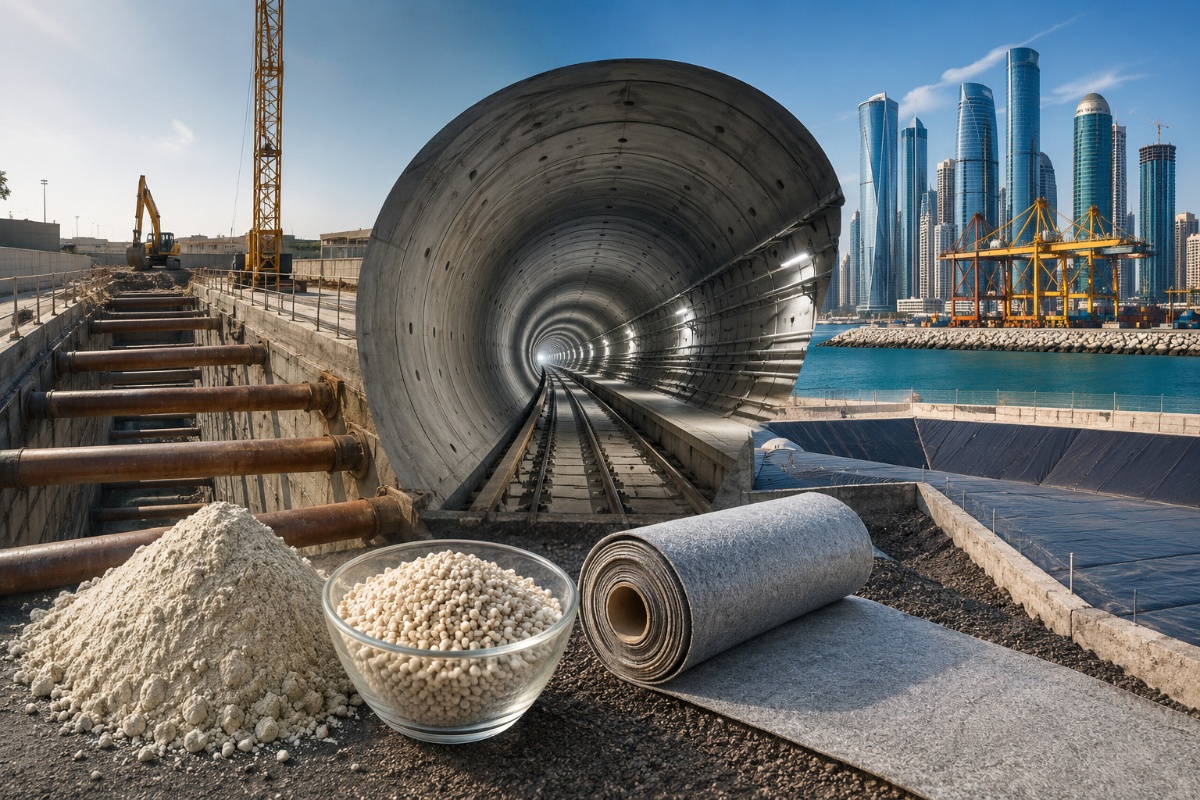
The Gulf Cooperation Council (GCC) region is experiencing one of the world's largest infrastructure development booms. Countries such as Saudi Arabia, United Arab Emirates, Qatar, Oman, Kuwait, and Bahrain are investing billions of dollars in mega infrastructure projects, including highways, tunnels, metros, airports, ports, water treatment facilities, industrial zones, and smart cities.
However, the Gulf region presents unique engineering challenges. Extreme temperatures, coastal environments, saline groundwater, desert soils, and high water tables demand specialized construction materials capable of delivering long-term durability and protection. Among the most trusted materials used for sealing, waterproofing, and geotechnical applications is bentonite.
Bentonite has become a critical component in modern infrastructure projects because of its exceptional swelling capacity, low permeability, self-sealing properties, and environmental compatibility. These characteristics make it ideal for waterproofing foundations, tunnel linings, diaphragm walls, containment barriers, reservoirs, and transportation infrastructure. Bentonite-based sealing systems are widely used throughout GCC projects to improve structural longevity and reduce maintenance costs.
At Axewelledge, we supply premium-quality Indian bentonite solutions suitable for infrastructure, construction, and waterproofing applications across the Gulf region.
Bentonite is a naturally occurring clay primarily composed of montmorillonite minerals. When exposed to water, bentonite absorbs moisture and expands significantly, creating a dense impermeable barrier.
This swelling behavior provides several engineering advantages:
When hydrated, bentonite fills voids and cracks, preventing water migration through soil or concrete structures. This characteristic makes it one of the most effective natural sealing materials available today.
Infrastructure projects across the Gulf face several environmental and engineering challenges.
Many coastal cities such as:
have construction zones affected by groundwater intrusion. Underground structures require robust waterproofing systems to prevent leakage and structural deterioration.
High salt concentrations accelerate corrosion of reinforcement steel and degrade conventional sealing materials.
Temperatures frequently exceed 50°C, causing thermal expansion and contraction in structures, which can create cracks and leakage pathways.
Mega projects demand materials that provide:
Bentonite sealing systems satisfy all these requirements.
Modern metro and transportation tunnels require advanced waterproofing solutions to prevent groundwater infiltration.
Bentonite is commonly used in:
When water reaches bentonite waterstops, the material swells and seals gaps automatically. This reduces leakage and protects tunnel integrity for decades.
Diaphragm walls are extensively used in:
Bentonite slurry stabilizes trench walls during excavation and prevents collapse before concrete placement.
Benefits include:
This method is widely adopted in large-scale Gulf developments.
One of the most advanced bentonite sealing technologies is the Geosynthetic Clay Liner (GCL).
A GCL consists of:
When hydrated, the bentonite forms an impermeable barrier capable of preventing water migration. GCL systems are frequently used in:
These liners provide superior performance while requiring less installation space than traditional compacted clay layers.
Foundation waterproofing remains one of the largest uses of bentonite in Gulf construction.
Bentonite panels and membranes are installed around:
Benefits include:
This approach is particularly valuable in coastal GCC cities where groundwater exposure is constant.
Cutoff walls are constructed to control groundwater movement and create underground barriers.
Applications include:
Cement-bentonite mixtures create low-permeability walls capable of preventing seepage and protecting adjacent structures.
Water conservation is critical throughout the GCC.
Bentonite-based sealing systems help:
Common applications include:
Geosynthetic clay liners are increasingly preferred for these projects due to their reliability and ease of installation.
Airports and transportation facilities require advanced groundwater management systems.
Bentonite solutions are used for:
These applications help maintain structural integrity while preventing water-related deterioration.
The GCC region relies heavily on ports and marine logistics facilities.
Marine projects face challenges such as:
Bentonite sealing systems assist in:
These systems offer durable protection even in aggressive environments.
Bentonite forms an impermeable barrier when hydrated, effectively preventing water infiltration into structures.
Unlike many synthetic materials, bentonite can automatically reseal minor cracks and punctures.
Infrastructure owners benefit from:
Bentonite is a naturally occurring mineral with minimal environmental impact.
Suitable for:
Properly designed bentonite systems can perform effectively for decades.
Not all bentonite products are suitable for infrastructure applications.
Selection should consider:
Higher swelling generally improves sealing performance.
Different projects require specific hydraulic conductivity values.
Saline groundwater may require specially modified bentonite formulations. Standard bentonite can experience reduced swelling in highly saline conditions.
The bentonite form may vary:
Always verify compliance with:
India is one of the world's leading bentonite producers.
Regions such as:
contain extensive high-quality bentonite reserves.
Advantages of Indian bentonite include:
These factors have made Indian bentonite a preferred choice for contractors and infrastructure developers across the Gulf.
At Axewelledge, we understand the demanding requirements of modern GCC infrastructure projects.
Our bentonite solutions are suitable for:
We provide:
Strict quality control ensures dependable performance.
Products tailored to project requirements.
Efficient logistics and documentation for GCC imports.
Guidance on product selection and application.
Timely delivery for large-scale infrastructure developments.
The future of bentonite sealing solutions in the GCC is highly promising.
Major regional developments continue to create demand for:
As sustainability and long-term durability become increasingly important, bentonite-based sealing systems will continue to play a critical role in protecting infrastructure assets.
Advanced geosynthetic clay liners, engineered bentonite composites, and innovative waterproofing technologies are expected to expand the use of bentonite across the region in the coming years.
Bentonite has become an indispensable material in Gulf infrastructure development. Its exceptional sealing properties, self-healing capability, low permeability, and environmental compatibility make it one of the most effective solutions for waterproofing and groundwater control.
From tunnels and metro systems to ports, airports, reservoirs, and high-rise foundations, bentonite sealing technologies help protect critical infrastructure against the harsh environmental conditions of the GCC region.
As infrastructure investments continue to grow across the Gulf, demand for high-quality bentonite solutions will remain strong. Companies seeking reliable bentonite products for major infrastructure projects can benefit from partnering with experienced suppliers like Axewelledge, ensuring consistent quality, technical expertise, and dependable international supply.













Have questions about our products? We're here to help!