Axewelledge, a leading exporter from India, specializes in high-quality Bentonite. With a commitment to excellence, we supply premium Bentonite to the Middle East and Southeast Asia markets.


North Angle Complex, 304,
150 Feet Ring Rd, Opposite Ambedkar Nagar BRTS Stop,
Madhav Park, Punit Nagar,
Mavdi, Rajkot, Gujarat 360004
© Axewelledge 2026, All Rights Reserved.
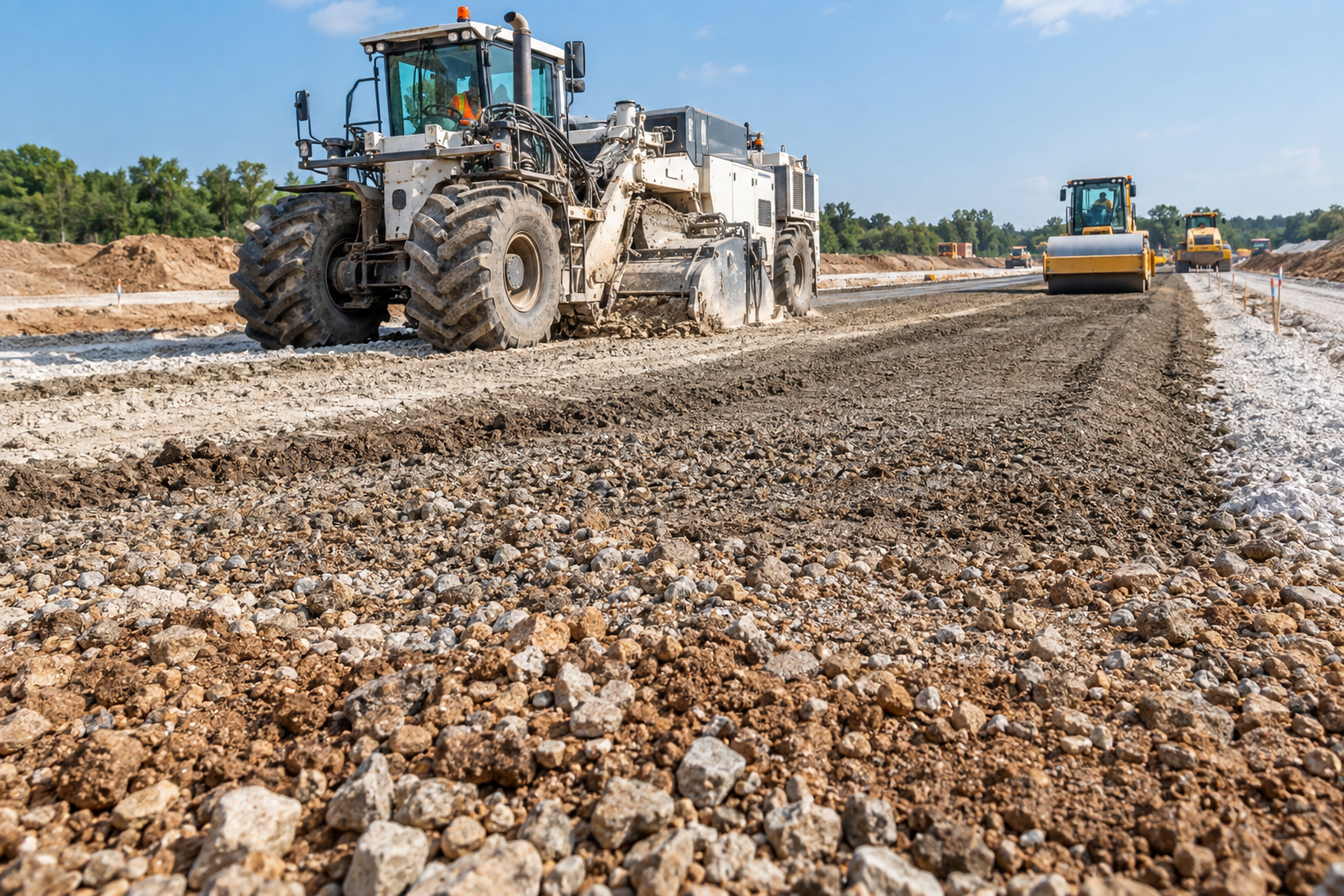
Bentonite can improve the performance of selected road-building soils and unbound granular materials, but it isn't a universal substitute for lime or cement. Its value comes from how its fine, highly active clay particles interact with water and the surrounding soil or aggregate structure. In the right formulation, bentonite can change permeability, moisture behavior, particle interaction, stiffness, and resistance to permanent deformation. In the wrong formulation, its strong swelling behavior can create a new engineering problem.
That is why bentonite soil stabilization should be treated as a materials-engineering exercise rather than a simple additive application. The existing soil, bentonite type, dosage, moisture content, gradation, compaction, drainage, and traffic loading all influence the result. A road foundation needs to remain stable under the conditions it will actually experience, not just produce a good result in a dry laboratory test.
So, can bentonite improve soil stabilization for road construction? Yes, in selected applications. Research on unbound road materials has reported that both calcium and sodium bentonite can be used in engineered road-stabilization mixtures, with laboratory testing showing changes in stiffness and resistance to permanent deformation in the materials studied. Those findings are useful, but they don't mean that every bentonite product will improve every road soil.
The important word is can. Before full-scale construction, the proposed material and dosage should be supported by laboratory testing and, where appropriate, a controlled field trial.
Bentonite soil stabilization is the controlled addition of bentonite clay to a soil or granular mixture to modify engineering properties that affect road performance. Depending on the starting material and project objective, the treatment may be intended to change moisture behavior, permeability, particle interaction, stiffness, or resistance to deformation.
Bentonite is a clay material containing a high proportion of smectite minerals, commonly including montmorillonite. Sodium bentonite generally has greater swelling and water-absorption capacity than calcium bentonite. That property makes bentonite valuable in applications such as sealing and drilling, but it also requires careful control when the material is introduced into pavement foundations.
This is an important distinction. Bentonite is not simply another cementitious binder.
Conventional stabilization systems often use lime, Portland cement, fly ash, or other pozzolanic or cementitious materials to change soil structure and improve strength or stiffness. Bentonite behaves differently. Its very fine particles and strong affinity for water can alter pore structure and water movement within a suitable mixture.
For a road project, the objective isn't to make the soil absorb as much water as possible. The objective is to create a mixture whose moisture behavior and mechanical properties remain within the limits required by the pavement design.
A pavement can have a high-quality asphalt or concrete surface and still develop problems if the foundation beneath it is weak, wet, poorly compacted, or unstable.
The pavement structure distributes traffic loads through the surface, base, subbase, and subgrade. The subgrade needs to provide a reasonably uniform and stable platform. If it loses strength when wet, deforms under repeated loading, or changes volume with seasonal moisture variations, the pavement above it can suffer.
Typical problems associated with unsuitable road foundation materials include:
Water is often part of the problem. A soil that performs adequately in a relatively dry condition may behave very differently after prolonged rainfall or saturation. Some fine-grained soils soften when wet, while expansive soils can change volume as their moisture content changes.
That is why stabilization shouldn't be judged by dry strength alone. Moisture condition, drainage, density, and volume stability all belong in the design discussion.
Bentonite can influence a road mixture in several ways. The exact mechanism and practical benefit depend on the starting soil or aggregate, the bentonite type, the dosage, and the moisture condition.
One of bentonite's defining properties is its ability to absorb water and swell. When bentonite particles hydrate, they can occupy more space and alter the size and continuity of water-flow pathways in a suitable mixture.
This can reduce permeability. Fine particles can occupy voids and create a more tortuous route for water moving through the material. The result may be useful where controlling water movement is part of the engineering objective.
But lower permeability isn't automatically better for a road. A pavement foundation still needs a suitable drainage strategy. If water enters the pavement structure and has nowhere to go, reducing permeability in the wrong location can contribute to moisture-related damage.
The practical objective is controlled moisture behavior, not simply the lowest possible permeability.
A well-graded aggregate contains particles across a range of sizes. Smaller particles occupy some of the spaces between larger aggregate particles and influence the structure of the mixture.
Bentonite introduces a very fine, highly active clay fraction. In an engineered mixture, this can change particle packing and the way the material responds to moisture and loading.
This is particularly relevant to selected unbound road layers. Research published in 2022 investigated calcium and sodium bentonite as stabilizers for unbound road materials and used repeated-load triaxial testing to evaluate stiffness and permanent deformation. The researchers reported that both bentonite types were suitable for the specific road-stabilization application examined.
That result should be read in context. The study involved particular materials, formulations, and laboratory conditions. It doesn't establish a universal dosage or prove that any bentonite will improve any aggregate. What it does show is that bentonite can be a technically relevant material for investigation in selected unbound road applications.
Road foundations experience repeated traffic loading rather than one isolated load. Every heavy vehicle produces stress in the pavement structure, and a weak unbound layer can gradually accumulate permanent deformation.
For this reason, a stabilization program intended for traffic-bearing layers should consider repeated loading rather than relying on one simple strength value.
Repeated-load triaxial testing has been used in research on bentonite-modified unbound road materials to examine stiffness and permanent deformation behavior. This type of testing can provide a more useful picture of how a proposed mixture may respond to repeated traffic than a single dry-condition measurement.
The broader lesson is straightforward: the test program should resemble the service conditions that matter to the project. If repeated truck loading is the design concern, the laboratory program should include an appropriate measure of repeated-load behavior.
Bentonite has extremely fine particles and a large reactive surface area relative to its mass. When added in a controlled quantity, it can change how fine and coarse particles interact within a granular mixture.
This can be useful when the existing material has a suitable basic gradation but needs modification of its fine fraction or moisture response.
There is a limit, though. Adding excessive amounts of highly plastic clay can increase water sensitivity, complicate compaction, and increase swelling potential.
The useful question isn't, 'How much bentonite can we add?' It is, 'What bentonite content gives the required engineering properties for this material and this project?'
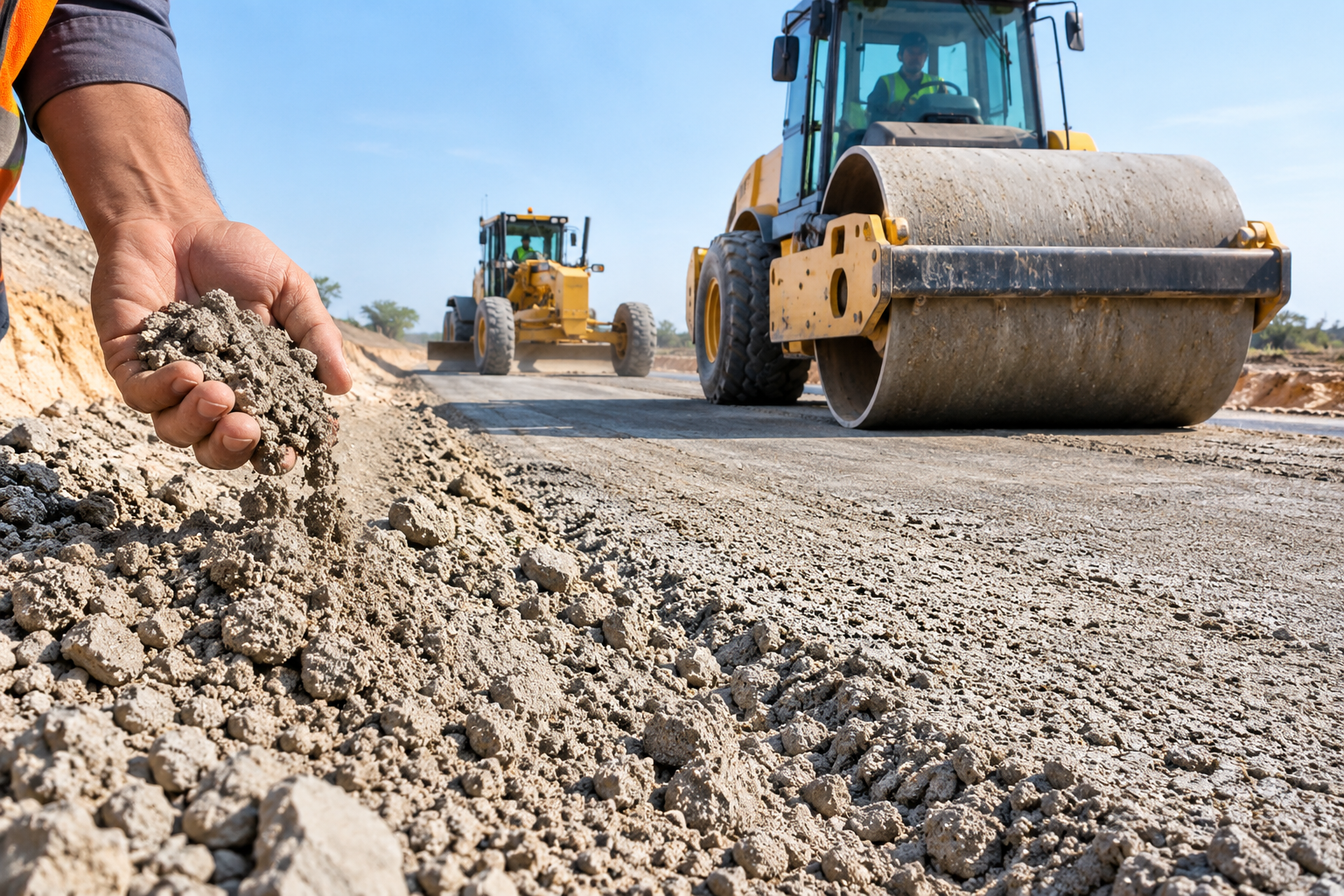
This is one of the most important points for anyone considering bentonite for road construction.
Lime and cement are established stabilization materials for specific soil conditions. They can cause chemical and physical changes that improve strength and stiffness. Their use is supported by established design and construction practices for many applications.
Bentonite works through a different set of material properties, particularly its fine particle size, surface chemistry, water interaction, and swelling behavior. It should therefore be considered as a specialized mineral additive rather than a direct substitute for conventional stabilizers.
| Material or approach | Main purpose | Key consideration |
|---|---|---|
| Bentonite | Modify fine fraction, moisture behavior, and selected unbound-layer properties | Swelling and water interaction require careful dosage and testing |
| Lime | Modify and stabilize suitable clay soils | Soil chemistry and lime demand affect performance |
| Portland cement | Increase strength and stiffness | Mixing, moisture, dosage, and curing must be controlled |
| Mechanical stabilization | Improve gradation and density | Performance depends heavily on aggregate quality and compaction |
| Geosynthetics | Provide reinforcement, separation, filtration, or drainage | Product selection and installation determine performance |
| Soil replacement | Remove unsuitable material | Can be effective but may increase excavation and haulage requirements |
These approaches can also be combined. A road project may use mechanical improvement, drainage measures, geosynthetics, or chemical stabilization as part of one overall pavement strategy.
Bentonite is most worth investigating when the project team has identified a specific material problem that its properties may address.
Potential applications include selected unbound granular layers, engineered road-base mixtures, and other situations where moisture behavior and resistance to repeated deformation are important design considerations.
It may also be considered when locally available aggregate needs modification rather than complete replacement. That can be attractive where transporting high-quality imported aggregate would add significant cost, but the economics must be evaluated for the individual project.
Stabilization can sometimes allow locally available materials to meet required performance characteristics without removing and replacing the entire layer. Whether that is practical depends on the material, project specification, construction equipment, transport costs, and results from laboratory testing.
The decision should be based on measured performance, not simply on whether bentonite is described as natural, mineral-based, or environmentally friendly. A naturally occurring material still has to meet the engineering requirements of the road.
Bentonite's strongest engineering property can also be its main limitation: its interaction with water and its tendency to swell.
If a mixture contains too much bentonite and later experiences uncontrolled moisture changes, volume change can become undesirable. Expansive behavior is already a recognized pavement concern because repeated wetting and drying can cause movement beneath a pavement.
This is why simply spreading sodium bentonite over weak soil and compacting it isn't a reliable general-purpose stabilization method.
Be especially cautious when:
If expansive soil is the underlying problem, the engineering team should first establish the soil's mineralogy, plasticity, swell behavior, moisture condition, and drainage environment. Depending on the findings, options may include moisture control, removal and replacement, encapsulation, or stabilization with a material suited to the soil.
Bentonite shouldn't be added to an expansive subgrade simply because it is marketed as a soil stabilizer. The existing soil has to be diagnosed first.
A sound stabilization program starts with representative material samples and laboratory testing, not with full-scale placement on the road.
Start with the material that will actually be used on the project. Samples should represent the expected range of material from the borrow area, quarry, or existing road layer.
Depending on the project, characterization may include:
The purpose is to establish a reliable baseline. Without an untreated reference sample, it becomes difficult to determine whether bentonite actually improved the material.
Don't treat all bentonite products as interchangeable.
At minimum, establish whether the product is predominantly sodium or calcium bentonite and obtain consistent quality information from the supplier. Depending on the application, useful information can include moisture content, particle-size distribution, swelling characteristics, mineral composition, and other relevant quality parameters.
For a commercial road project, the supplier's specification should be compared with the project's material requirements. If the product will be evaluated in a laboratory, the same product should be used for subsequent trials and, where possible, matched to the material intended for field construction.
There is no universal bentonite percentage that works for every road.
Prepare multiple trial mixtures rather than testing one arbitrary dosage. The exact percentages should be selected by the project geotechnical or pavement engineer based on the starting material and the required performance.
A laboratory program might compare an untreated control with several progressively modified mixtures. The objective is to find out whether performance improves, reaches an optimum, and then deteriorates as the bentonite content increases.
That response curve is much more useful than a single test result.
Density matters.
If one specimen is compacted more heavily than another, the test may reflect density differences rather than the effect of bentonite. Use the project-relevant compaction procedure and control moisture content carefully.
Compaction affects void ratio, density, strength, stiffness, permeability, and moisture response. A laboratory comparison is only meaningful when the specimens are prepared consistently.
Road foundations don't operate in a perfectly controlled laboratory environment.
If water sensitivity is part of the problem being investigated, test the mixture under relevant moisture conditions. Depending on the project, the program may include soaked CBR, permeability, resilient modulus, repeated-load testing, swell testing, or other specified procedures.
The right test package depends on the pavement design method and local road authority requirements. There is no reason to run every possible test if a particular property has no bearing on the project, but moisture-related performance should not be ignored when it is a known field risk.
A mixture with higher dry strength isn't necessarily the best road material.
Compare the complete performance picture:
The preferred formulation is the one that satisfies the project's engineering requirements as a complete system. A strong laboratory result has limited value if the material cannot be mixed uniformly, compacted consistently, or kept within its required moisture range during construction.
Once the laboratory formulation has been selected, field execution becomes just as important as the mix design.
A technically sound mixture can perform poorly if the material isn't distributed uniformly, the moisture content is outside the specified range, or the layer isn't compacted to the required density.
A typical stabilization sequence may include preparation of the existing layer, controlled placement of the stabilizing material, mixing, moisture adjustment, grading, compaction, and quality-control testing. The exact sequence depends on the stabilization method, equipment, material, and project specification.
For bentonite-containing mixtures, uniform distribution deserves particular attention because bentonite is a fine material. Local pockets containing substantially more bentonite can behave differently from the surrounding layer.
Moisture should also be controlled carefully. Bentonite reacts strongly with water, so adding water too early, too quickly, or unevenly can affect handling and mixing. The target moisture range should come from the laboratory mix design and field compaction requirements rather than from visual judgment alone.
Field quality control should confirm that the constructed layer matches the assumptions used in the laboratory design. Depending on the specification, this can include checks on density, moisture content, layer thickness, gradation, and other relevant properties.

It doesn't.
A higher bentonite content can increase water sensitivity and swelling. The optimum amount has to be established experimentally for the actual material and project conditions.
They have different swelling characteristics and can behave differently in engineering applications. The supplier should clearly identify the product being supplied and provide consistent specifications.
A formulation developed with one bentonite shouldn't automatically be transferred to another product without checking whether its relevant properties are comparable.
Road foundations experience moisture changes. A dry laboratory result can therefore provide an incomplete picture of field performance.
If moisture is one of the reasons for considering stabilization, the laboratory program should include relevant wet or conditioned states.
A low-permeability layer isn't a substitute for a properly designed drainage system.
The pavement structure, shoulders, subgrade, groundwater conditions, and surface drainage all affect how water enters and leaves the road. Bentonite should be evaluated as one component of that system rather than as a stand-alone drainage solution.
If the actual problem is poor gradation, organic soil, severe compressibility, inadequate drainage, or expansive clay, bentonite may not be the appropriate answer.
Stabilization works best when the failure mechanism is understood first and the treatment is selected to address it.
A lower-priced mineral can become more expensive if it requires a higher dosage, creates handling problems, produces inconsistent results, or fails to meet the required performance.
Compare delivered cost, dosage, quality consistency, handling requirements, and tested performance rather than looking only at the purchase price per tonne.
Replacing unsuitable soil can be straightforward when the problematic layer is shallow and suitable borrow material is readily available.
But excavation has costs beyond the replacement material itself. These can include excavation, haulage, disposal, procurement of new material, traffic management, and additional construction time.
Stabilization can sometimes reduce the volume of material that needs to be removed. That can make it worth investigating when suitable local material is available but does not initially meet the required performance criteria.
The correct comparison isn't simply 'bentonite versus excavation'. It is the total cost and expected performance of each technically acceptable solution.
For example, a stabilization option may have a lower material-haul requirement but require more intensive mixing and quality control. Soil replacement may be simpler to execute but involve substantial transport and disposal. The project team should compare these factors using actual quantities and site conditions.
Suppose a contractor has an aggregate-based road layer that doesn't perform adequately under repeated loading. Rather than immediately increasing pavement thickness or replacing all available aggregate, the engineering team could investigate whether a bentonite-modified mixture is technically viable.
The evaluation could follow this sequence:
The point of this process is to make an engineering decision rather than a marketing decision. If the bentonite-modified mixture doesn't outperform the untreated material or another technically suitable stabilization method, there is no reason to use it simply because bentonite is available.
The exact specification varies by country, state, road authority, and pavement design method. A useful evaluation normally covers several categories of material behavior.
| Property | Why it matters |
|---|---|
| Gradation | Determines particle packing and influences mixture structure |
| Plasticity | Indicates how fine material responds to moisture |
| Moisture-density relationship | Establishes compaction targets |
| CBR | Provides a common indicator of bearing capacity for pavement subgrades |
| Resilient modulus | Helps characterize stiffness under repeated loading |
| Swell | Identifies potential volume-change risk |
| Permeability | Shows how readily water can move through the material |
| Repeated-load behavior | Helps evaluate permanent deformation under traffic |
| Field density | Confirms construction quality |
| Moisture content | Confirms that the material is being placed within the intended condition |
Not every project needs every test. The geotechnical design team should select tests that correspond to the pavement's performance requirements and the failure mechanisms identified during site investigation.
A road project can involve hundreds or thousands of tonnes of material. Small differences in a mineral additive can become significant when the product is distributed across a large construction area.
For that reason, a reliable supplier should be able to provide consistent product specifications, technical documentation, and batch information appropriate to the application.
For buyers evaluating bentonite for construction, useful questions include:
For an international project, logistics matter as well. A product that performs consistently in laboratory trials still needs to arrive in a condition that can be handled, stored, mixed, and incorporated as specified at the job site.
Axewelledge supplies bentonite from India for industrial applications and can be considered when a project team is sourcing bentonite for laboratory evaluation or commercial use. Product selection should still be based on the project's technical specification, representative samples, and independent engineering testing before full-scale application.
Bentonite is a naturally occurring clay mineral, which can make it attractive to projects considering mineral-based materials. But the label 'environmentally friendly' doesn't tell you whether a stabilization method has a lower overall environmental impact.
The environmental performance of a road treatment depends on the complete system. Relevant factors can include extraction, processing, transport distance, dosage, construction energy, service life, maintenance requirements, and eventual rehabilitation.
There may be an environmental benefit when stabilization allows suitable local material to remain in use instead of transporting large quantities of replacement aggregate over long distances. That benefit, however, needs to be assessed for the actual project rather than assumed.
A defensible comparison looks at technically equivalent alternatives and considers total material use, transport requirements, construction energy, expected service life, and maintenance.
You shouldn't assume that it can.
Cement and lime have established mechanisms and design procedures for many soil stabilization applications. Bentonite has different material behavior and should be evaluated for the specific purpose and mixture under consideration.
Research has demonstrated that bentonite can be used to stabilize selected unbound road materials, but that does not make it a universal replacement for conventional stabilizers.
If a project specification calls for cement or lime stabilization, the engineer should not substitute bentonite without an approved redesign and test data showing that the alternative mixture satisfies the required performance criteria.
The same principle applies in reverse. Bentonite may be technically useful for a particular material problem where cement or lime isn't the most appropriate treatment. The selection should follow the engineering requirements rather than a preference for one material category.
Contractors should start with the project specification and the laboratory requirements, then work backward to the material they need to source.
Ask the supplier for a technical data sheet and representative sample. Confirm the bentonite type, relevant physical properties, consistency requirements, packaging, and shipping conditions. If the project requires a specific performance characteristic, make sure the laboratory sample is representative of the commercial product that will eventually be supplied.
It is also useful to establish a quality-control procedure before purchasing large quantities. The procedure can define which properties will be checked on incoming material, how samples will be collected, and what happens if a shipment falls outside the agreed specification.
This becomes especially important for large projects. A formulation that works with one consistent product can become difficult to reproduce if the supplied material varies substantially between shipments.
Bentonite can play a useful role in road soil stabilization, particularly in carefully engineered unbound mixtures where moisture behavior, fine-particle interaction, stiffness, and resistance to permanent deformation are important.
But bentonite isn't a magic additive. Its swelling and water-absorption properties are powerful engineering characteristics that need to be controlled rather than assumed to be beneficial in every situation.
The most reliable approach is straightforward: characterize the existing material, select a consistent bentonite, test several trial mixtures, evaluate relevant dry and wet conditions, check swelling and deformation behavior, and validate the selected formulation before full-scale construction.
For contractors, the practical lesson is to ask for performance data rather than relying on a generic claim that a bentonite is suitable for roads. For material buyers, ask for consistent specifications and representative samples. For engineers, treat bentonite as one possible component of a broader pavement, materials, and drainage design.
If you're evaluating bentonite for a road stabilization project, Axewelledge can help with product specifications and sourcing requirements for laboratory evaluation and commercial supply. The final product selection should still be based on the soil characteristics, project specification, representative testing, and independent engineering review.
A reliable road foundation starts with understanding the material beneath the pavement. Get the soil, moisture, drainage, mix design, and construction process right, and the pavement above it has a much stronger basis for long-term performance.













Have questions about our products? We're here to help!